MEMETERIA by Thomas May

Music & the Arts

The Miró Quartet at 25

The November-December 2019 issue of Strings magazine is now available. I wrote a profile of the marvelous Miró Quartet and their Archive Project, which celebrates the ensemble’s quarter-century milestone.

When the Miró Quartet started out in October 1995, a prediction that it would be thriving a quarter century on must have sounded wildly optimistic. “Because we were such different personalities in terms of musical approach and demeanor, we had a lot of fights and disagreements in the first couple of years,” recalls cellist Joshua Gindele…

continue (starts p. 20)

Filed under: Beethoven, profile, string quartet, Strings

Lei Liang Wins the 2020 Grawemeyer Award


Just announced:
The Chinese-American composer Lei Liang has won the 2020 University of Louisville Grawemeyer Award for Music Composition. He was chosen on the basis of his orchestral work A Thousand Mountains, a Million Streams, commissioned and premiered by the Boston Modern Orchestra Project under Gil Rose. The new work addresses the issue of climate change and what humans can do to change the outcome.

From the Grawemeyer announcement:

“The world we live in today is dangerous,” Liang said. “Our very existence is threatened by global warming, which is causing violent disruptions to the living things on our planet and being made worse by human irresponsibility.”

The half-hour piece takes listeners on a journey through a virtual landscape that first sings and dances but later jolts and collapses into fragments. Near the end, the sound of rain emerges and resurrects nature.

“When creating the work, I wanted to convey the importance of preserving our landscapes, both physically and spiritually, to sustain a place where we and our children can belong,” he said.

Liang, 47, is a music professor at University of California, San Diego, and research-artist-in-residence at Qualcomm Institute, the UC San Diego division of the California Institute for Telecommunications and Information Technology. He has composed more than 100 works, including pieces addressing other contemporary social issues such as human trafficking and gun violence.

“Xiaoxiang,” his concerto for saxophone and orchestra, was named a finalist for the Pulitzer Prize in Music in 2015.

“Liang’s piece, which explores a huge range of emotions and ends with both hope and ambiguity, has a forceful, convincing arc and wonderful orchestral colors,” said Marc Satterwhite, music award director. “Like some of our other winners, he challenges people inside and outside the field of music to ponder important things, even when it’s uncomfortable to do so.”

Schott Music, a company founded in 1770 in Germany now with offices worldwide, publishes all of Liang’s compositions. BMOP/sound record label released a recording of his Grawemeyer-winning piece in 2018.

Filed under: awards, music news

Musical America’s New Artist of the Month: Hao Zhou

Congratulations to Hao Zhou, who is featured by Musical America as New Artist of the Month. Here’s my profile of this extraordinary violinist.

More on Hao Zhou here.

Video of Hao Zhou with Viano String Quartet.

Filed under: Musical America, violinists

RIP Mariss Jansons (1943-2019)

The great Latvian conductor Mariss Jansons has died at his home in St. Petersburg. He was only 76. From his orchestra, the Bavarian Radio Symphony:
“The news of the death of our chief conductor Mariss Jansons has filled us with deep dismay and sorrow. With his death, the music world loses one of its greatest artists. We consider ourselves very fortunate to have shared many unforgettable concerts with him over the past 17 years and treasure our close personal and artistic collaboration. The unrelenting demands he made on himself and his musicians, the treatment of his colleagues that was unfailingly full of respect, and the great dedication to music he demonstrated will forever be remembered. Mariss Jansons will occupy a place of honor in the history of our orchestra, and we will honor his memory and keep it alive.” (Orchestra Board of the BRSO)
“The news of Mariss Janson’s death fills me and indeed all those who got to know him with unfathomable sadness. As an individual and a musician alike, he made the lives of so many people richer. I will always be grateful to him for this.” (Nikolaus Pont, Manager BRSO)

Filed under: conductors, music news

Melody, Metamorphosis, and Memory: Music for Oboe and Friends

For this evening’s recital at the Boulez Saal by Cristina Gómez Godoy, principal oboist of the Staatskapelle Berlin, has chosen a fascinating program of Saint-Saëns, Britten, Skalkottas, Carter, Kalliwoda, and Loeffler. Michail Lifits accompanies from the keyboard, and violist Joost Keizer joins the lineup. My program essay is here (starting p. 13).

Filed under: concert programming, oboe, Pierre Boulez Saal, program notes

Rites of Ecstasy: Thomas Dausgaard Pairs Knockout Scores by Scriabin and Stravinsky

152723-sso-2019-11-21-carlin-ma-9911

Thomas Dausgaard conducts the Seattle Symphony; photo (c) Carlin Ma

My review of the most recent program performed by Seattle Symphony under Thomas Dausgaard:

As Thomas Dausgaard continues along in his inaugural season as Seattle Symphony’s Music Director, it’s gratifying to see his intense rapport with the musicians expanding to different areas of the repertoire…

continue

Filed under: Alexander Scriabin, review, Seattle Symphony, Stravinsky, Thomas Dausgaard

La storia di Orfeo: Reframing an Operatic Myth

IMG_0255

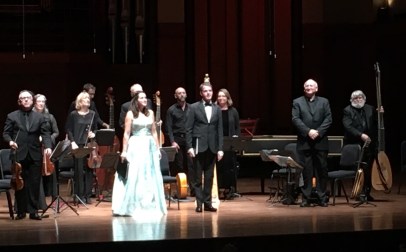
Amanda Forsythe and Philippe Jaroussky with Boston Early Music Chamber Ensemble and co-directors Stephen Stubbs and Paul O’Dette

In contemporary times, the connotations of myth have been degraded to suggest something like “fake news.” Still, the truths they contain make the stories passed down as myths an inexhaustible source for inspiration and enlightenment. It seems inevitable that opera, from the start, needed to fall in love with the myth of Orpheus and Eurydice in particular and has needed to return to it again and again — much as the legendary hero longs to be reunited with his beloved and bring back their vanished happiness.

But these reiterated operatic Orfeos are no mere repetitions. The brilliant concept underlying Philippe Jaroussky and colleagues’ La storia di Orfeo is to juxtapose parts of three different versions of the story spanning the 17th century and thus to create a new composite.

Jaroussky introduced the project a few years ago, recording it on the Warner label with Diego Fasolis and I Barocchisti. This fall, the countertenor has taken it up again (in somewhat modified form) for a North American tour. He is joined by soprano Amanda Forsythe as Eurydice and the Boston Early Music Festival Chamber Festival, led by co-directors Stephen Stubbs and Paul O’Dette*.

Their performance in Seattle last night — hosted by Seattle Symphony at Benaroya Hall — benefited from the highest level of musical values while at the same time overwhelming the audience with its emotional force. If you have a chance to catch the show’s remaining stops in Boston and the Morgan in New York, this really is one not pass it up.

Jaroussky explains that La storia di Orfeo “was conceived as a kind of opera in miniature or as a cantata” for compact forces. I found the narrative arrangement to have an immediacy and an arc that indeed seemed operatic in effect, even with the minimal (and tastefully done) semi-staging used here.

Chronologically listed, the three source Orfeos were Monteverdi’s landmark court opera from 1607 in Mantua and two later treatments by Luigi Rossi (1597-1653) and Antonio Sartorio (1630-1680) that premiered in 1647 in Paris and in 1672 in Venice, respectively.

The dramaturgical result was not a collage but followed the story’s familiar trajectory, though with different points of emphasis than we would experience from any single one of these three operas on their own. As Jaroussky notes, “Sartorio and Rossi depict the happiness of the young lovers and the scene in which Eurydice is bitten by the snake; Monteverdi, on the other hand, concentrates more on Orpheus’s search for Eurydice in the Underworld.”

An excellent essay in the program (by Jean-François Lattarico, from the album’s liner notes) elaborated on the myth’s musical-theatrical evolution in the 17th century, pointing out that the integral role of Renaissance humanism, Neo-Platonism, and poetry. It also explained the introduction of comic elements and even convoluted subplots post-Monteverdi, as well as the movement toward closed forms.

Yet for all the variety of its pastoral and dance-propelled moments, this Storia di Orfeo projected a profoundly melancholy, tragic demeanor that was further enhanced by the streamlined focus on the lovers — the opposite of the archetypal Romantic journey, building on Beethoven, from darkness to light.

Monteverdi’s “Possente spirto,” the centerpiece of his opera (Lattarico remarks that it borrows Dante’s “metrical structure” and encompasses the “three aspects of music — worldly, human, and instrumental”), also served as a fulcrum here. But there were also counterpart solos by Sartorio and Rossi following Orfeo’s second loss of Eurydice — respectively, “Chiuso, ahimè, di Cocito” and the devastating “Lasciate Averno” — that turned the program’s second half into a vast musical stele of mourning.

Jaroussky sang with heart-rending eloquence and enormous musical intelligence. His delicately weighted countertenor added a sense of vulnerability not often found in tenor Orfeos, but he fully brought out the role’s passion and despair. In one of the many paradoxes that surround this myth and its musical transformations, his intricate embellishments conveyed overpowering emotional honesty rather than florid artifice — as if these words, in this context, could be expressed only in this way.

It was illuminating to experience the iconic moments from Monteverdi’s opera in the context of the more extensive role allotted Eurydice through interpolated pieces from the other two operas, such as the exquisite “Mio ben, teco il tormento” from Rossi’s opera for Paris. Amanda Forsythe gave an equally memorable portrayal. One of the most searingly effective moments was her sudden appearance, after her death from the snakebite, as the “shade of Eurydice,” beckoning to Orpheus to brave the journey into the Underworld. Forsythe, whose voice in previous scenes conveyed the ideal “sweetness” referred to so often in the poetic texts (never cloying), brought out the grief-stricken intensity of Sartorio’s music — visibly moving her beloved and foreshadowing his own great task of moving the dark spirits of Hades.

Forsythe and Jaroussky were additionally given a number of duets, the purity of their vocal production merging into a fascinating hybrid. It’s not surprising that they have collaborated for some years now. (They’ve recorded Gluck’s Orfeo ed Euridice and, for Boston Early Music Festival, Agostino Steffani’s Niobe, regina di Tebe, among other works.) So it was a very smart idea to draw out their chemistry by interpolating, at the moment of the couple’s re-encounter in Hades, a scene from Steffani’s Orlando generoso in which Angelica and Ruggiero share their feelings of the absence of their respective lovers.

Along with the cast of just two singers, the ensemble for this tour involves a total of ten instrumentalists. The choral numbers that are part of the recording are dispensed with, but in their stead Stubbs and O’Dette have woven into the dramaturgy a fascinating range of contemporary instrumental interludes from across the 17th century. These serve as implicit commentaries to enhance the mood and setting.

An excerpt from a publication of Venetian sonatas “in stile moderno” by Monteverdi’s contemporary Dario Castello, for example, proved to be wonderfully evocative after Orpheus’s vibrant “Vi ricorda, o boschi ombrosi” from the Monteverdi opera. An extraordinarily dramatic sonata by Johann Rosenmüller (who fled the sex police in Leipzig and found refuge in Venice) served as a postlude to “Possente spirto.”

The ensemble played with style and dramatic presence — at times, the various strings emerged in the spotlight as extensions of Orpheus the musician, stretching the range of his lyre. On Baroque harp, Maxine Eilander’s silvery accompaniments added textural differentiation to the bowed strings so that I never felt a lack of color despite the absence of winds.

Not wishing to leave the enraptured audience in unassuaged gloom, Jaroussky, Forsythe, and the band provided a lieto fine after all by way of an encore: the final duet from Monteverdi’s L’incoronazione di Poppea (“Pur ti miro”), which no one wanted to end.

Complete Program:
La storia di Orfeo: Monteverdi • Sartorio • Rossi

Antonio Sartorio: Sinfonia to L’Orfeo
Sartorio: Cara e amabile catena
Claudio Monteverdi: Rosa del Ciel – Io non dirò
Luigi Rossi: Mio ben, teco il tormento
Rossi: Che dolcezza è la certezza
Rossi: Sinfonia from L’Orfeo
Monteverdi: Vi ricorda, o boschi ombrosi
Dario Castello: Sonata 15 from Sonate concertate…in stile moderno, Libro II
Rossi: M’ami tu?
Rossi: A l’imperio d’amore
Sartorio: Ahimè, Numi, son morta – Misero, oh Dio
Rossi: Lagrime, dove sete?
Biagio Marini: Passacalio from Sonate per ogni sorte di stromento musicale
Sartorio: È morta Euridice
Sartorio: Orfeo tu dormi? – Se desti pietà – Ferma, Euridice
Monteverdi: Sinfonia
Monteverdi: Possente spirto
Johann Rosenmüller: Sonata Settima à 4 in D minor from Sonatae a 2, 3, 4 e 5
Agostino Steffani: Se t’eclisse – Vive stele from Orlando
Sartorio: Numic he veggio
Sartorio: Chiuso, ahimè, di Cocito…Rendetemi Euridice
Rossi: Lasciate Averno

Boston Early Music Festival Musicians:
Paul O’Dette, chitarrone; Stephen Stubbs, chitarrone & Baroque guitar; Robert Mealy & Julie Andrijeski, violin; Sarah Darling, viola; David Morris, violoncello & lirone; Doug Balliett, double bass; Michael Sponseller, harpsichord; Maxine Eilander, Baroque harp

(c)2019 Thomas May — All rights reserved.

Filed under: early music, Monteverdi, review, Stephen Stubbs

Recommended Release: Michael Vincent Waller’s Moments

a4246499785_16

Almost a year ago, the New York-based composer Michael Vincent Waller told me about a new album he had in the works. The topic came up when I interviewed him for Musical America, which featured Waller as January’s new artist of the month.

The album, titled Moments, came out just last month on the Unseen Worlds label and offers a wonderful entrée into Waller’s musical world. His third album to date, it comprises 18 miniatures, 13 of them for solo piano, the other 5 for vibraphone.

Waller continues his collaboration with R. Andrew Lee, whose sensitive performances at the keyboard were featured on his preceding album, Trajectories (along with the phenomenal cellist Seth Parker Woods). The percussionist William Winant, a well-known personality in avant-garde circles, plays the pieces for vibraphone.

“One thing I’m trying to explore as an artist is the organic, intuitive sense we have about experiences — the human subtext to what is happening in the music, in its colors, harmonies, and melodies,” the composer explained during our talk last year. In Moments, he has distilled a range of experiences with an open-hearted, intimate honesty that resonates long after the ebb and flow of his compositions’ physical sounds.

It’s not necessary to know any of the autobiographical stories or family relationships and loved ones Waller memorializes here to be moved by the emotions they elicit. On another level, Moments pays gentle tribute to musical figures who are part of a generally known cultural repertoire. “For Pauline,” for example, referring to the late Pauline Oliveros, was prompted by her death in November 2016. Its bell-like chords in alternating registers concentrate the attention on the taken-for-granted miracle that is harmony, effecting an experience of “new sound.”

Similarly, the sounds of the piano itself begin to reassemble into something not-quite-familiar. This lays the ground for the wonderful effect of the vibraphone’s first entrance well into the album (in a kind of mini-suite comprising four of the miniatures and titled “Love”).

In the spirit of Oliveros and the philosophy of what she called “deep listening,” Waller composes with a deceptive simplicity. His aesthetic relies on — and expands from — a generous patience familiar from practices of meditation and mindfulness. These “moments” radiate a fullness that belies their duration — most of the pieces are between just two and three minutes long.

La Monte Young was a formative influence who opened Waller up to new ways of perceiving the materials of a composition — indeed, the phenomenon of sonority itself. Erik Satie and Morton Feldman are some of the other musical spirits evoked by various Moments. The final piece, “Bounding,” even alludes to a mainstay of Western music history, the descending “lamento” chord progression that has taken countless forms, from flamenco to the opening of Philip Glass’s Satyagraha).

But none of these are derivative or reduced to cliches. Waller’s use of the most elemental materials and gestures combines reflective process with an unironic, unconditional sharing of self and soul that I find deeply moving.

Waller again turns to the photographer Phill Niblock — as he does on his previous two albums — for the striking cover image of Moments. An LP edition is also available, and the record includes insightful commentary by Tim Rutherford-Johnson and liner notes by “Blue” Gene Tyranny.

Filed under: Michael Vincent Waller, new music, piano, review

Teodor Currentzis in North American Debut

Teodor Currentzis will make his North American debut with musicAeterna this week at The Shed in New York. On the program is Verdi’s Requiem, together with an experimental film by the late Jonas Merkas. I was asked to write a profile of Currentzis for Early Music America magazine.

Filed under: conductors, Early Music America, profile, Teodor Curentzis

A Prismatic Program from the Danish String Quartet

Danish-Quartet-759x500

Currently touring the West Coast, the Danish String Quartet paid a visit recently. I now get what the fuss is about. Here’s my review for Strings:

The Danish String Quartet‘s contribution to the Beethoven 250 celebrations this season includes a tripartite North American tour. As part of the fall segment of this tour, which is currently underway, the Scandinavian foursome made a recent stop in Seattle. On offer was the first of the Beethoven-themed programs they are presenting under the project name PRISM. The performance launched this season’s International Chamber Music series at the Meany Center for the Performing Arts of the University of Washington.

continue

Filed under: Bach, Beethoven, chamber music, Danish String Quartet, review, Shostakovich, string quartet, Strings

Archive

Enter your email address to follow this blog and receive notifications of new posts by email.