João Carlos Martins at Carnegie Hall Farewell Concert, 9 May 2025; photo: Jorge Gustavo Elias
Happy 85th birthday to o Maestro, João Carlos Martins! Born on 25 June 1940 in São Paulo, Martins established himself as one of the most brilliant keyboard interpreters of Johann Ses=bastian Bach in the second half of the 20th century.
Yet his Bach legacy is just one component of an artistic journey marked by both acclaim and adversity. João Carlos Martins’s story is as much about resilience and reinvention as it is about musical brilliance. Following prodigious beginnings – he made his Carnegie Hall debut at age 20 – repeated injuries to his hands forced Martins to step away from the piano, just as he was reaching the height of his international career. But rather than retreat from music, he redirected his focus to conducting, bringing the same fervor and eloquence to the podium that once defined his playing.
Martins additionally became an enormously influential cultural force in Brazil. Through his Bachiana Foundation, he has brought classical music to thousands of young people, many from underserved communities, creating access where there was none. Alongside this work with the Fundação Bachiana, Martins has also been a champion of Latin American composers.
His initiatives have blended high artistic standards with social impact, forging a vision of music as both an expressive art and a tool for transformation. Under his leadership, the Bachiana Filarmônica SESI-SP has become one of Brazil’s most dynamic cultural foundations – a platform for emerging talent and a vehicle for national pride, performing everywhere from favelas to major concert halls.
Martins’s late-career return to the keyboard – made possible by specially adapted bionic gloves – has added an inspiring new chapter to an already remarkable artistic narrative. Following his moving farewell concert at Carnegie Hall last month, Martins continues to extend a career that has continually defied limitation as he devotes himself to a broad new initiative to improve music education across Brazil.
Feliz Aniversário, Maestro! Your artistry continues to resonate far beyond the concert hall.
João Carlos Martins at Carnegie Hall Farewell Concert, 9 May 2025; photo: Jorge Gustavo Elias
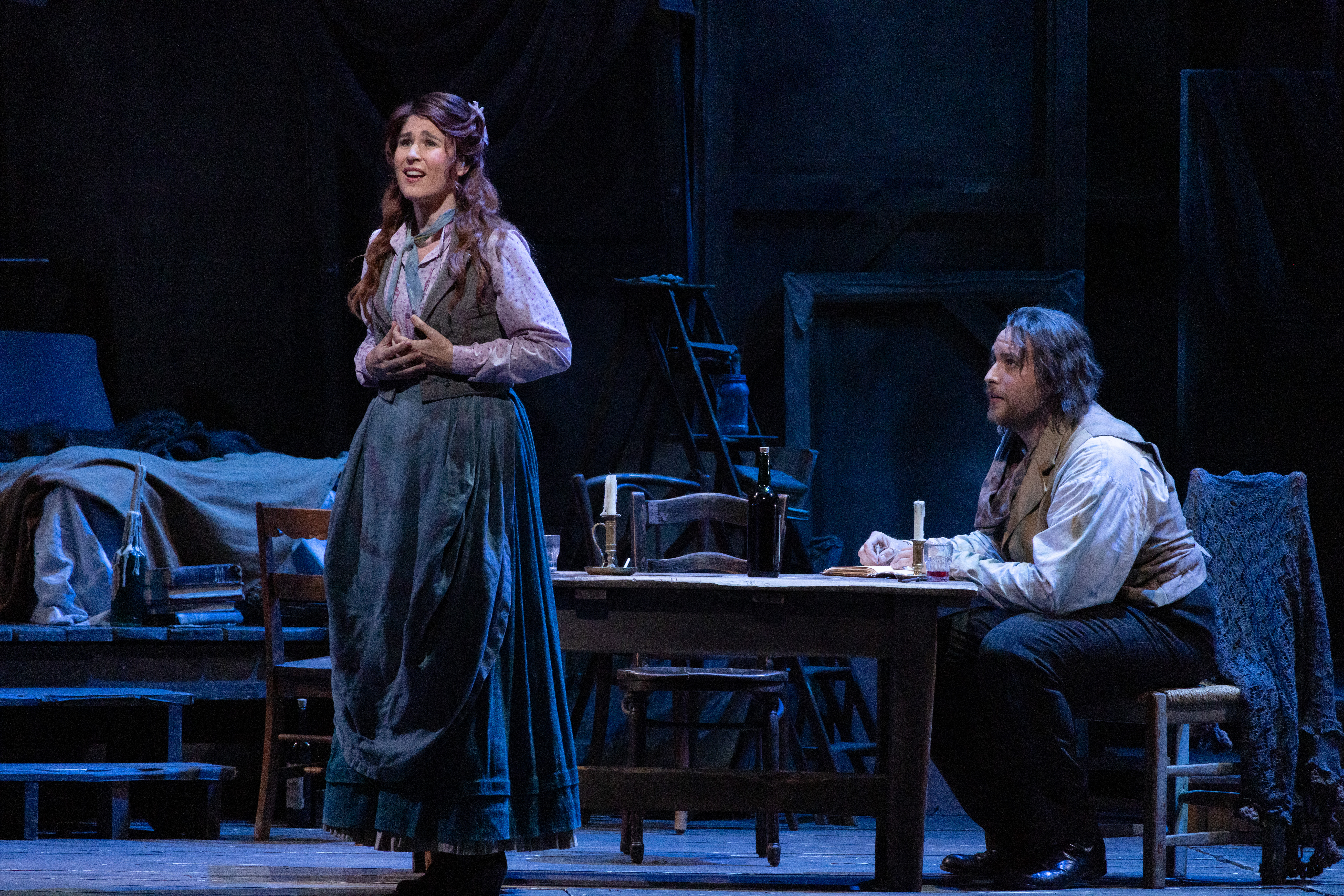
Since its founding in 1923, San Francisco Opera has maintained a love story of its own with La Bohème. The company actually opened with a performance of the beloved classic, cementing its identity with Puccini’s story of young love and youthful illusions. One thing this summer’s revival makes clear: when done persuasively, La Bohème seems immune to aging, undiminished in its emotional pull.
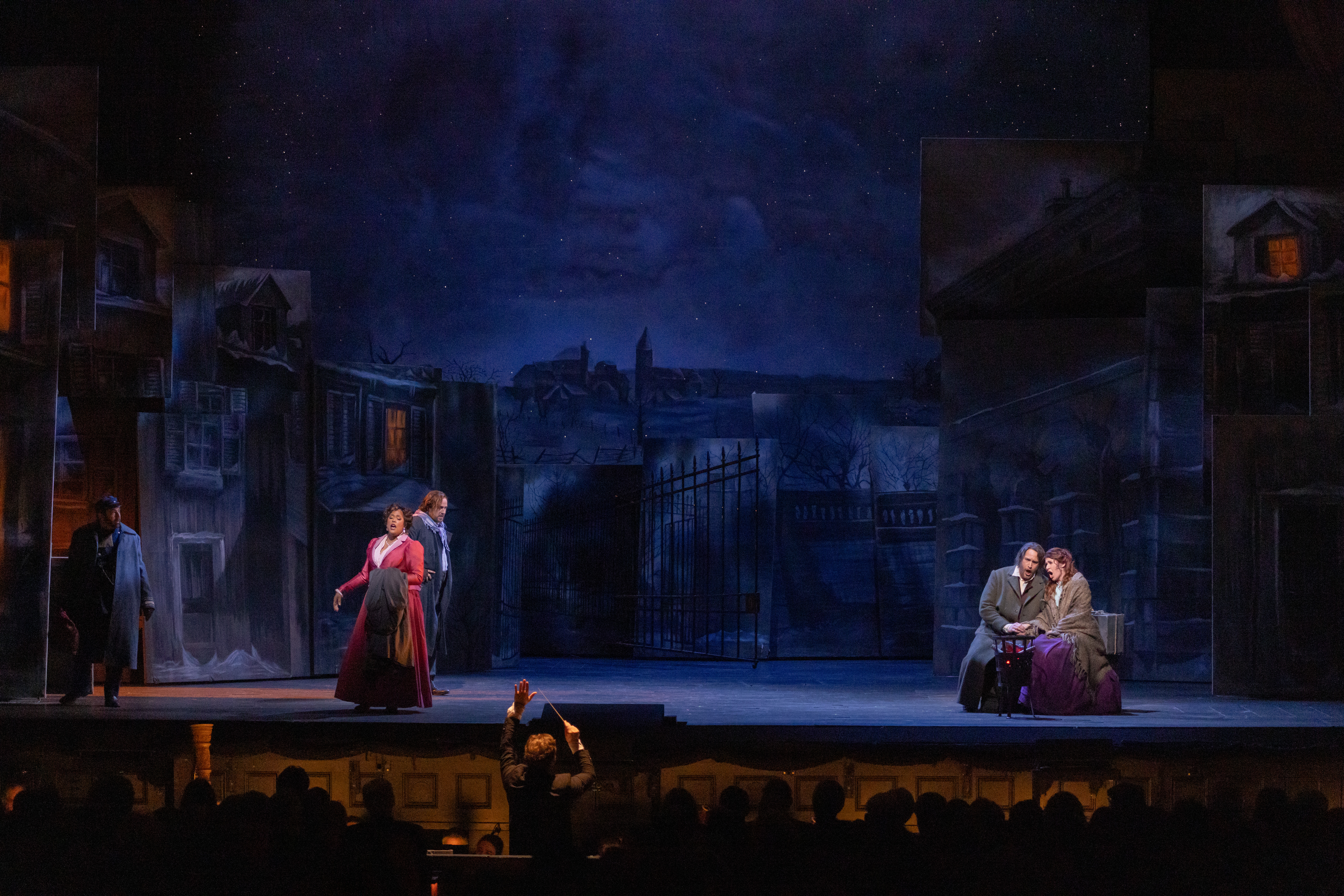
John Caird’s production, which originated in 2012 and first arrived at the War Memorial Opera House in 2014, with a revival in 2017, was presented as part of this summer’s shorter-than-usual season alongside a gripping interpretation of another great opera by a youthful artist in the process of making pivotal discoveries about what opera can do: Idomeneo, by the 20-something Mozart. In this revival of Caird’s original staging by Katherine M. Carter, the chemistry between the two main couples and among their circle of close friends gained a dramatic clarity that was believable.
A visual metaphor for the intensity of their dreams and idealism emerges in designer David Farley’s sets, which seem filtered through the imagination of the painter Marcello – as if memory itself were the canvas. Instead of a cosy view of the Parisian skyline, the distinctly crowded and cluttered garret is framed by panels that seem to be his own creation, works in progress. In the crowd scene at Momus, the wintry city is populated by still more painted façades that verge on abstraction, Cubistally tilted as if to hint at the transformation of experiences recollected from a distance, as they become stylized, mythologized. While also nodding to the aesthetic of Toulouse-Lautrec and the Belle Époque, the visual world inhabited by this Bohème wasat times almost dreamlike, even surreal.
Puccini’s achievement in this opera, bolstered by his collaboration with librettists Luigi Illica and Giuseppe Giacosa, gains traction from the varying manifestations of community among these young people: the cramped garret coming alive with roughhousing banter and energy and the glittering Café Momus brimming with a chaotic joy and sense of possibility against all the odds.
Much has been written about La Bohème as an opera of Romantic nostalgia, but this production underscores its deeper structure as a work of memory. Puccini’s savvy recapitulation of musical material – most movingly in the final act’s return to the music of Mimì and Rodolfo’s first meeting – carried incalculable expressive weight in Ramón Tebar’s sensitively detailed conducting, a highlight of the production. With his fine ear for balance and unwavering attention to the colors and harmonic richness of Puccini’s score, he had the orchestra paint in layered brushstrokes of timbre, shaping phrases with warmth and elasticity.
I heard the “alternate” cast on June 18. As Rodolfo, tenor Evan LeRoy Johnson made a welcome impression with his hefty, burnished tone and grounded stage presence. His rapport with Australian soprano Nicole Car as Mimì allowed him to trace an arc from self-conscious artist to grief-stricken lover. Car, in turn, conveyed Mimì’s innocence and vulnerability without reducing her to frailty. Even in the character’s earliest moments, there was a quiet self-awareness beneath the surface. Car uncovered more psychological nuance than is often seen in the third-act encounter with Rodolfo, singing with radiant control across the range. Her resonant low notes lent unexpected weight to a role sometimes misconstrued as a passive victim.
Filling in for the originally announced Will Liverman, baritone Lucas Meachem sang Marcello for the full run, bringing the painter to life with vocal vitality and a sharply etched dramatic immediacy through telling details, like his hint of jaded disdain when he first interacts with Mimì at Momus. He emerged as the opera’s emotional linchpin, bridging the bohemians’ slapstick and the lovers’ tragedy. His scenes with Rodolfo had the ease of real camaraderie – and rivalry.
As Musetta, soprano Brittany Renee lit up the stage with a performance abounding in vocal charisma and larger-than-life presence that also amplified the somewhat underworked Toulouse-Lautrec angle. Her “Quando me’n vo’” was anything but coquettish posturing but a declaration of unapologetic vitality. At the same time, she allowed a genuine compassion for Mimì to emerge with affecting sincerity in the deathbed watch.
There was much to enjoy in the detailed work of the companions as well. Bogdan Talos made a dignified and ultimately touching Colline, keeping a mostly detached air until the death scene released a surge of directness. His “Vecchia zimarra” felt like an intimate farewell to youth itself. Another highlight of the production was Samuel Kidd’s vividly observed portrayal of Schaunard (the one actual musician among these Bohemians), especially in his gleefully morbid story of how a dead parrot brought a windfall – a comic moment that, like so much in Bohème, holds a tragic echo in hindsight. Dale Travis brought seasoned comedic timing to his dual character roles as the landlord Benoit and sugar daddy Alcindoro. The SF Girls and Boys Choruses added charm to the Café Momus scene.
But what gave this performance its distinctive character was the sensitive, detailed conducting of Ramón Tebar. The Spanish conductor proved a superb collaborator – very much a singers’ conductor – with an ear for balance and a painter’s attention to color. He brought out the harp’s glitter, the dark undertow of strings beneath bright melodies, and the often-overlooked harmonic richness of Puccini’s score.
As Larry Rothe insightfully writes in his beautiful program essay, Rodolfo, in retrospect, is not a novice in love but an artist transformed by a singular experience: “He hears himself pleading his case to Mimì in a new voice, honest and unguarded … Mimì, as Rodolfo recalls her, will always illuminate the memory of those rough days … those days that, for all their hardship, will always bear the tender ache suggested in that pivotal rising and falling fourth [of Rodolfo’s motif].”
That “tender ache” lingered well after Rodolfo’s cries of despair in this wonderful revival, reminding us not just of the pain of loss, but of how art redeems it – by turning memory into music.
Ludovic Morlot conducts the Seattle Symphony, with soloist Demarre McGill
With Seattle Symphony on the cusp of a new chapter – music director designate Xian Zhang takes the reins in September – this season-closing program offered a vivid snapshot of the ensemble’s artistic breadth. …
Esa-Pekka Salonen with San Francisco Symphony; photo (c)Brandon Patoc
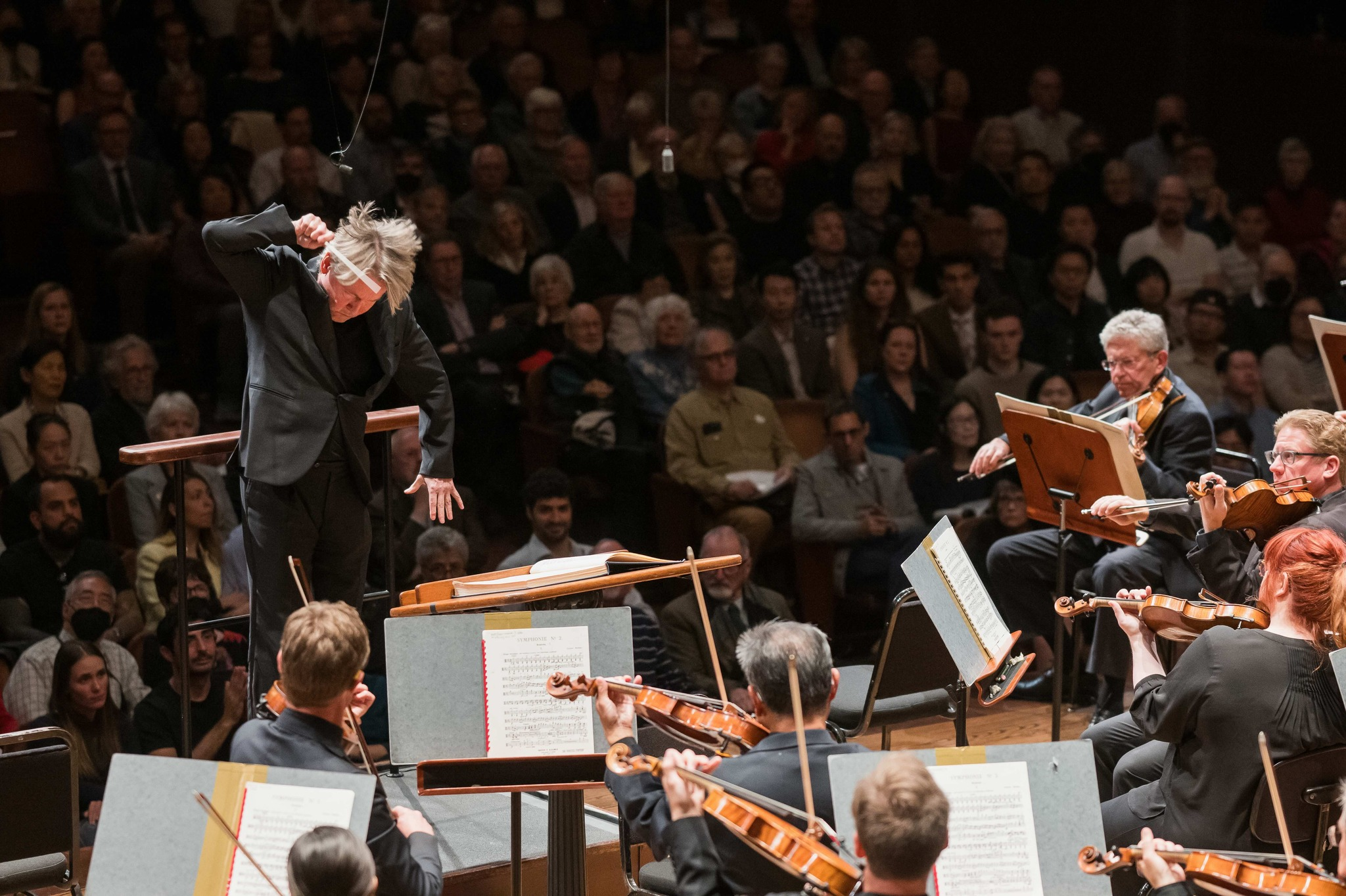
I was fortunate to have a chance to make it to Esa-Pekka Salonen’s very final performance of his San Francisco Symphony tenure – a program of Mahler 2.
And it begins! Ojai Music Festival launches its 79th edition today, 5 June, and will be streaming the concerts at Libbey Bowl on the OMF homepage at OjaiFestival.org and on the festival’s YouTube channel.
Writing the OMF program notes is always an immersive experience, but this year’s festival programming by Music Director Claire Chase has proved to be the most fulfilling since I began writing for the festival. The 2025 edition also carries a bittersweet resonance since Artistic and Executive Director Ara Guzelimian just announced that he will conclude his tenure with the 2026 OMF.
So many highlights to look forward to over this extended weekend, which showcases the incredible community of fellow artists with whom Claire Chase has chosen to collaborate. In the spotlight tonight are Marcos Balter and his epic Pan – a signature contribution to Chase’s ongoing Density 2036 project – and Annea Lockwood’s bayou-borne, an homage to the late Pauline Oliveros, her close friend, mentor to Chase, and a tutelary spirit watching over the music-making at Ojai.
Byron Schenkman, founder and artistic director of Sound Salon; photo (c) Shaya Lyon
Queer Baroque, the final program of Sound Salon’s season, salutes Pride Month with a blend of 17th-century drama and 21st-century insight to celebrate musical and personal otherness. Two performances: May 30 at 7.30pm at the Royal Room (5000 Rainier Ave S.) and May 31 at 7.00pm at the Good Shepherd Center (4649 Sunnyside Ave N.); tickets are “pay-as-you-wish, “with a suggested price of $36 and a minimum of $1.
Baroque music thrives on extremes. For harpsichordist Byron Schenkman, its emotional volatility and theatrical flair – hallmarks of a musical language that flourished in 17th- and early 18th-century Europe – hold special resonance for contemporary audiences and performers alike.
That belief underpins Queer Baroque, the final program of the season for the chamber music series Sound Salon, which Schenkman (they/them) founded and directs. They will be joined by multi-instrumentalist and composer Niccolo Seligmann (they/them) and male soprano Elijah McCormack (he/him) for two performances to mark the start of Pride Month with an imaginative – and often playful – exploration of identity and otherness through the lens of Baroque music.
The concept for the program goes back to the mid-1990s, spanning a period of profound cultural shifts – both in Seattle’s LGBTQ+ community and in the broader evolution of how queerness, and those who embody it, are seen, represented and understood.
“Thirty years ago, I helped plan a concert called ‘Queer Baroque,’ featuring musicians from Seattle Baroque Orchestra – and it nearly got canceled,” Schenkman recalls. When the presenting board at the time asked them to change the name in order to receive funding, they refused. “It generated so much buzz that the concert ended up being packed and was a big success. But one of the board members resigned over it.”
About a year and a half ago, as Schenkman began planning a version of the program updated to reflect a more expansive understanding of queerness, they assumed the moniker “Queer Baroque” no longer conveyed the edginess it once had. But in light of rising anti-LGBTQ+ rhetoric, particularly targeting trans communities, the title – and the conversation around it – feels urgent again.
Elijah McCormack
“At a time when we see ‘deviants’ scapegoated for so many social ills, I think this is an important program,” says McCormack, a transgender singer who specializes in early music. “Queer identities have been medicalized and classed as inherently disordered. It’s not new for these things to be pathologized or demonized.”
The program combines vocal and instrumental music from the 17th and 18th centuries to consider what it means to be seen as “other.” In the Baroque era, that otherness was often manifested in portrayals of madness in songs and stage works.
“This fascination with madness in the 17th century reflects a change in society’s attitude that led to people perceived as ‘crazy’ being put into institutions – behind bars – where the ‘normal’ people would come to look at them,” says Schenkman, who describes themself as “a queer Jewish keyboard player and scholar.”
By the 19th century, they add, “the idea of madness had become entangled with gender and sexuality: to be overly emotional, feminine or sexually expressive was often pathologized as insanity. Being queer, being feminine and being ‘crazy’ were increasingly seen as overlapping.”
That entanglement between emotional excess and perceived deviance plays out in several of the program’s vocal works. Barbara Strozzi’s cantata L’Astratto is a comic mad scene in which the singer cycles unpredictably through emotions and musical styles, unable to settle on one. “It’s also a kind of self-portrait of someone trying to locate themselves through art,” Schenkman says.
For McCormack, the piece culminates “in a touching sort of lament about the perils of losing yourself, even your own mind, in the love of someone else.”
He also performs Élisabeth Jacquet de la Guerre’s cantata Susanne, a retelling of the biblical story of Susanna and the Elders. “It’s so common for women – and people perceived as women – to be punished for maintaining agency over their own bodies,” McCormack says. “I imagine that, for Jacquet de la Guerre, it was powerful to set a text about a heroine who defies the entitlement of men in authority. It’s still powerful today.”
Another vocal highlight is Henry Purcell’s From Rosy Bowers, a theatrical song in which a chambermaid feigns madness to trick Don Quixote. “Here we have a woman pretending to be crazy to manipulate a character created by a male writer and composer,” Schenkman says. “It’s like putting on a drag show: playing with the stereotypes and tossing them on their heads. Some of that happens musically as well.”
Not all of the program’s queerness is textual or narrative. Some of it lies in performance choices themselves – like Seligmann playing a movement from one of Jacquet de la Guerre’s violin sonatas on the bass viol, a bowed, fretted string instrument from the Baroque era that’s typically used for lower lines. Schenkman likens the transposition to subverting gender expectations: “What’s a high voice supposed to do? What’s a low voice?”
Niccolo Seligmann; photo: Anna Schutz
“This program uses Baroque music to celebrate that queerness is not just one thing,” Seligmann says. “It’s a rich panoply of experiences that intersect with other axes of identity, including the time period.”
Seligmann, whose playing has been widely heard both in live concerts and on soundtracks like the Netflix series The Witcher, also contributes an example of their work as a composer. McCormack will sing a scene from Seligmann’s Julie, Monster: A Queer Baroque Opera, inspired by the life of Julie d’Aubigny (1673-1707), a genderfluid opera diva and swordfighter. Seligmann describes the excerpt as “a queer seduction aria that proposes more egalitarian ways of sharing intimacy,” connecting Julie “with a herstory of gender rebels” and today’s audiences “with queer ancestors for us to honor and celebrate.”
For Schenkman, who has long blended scholarship with activism, the concept of “Queer Baroque” continues to resist classification. “We’re all a little queer, and a little not,” they say. “The problem isn’t difference. The problem is pretending there’s only one normal way to be. I want whoever’s in the room to enjoy looking at different ways people diverge from norms – and celebrate it.”
Dover Quartet: Joel Link, Bryan Lee, Camden Shaw, Julianne Lee; photo: Jorge Gustavo Elias
My review for The Strad of this past weekend’s Dover Quartet performance, presented by Seattle Chamber Music Society:
On a glorious spring Sunday in Seattle, the Dover Quartet drew a full house to the 536-seat Nordstrom Recital Hall for a splendid afternoon concert – no small feat given the lure of sunshine and blue skies on a holiday weekend. Notably, the audience included a sizable contingent of younger listeners – a testament to the Seattle Chamber Music Society’s outreach efforts and to the appeal of this Signature Series concert, which closed the organisation’s inter-season extension between its winter and summer festivals. continue
I had the honor of writing the program note for this week’s performances of Philip Glass’s Symphony Np. 11 by the New York Philharmonic, with Gustavo Dudamel conducting:
It wasn’t until he was 54 that Philip Glass began writing symphonies. With Symphony No. 1 in 1992, he opened up a new creative frontier that has remained an essential part of his work ever since….
San Francisco Symphony just gave the world premiere of Before we fall, Anna Thorvaldsdottir’s new cello concerto for Johannes Moser, with Dalia Stasevska on the podium.
My behind-the-scenes feature on its creation is the current Strings magazine cover story.
Here’s Lisa Hirsch’s review for the San Francisco Chronicle:
“Thorvaldsdottir’s new cello concerto, Before We Fall, is a banger, sonically and intellectually, dense with ideas and meriting repeat hearings. It launches explosively, which is not an unusual strategy for a concerto, but don’t be misled. This isn’t a conventional soloist-versus-orchestra showdown…. continue
Chapeau to Karen P. Thomas and Seattle Pro Musica, whose various sub-ensembles sang sublimely and with luminous grace in last night’s season finale program – and to Nathan Chan, the eloquent cello soloist in Caroline Shaw’s “Its motion keeps,” Roxanna Panufnik’s “All shall be well,” and Thomas’s own “The world is charged,” a striking new work for cello and choir that closed a radiant evening in the warmth of St James Cathedral.
So many signature Pro Musica moments in this gorgeous program — from the perfectly contoured phrasing of Biebl’s beloved “Ave Maria” and the subtle rhythmic lilt of Shaw to a wrenching account of Herbert Howells’s Requiem, an a cappella expression of private grief laid bare. Britten’s inspired Auden setting in “Hymn to Saint Cecilia” found clarity and proportion in Thomas’s lucid direction.
Thomas also revealed her compositional eloquence in “The world is charged” – an imaginative and affecting setting of Gerard Manley Hopkins’s “God’s Grandeur,” which grapples with modern humanity’s estrangement from the natural world. I admired her musical evocation of Hopkins’s dense syntax and imagery, and of the quiet hope for renewal that pulses through the poem.










 MEMETERIA by Thomas May