MEMETERIA by Thomas May

Music & the Arts

Salonen with the Parisians in Lucerne

Big news this week: just after Esa-Pekka Salonen wrapped up his Lucerne Festival visit with the Orchestre de Paris, it was announced that he has been named the ensemble’s Chief Conductor starting in 2027. Parallel to that, he’ll become the take up the new Creativity and Innovation Chair of the Philharmonie de Paris. Salonen’s collaboration with the orchestra in Lucerne offered a vivid taste of that future partnership in two very different programs last weekend.

In the first, Augustin Hadelich was the soloist in an account of the Brahms concerto notable for its shadowed lyricism and spacious pacing, illuminating the score’s darker hues. Hadelich played his own cadenza and his arrangement of a Carlos Gardel tango as a steam-vent of an encore following such intensity. If Salonen brought structural clarity to the Brahms, the suite from Prokofiev’s ‘Romeo and Juliet’ that followed surged with dramatic sweep. The episodes seemed to unfold as part of an inexorable tragic arc rather than a set of contrasting miniatures.

His second evening with the Paris musicians revealed a touch more humor alongside the testosterone of ‘Don Juan’. But all that Straussian horn-iness set the stage for the much-anticipated world premiere of Salonen’s own Horn Concerto written for Berliner Philharmoniker principal Stefan Dohr. It’s a big piece, heroic in its way and abounding in the composer’s deep knowledge of the literature across music history, especially Mozart, Beethoven, and Bruckner (Salonen also trained as a horn player). He colorfully remarked that these moments from the musical past ‘appear and disappear like fish coming to the surface to catch an insect before diving to the depths of the sea again’.

The concerto teems with exposed solo passages that seem to test the limits of breath and control — not to mention imagination, indispensable to giving expressive shape to Salonen’s fertile ideas. Around the horn, the orchestra cast a kaleidoscope of refined colors. The concerto will travel widely in the coming months, so I hope to get a chance for more encounters.

Horn sounds resounded still again, sublimely, in the Sibelius Fifth. Salonen’s control of the art of transition, with subtly judged but dramatically thrilling accelerando, was a marvel. For all the monumentality of the closing chords, I fancied amid their awe an echo of mortality, like the trees being felled at the end of ‘The Cherry Orchard’. But the solace of Sibelius’s glorious Swan Theme circled in the mind’s ear as the swans on Lake Lucerne outside the KKL glided serenely by in serene silence.

Filed under: Esa-Pekka Salonen, Lucerne Festival, music news, Sibelius, , , , ,

A Dance, a Dream, a Riot of Color

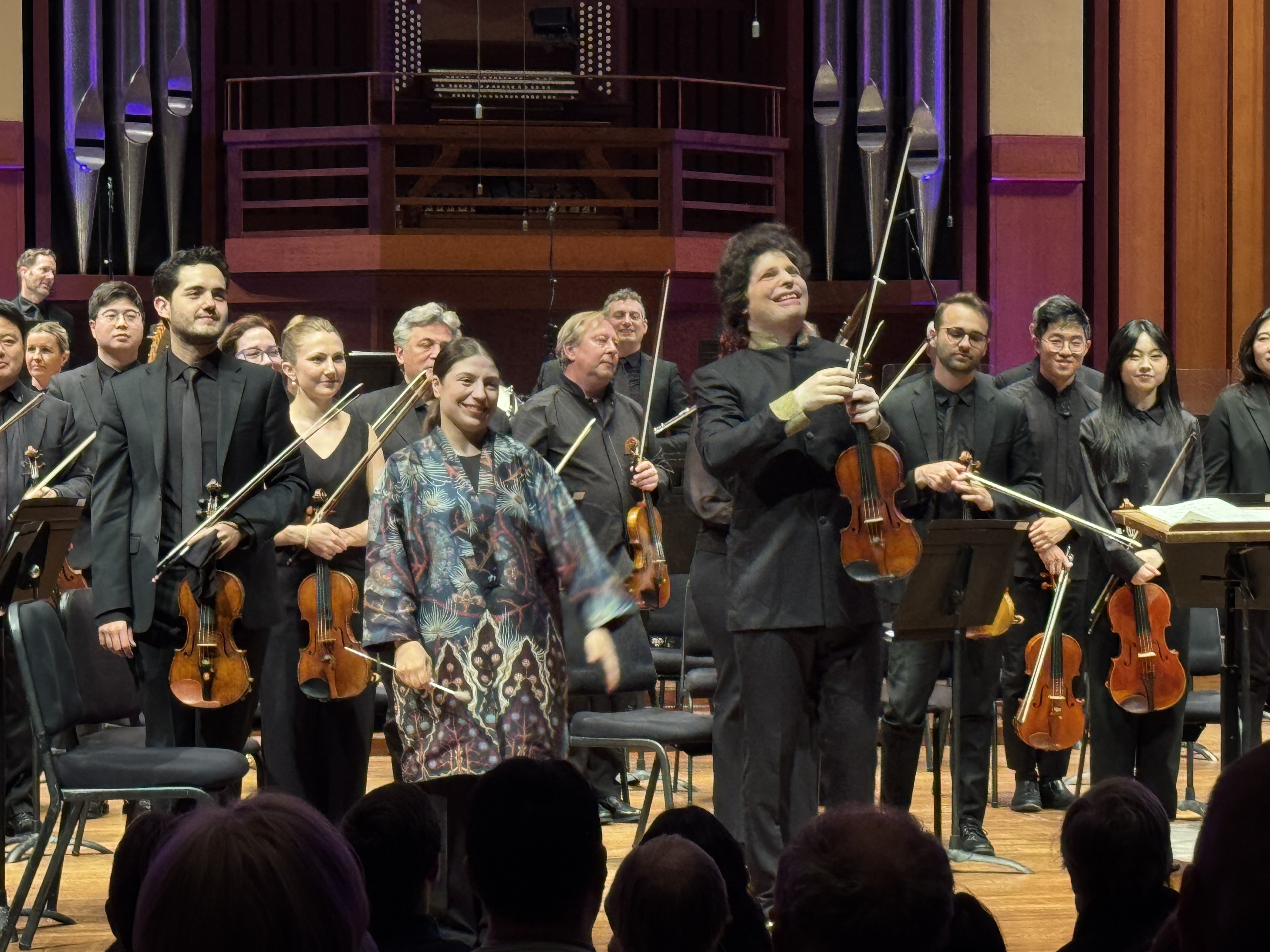
Dalia Stasevska and Augustin Hadelich with Seattle Symphony; (c)Jorge Gustavo Elias

Dalia Stasevska has returned to guest conduct Seattle Symphony this week with a relatively brief but refreshing program. Thursday night’s performance offered plenty of dazzling energy, albeit a curious combination of early Prokofiev sandwiched between two vibrant Latin American works. 

Alberto Ginastera’s Malambo from the 1941 ballet Estancia — music that put him on the international map – launched the concert with such kinetic force that it reminded me what a crime it is that his music remains so rarely programmed in the US. (Bravo to the Miró Quartet for recording the entire Ginastera string quartet cycle, forthcoming later this year as part of the ensemble’s 30th-anniversary celebrations.) Stasevska articulated the layered rhythms and boldly strident dissonances of Ginastera’s dance with razor-sharp clarity. Even at just a few minutes in duration, it left the audience breathless.

So did violin soloist Augustin Hadelich — though in a very different way. A Seattle favorite – he gave a deeply memorable account of the Britten Violin Concerto on his last stop with the orchestra two years ago – Hadelich brought his signature artistry Prokofiev’s precocious Violin Concerto No. 1. 

From his first phrases, which open the concerto, Hadelich astonished with the sheer beauty of his sound, caressing Prokofiev’s melodic line as if entering into a dream. Phrasing glissandi with effortless sprezzatura, he brought a transportive intensity to his account that was never schmaltzy. Hadelich embraced the concerto’s oneiric, fairy-tale character with personal warmth. Stasevska created a more integrated, immersive orchestral blend by positioning the brass stage right and offered sensitive, fluid support. 

Hadelich then delighted with an encore that nodded to the evening’s Latin American framing: his own arrangement of Carlos Gardel’s Por una Cabeza, proving, with wryly elegant melancholy, that it doesn’t always take two to tango.

The concert’s second half was devoted to Mexican composer Silvestre Revueltas’s La noche de los Mayas, a quasi-symphony fashioned from his score for the now-forgotten 1939 film of the same name, which uses a tragic love story to romanticize pre-Columbian Mayan culture. Stasevska underscored the piece’s rhythmic elan and churning colors, along with its touches of chaos a la Stravinsky Rite

The musicians seemed to thoroughly enjoy giving their all to the score – whether in the weighty brass chords evoking solemn ancient rituals, the mixed meter and collective revelry of a nighttime fiesta, or a  touching Mayan serenade duet for flute and percussion.

The last movement opened up into a tour de force spectacle for a massively expanded percussion section that calls for an orchestra-within-the-orchestra, complete with rattles, güiro, and conch shells. I came way impressed by Stasevska’s versatility—a world away from the Sibelius of her last Seattle appearance, and wholly in the spirit of the evening’s exuberance.

(c)2025 Thomas May

Filed under: conductors, Prokofiev, review, Seattle Symphony, violinists, , , , ,

Mozart and the Fortepiano

replica of a Viennese fortepiano built by Rodney Regier that will be used for the Mozart concertos

A week after its sold-out immersion in Winterreise with baritone Charles Robert Stephens (on Schubert’s birthday), Seattle Chamber Orchestra presents a program exploring the fortepiano – the kind of keyboard Mozart knew.

Mozart had to carve out his own path as a freelance artist in Vienna during the final decade of his career. He relied on his reputation as a celebrity virtuoso to cultivate a core audience, largely through his dazzlingly inventive series of piano concertos (as we call them), which he typically premiered in subscription concerts that doubled as crucial fundraising opportunities.

Conductor and pianist Lorenzo Marasso, SCO’s founder and music director, has curated a program around two of these concertos, which will be performed using a fortepiano: K. 449 in E-flat major and K. 488 in A major, with Tamara Friedman and Marasso as the soloists. He will also conduct SCO in Mozart’s Divertimento in D major, K133, and the great G minor Symphony, K. 550.

“A fortepiano is an early piano,” Marasso explains. “In principle, the word fortepiano can designate any piano dating from the invention of the instrument by Bartolomeo Cristofori in 1698 up to the early 19th century. Most typically, however, it is used to refer to the mid-18th- to early-19th-century Viennese instruments, for which composers of the Classical era, especially Haydn, Mozart, and Beethoven, wrote their piano music.”

The concertos will be performed on a replica of just such a Viennese fortepiano, which was built by Rod Regier and is borrowed from the collection of historical keyboards of Prof. George Bozarth and Tamara Friedman. 

The concert will be held on 7 February 2025 at Plymouth United Church of Christ in downtown Seattle (1217 6th Ave). A pre-concert talk will take place at 7:15pm; the performance begins at 8pm. Admission includes the pre-concert talk and the performance, accompanied by drinks and appetizers. Tickets here.

PROGRAM:

Wolfgang Amadeus MOZART 

Divertimento in D major K133

Piano Concerto No. 14 in E-flat major K449

Piano Concerto No. 23 in A major K488

Symphony No. 40 in G minor K550

Tamara Friedman fortepiano
Lorenzo Marasso fortepiano & conductor
Seattle Chamber Orchestra

Seattle Chamber Orchestra provides this bio:

The newly formed SCO is rooted in our cherished Pacific Northwest’s casual and open culture and brings together the region’s top instrumentalists to create an all-sensory experience of music where you are invited to be part of the experience rather than merely witnessing it. Founded in 2021, the Seattle Chamber Orchestra seeks to bring music lovers tantalizing combinations of the traditional and contemporary repertoire, performed by world-class professional musicians. Brought to life through thoughtful programming that educates as much as it inspires, SCO seeks to reinvigorate live classical music by providing opportunities for musicians and audiences to explore traditional and new music and challenge established boundaries.

Filed under: Mozart, music news, piano, Seattle Chamber Orchestra, , , , ,

Archive

Enter your email address to follow this blog and receive notifications of new posts by email.