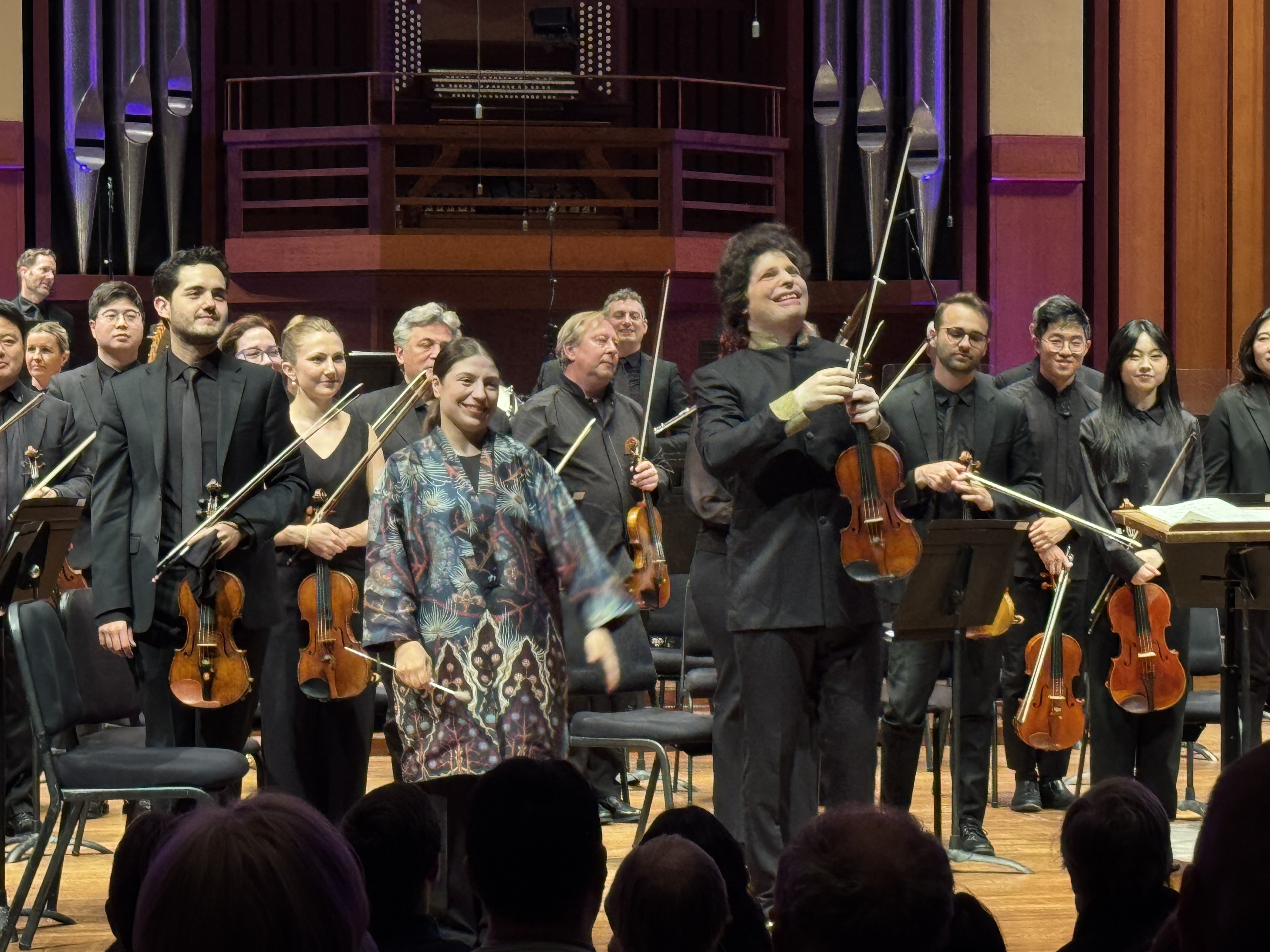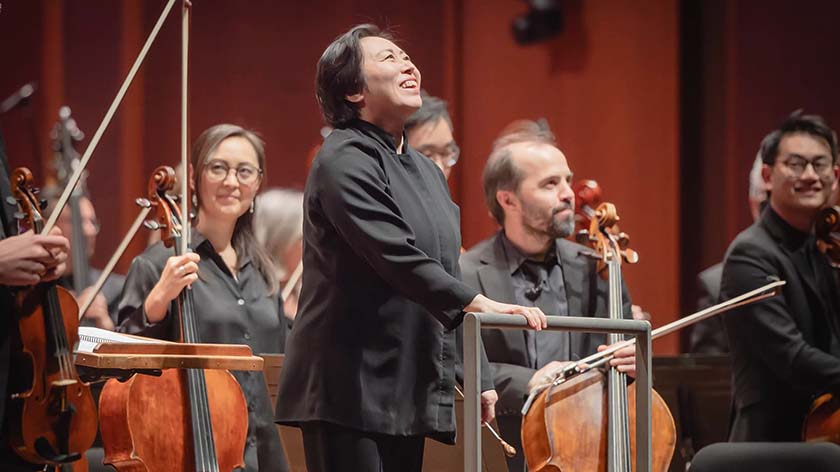
Dalia Stasevska and Augustin Hadelich with Seattle Symphony; (c)Jorge Gustavo Elias
Dalia Stasevska has returned to guest conduct Seattle Symphony this week with a relatively brief but refreshing program. Thursday night’s performance offered plenty of dazzling energy, albeit a curious combination of early Prokofiev sandwiched between two vibrant Latin American works.
Alberto Ginastera’s Malambo from the 1941 ballet Estancia — music that put him on the international map – launched the concert with such kinetic force that it reminded me what a crime it is that his music remains so rarely programmed in the US. (Bravo to the Miró Quartet for recording the entire Ginastera string quartet cycle, forthcoming later this year as part of the ensemble’s 30th-anniversary celebrations.) Stasevska articulated the layered rhythms and boldly strident dissonances of Ginastera’s dance with razor-sharp clarity. Even at just a few minutes in duration, it left the audience breathless.
So did violin soloist Augustin Hadelich — though in a very different way. A Seattle favorite – he gave a deeply memorable account of the Britten Violin Concerto on his last stop with the orchestra two years ago – Hadelich brought his signature artistry Prokofiev’s precocious Violin Concerto No. 1.
From his first phrases, which open the concerto, Hadelich astonished with the sheer beauty of his sound, caressing Prokofiev’s melodic line as if entering into a dream. Phrasing glissandi with effortless sprezzatura, he brought a transportive intensity to his account that was never schmaltzy. Hadelich embraced the concerto’s oneiric, fairy-tale character with personal warmth. Stasevska created a more integrated, immersive orchestral blend by positioning the brass stage right and offered sensitive, fluid support.
Hadelich then delighted with an encore that nodded to the evening’s Latin American framing: his own arrangement of Carlos Gardel’s Por una Cabeza, proving, with wryly elegant melancholy, that it doesn’t always take two to tango.
The concert’s second half was devoted to Mexican composer Silvestre Revueltas’s La noche de los Mayas, a quasi-symphony fashioned from his score for the now-forgotten 1939 film of the same name, which uses a tragic love story to romanticize pre-Columbian Mayan culture. Stasevska underscored the piece’s rhythmic elan and churning colors, along with its touches of chaos a la Stravinsky Rite.
The musicians seemed to thoroughly enjoy giving their all to the score – whether in the weighty brass chords evoking solemn ancient rituals, the mixed meter and collective revelry of a nighttime fiesta, or a touching Mayan serenade duet for flute and percussion.
The last movement opened up into a tour de force spectacle for a massively expanded percussion section that calls for an orchestra-within-the-orchestra, complete with rattles, güiro, and conch shells. I came way impressed by Stasevska’s versatility—a world away from the Sibelius of her last Seattle appearance, and wholly in the spirit of the evening’s exuberance.
Lionel Meunier and his vocal and period instrument ensemble Vox Luminis make their Pacific Northwest debut this weel with a program of sacred music by Claudio Monteverdi. Presented by Cappella Romana, there will be performances in Portland on 6 November and in Seattle on 7 November, both at 7.30pm (St. Mary’s Cathedral in Portland and St. Demetrios Greek Orthodox Church in Seattle); tickets here.
French conductor and baritone Lionel Meunier counts among the most influential figures in today’s historical performance and choral scenes. He founded Vox Luminis (“Voice of light”) in Belgium in 2004, having studied at the Institut Supérieur de Musique et Pédagogie in Namur.
Vox Luminis comprises a core ensemble of vocal soloists specializing in English, Italian, and German repertoire from the 17th and early-18th centuries; depending on the repertoire, they are supplemented with solo instruments, an extensive continuo, or a complete orchestra.
Artist in residence at Concertgebouw Brugge, Vox Luminis has earned international acclaim for its signature sound, with each voice emerging in a solo light while being able to fuse with the others “into one luminous fabric of sound.” The ensemble performs some 70 concerts a year and boasts an award-winning discography.
Meunier has put together a program of sacred music by Monteverdi, mostly from his later collection Selva morale e spirituale (“The Virtuous and Spiritual Forest”), which was published in 1640-41 in Venice. They will also present a couple of motets and the instrumental and vocal versions of the echo motet O bone Jesu o piissime Jesu (“O good Jesus, have mercy on us”).
PROGRAM:
Gloria (SV 258) from Selva morale e spirituale
Dixit Dominus II (SV 264) from Selva morale e spirituale
Beatus vir I (SV 268) from Selva morale e spirituale
O bone Jesu o piissime Jesu (SV 313) (instrumental version)
Adoramus te Christe (SV 289) from Libro primo de motetti, Giulio Bianchi
Cruxifixus (SV 259) from Selva morale e spirituale
Laetaniae della Beata Vergine (SV 204) from Libro secondo de motetti, Giulio Bianchi
O bone Jesu o piissime Jesu (SV 313) (vocal version)
Magnificat I (SV 281) from Selva morale e spirituale
Claudio Monteverdi was born in Cremona, the son of a surgeon and apothecary. Although there is no record of him being a member of the city’s cathedral choir, the young Monteverdi received his first composition lessons from its maestro di cappella Marc’Antonio Ingegneri, whose teachings he acknowledged in his first publications.
Monteverdi was clearly a precocious talent. His first publication, the three-voiced Sacrae cantiunculae (1582), was printed when he was just 15 years old. After attempts to find employment in Verona and Milan, he was eventually appointed as a viol player at the court of Vincenzo I Gonzaga, Duke of Mantua. It was in Mantua that he first began to experiment with the contemporary forms of liturgical music and develop a novel approach that united elements of the musical past and present, while offering glimpses of the future. This balance between tradition and innovation was epitomised in his much-loved Vespro della BeataVergine of 1610. His compositional achievements undoubtedly helped him in 1613, when he advanced to the prestigious post of maestro di cappella at Venice’s Basilica di San Marco, where he would remain until the end of his career.
The majority of the repertoire contained within this programme is drawn from three publications: the Selva morale e spirituale(‘Moral and Spiritual Forest’), published in 1640, and Giulio Bianchi’s two books of motets, both of which were published in 1620. The Selva morale e spirituale was a retrospective anthology that drew together some of his most innovative and successful music from his time in Mantua alongside his more recent Venetian work. It includes a mass, several psalm and Marian hymn settings, as well as two separate Magnificats. Bianchi was a cornettist and composer, who was also born in Cremona and led the wind band at Mantua alongside Monteverdi.
The seven-voiced setting of the Gloria is thought to have originally been part of a large-scale mass written by Monteverdi in 1631 to commemorate the end of the Italian Plague of 1629-31 (also known as the Great Plague of Milan). The plague brought great devastation to northern Italy and is thought to have killed up to 50,000 people in Venice alone. Monteverdi divides the Gloria into five distinct sections, closely following the sense of the text. Over the course of the piece, individual voices and pairs of voices emerge from the main texture with flashes of rapid coloratura, to participate in a compelling musical dialogue with the violins.
Dixit Dominus is the first psalm of the evening office of Vespers on Sundays and feast days. As part of the San Marco liturgy, Vespers services on special occasions saw the uncovering of the Pala d’Oro, the exquisite gold high altar at the far east end of the church. To accompany this, sixteenth-century Venetian composers normally produced lavish eight-voice, double-choir settings of the Dixit Dominus. While this second setting by Monteverdi is scored for eight voices, he does not stick to a rigid division between two ensembles. Instead, he uses the forces in a series of different combinations to depict the psalm’s lucid imagery — for example, using the full ensemble to terrifying effect in the stile concitato (‘agitated style’) section at the words Confregit in die irae suae reges (‘The Lord shall strike through kings in the day of his wrath’), but then suddenly paring back, in complete contrast, to a pair of soprano voices for the beginning of the following verse.
One of Monteverdi’s best-known later sacred works, Beatus vir (his first of two settings of Psalm 111) was actually based on a secular canzonetta Chiome d’oro, which was included in his Seventh Book of Madrigals (1619). In Beatus vir, Monteverdi borrows the charm and naïveté of his earlier work, originally addressed to the beauty of a lover’s physical features, to convey the blissful assurance of the faithful man that fears God and obeys his commandments.
Adoramus te, Christe was included in Bianchi’s first book and is a simple but heartrending setting of a text from the Hours of the Cross in devotional Books of Hours. Its opening statement, ‘We adore you, O Christ’, is tinged with bittersweetness, effected by Monteverdi’s unconventional use of dissonances, but the closing statements of Miserere nobis (‘Have mercy on us’) bring comfort and solace in the ending.
In addition to the simple four-part mass setting published in the Selva morale, Monteverdi also includedsome more modern alternative settings that could be substituted for sections of the mass. This short Crucifixus setting is one such alternative. It is cast in a much more modern style, with its descending chromatic line giving it a distinctly different character to the ordinary of the mass, which remained very consciously within the parameters of the stile antico.
There was a conspicuous increase in expressions of Marian devotion in Venice from 1571, after the city’s victory over the Turkish navy at the Battle of Lepanto, with Pope Pius V attributing the victory to the intervention of the Virgin Mary. As part of this, musical settings of the Litany became popular. Monteverdi’s setting of the Litany of Loreto, the Litaniae della Beata Vergine, was printed in Bianchi’s second book. Between the opening Kyrie eleison and the closing Agnus Dei, the Litany consists of a sequence of invocations addressed to the Trinity and then to Mary, as mother, virgin, saint and queen. The music is relatively simple and it is likely the piece was intended to be sung in procession.
O bone Jesu was actually first printed outside Italy, in a collection entitled Promptuarii musici issued by the German composer Johannes Donfrid in Strasbourg in 1622. A simple setting for two sopranos and continuo of a devotional hymn text, it is an example of the so-called ‘echo motet’, whereby the first voice sings a phrase that is immediately repeated by the second voice, before the pair join together to elaborate and extend the melodic materials. Growing out of a fairly sparse opening, the piece builds cumulatively in intensity, culminating in the final invocation, Salva me (‘save me’).
Following the five psalms at Vespers, the Magnificat featured as the centrepiece of the liturgy, being sung as the altar was censed. This eight-voice setting is the first of two contained within the Selva morale e spirituale.Breaking the text down into a series of standalone sections, Monteverdi explores its vivid imagery in a number of fresh ways. The stile concitato is introduced once again with the words Fecit potentiam in brachio suo (‘He hath showed strength with his arm’). In juxtaposing these modern forms of expression with elements of the musical past, in the shape of short fragments of plainsong and imitative polyphony, Monteverdi demonstrates his unique ability to make the unfamiliar seem somehow familiar. These truly immersive soundworlds must have been utterly entrancing to seventeenth-century ears — but they remain no less captivating to contemporary audiences.