MEMETERIA by Thomas May

Music & the Arts

Salonen with the Parisians in Lucerne

Big news this week: just after Esa-Pekka Salonen wrapped up his Lucerne Festival visit with the Orchestre de Paris, it was announced that he has been named the ensemble’s Chief Conductor starting in 2027. Parallel to that, he’ll become the take up the new Creativity and Innovation Chair of the Philharmonie de Paris. Salonen’s collaboration with the orchestra in Lucerne offered a vivid taste of that future partnership in two very different programs last weekend.

In the first, Augustin Hadelich was the soloist in an account of the Brahms concerto notable for its shadowed lyricism and spacious pacing, illuminating the score’s darker hues. Hadelich played his own cadenza and his arrangement of a Carlos Gardel tango as a steam-vent of an encore following such intensity. If Salonen brought structural clarity to the Brahms, the suite from Prokofiev’s ‘Romeo and Juliet’ that followed surged with dramatic sweep. The episodes seemed to unfold as part of an inexorable tragic arc rather than a set of contrasting miniatures.

His second evening with the Paris musicians revealed a touch more humor alongside the testosterone of ‘Don Juan’. But all that Straussian horn-iness set the stage for the much-anticipated world premiere of Salonen’s own Horn Concerto written for Berliner Philharmoniker principal Stefan Dohr. It’s a big piece, heroic in its way and abounding in the composer’s deep knowledge of the literature across music history, especially Mozart, Beethoven, and Bruckner (Salonen also trained as a horn player). He colorfully remarked that these moments from the musical past ‘appear and disappear like fish coming to the surface to catch an insect before diving to the depths of the sea again’.

The concerto teems with exposed solo passages that seem to test the limits of breath and control — not to mention imagination, indispensable to giving expressive shape to Salonen’s fertile ideas. Around the horn, the orchestra cast a kaleidoscope of refined colors. The concerto will travel widely in the coming months, so I hope to get a chance for more encounters.

Horn sounds resounded still again, sublimely, in the Sibelius Fifth. Salonen’s control of the art of transition, with subtly judged but dramatically thrilling accelerando, was a marvel. For all the monumentality of the closing chords, I fancied amid their awe an echo of mortality, like the trees being felled at the end of ‘The Cherry Orchard’. But the solace of Sibelius’s glorious Swan Theme circled in the mind’s ear as the swans on Lake Lucerne outside the KKL glided serenely by in serene silence.

Filed under: Esa-Pekka Salonen, Lucerne Festival, music news, Sibelius, , , , ,

Happy Birthday to João Carlos Martins!

João Carlos Martins at Carnegie Hall Farewell Concert, 9 May 2025; photo: Jorge Gustavo Elias

Happy 85th birthday to o Maestro, João Carlos Martins! Born on 25 June 1940 in São Paulo, Martins established himself as one of the most brilliant keyboard interpreters of Johann Ses=bastian Bach in the second half of the 20th century.

Yet his Bach legacy is just one component of an artistic journey marked by both acclaim and adversity. João Carlos Martins’s story is as much about resilience and reinvention as it is about musical brilliance. Following prodigious beginnings – he made his Carnegie Hall debut at age 20 – repeated injuries to his hands forced Martins to step away from the piano, just as he was reaching the height of his international career. But rather than retreat from music, he redirected his focus to conducting, bringing the same fervor and eloquence to the podium that once defined his playing.

Martins additionally became an enormously influential cultural force in Brazil. Through his Bachiana Foundation, he has brought classical music to thousands of young people, many from underserved communities, creating access where there was none. Alongside this work with the Fundação Bachiana, Martins has also been a champion of Latin American composers.

His initiatives have blended high artistic standards with social impact, forging a vision of music as both an expressive art and a tool for transformation. Under his leadership, the Bachiana Filarmônica SESI-SP has become one of Brazil’s most dynamic cultural foundations – a platform for emerging talent and a vehicle for national pride, performing everywhere from favelas to major concert halls.

Martins’s late-career return to the keyboard – made possible by specially adapted bionic gloves – has added an inspiring new chapter to an already remarkable artistic narrative. Following his moving farewell concert at Carnegie Hall last month, Martins continues to extend a career that has continually defied limitation as he devotes himself to a broad new initiative to improve music education across Brazil.

Feliz Aniversário, Maestro! Your artistry continues to resonate far beyond the concert hall.

João Carlos Martins at Carnegie Hall Farewell Concert, 9 May 2025; photo: Jorge Gustavo Elias

An archive of JCM videos can be found here.

Filed under: Bach, Brazil, music news, , , , ,

A Dance, a Dream, a Riot of Color

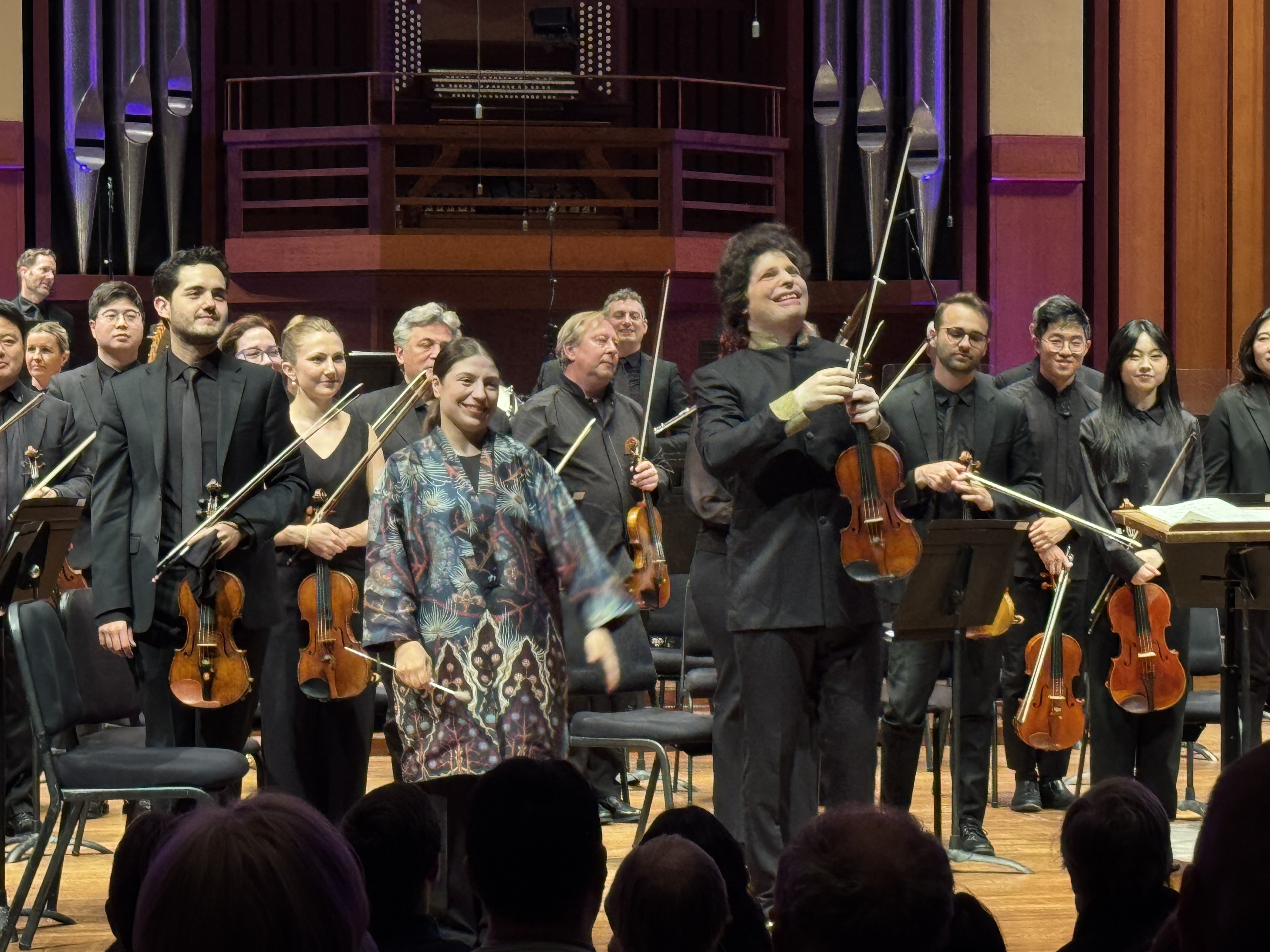
Dalia Stasevska and Augustin Hadelich with Seattle Symphony; (c)Jorge Gustavo Elias

Dalia Stasevska has returned to guest conduct Seattle Symphony this week with a relatively brief but refreshing program. Thursday night’s performance offered plenty of dazzling energy, albeit a curious combination of early Prokofiev sandwiched between two vibrant Latin American works. 

Alberto Ginastera’s Malambo from the 1941 ballet Estancia — music that put him on the international map – launched the concert with such kinetic force that it reminded me what a crime it is that his music remains so rarely programmed in the US. (Bravo to the Miró Quartet for recording the entire Ginastera string quartet cycle, forthcoming later this year as part of the ensemble’s 30th-anniversary celebrations.) Stasevska articulated the layered rhythms and boldly strident dissonances of Ginastera’s dance with razor-sharp clarity. Even at just a few minutes in duration, it left the audience breathless.

So did violin soloist Augustin Hadelich — though in a very different way. A Seattle favorite – he gave a deeply memorable account of the Britten Violin Concerto on his last stop with the orchestra two years ago – Hadelich brought his signature artistry Prokofiev’s precocious Violin Concerto No. 1. 

From his first phrases, which open the concerto, Hadelich astonished with the sheer beauty of his sound, caressing Prokofiev’s melodic line as if entering into a dream. Phrasing glissandi with effortless sprezzatura, he brought a transportive intensity to his account that was never schmaltzy. Hadelich embraced the concerto’s oneiric, fairy-tale character with personal warmth. Stasevska created a more integrated, immersive orchestral blend by positioning the brass stage right and offered sensitive, fluid support. 

Hadelich then delighted with an encore that nodded to the evening’s Latin American framing: his own arrangement of Carlos Gardel’s Por una Cabeza, proving, with wryly elegant melancholy, that it doesn’t always take two to tango.

The concert’s second half was devoted to Mexican composer Silvestre Revueltas’s La noche de los Mayas, a quasi-symphony fashioned from his score for the now-forgotten 1939 film of the same name, which uses a tragic love story to romanticize pre-Columbian Mayan culture. Stasevska underscored the piece’s rhythmic elan and churning colors, along with its touches of chaos a la Stravinsky Rite

The musicians seemed to thoroughly enjoy giving their all to the score – whether in the weighty brass chords evoking solemn ancient rituals, the mixed meter and collective revelry of a nighttime fiesta, or a  touching Mayan serenade duet for flute and percussion.

The last movement opened up into a tour de force spectacle for a massively expanded percussion section that calls for an orchestra-within-the-orchestra, complete with rattles, güiro, and conch shells. I came way impressed by Stasevska’s versatility—a world away from the Sibelius of her last Seattle appearance, and wholly in the spirit of the evening’s exuberance.

(c)2025 Thomas May

Filed under: conductors, Prokofiev, review, Seattle Symphony, violinists, , , , ,

Mozart and the Fortepiano

replica of a Viennese fortepiano built by Rodney Regier that will be used for the Mozart concertos

A week after its sold-out immersion in Winterreise with baritone Charles Robert Stephens (on Schubert’s birthday), Seattle Chamber Orchestra presents a program exploring the fortepiano – the kind of keyboard Mozart knew.

Mozart had to carve out his own path as a freelance artist in Vienna during the final decade of his career. He relied on his reputation as a celebrity virtuoso to cultivate a core audience, largely through his dazzlingly inventive series of piano concertos (as we call them), which he typically premiered in subscription concerts that doubled as crucial fundraising opportunities.

Conductor and pianist Lorenzo Marasso, SCO’s founder and music director, has curated a program around two of these concertos, which will be performed using a fortepiano: K. 449 in E-flat major and K. 488 in A major, with Tamara Friedman and Marasso as the soloists. He will also conduct SCO in Mozart’s Divertimento in D major, K133, and the great G minor Symphony, K. 550.

“A fortepiano is an early piano,” Marasso explains. “In principle, the word fortepiano can designate any piano dating from the invention of the instrument by Bartolomeo Cristofori in 1698 up to the early 19th century. Most typically, however, it is used to refer to the mid-18th- to early-19th-century Viennese instruments, for which composers of the Classical era, especially Haydn, Mozart, and Beethoven, wrote their piano music.”

The concertos will be performed on a replica of just such a Viennese fortepiano, which was built by Rod Regier and is borrowed from the collection of historical keyboards of Prof. George Bozarth and Tamara Friedman. 

The concert will be held on 7 February 2025 at Plymouth United Church of Christ in downtown Seattle (1217 6th Ave). A pre-concert talk will take place at 7:15pm; the performance begins at 8pm. Admission includes the pre-concert talk and the performance, accompanied by drinks and appetizers. Tickets here.

PROGRAM:

Wolfgang Amadeus MOZART 

Divertimento in D major K133

Piano Concerto No. 14 in E-flat major K449

Piano Concerto No. 23 in A major K488

Symphony No. 40 in G minor K550

Tamara Friedman fortepiano
Lorenzo Marasso fortepiano & conductor
Seattle Chamber Orchestra

Seattle Chamber Orchestra provides this bio:

The newly formed SCO is rooted in our cherished Pacific Northwest’s casual and open culture and brings together the region’s top instrumentalists to create an all-sensory experience of music where you are invited to be part of the experience rather than merely witnessing it. Founded in 2021, the Seattle Chamber Orchestra seeks to bring music lovers tantalizing combinations of the traditional and contemporary repertoire, performed by world-class professional musicians. Brought to life through thoughtful programming that educates as much as it inspires, SCO seeks to reinvigorate live classical music by providing opportunities for musicians and audiences to explore traditional and new music and challenge established boundaries.

Filed under: Mozart, music news, piano, Seattle Chamber Orchestra, , , , ,

Two Faces of Romanticism: A Recital by Yulianna Avdeeva

Yulianna Avdeeva; photo (c) Carlin Ma

Yulianna Avdeeva‘s Sunday afternoon recital at Benaroya Hall seemed to be timed especially well: The New York Times published a story that day about the unexpected find of a waltz by Chopin. Her refined interpretations of that composer suggested how much remains open to discovery, even in the case of long-familiar pieces.

Avdeeva burst on the scene when, at the age of 25, she took the gold medal in the 2010 Chopin Competition (the first woman since Martha Argerich to have garnered the award). She recently released Chopin: Voyage, an album focused on late works that he composed while surrounded by nature, which the Moscow-born pianist recorded in the idyllic setting of Tippet Rise Art Center in Montana. She performs widely across Europe but still seems to be something of a well-kept secret in the US. On the basis of Sunday’s performance, I certainly hope that changes.

Though for years they lived just a few minutes away from each other by foot in Paris, Chopin and Liszt inhabit such strikingly different worlds that it was fascinating to find them juxtaposed on Avdeeva’s program, with one half devoted to each composer. 

She began with Chopin, lingering on the first note as she launched into the Op. 30 Mazurkas, as if preparing to whisk us away from ordinary life. In his 1851 biography of Chopin (likely co-written with his Polish mistress, Princess Carolyne von Sayn-Wittgenstein), Liszt ascribes to Chopin’s mazurkas “the most delicate, tender, and evanescent shades,” evoking impressions that are “purely personal, always individualized and divided.” 

Each of the four mazurkas in the Op. 30 set, which Avdeeva played without breaks, indeed seemed to be a separate microcosm rather than another elaboration on a type. Her management of micro-transitions, of the slightest fluctuation of mood, was especially impressive. Even in the more assertive No. 3 in D-flat, an inner melancholy shaded the echoing phrases. 

Avdeeva maintained a spirit of improvisation while executing compelling and clearly thought-out ideas about each piece with breathtaking precision. 

The Op. 60 Barcarolle in F-sharp major suggested an idealized singer in a state of ecstasy – a melody beyond human reach yet fallible with emotion, as far as could be from mechanical virtuosity. 

Avdeeva spun out the sense of mystery and enigmatic wandering that makes the Op. 45 Prelude in C-sharp minor so beguiling, while the Scherzo No. 3 (in the same key) abounded in well-judged contrasts and textural control.

It was above all in the Andante spianato and Grande Polonaise brillante, Op. 22, that Avdeeva revealed new facets. Her Chopin involves such complex, meticulously articulated gradations of weight and light that you realize how much variety lives within a single miniature – not just Schumann’s “cannons buried in flowers” in the case of Op. 22, but an entire epic encompassing heroic adventures and bravely intimate confessions. Rhythmic and dynamic nuances are a special forte with this pianist, who is equally subtle in she staging of rubato and crescendo. 

Avdeeva then turned from Chopin’s lyric poetry to the mystical, tormented Romanticism of his far longer-lived peer, Franz Liszt – and showed that she had a great deal to say on that score as well. Her combination of two late-period, avant-garde works from 1885 with the B minor Sonata  – all played seamlessly, as if transcribing a single brooding meditation by the robed, solitary Abbé – proved intriguing. 

On the one hand, with the Bagatelle sans tonalité and Unstern!  – Sinistre, the difference and distance from Chopin could not have been more pronounced. Avdeeva seemed to depict a stark search for threads of meaning amid Liszt’s harmonic vagaries, stalled by abysses of silence. The effect was utterly mesmerizing. 

When she arrived at the B minor Sonata, Avdeeva drew on the full arsenal of her stupendous technique to portray an intense psychic drama. The Benaroya Steinway resounded with the most thunderous playing of the afternoon, but Avdeeva also relished Liszt’s celestial harmonies and gossamer ornaments, articulating with a scintillating transparency that recalled Chopin – and what Liszt admired in Chopin’s playing. Her two encores once again confronted the two personalities, offering prismatic accounts of Chopin’s Op. 42 Waltz in A-flat major and the Concert Paraphrase Liszt made from Rigoletto.

review (c) 2024 Thomas May All rights reserved

Filed under: Chopin, Franz Liszt, pianists, review, , , , ,

Archive

Enter your email address to follow this blog and receive notifications of new posts by email.