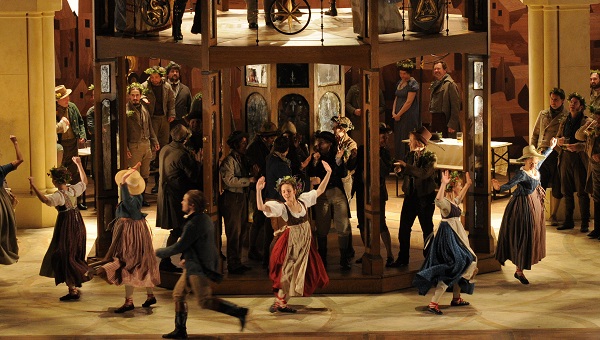
My essay for San Francisco Opera’s new Meistersinger production has now been posted:
Richard Wagner was among those fired up by the fervor and idealism of the mid-nineteenth century revolutionary mindset sweeping Europe. He had tried to jumpstart radical change in the aftermath of the failed Dresden uprising of 1849 (in which he had actively taken part).
After a period spent rechanneling that energy from poetics into art with his new Ring project, Wagner eventually came to recognize the necessity of more gradual transformation.
Here’s an interview I conducted with composer Philip Glass, librettist Christopher Hampton, and director Robert Woodruff for San Francisco Opera on the occasion of the world premiere of the original version of Appomattox in 2007:
Philip Glass and Christopher Hampton first met in 1989 at a San Francisco Opera performance of Glass’s Satyagraha. Glass later wrote the score to the British playwright’s film adaptation of Conrad’s The Secret Agent (1996), and in 2005 they introduced their opera Waiting for the Barbarians, drawn from the novel of South African writer J.M. Coetzee.
Appomattox involves a highly personal journey for the prolific Glass. In this interview Glass, Hampton, and the stage director Robert Woodruff discuss what each brought to the table for Appomattox and share their thoughts about the challenges of creating a new opera.
THOMAS MAY: What was behind your impulse to write an opera rooted in the American Civil War?
PHILIP GLASS: The idea for the piece got started when I was reading a book about the surrender. I came across the images of Lee and Grant together (they were actually in a private home — “Appomattox Court House” is the name of the historic town where the surrender was signed).
The characters of Lee and Grant are so completely interesting. These are men of tremendous moral and intellectual stamina. The popular idea of Grant as somehow buffoonish and a lesser person than Lee is not true at all.
If you read Grant’s autobiography, you see how amazing the man was. And I thought there are no people in public life today with the stature or moral stamina of these two men.
Americans have a lot of contempt for politicians nowadays, yet it wasn’t that long ago that there were men in power who had a different way of working. One of the things about the Civil War itself is that it’s within range of historical recollection.
We know what people said from so many sources — it’s not conjecture. We know the way the house looked and the way the men looked. Lee arrives with a clean uniform while Grant looks like he’d slept in a field. So I had a very strong image of the actual room the surrender took place in.
TM: You had previously dealt with the Civil War in your collaboration on the CIVIL warS project with Robert Wilson. You wrote the final act — the “Rome Section” — for the 1984 Olympic Games in Los Angeles. In fact, Lee appears as a character in that piece as well, along with Abraham Lincoln. What has changed in your outlook in the intervening years?
GLASS: I’m in a different place compared to where I was 30 years ago. I’ve moved away from the kind of idealism you see in my early works. To put it succinctly, the world has changed. For a lot of people, the world is a more threatening place than it used to be.
I’m not just talking about America – this is a global problem. I don’t know any government in the world that has real leaders instead of politicians. So I probably couldn’t write a piece like Satyagraha today. In fact, the night we premiered Satyagraha at San Francisco Opera in 1989 was the very night of the crackdown on the Tiananmen Square protests in China. It was a shocking thing.
TM: Is this shift away from idealism reflected in the balance between the private moments of the characters in Appomattox, which figure so prominently, versus their public roles?
There’s a good deal of gritty realism (for example, in the depiction of Grant’s migraines or the business of his appearance at the surrender, as you mentioned).
GLASS: Things that were not mentioned in the earlier librettos are presented much more forthrightly now. For example, Satyagraha, which was an opera about social change and nonviolence, mentions the idealism of Ghandi, but it doesn’t mention his failures.
They were huge by the end of his life. The partition of India was a tremendous failure for him — he was in despair about it. The abolition of the caste system never happened. Yet at the same time his ideas inspired the American civil rights movement.
When I wrote Satyagraha in the late 1970s it was because I thought there was an urgent need to have a public conversation about nonviolence. Little did I – or any of us – know the directions that we were racing toward 30 years later – far, far worse than we ever imagined it could be.
Appomattox is not about the Civil War in an idealistic way. It’s about the way the outcome of the war set the stage for the struggle over the next hundred years. In the opera itself, there’s a moment when Grant actually says, “How we end the war today will still be felt a hundred years from now.”
TM: So the story of the ending of the Civil War, which we might think of as enclosed and put to rest, actually bleeds into the following century….
CHRISTOPHER HAMPTON: When we decided not to deal only with the last few days of the war but the repercussions over the next hundred years, the whole thing opened up in a certain way for me.
It became not just an historical treatise or pageant but something that reached its tentacles right down to today. I started thinking about what happened hundred years after the signing. And of course what was happening then was the Civil Rights movement.
I discovered that the murder of the civil rights protestor Jimmie Lee Jackson took place almost exactly a hundred years after the signing of the surrender. So this led to the idea of putting those increasingly modern incidents into the mix.
ROBERT WOODRUFF: I saw the events of the second part of the piece as car crashes into the historical event of Appomattox. They do -– literally, in physical space — come crashing into the room of the historical setting. Ultimately the opera is about the resonance between that moment in history and the succeeding moments of violence and violation of the spirit of that pact.
TM: Along with that powerful image of Lee and Grant facing each other at the moment of surrender, what was the first musical image for Appomattox?
GLASS: I looked into the songs that were sung at the time of the Civil War and did what I could to make it sound like the time. For example, we’re told one of the Psalms [“Clap your hands all you people”] was the hymn that was sung by the freed slaves when Abraham Lincoln came into Richmond. It’s an amazing text filled with imagery of a vengeful Jehovah.
They were singing about a fierce God, and that matches well with the temper and the violence of a war where more than 500,000 men died. My first images were of the soldiers singing. I didn’t want the opera to somehow remain in an abstract world.
When people write operas, they often make references to other operas: to the history of opera or to other composers. I avoided that way of working entirely. Instead I used several kinds of colloquial music, things that you wouldn’t expect in a traditional operatic setting. One piece I set was a found text from the First Arkansas Brigade –- a black regiment fighting for the Union that enters Richmond in the first act –- for which I composed my own music. It’s the subject matter and where that compels us to go that’s important.
HAMPTON: When I was introducing the story of Jamie Lee Jackson, I talked about writing a ballad and thought of a kind of Bob Dylan song –- the language is from that world.
The way Philip thought about that piece is in a slightly different style from the rest. All these elements are gathered together in the opera and make for an interesting texture.
TM: How does this use of vernacular elements relate to the way you approach the vocal writing in Appomattox?
GLASS: English is a notoriously difficult language to understand when it’s being sung. Nowadays most opera houses will project the text. But there are some downsides to the surtitle business too. The best solution is if we understand what people sing.
I’ve made a point of that since I began to write opera in English in the 1980s, with The Fall of the House of Usher and The Juniper Tree and so on. I’ve learned a lot from the many operas I’ve written and also my song cycles, including my recent collaboration with Leonard Cohen, The Book of Longing.
Part of it involves working closely with singers and learning how the tessitura, or the placement in the voice, will determine a lot about the comprehensibility of a phrase.
For example, in English, the final consonants often indicate the meaning of a word. So if you go very high with the voice it becomes difficult to understand the words. What you’re looking for is a style of singing which is melodic but stays well within the range of the spoken voice.
As you get above the spoken voice it tends to become increasingly difficult to understand. But you’re not going to write entirely in the middle part of the voice. For a lot of reasons you want to use the whole range of the voice, but you have to be careful about where you put the words.
Part of the métier of an opera composer is to understand how the orchestra can illuminate the voice and at the same time bring color to the overall composition of the opera.
TM: How would you describe the orchestral palette you’ve chosen for the score to Appomattox?
GLASS: There are places that are extremely dark here, like the interlude depicting the destruction of Richmond in Act One. This is a very different version of the Civil War from what you get in the documentaries.
As a boy growing up in Maryland, I was taken to Gettysburg numerous times. We celebrate the Civil War as a moment of great courage and glory. In fact the dark side of it we don’t talk about much—but this opera does.
I would say that the orchestration is very dark. It doesn’t shine with the kind of exuberance you might find in Satyagraha, for example.
TM: Along with the prominence of low male voices -– for Grant, Lee, and Lincoln -– and the male chorus of the First Arkansas Brigade, there are crucial soprano roles for the wives. And in fact Appomattox begins and ends with the sound of female voices.
HAMPTON: I thought at first that the events of the last few days of the war would provide enough to deal with in the opera. But I became particularly interested in various unforeseen things. I saw the roles of Mrs. Grant, Mrs. Lee, and Mrs. Lincoln as I read more, and the perspective they could give on the men.
GLASS: In this opera you see all the different sides. The opera begins and ends with women because, in fact, wars are about women.
I grew up in the Second World War when every male relative in my family was in the army. We were raised by women. In that sense we can say that my version of the Civil War is very autobiographical. It’s what I remember from growing up during the Second World War and from the Civil Rights movement.
Opera — if it’s about anything — is a subjective poetic expression. I don’t make any bones about that. This is not meant to be a historical documentary. Opera is a species of poetry, it’s not a species of history, historical as the subject may be.
That would be true for all the people who have worked on Appomattox: Bob [WOODRUFF], the singers, the designers, everyone involved. I chose Christopher to be my librettist because he wasn’t American. I wanted someone who has an impeccable sense of theater and who could come to this subject matter and look at it in a fresh way.
HAMPTON: I knew virtually nothing about the Civil War -– no more than the average layman in England, which isn’t much at all. It was an education. I found that there was a vast library, and in that library, some fascinating books. So I did a crash reading course and discovered the American Civil War is one of the most documented events in history. That taught me as an outsider how it still sits in the middle of the American psyche in some kind of iconic way.
WOODRUFF: For me, one thing that has been surprising as I’ve learned more about the Civil War is coming to grips with this nation being in that kind of struggle. The scale of it challenges your imagination. The country was really on the brink of dissolution as a nation.
In the opera, the image of Richmond is the shell of a destroyed society. That’s really the visual muscle of the event. The interesting part of Appomattox visually is the way the signing relates to the destroyed Richmond.
This is a war that was distinctly American, and yet the idea of the opera is that it’s built upon elements — from refugees to racism to a kind of atavistic human temperament — that we live with everyday in society.
TM: How does Appomattox relate to your previous work in the theater?
HAMPTON: I think there’s a strand of my writing that this fit into very well. It goes back to a play I wrote in the early 1970s, Savages, about the extermination of the Brazilian Indians. This is not exactly a political strand as such but a strand that has a great interest in political subjects like racism or the disappeared in Argentina (which I made a film about).
These are fairly cataclysmic historical events which either are in danger of repeating every now and then or which have marked our own time indelibly. I’m very interested in those patterns of events.
WOODRUFF: I don’t see any separation here working on theater from my other work. This is theater. Christopher’s writing and Philip’s music create a form that is not distinctive from the form of theater and excellent story telling. There’s a narrative that then becomes jarred and fractured. It uses the elements of form and chaos and surprise, so that for an audience the journey is not predictable.
You might think you know the historical narrative, but the journey of the evening truly is something that comes from Philip’s and Christopher’s own ideas of what they wanted to create.
TM: How has the collaborative process played out in creating Appomattox?
HAMPTON: This is my third collaboration with Philip. But the previous two, a film and an opera, involved setting stories by other writers. So this is really the first time that I was left to do my own libretto. It was not based on anything except for Philip’s rather precise interest in doing an opera about the end of the Civil War and the civilized way in which those generals behaved at Appomattox.
I was very conscious of the notion of singability. I would write a page of the libretto, and Philip would set about composing immediately, with maybe a few comments. We got to a point where we more or less wrote it simultaneously.
WOODRUFF: As far as the rehearsals go, there’s a kind of relaxed openness between everybody. We all give voice to whatever we’re thinking whenever we’re thinking it. It’s a great way to work: there’s no pecking order.
Especially when you’re creating something new, this is the way to do it: you’re asking questions and testing and listening all at the same time. Bringing this physically to the stage, you’re trying to create a poetics between the physical body and the physical space.
This is particularly the case with Appomattox, where the gestures in a way would seem grounded because they’re historically rooted and there’s a strong historical narrative. There’s not a question of a hyperpolated physical gesture. So you’re trying to create poetry between the body of the actor and the environment that he’s sitting in.
GLASS: My feeling is always that if you bring talented people to a project, you let them do their best work. I don’t give instructions but I’m watching — and I’m inspired by it actually.
The realization of an opera is the work of a tightly bound group of people. Together they create the staging and visual images, in the same way that singers, as we say, create the roles in opera. Everyone who is singing on opening night will be creating that role for the first time.
As a composer, part of my job is to be there from the first week, listening to rehearsals. I focus on getting the balances with the singer, the hall, the orchestra right. I can’t do this theoretically.
Dennis Russell Davies [the conductor of the world premiere in 2007] and I have worked together for a long time, and there’s mutual trust that makes it possible to solve problems without any personal issues.
Questions of vanity and pride do not enter in at all. Working in the theater is a lifetime occupation. You never stop learning. I often go to costume fittings -– I’ve learned a lot from just seeing people put on their costumes — and watch the lights being focused. I watch everything. I encourage young composers to live in the theater, to spend as much time as they can becoming part of it. You have to understand the theater from top to bottom to become an opera composer.
Bearing an exotically enigmatic title — Nu.Mu.Zu — the new work by the 80-year-old Georgian composer Giya Kancheli left a distinctly memorable impression in its North American premiere by the Seattle Symphony Orchestra under Ludovic Morlot. The world premiere took place only a few weeks ago in Brussels (Kancheli’s current residence is in Antwerp), with Andrey Boreyko and the National Orchestra of Belgium; both that ensemble and the SSO co-commissioned the piece. continue reading
Trick Danneker, Chesa Greene, Jeanne Paulsen, and Spencer Hamp; photo by John Ulman
One of the shows on my personal most-anticipated list for the season opened Friday, and I’m still digesting the experience. Staging Mother Courage and Her Children, which is on the boards now at Seattle Shakespeare Company, is not an effort to be undertaken lightly. This is, aside from their 2011 production of The Threepenny Opera, Seattle Shakes’ first time out with the work of Bertolt Brecht.
Obviously at home with the dislocations and built-in “alienation effects” inherent in Shakespearean dramaturgy, the company brings to the challenge a valuable perspective from its long experience with the Bard.
An unconventional, class-focused production of Coriolanus that Bertolt Brecht saw in Berlin in the 1920s (directed by Erich Engel) was, after all, one of the formative influences on the German playwright’s ideas for a radically new kind of theater.
Directed by Jeff Steitzer, this production uses the acclaimed translation David Hare prepared for a Royal National Theatre production in 1995 (directed by Jonathan Kent).
That choice establishes a basic interpretive grid from the outset. Hare’s version underlines the caustic, cynical humor of the text, mostly leavening any hint of preachiness in the longer philosophical asides with a theatrical tartness reminiscent of Samuel Beckett. Could it be that some variety of humor — the more acid-etched, the better — is our preferred modern form of “alienation”?
A couple of topical references depressingly bring home how little has changed over the past two decades. In fact the most “Brechtian” aspect of this Mother Courage might be how it shows the ease with which the condition of war becomes normalized — in the ways it gets talked, even joked, about, justified, maneuvered around.
No matter how far we like to think we’ve advanced since Brecht’s masterpiece was first produced in 1941 (in neutral Zurich, in the middle of war-torn Europe) — or since the play’s setting in the Thirty Years’ War (1618-48), for that matter — the headline news of today’s refugees unnervingly echoes the grim plight of those caught up in those historical conflicts.
Jeanne Paulsen as Mother Courage; photo by John Ulman
Mother Courage is a play, and a project, riddled with paradoxes that are necessarily insoluble — starting with Brecht’s theoretical aims versus realizing the play in praxis. One of these is the (very Shakespearean) ensemble nature of the work which at the same time requires a “star” quality performance to make the role of Anna Fierling (nicknamed “Mother Courage”) work properly.
That’s what Jeanne Paulsen delivers in her unflinching, gritty, sentimentality-proof portrayal of the intrepid matriarch whose idée fixe is to make a living and get her three children — Eilif, Swiss Cheese, and Kattrin — through the war.
But the living she makes by trading from her moveable canteen turns out to be most profitable when nations are at war, so Mother Courage is not to be thought of merely as a pitiable victim of the violence — even if she ends up losing all three children to it.
That’s the paradox anyone who takes on the role has to cope with, and Paulsen emphasizes how this contradiction has hardened Anna into a position where her own cynicism is among her most potent weapons of self-defense.
Paulsen’s steely-tempered Anna delivers her repartees with the deadpan timing of a 17th-century Bea Arthur. She has no need of a Shakespearean fool — it’s the character inside her who comes out with devastatingly witty responses to the war. We see Paulsen’s Mother Courage endure unbearably cruel experiences, yet at her core she’s already been numbed from the beginning.
Seattle Shakes has assembled an admirably strong cast to counterbalance Anna’s powerful personality with other vivid character portrayals and effectively paced ensemble work.
R. Hamilton Wright and Larry Paulsen; photo by John Ulman
Trick Danneker gives the elder son Eilif a touch of a dark-spirited Candide, swiftly corrupted by his success at slaughter but too slow to learn the rule of moral relativism that holds sway. Spencer Hemp plays the good-natured Swiss Cheese like the ill-fated hero of a Brechtian fable. As the mute, genuinely heroic daughter Kattrin (in a world where heroism is a sick joke), Chesa Greene does superb work inhabiting her character to life with only gestures and body language.
Larry Paulsen, who accompanies Mother Courage through many of the play’s peripatetic sequence of scenes, reveals the complexity Brecht built into the Chaplain — exactly the sort of character you initially expect to remain a nasty caricature of the evils of religion doubling as an excuse-maker for war. While he doesn’t disguise the Chaplain’s cowardice and opportunism, Paulsen underscores his contradictions, which are almost as imposing as Anna’s — including a sense of compassion he develops in contrast to her stuck-in-place cold-heartedness.
R. Hamilton Wright makes a terrific Cook, an everyman with a well-developed carapace of cynicism as well as a philosophical streak that can match Anna. Alyssa Keene’s Yvette, showing her own ways to profit from the war, also brings to mind a few scenes of Candide in her cartoonish arc from pneumatic camp prostitute to plump, rich widow.
Reacting to the first of her children’s deaths (just before the one intermission taken in this production), Paulsen retreats inside her wagon and lets out a searing cry of anguish — heard but never seen, for as Mother Courage her entire survival strategy requires a constant facade of acting, never revealing true emotion.
Jeanne Paulsen and Chesa Greene; photo by John Ulman
It’s a wrenching moment that crystallizes the larger issue that looms over any production of this play: the paradox of Brecht’s epic theater of ironic emotional detachment versus the urge to feel sympathy for Anna. Steitzer’s staging essentially opts to set this contradiction aside, with only a few token efforts at creating “alienation”: the bare-bones set design with curtain (Craig B. Wollam) and some over-the-top stylizations of ancillary characters like the Commander-in-Chief Bill Johns) who mentors his young warrior Eilif.
Otherwise the dramaturgy and design (including Doris Black’s period costumes and Rick Paulsen’s lighting) aren’t really too far off from the staging of a Shakespeare play.
The one area where I’d most expect the distancing to be played up — the songs — represents the production’s weakest aspect. Oddly, there’s no clear credit in the program for the composer of the new songs (not Paul Dessau’s), just a reference to Robertson Witmer for “music arrangements.” In any case, the score offers little more than pallid imitation Kurt Weill. The pre-recorded tracks sound a bit too canned and, not surprisingly, inspire lackluster singing at best. (Seattle Shakes’ blog posts a playlist of songs from various Brecht plays.)
That aside, Seattle Shakes has achieved a powerful and thoroughly engaging theatrical interpretation of a show that tends to be more revered as a “classic” than actually experienced, particularly by American audiences. Anyone bothered by the deviations from Brecht’s principles would do well to remember that the playwright himself believed the classics like Shakespeare only survived through “sacrilege.”
If you go: Seattle Shakespeare’s production of Mother Courage and Her Children plays at the Center Theatre at Seattle Center (305 Harrison Street, Seattle) through 22 November 2015. Tickets here.
The SSO describes Sonic Evolution, which began with Ludovic Morlot’s tenure and is now in its fifth season, as “a bridge for the Symphony to engage with Seattle’s creative community through innovative concert programs that celebrate the past, present, and future of the city’s musical legacy.”
Alack and alas, the series has managed to trigger a panic attack for the likes of Norman Lebrecht, who was moved last year to pen an absurd editorial claiming that the orchestra had “handed the pass to the enemy.”
This despite the irrelevant triviality of not having actually attended the performance in question, a part of which featured the rap legend Sir Mix-A-Lot (the object of his freak-out).
Two Sonic Evolution events rather than one have been baked into the current season. (Is that enough for Lebrecht to fret over the prospect of this unconventional concert format “replacing” the usual repertoire?) The second one, in May 2016, promises a collaboration (to which I’m especially looking forward) with the Seattle International Film Festival, Michael Gordon, William Brittelle, Fly Moon Royalty, and others.
There was much to recommend last week’s program as well, titled “Under the Influence of Jazz.” The concept of a jazz band-symphonic “fusion” of course has long roots by now, with George Gershwin among its most celebrated pioneers.
It remains a tricky proposition. And yet Derek Bermel upped the ante by pitching his multi-movement jazz concerto The Migration Series on an epic scale. (Bermel was returning to Seattle after a new commission last year from the Seattle Chamber Music Society.)
For this listener the risk paid off abundantly. Bermel originally wrote The Migration Series in 2006 on a commission from the American Composers Orchestra and the Lincoln Center Jazz Orchestra under Wynton Marsalis.
It wasn’t until he was already involved in the composition, Bermel said during a brief onstage interview, that the sounds he was hearing began to evoke memories of the great cycle of 60 paintings by the same title by Jacob Lawrence (1917-2000). The artist had a Seattle connection, having moved here later in his career, where he became a professor at the University of Washington. Bermel added that as a teenager he recalled being profoundly affected by seeing the series (which is currently split between the collections of MOMA in New York and the Phillips Collection in Washington, D.C.).
This cross-connection between music and visual art is another dimension of the ways Sonic Evolution is experimenting with opening up the concert format to other kinds of stimulation. As we listened to the Bermel, reproductions of paintings from Lawrence’s cycle were projected, ranging from landscapes and urban settings to chilling depictions of the violence faced by African-Americans during the Great Migration northward, along with complex crowd scenes.
Bermel says he didn’t aim to “illustrate” particular paintings but wanted “to focus on the shapes, colors, moods, and atmospheres evoked by groups of scenes within the series… In this grand American story, I gravitated toward the larger themes, those of determination, mystery, despair, and hope; Lawrence’s unique sense of perspective and distance – his generosity and universality of narrative – allowed the space for me to add music.” Apparently this was the first performance of The Migration Series to present the music in tandem with the art that inspired it.
Bermel constructs his five-movement score (with three connecting interludes) as a kind of jazz concerto grosso. The super-talented Roosevelt High School Jazz Band took on the role of the concertino, the band as hyper-soloist in dialogue with the SSO, while Bermel himself played a soulful, extended clarinet solo.
The composer aptly compares his method of construction here to a mosaic, and parts of the score tend to lure the ear like glittering shapes, while simple motifs recur as binding devices. If some stretches feel a touch overlong, what remains most striking is the quality of Bermel’s musical language: engaging, original, with something genuine to say. (You can hear a sample at the bottom of this piece from Second Inversion.)
Also on the agenda was a world premiere was by local jazz wizard Wayne Horvitz: Those Who Remain, a compact two-movement concerto for his longtime collaborator, jazz guitarist Bill Frisell. In this case, I found the interest of the source of inspiration — the poetry of Seattle’s own Richard Hugo (1923-1982) — overshadowed the substance of the musical work.
Horvitz’s solo part (including room for improvisation) for Frisell seemed deliberately understated, and the orchestration was colorful and vibrant — especially the second movement’s chorale theme — but for all its charms, a first hearing left me underwhelmed, without a clear sense of musical profile.
In fact I was fortunate to have gotten a wonderful Horvitz fix earlier in the week at the Paramount Theater’s presentation of his original score for The Cabinet of Dr. Caligari (part of the Trader Joe’s Silent Movie Mondays): Horvitz and his ensemble performed the music live. It’s a fascinating and truly inventive collaboration between jazz and silent film.
The concert’s second half brought the Seattle-born vocalist Shaprece center stage, accompanied by Morlot and the SSO in arrangements of her songs by Phillip Peterson (and by an expressive pair of dancers and a bearded backup vocalist).
The theme of visuals continued throughout the concert — less successfully for the Horvitz and then with more liveliness (and club floor slickness) for Shaprece’s numbers. She commands such a beautiful voice I’d love to hear Shaprece in a wider range of material. But anything that’s reminiscent of Björk, as several songs in her set were, is fine by me.
I can’t decide whether anger outweighs embarrassment at this latest example of civic institutional stupidity. The Seattle Public Library’s Board of Trustees was fortunately compelled to vote against proceeding with a proposed name change: from “The Seattle Public Library” to “Seattle Public Libraries.”
Not before wasting a gob-smacking $365,000 on the preliminary “study” for this planned rebranding.
Paul Constant and Martin McClellan of The Seattle Review of Books recently published a scathing critique in the form of an open letter to the SPL Board and City Librarian Marcellus Turner:
Branding is important; it’s how organizations explain themselves to the world. The problem is, this botched attempt at rebranding perhaps honestly communicates more about the state of Seattle Public Library than the Board may have intended. The reason the response to this rebranding study was so visceral is that the city of Seattle was horrified to learn that this rebranding campaign might possibly identify the true spirit of SPL management—its incompetence; its tone-deaf corporate speak; and its utter lack of respect for patrons, librarians and literature.
Sounds like day-to-day business at SPL is another repeat of the same old story of useless, resource-hogging middle managers (who happen to loathe, you know, books):
They told us about an SPL that is freighted down with many layers of unnecessary middle management but which still somehow doesn’t communicate with its ground-level employees. They told us about an SPL that creates a hostile work environment for librarians; that narrowly focuses on white, middle-class patrons at the expense of minorities and underprivileged populations; that is at best uninterested or at worst openly hostile to its role as a champion of literature and culture on the behalf of the people of Seattle.
And I’m not finding much to be confident in when this is the officially crafted response to this past week’s defeat of the ill-considered rebranding campaign: “We are committed to ensuring that you, and the next generation of users, have a strong Library system that continues to meet your needs and expectations,” writes Board President Theresa Fujiwara in this vacuous statement. Standard bureaucratic claptrap, its obscurantism failing to hide an arrogant indifference to language.
Sadly, the vote to halt the waste of another $570,000 on implementing the rebrand does not seem to signal any realization of more fundamental changes that are desperately needed. As Martin McLellan observes:
Last night contained no aspect of censure or introspection about the policies that led them to where they are. While stopping the logo was important in order to not throw good money after bad, we have always been clear that the problem here was not the rebranding itself. The problem is communication, a drive to change the fundamental meaning of what our library is to its community, and that library leadership is still ”anti-book”. There was no sense, on that front, that the board heard the public at all.




 MEMETERIA by Thomas May