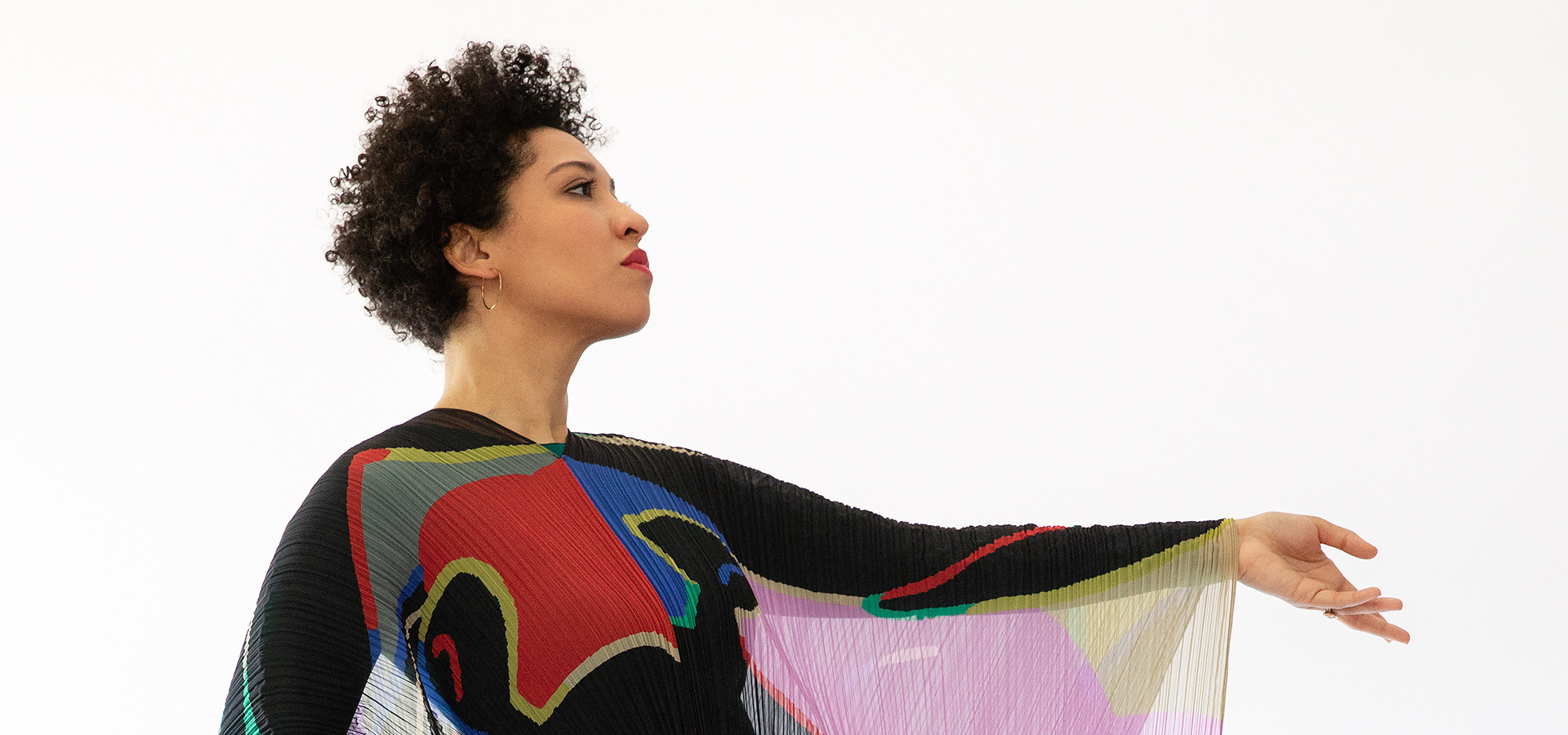
Julia Bullock is the 2024–25 season Artist in Residence at Cal Performances. Her first appearance in that capacity is in a collaboration with her colleagues in the American Modern Opera Company (also known as AMOC*, of which she is a founding member) for a boldly original staged production of Messiaen’s Harawi, which was premiered in the summer of 2022 at the Festival Aix-en-Provence and subsequently toured across Europe. The performance takes place on 27 September at Zellerbach Hall.
I wrote about this extraordinary artist and her fascination with Harawi for Cal Performances:
The first time Julia Bullock heard Harawi, Olivier Messiaen’s song cycle from 1945, she recalls that both the poetry and the music “shook me to a fundamental core … even though I didn’t fully grasp the depths of the content and the references on first listen….”
In the years since Garth Greenwell published his 2016 debut novel, What Belongs to You, the 46-year-old novelist, poet, critic, and teacher has established himself as one of the most distinguished American writers at work today.
Garthwell, who at one point studied voice at the Eastman School of Music, is deeply knowledgable about opera and also writes fascinating and highly worthwhile music criticism. His own work will now be the subject of literary and music criticism alike, thanks to composer David T. Little’s adaptation of What Belongs to You to the opera stage.
Little adapted his own libretto from Garthwell’s text and has collaborated with the legendary choreographer Mark Morris as stage director and conductor Alan Pierson to reframe the novel for the opera medium.
What Belongs to Me “tells the story of a man caught between longing and resentment, unable to separate desire from danger, and faced with the impossibility of understanding those he most longs to know,” says Garthwell. Adds Little: “The story is specific and personal, but the experience Greenwell describes is universal: the search for self and the desire to belong amidst loneliness and enduring heartbreak.”
In his New York Timespreview, Joshua Barone describes Little’s musical response to the material: “There are flashes of rock, but it is largely inspired by Monteverdi and Schubert, as well as John Dowland, Giovanni Valentini and Gérard Grisey, taking cues from the Renaissance through the 20th century. There is even some Britten. Little called it all ‘a constellation of influences’ shaped by the material.”
“At its most shocking, Little’s music calls on the instrumentalists of Alarm Will Sound to sing, acting as a chorus to embody the hustler Mitko and the protagonist’s father during two pivotal, terrifying moments.”
Simone Menezes and her adventurous Ensemble K have created a concert project using a new chamber arrangement of Rimsky-Korsakov’s Scheherazade music, into which are woven excerpts from One Thousand and One Nights, ancient love poetry, and newly written dialogue to provide a contemporary look at the legendary character.
Boulez Saal in Berlin is presenting the live performance premiere on 26 September, in cooperation with Cartier.
I interviewed Simone Menezes and translator Yasmine Searlefor the program book. The project has also been released as an album — more info here.
This weekend, Mary D. Watkins‘s new opera Is This America?receives its premiere at Dorchester’s The Strand Theatre in a production presented by the activist performing arts company White Snake Projects(WSP), which was founded by Cerise Lim Jacobs. The 85-year-old Watkins has blazed the trail for other Black women composers in the field of opera.
This new, 90-minute-long, fully-staged opera celebrates the life and legacy of civil rights activist Fannie Lou Hamer and features performances by the Massachusetts-based Victory Players chamber orchestra alongside a small ensemble of singers; mezzo-soprano Deborah Nansteel (Met Opera, Lyric Opera of Chicago) will create the lead role of Hamer. Haitian American queer woman Pascale Florestal stage directs. Tickets available here.
(Content Warning: Is This America? contains very strong, racially-loaded language, and references to violence.)
Is This America? brings to life one of the most turbulent periods in American history to tell the story of Hamer, the great Mississippi activist who galvanized the registration of Black voters in her home state despite overwhelming odds, including death threats, beatings, and rejections by her own constituency.
The title of the work is taken from the iconic speech that Hamer made 60 years ago before the 1964 Democratic National Convention, when she petitioned the Convention to give her newly formed political party, the Mississippi Freedom Democratic Party (MFDP), seats at the Convention and to recognize the MFDP as the legitimate representative of the people of Mississippi. A year later, President Johnson signed the Voting Rights Act of 1965, which outlawed discriminatory voting practices.
Is This America? is 15 years in the making. A chamber orchestra version was workshopped by the Oakland Opera Company in 2009. The first concert version was performed by the Mount Holyoke Symphony Orchestra in Massachusetts in 2014. This WSP production marks the second Watkins premiere with the company; it commissioned her virtual opera I Am A Lifer, which is part of Death by Life (2021), the Company’s musical response to the death of George Floyd.
“My goal is to show the dignity and strength with which Fannie Lou Hamer and her fellow civil rights workers carried themselves in spite of the terror and dehumanizing treatment they were subjected to and to convey the great spirit of love that bound them together,” says Watkins. “Their story deserves to be told in a grand way – a way befitting the souls of the people who marched in the streets in the hot sun with such determination, singing through their fears while their opponents spat upon them, beat them, kicked them, called them vile names, terrorized their families, and imprisoned them. Is This America? is my salute to these beautiful, courageous people. I chose to tell Fannie Lou Hamer’s story as an opera because I wanted to use an art form that would capture the power and sweep of her life. I wanted to give full voice to this amazing African-American female political leader.”
In Vienna’s Leopoldstadt, 150 years ago today, was born one of the 20th century’s defining figures, Arnold Schoenberg. The Pierre Boulez Saal in Berlin is paying homage with an all-Schoenberg program this evening by the Boulez Ensemble, with Zubin Mehta conducting the Chamber Symphony, Op. 9, and Pierre lunaire (with Mojca Erdmann as the “reciter”) — the latter having been first performed in 1912 just a few km from the Boulez Saal.
Here’s my program essay (you can find my colleague Wolfgang Stähr’s excellent contribution in German here):
It was exactly 150 years ago, on September 13, that Arnold Franz Walter Schoenberg was born in Vienna. (His birthday fell on a Sunday in 1874, though the triskaidekaphobia-stricken composer did die on Friday 13th nearly 77 years later.) Yet even from this distance in time, Schoenberg’s name continues to strike its own superstitious fear among those conditioned to reject his music even without listening to it.
Tazewell Thompson’s “Jubilee,” about the Fisk Jubilee Singers, will have its world premiere at Seattle Opera Oct. 12-26. (Jeffrey Henson Scales)
My picks for classical events in Seattle in the fall:
No matter how many other leisure-time options compete for our attention, there really is nothing to replace the connection that happens at a live performance. Fortunately for classical music lovers, local organizations are busting out a new season of enticing variety, from early music innovators to contemporary composers inspired by the findings of science. continue
For Gramophone‘s September issue, I reviewed Oliver Leith’s Last Days, based on Gus Van Sant’s 2005 film riffing on Kurt Cobain’s suicide.
‘A place where flecks of magic are chipped or hacked from mundanity – where the familiar and domestic are heightened or warped’ is how Oliver Leith sums up what he wanted to convey with Last Days, his debut opera…
It’s been a long wait … But Seattle Symphony has finally secured its next music director. Xian Zhangwill begin her five-year tenure at the start of the 2025-26 season, it was announced today. A fantastic choice.
This season, Zhang can be heard in two programs with SSO: Holst’s The Planets (paired with Billy Childs’s saxophone concerto Diaspora, with soloist Steven Banks) on March 27-20, 2025; and a Beethoven-Prokofiev program June 12-15, 2025 (with Hilary Hahn as the soloist in Beethoven’s Violin Concerto).
From the press release:
The Seattle Symphony is pleased to announce Xian Zhang as its next Music Director, beginning a 5-year contract in the 2025/2026 season. Zhang is a long-term collaborator with the Symphony, debuting at Benaroya Hall in 2008. Zhang has a special relationship with Seattle; she supported the Seattle Symphony throughout the height of the pandemic as one of the first conductors to return to the stage with our orchestra. Throughout her career, Zhang has gained international acclaim, most notably in her eight seasons as Music Director of the New Jersey Symphony and in her recent appearances as guest conductor at the Metropolitan Opera, Philadelphia Orchestra (with which she won a Grammy in 2023), Los Angeles Philharmonic and Boston Symphony Orchestra, among others. Zhang also holds the positions of Artistic Ambassador of Melbourne Symphony Orchestra and Conductor Emeritus of Orchestra Sinfonica di Milano.
Her commitment to advancing diversity, equity and inclusion in the arts has been a hallmark of her career. She has made a point of raising the profile of music composed by women and people of color while being a trailblazer herself. Zhang is the New Jersey Symphony’s first woman Music Director and the first woman to serve as Music Director of any Italian symphony orchestra. She will now be the first to lead a major West Coast orchestra.
Zhang brings boundless energy to the stage, inspiring a powerful sound and a strong connection with both musicians and audience. Most recently, she conducted the Seattle Symphony in performances of Carl Orff’s Carmina burana and Aaron Copland’s Appalachian Spring, filling the house and impressing audiences with inspired pairings of well-known works with cutting-edge contemporary pieces. Zhang performs at Benaroya Hall twice during the 2024/2025 season as Music Director Designate. First, on March 27, 29 and 30, to conduct Holst The Planets: An HD Odyssey, also featuring saxophonist Steven Banks in a new concerto by American composer Billy Childs. Next, she conducts Hilary Hahn Plays Beethoven, on June 12, 14 and 15, featuring Beethoven’s Violin Concerto and Prokofiev’s triumphant Fifth Symphony.
“I am overjoyed to be the next Music Director of the Seattle Symphony and continue creating music with this exceptional orchestra,” said Xian Zhang, Seattle Symphony Music Director Designate. “For many years, I have been inspired by the Symphony’s incredible talent and keen desire to bring new music to the stage. Joining the Seattle Symphony now feels like coming home. From my 2008 Benaroya Hall debut to joining the orchestra in 2020 for its careful return to live performances, I have long felt a special bond with these incredible musicians. Visiting Seattle has always been a treat as well, for its beautiful landscapes, and of course, to see the clear devotion audiences have for the local arts community. As Music Director, I look forward to connecting with audiences on a deeper level, experiencing inspiring concerts together and discovering new music at Benaroya Hall, one of my all-time favorite performance halls to conduct in. Thank you to all of the wonderful people I have been able to work with at the Seattle Symphony so far — musicians, board members and administrative staff. I look forward to a wonderful future together.”
“Today we are witnessing history being made with the appointment of Xian Zhang as the Music Director of the Seattle Symphony,” said Seattle Symphony President & CEO Krishna Thiagarajan. “Her passionate musicianship is inspiring, her technique is clear and precise and the resulting performances captivate our audiences in heart and soul. Xian was among the first conductors to return to the stage with our orchestra during the COVID-19 pandemic. Since then, she has forged strong bonds here in Seattle. In fact, her concerts rank among the highest-attended performances since audiences have returned to Benaroya Hall. As Seattle has grown into an important world city and gateway to the Pacific, Xian’s diverse expertise across Asian, Oceanian, European and American orchestras and music schools — from Beijing to New York, Melbourne to Milan — makes her the perfect choice to lead the orchestra in this new era. I am excited by the possibilities and personally could not be happier to gain such a wonderful colleague for our organization. I want to thank the Seattle Symphony search committee, musicians, staff and audiences, who all played a crucial role in this process, as we welcome Xian and her family to the Pacific Northwest. What seemed like a dream a few months ago has now become a reality. Welcome, Xian Zhang!”
“Xian Zhang’s outstanding performances with the orchestra during this search process easily made her a leading choice for Music Director of our Seattle Symphony,” said Susan Detweiler, MD, Seattle Symphony Music Director Search Committee Chair and Board Member. “Our musicians immediately responded to the depth of Xian’s artistry, producing performances that thrilled both us and the audience, making the Board confident that her extensive experience and deep understanding of classical repertoire will further enhance the Symphony’s artistic development. We eagerly await her return to the Seattle Symphony’s podium in March.”
One of those nights — my insta-review of Sir Simon Rattle’s return to Lucerne, this time with the Bavarian Radio Symphony Orchestra, to perform Mahler’s Sixth Symphony:
Last night’s interpretation of Mahler’s Sixth by Sir Simon Rattle and the Symphonieorchester des Bayerischen Rundfunks at Lucerne Festival ranks with the great ones. Rattle has obviously put his all into his recent grapplings with a work that is loaded with special significance for him. (He chose it for their recent North American tour in spring.) This was my first time hearing Rattle conduct the Bavarians, and they’ve clearly forged a strong bond. Their sound has a wonderful darkness and even something almost raw that is burning even at the lyrical. Not a trace of sentimentality – the cowbells actually worked.
Rattle lingered over the “daydreams” embedded in the overall framework. The realization that they insubstantial pageants, fading, happens gradually and was made to underline the tragedy. The Andante (placed, importantly, second in order in Rattle’s interpretation) was especially stirring and emotionally authentic.
Rattle navigated the continual shifts in perspective in the Scherzo and in the vast, unfathomable finale with a translucent attention to detail. The twofold hammer strokes (the third left unstated) seemed a plausible continuation, through the orchestra, of the dramatic thunder-lightning storms of the night before. The final chord’s bitter fadeout was devastating, and it seemed no one wanted to acknowledge it was simply over — was almost afraid to. Immense applause, and Rattle gracefully trying to indicate that he wasn’t begrudging the audience an encore — but that it was simply impossible to continue playing after this. (Fun fact: Not until 1947 did Mahler’s Sixth have its US premiere.)




 MEMETERIA by Thomas May