MEMETERIA

Icon

Arts writing by Thomas May

A ‘Twilight’ With Teeth: Atlanta Opera’s First-Ever ‘Ring’ Comes Full Circle

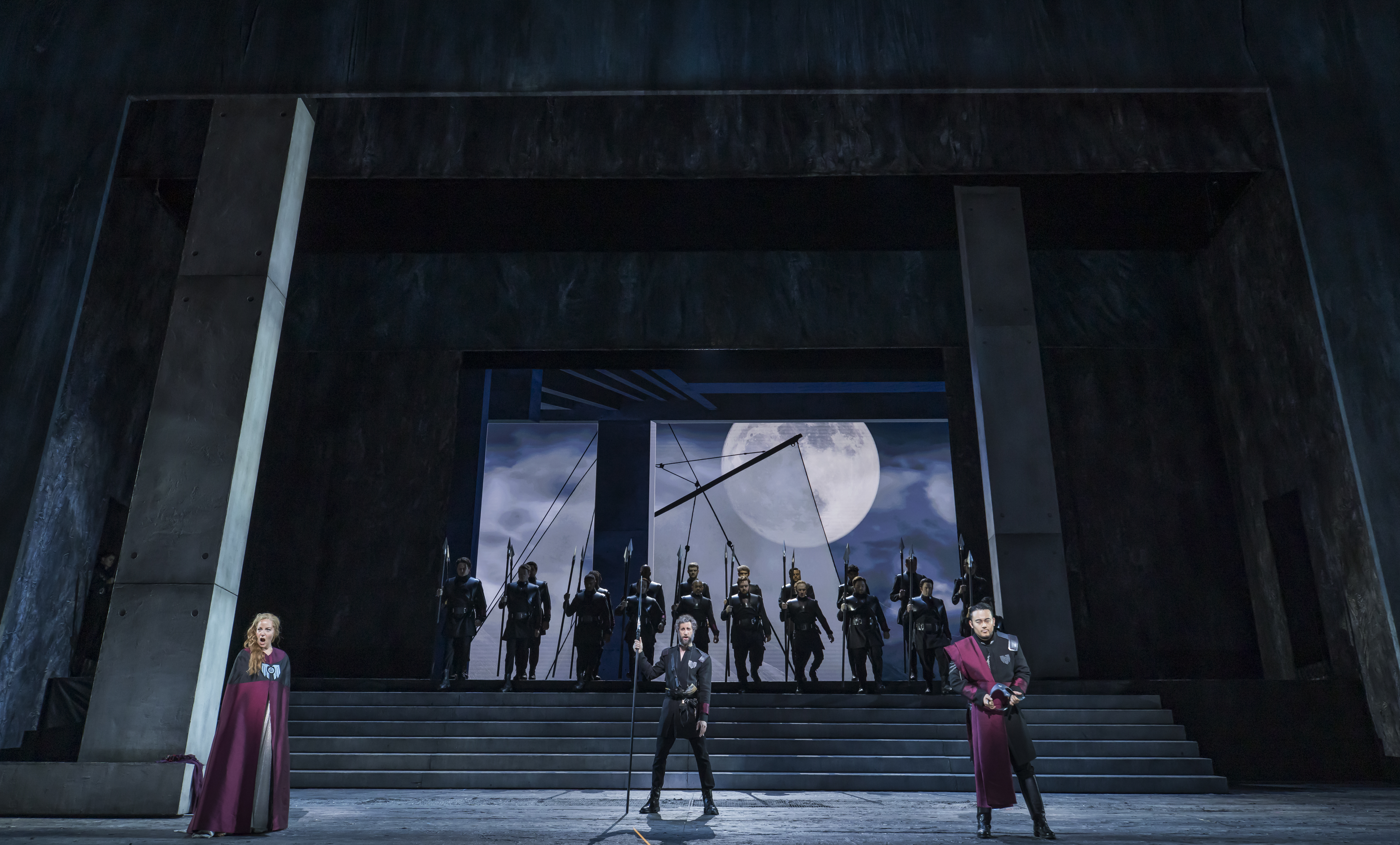
Lise Lindstrom as Brünnhilde, David Leigh as Hagen, Le Bu as Gunther; photo (c) Raftermen

With Götterdämmerung – billed by Atlanta Opera in English as Twilight of the Gods – the company completed the first Ring cycle in its history. The milestone also appears to mark the first fully staged Ring in the U.S. Southeast. Having missed the earlier installments, I can’t speak to the arc of the cycle as a whole. But taken on its own terms, this final drama was a formidable achievement: not only ambitious but lucidly told and gripping throughout. I could hardly imagine more persuasive evidence of the company Atlanta Opera has become under its general and artistic director Tomer Zvulun.

Earlier that day, to members of the Music Critics Association of North America gathered for their annual conference, Zvulun described the Ring as the kind of summit goal that “jolts the whole organization into a different metabolism.” On this evidence, the jolt has taken. This was hardly a matter of a company checking off the institutional trophy box.

The production had an added charge in that it was dedicated to the memory of Speight Jenkins, the former general director of Seattle Opera, who had died on May 30, opening night — a striking coincidence, given Jenkins’s deep association with Wagner and his importance as the mentor Zvulun credits with introducing him to that world. Atlanta Opera was thus marking its own arrival as a Wagnerian force while honoring one of the figures who helped define what Wagner performance could mean in this country.

Zvulun’s own relationship to Wagner is deeply conflicted. He described the music as something “spiritual,” “like a portal that opens up,” while also acknowledging his ambivalence as an Israeli Jewish artist confronting Wagner’s anti-Semitism. This was not reverential Wagner worship but Wagner understood as dangerous inheritance.

Erhard Rom’s scenic and projection design, with costumes by Mattie Ullrich and lighting by Robert Wierzel, imagined the Gibichungs’ world as sterile and oppressive, with overtones of fascism but without reducing the proceedings to a preachy, one-note allegory.
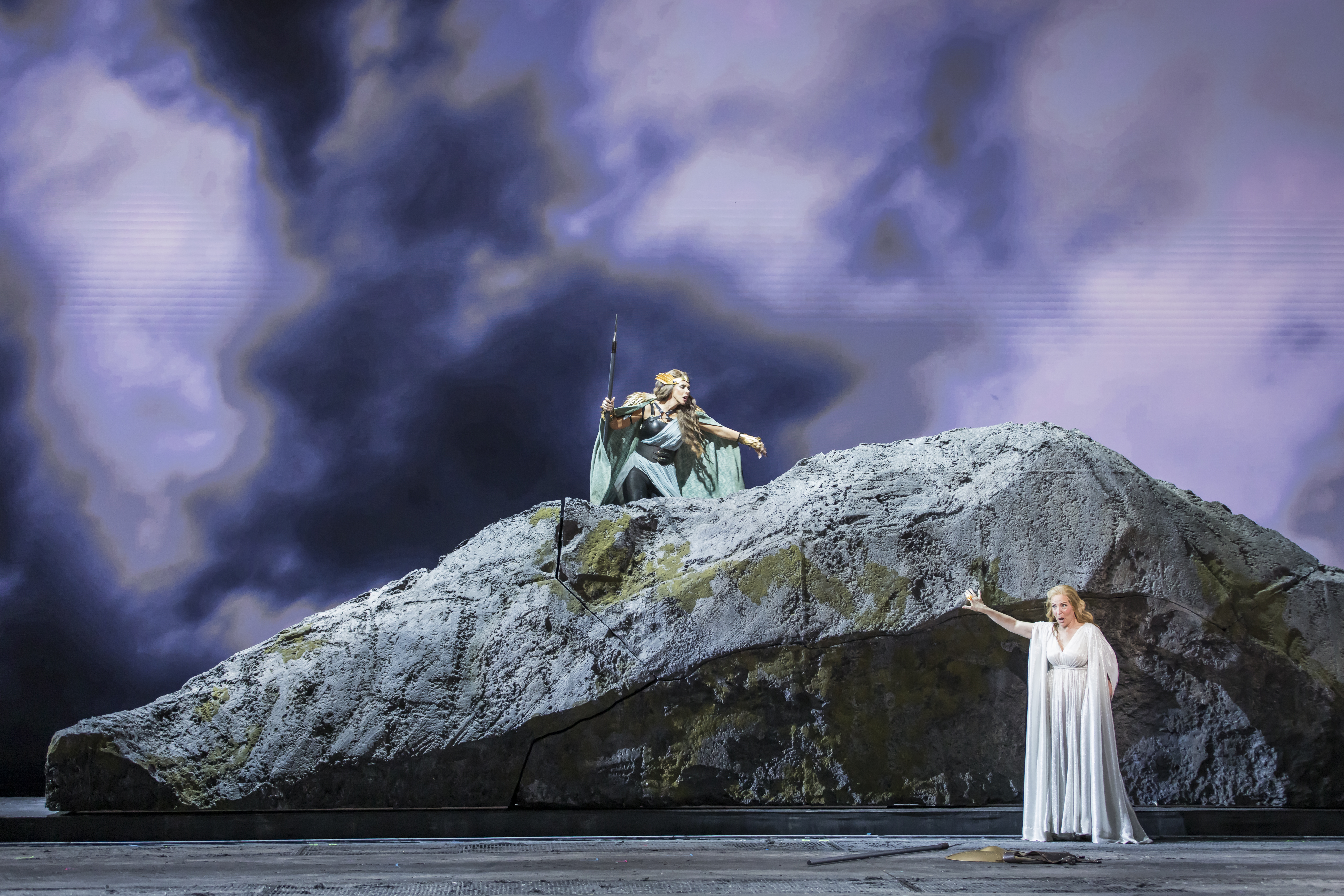
Tamara Mumford as the Valkyrie Waltraute brings a message to Brünnhilde, sung by Lise Lindstrom; photo (c) Raftermen

The integration of physical scenery with an 80-by-40-foot LED wall was impressively persuasive in using digital space to extend the spare theatrical architecture. The Norns scene unfolded amid pale, ruin-like forms suggesting a collapsed library or archive, as the rope of fate merged with the Norns’ own streaming hair. Brünnhilde’s rock was conceived in a more literal mythic register: a hulking crag before a cloud-churned LED sky.

Especially effective was the cold and coercive atmosphere of the Gibichung palace. Massive physical piers and blackened framing opened onto projections of receding slabs, catwalks, windows, and voids. Hagen’s nocturnal scene acquired a chamber-horror intimacy, with Alberich creeping out of the upstage shadows. In Act III, the Rhine seemed to return as an underworld, bathed in yellowish light and now degraded almost beyond hope.

Zvulun’s chief strength as stage director is narrative clarity. He did not solve every dramaturgical knot in Götterdämmerung – as if that were possible – but he made its contradictions feel active rather than embarrassing.

The pivotal deception at the end of Act I, for instance, is often simply taken at face value. Siegfried, supposedly the uncorrupted hero, participates in a grotesque fraud against Brünnhilde, even if “under the influence” of a magic potion. Gunther agrees to the scheme, then finds himself humiliated by it. Gutrune, often reduced to a naïvely willing participant, becomes implicated in a crime she only partly understands.

Zvulun’s staging treated these contradictions not as plot problems to be explained away, but as evidence of a world already morally compromised. Brünnhilde’s devastating humiliation brings the drama’s moral rot into the open as shame.
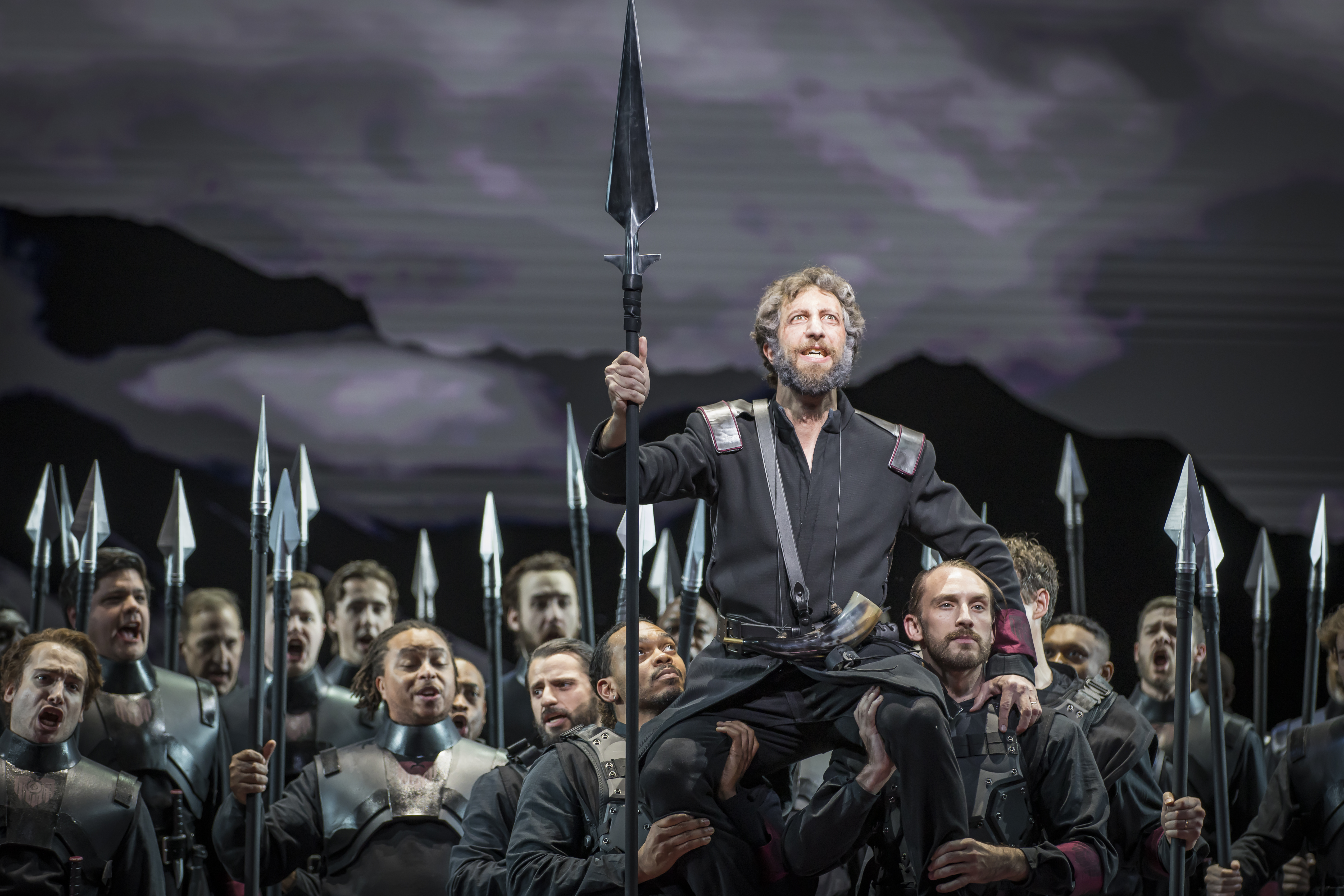
David Leigh as Hagen rides on the shoulders of his vassals; photo (c) Raftermen

But shame is only one part of the machinery. Around it, Zvulun traced a wider system of grievance and revenge: Gunther’s sexual and political disgrace, Gutrune’s dawning recognition that she has been both agent and pawn, Alberich’s hatred still seething through the next generation, and Hagen’s poisonous need to act on it. In the Ring, greed for power is the great motivating force set against love. Here, though, vengeance felt even more combustible: power’s most intimate, poisoned form – made literal in the revenge motive that binds Alberich’s command to Hagen’s obedience.

Zvulun emphasized this by giving Act II a faint revenge-tragedy charge. Alberich’s nocturnal apparition to Hagen already has a Hamlet-like structure: the father’s ghostly command, the son’s burden of vengeance, the inheritance of an old grievance. With Hagen cradling a metallic orb that inevitably suggested Yorick’s skull, Zvulun made the parallel hard to miss. David Leigh’s Hagen had the right physical profile for this idea – tall, thin, watchful, exuding sadistic glee – he even snarled with a nihilistic laugh after Siegfried’s murder, echoing Alberich’s spiteful laugh upon grabbing hold of the gold in Das Rheingold‘s opening scene. Vocally, however, I wanted just a bit more weight and color in the depths, though he effectively projected an almost charismatic menace.
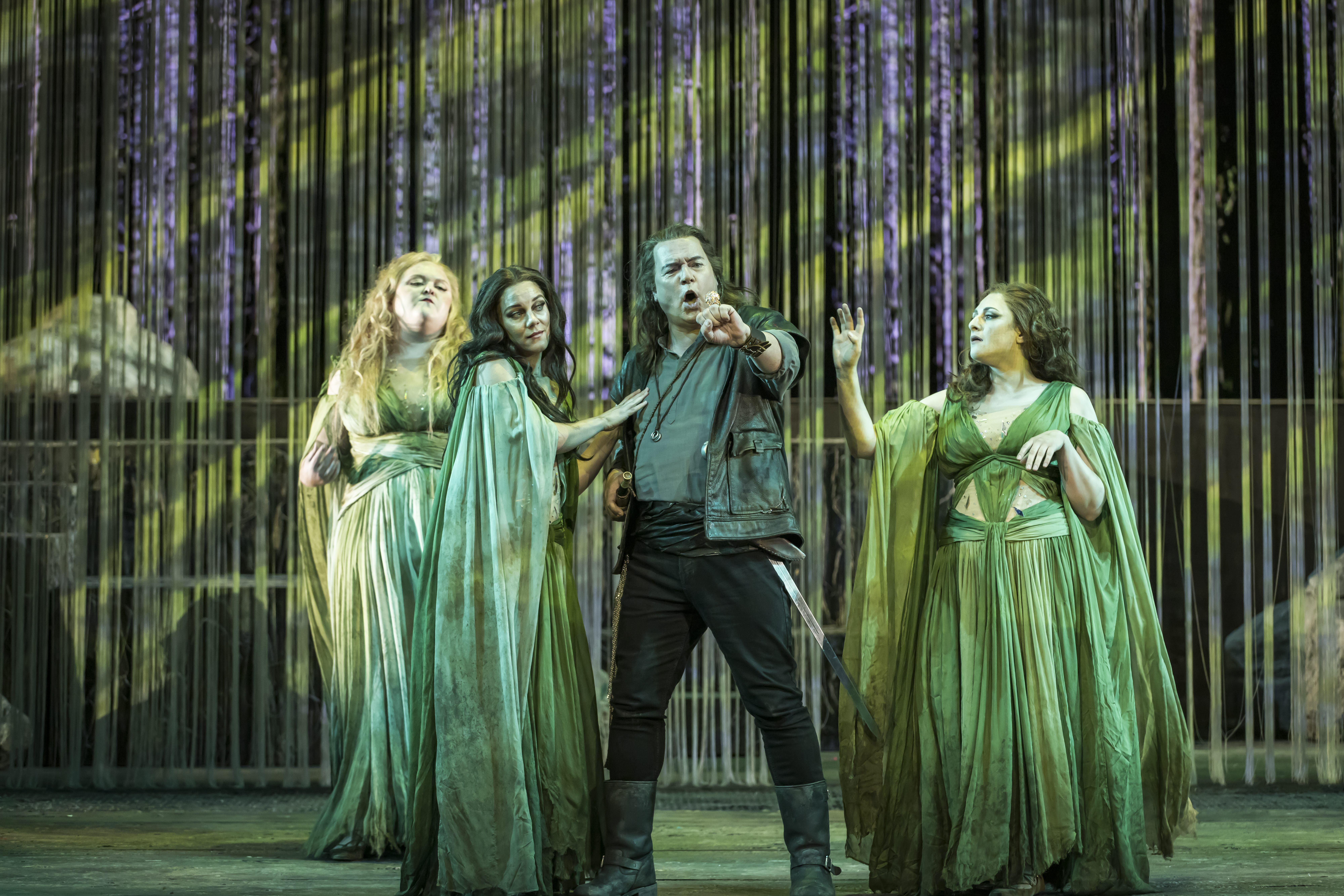
Stefan Vinke as Siegfried shows the ring of power to the Rhinemaidens: from left, Gretchen Krupp (Flosshilde), Cadie J. Bryan (Woglinde), and Alexandra Razskazoff (Wellgunde); photo (c) Raftermen

The acting was often unusually detailed. Stefan Vinke’s Siegfried was vocally the real thing: tireless, bright, fearlessly energetic, and with an exceptionally extended high C in the Act III hunting scene that seemed to confirm the character’s fatal confidence. His death scene, for once, seemed less stagey, a careful diminuendo of the life force as he continued his memory of awakening Brünnhilde.

Lise Lindstrom, who impressed me with her recent Dallas Brünnhilde (just released on Delos), offered a multidimensional portrayal. In the Prologue, she gave the reawakened Valkyrie’s love a sensual warmth without making it merely private. Costumed in white against the darker world around her, she suggested something more elemental: a primal, nurturing force whose devotion still had the power to change history. In Act II, even at her angriest, Lindstrom did not reduce Brünnhilde to vengeance. Her fury was shadowed by disbelief and grief, as if some part of her still could not accept what had happened and did not truly want to betray Siegfried in return. The Immolation was surprisingly intimate rather than merely monumental. If there were moments when the voice was submerged, the performance’s psychological concentration held.
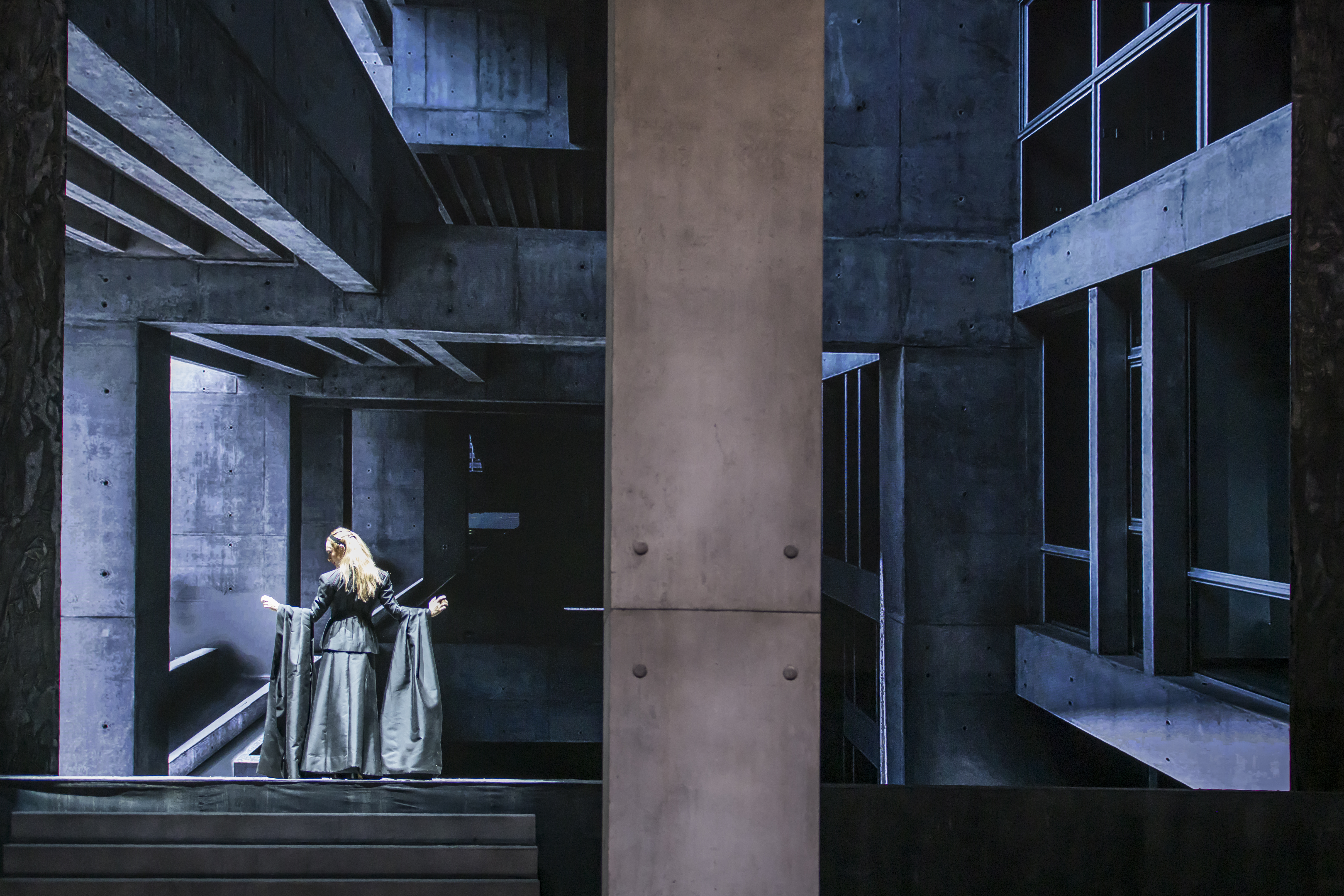
Sylvia D’Eramo as Gutrune; set and projection design by Erhard Rom

Among the Gibichungs, Sylvia D’Eramo was a revelation as Gutrune, singing with a poignant vulnerability that made the character’s moral trajectory unusually clear. In Zvulun’s staging, she was naïve and susceptible at first, then increasingly aware that she had been used as an instrument in a catastrophe. Her third-act solo scene waiting vainly for Siegfried’s return became one of the evening’s unexpected highlights – a study in suspended dread. As brother Gunther, Le Bu had vocal thunder, though dramatically he remained too fixed in grim solemnity; the scowl told us something, but not everything.

The Norns became strongly differentiated personalities rather than blending into generic fate machinery, with Tamara Mumford’s First Norn especially striking. As Waltraute later on, she and Lindstrom did not quite ignite the scene’s desperate sibling chemistry, though the encounter still clarified Brünnhilde’s frighteningly absolute devotion to Siegfried.

As for the Rhinemaidens, their scene ranks among the finest staged versions I have seen. Instead of functioning as a perfunctory attempt to pry the Ring from Siegfried, it became a reversal of the original seduction game from Rheingold. Each step mattered, and Siegfried’s inability to understand what was being offered – or what he was refusing – became another stage in his doom.

Zvulun’s staging was strongest when it trusted such consequences to accumulate. The gradual darkening of Act III, with Siegfried’s narration closing in under a full moon, gave his murder and the Funeral March a satisfying inevitability. A particularly effective touch came when Hagen’s own men began to recoil following the murder, sadly joining the march as if only then grasping the enormity of what their leader had led them into.

The production was less persuasive when it tried to add apocalypse from the outside. There were occasional projection glitches — odd white-noise or hallucination-like eruptions in a corner of the LED wall – and the added catastrophic sound effects in the Immolation felt like blockbuster-trailer overkill, covering the orchestra at exactly the wrong moment. Wagner needs no help sounding apocalyptic.
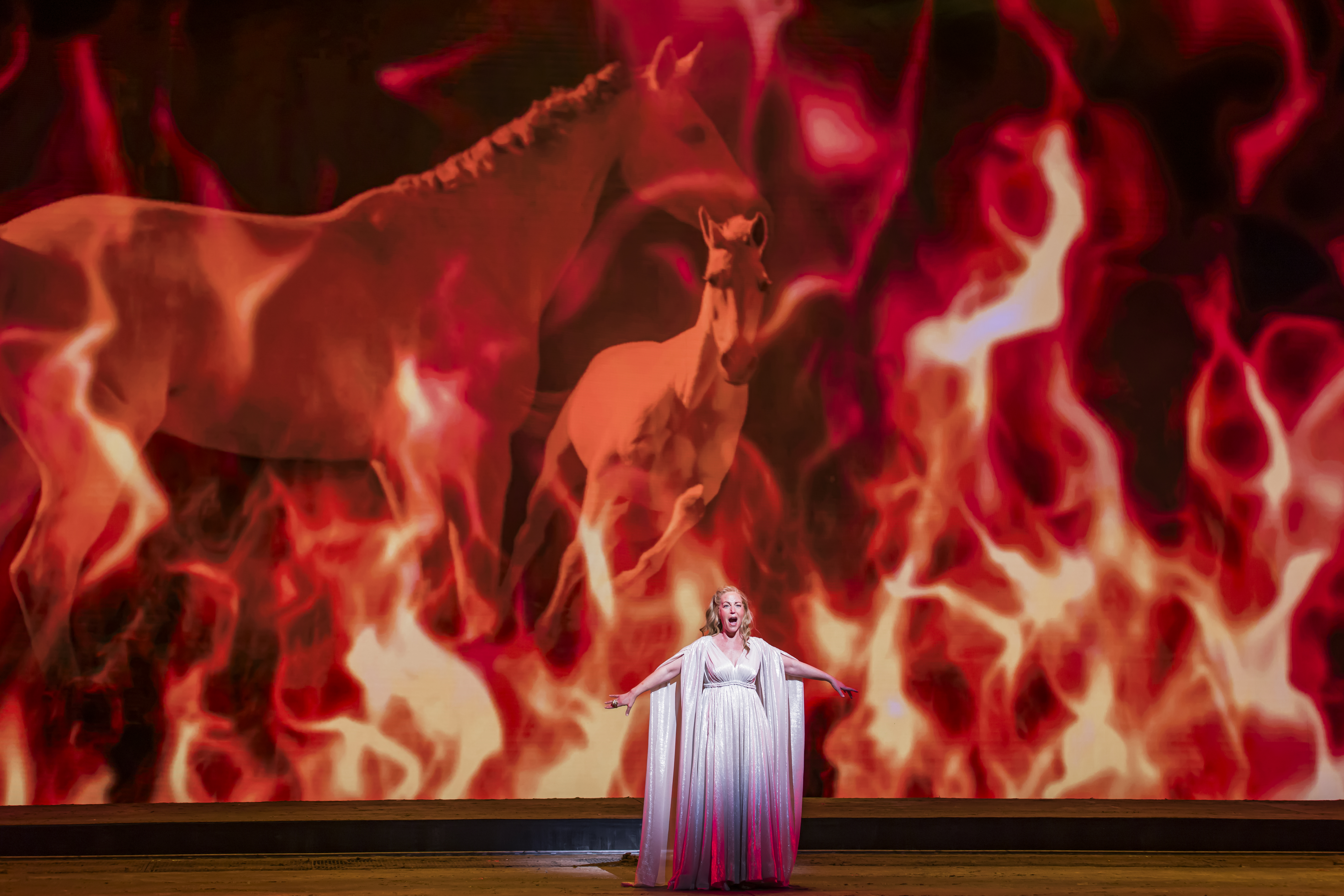
Lise Lindstrom as Brünnhilde; photo (c) Raftermen

Roberto Kalb conducted with clarity and sensitivity, and he delineated the narrative with admirable, unfussy directness, drawing excellent playing from the orchestra. In this score, I sometimes wanted a darker undertow and more ominous attack – especially in Hagen’s music – as well as greater elasticity in the phrasing. The Cobb Energy Performing Arts Centre’s acoustics did not always help; a persistent mechanical whir, apparently from the video cameras, intruded at quiet moments and added an unwelcome layer of noise. Still, Kalb understood the architecture, and the final return of Brünnhilde’s glorification motif possessed real force.

Zvulun’s staging told the story with unusual confidence, making the drama’s moral and symbolic structures legible without flattening them. This Twilight of the Gods registered like a company expanding its own imagination through Wagner.

Review (c) 2026 Thomas May – All rights reserved

Filed under: Atlanta Opera, conductors, directors, Ring cycle, Wagner, , , , ,

San Francisco Opera’s “La Bohème” Paints Love in Hindsight

Nicole Car as Mimì and Evan LeRoy Johnson as Rodolfo in Puccini’s “La Bohème.”
Photo: Matthew Washburn/San Francisco Opera

Since its founding in 1923, San Francisco Opera has maintained a love story of its own with La Bohème. The company actually opened with a performance of the beloved classic, cementing its identity with Puccini’s story of young love and youthful illusions. One thing this summer’s revival makes clear: when done persuasively, La Bohème seems immune to aging, undiminished in its emotional pull. 

John Caird’s production, which originated in 2012 and first arrived at the War Memorial Opera House in 2014, with a revival in 2017, was presented as part of this summer’s shorter-than-usual season alongside a gripping interpretation of another great opera by a youthful artist in the process of making pivotal discoveries about what opera can do: Idomeneo, by the 20-something Mozart. In this revival of Caird’s original staging by Katherine M. Carter, the chemistry between the two main couples and among their circle of close friends gained a dramatic clarity that was believable. 

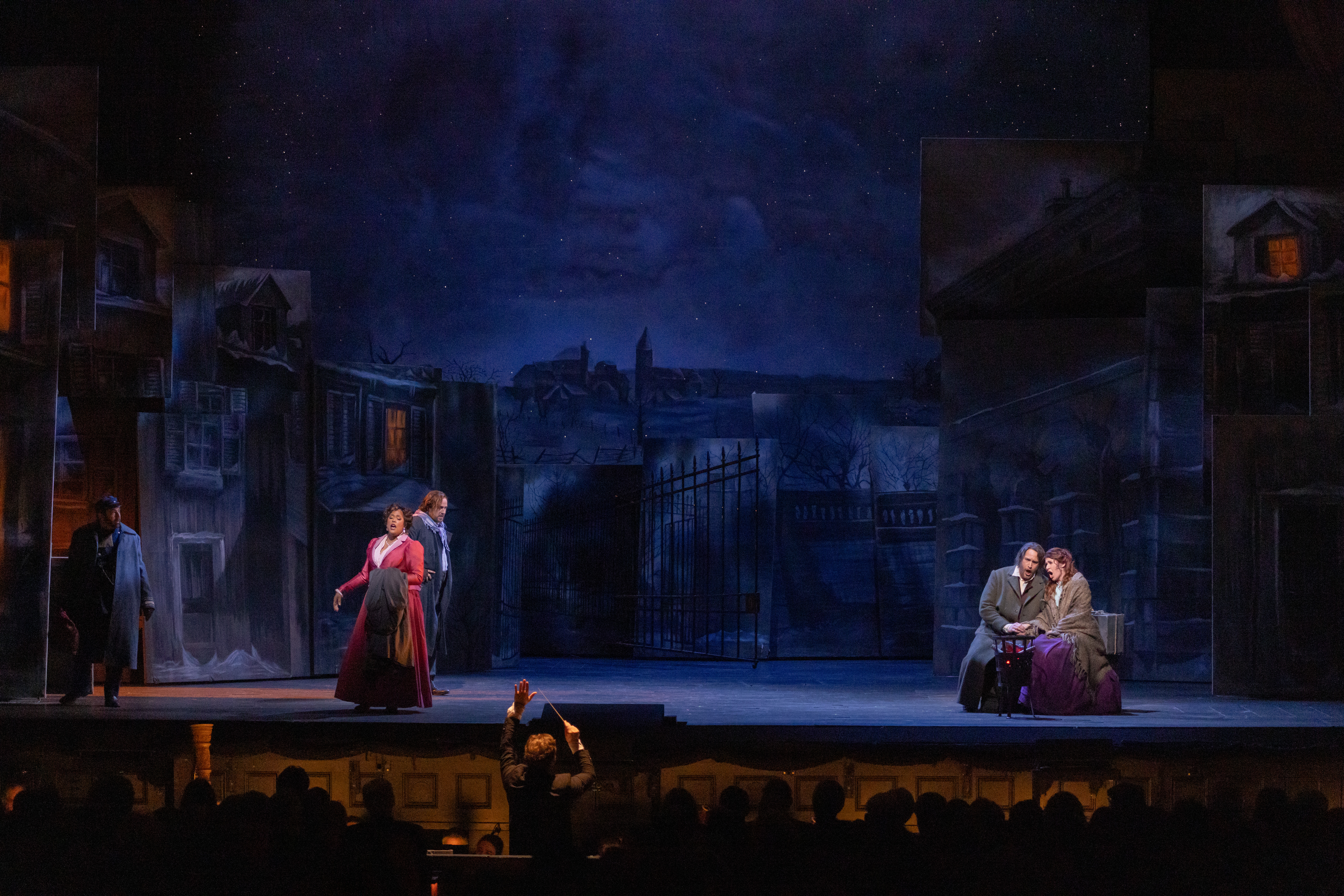
Act II of Puccini’s “La Bohème.”
Photo: Cory Weaver/San Francisco Opera

A visual metaphor for the intensity of their dreams and idealism emerges in designer David Farley’s sets, which seem filtered through the imagination of the painter Marcello – as if memory itself were the canvas. Instead of a cosy view of the Parisian skyline, the distinctly crowded and cluttered garret is framed by panels that seem to be his own creation, works in progress. In the crowd scene at Momus, the wintry city is populated by still more painted façades that verge on abstraction, Cubistally tilted as if to hint at the transformation of experiences recollected from a distance, as they become stylized, mythologized. While also nodding to the aesthetic of Toulouse-Lautrec and the Belle Époque, the visual world inhabited by this Bohème wasat times almost dreamlike, even surreal.

Puccini’s achievement in this opera, bolstered by his collaboration with librettists Luigi Illica and Giuseppe Giacosa, gains traction from the varying manifestations of community among these young people: the cramped garret coming alive with roughhousing banter and energy and the glittering Café Momus brimming with a chaotic joy and sense of possibility against all the odds.

Ramón Tebar conducts the San Francisco Opera Orchestra with Brittany Renee as Musetta, Lucas Meachem as Marcello, Evan LeRoy Johnson as Rodolfo, and Nicole Car as Mimì in Puccini’s “La Bohème.”
Photo: Matthew Washburn/San Francisco Opera

Much has been written about La Bohème as an opera of Romantic nostalgia, but this production underscores its deeper structure as a work of memory. Puccini’s savvy recapitulation of musical material – most movingly in the final act’s return to the music of Mimì and Rodolfo’s first meeting – carried incalculable expressive weight in Ramón Tebar’s sensitively detailed conducting, a highlight of the production. With his fine ear for balance and unwavering attention to the colors and harmonic richness of Puccini’s score, he had the orchestra paint in layered brushstrokes of timbre, shaping phrases with warmth and elasticity. 

I heard the “alternate” cast on June 18. As Rodolfo, tenor Evan LeRoy Johnson made a welcome impression with his hefty, burnished tone and grounded stage presence. His rapport with Australian soprano Nicole Car as Mimì allowed him to trace an arc from self-conscious artist to grief-stricken lover. Car, in turn, conveyed Mimì’s innocence and vulnerability without reducing her to frailty. Even in the character’s earliest moments, there was a quiet self-awareness beneath the surface. Car uncovered more psychological nuance than is often seen in the third-act encounter with Rodolfo, singing with radiant control across the range. Her resonant low notes lent unexpected weight to a role sometimes misconstrued as a passive victim.  

Evan LeRoy Johnson as Rodolfo, Nicole Car as Mimì, Brittany Renee as Musetta, and Lucas Meachem as Marcello in Puccini’s “La Bohème.”
Photo: Matthew Washburn/San Francisco Opera

Filling in for the originally announced Will Liverman, baritone Lucas Meachem sang Marcello for the full run, bringing the painter to life with vocal vitality and a sharply etched dramatic immediacy through telling details, like his hint of jaded disdain when he first interacts with Mimì at Momus. He emerged as the opera’s emotional linchpin, bridging the bohemians’ slapstick and the lovers’ tragedy. His scenes with Rodolfo had the ease of real camaraderie – and rivalry.

As Musetta, soprano Brittany Renee lit up the stage with a performance abounding in vocal charisma and larger-than-life presence that also amplified the somewhat underworked Toulouse-Lautrec angle. Her “Quando me’n vo’” was anything but coquettish posturing but a declaration of unapologetic vitality. At the same time, she allowed a genuine compassion for Mimì to emerge with affecting sincerity in the deathbed watch.

There was much to enjoy in the detailed work of the companions as well. Bogdan Talos made a dignified and ultimately touching Colline, keeping a mostly detached air until the death scene released a surge of directness. His “Vecchia zimarra” felt like an intimate farewell to youth itself. Another highlight of the production was Samuel Kidd’s vividly observed portrayal of  Schaunard (the one actual musician among these Bohemians), especially in his gleefully morbid story of how a dead parrot brought a windfall – a comic moment that, like so much in Bohème, holds a tragic echo in hindsight. Dale Travis brought seasoned comedic timing to his dual character roles as the landlord Benoit and sugar daddy Alcindoro. The SF Girls and Boys Choruses added charm to the Café Momus scene. 

But what gave this performance its distinctive character was the sensitive, detailed conducting of Ramón Tebar. The Spanish conductor proved a superb collaborator – very much a singers’ conductor – with an ear for balance and a painter’s attention to color. He brought out the harp’s glitter, the dark undertow of strings beneath bright melodies, and the often-overlooked harmonic richness of Puccini’s score.

As Larry Rothe insightfully writes in his beautiful program essay, Rodolfo, in retrospect, is not a novice in love but an artist transformed by a singular experience: “He hears himself pleading his case to Mimì in a new voice, honest and unguarded … Mimì, as Rodolfo recalls her, will always illuminate the memory of those rough days … those days that, for all their hardship, will always bear the tender ache suggested in that pivotal rising and falling fourth [of Rodolfo’s motif].”

That “tender ache” lingered well after Rodolfo’s cries of despair in this wonderful revival, reminding us not just of the pain of loss, but of how art redeems it – by turning memory into music.

Filed under: Puccini, review, San Francisco Opera, , , ,

Seattle Opera Announces 2025-26 Season

Today Seattle Opera announced the lineup for the company’s first full season with General and Artistic Director James Robinson at the helm.

I’m especially pleased to see Gregory Spears’s Fellow Travelers – more timely than ever – among the three company premieres. Last summer’s Santa Fe Opera season included The Righteous, a collaboration between Spears and poet Tracey K. Smith, and the production knocked me out. Fellow Travelers is set during the McCarthy era and is based on the Thomas Mallon novel about the “Lavender Scare” that affected workers in the federal government.

Budget tightening obviously plays a big role here, but the rest of the season is quite a mixed bag:  Seattle Opera’s first venture into Gilbert & Sullivan territory with The Pirates of Penzance; a Richard Strauss rarity, Daphne, but in concert format, which will star Heidi Stober as the mythic protagonist and with David Afkham conducting; and the perennial Carmen, which will star Sasha Cooke in her role debut (alternating with J’Nai Bridges in one of her signature parts). Another plus: Ludovic Morlot will conduct.

So we’re now done to just four mainstage productions, one of them in concert format, and no more season opener in August – when the Ring used to be the center of attention, so long ago.

Here’s the complete program:

Performance Information (see full cast lists at seattleopera.org)

The Pirates of Penzance
Music by Arthur Sullivan

Libretto by W.S. Gilbert
Conducted by David Charles Abell
Directed and Choreographed by Seán Curran
October 18, 19, 24, 26, 28, 29, November 1, 2025
McCaw Hall (321 Mercer St, Seattle, WA 98109)
seattleopera.org/pirates

Gay Apparel: A Holiday Show

December 12 & 13, 2025
The Opera Center (363 Mercer St, Seattle, WA 98109)
seattleopera.org/gayapparel

Daphne in Concert
Music by Richard Strauss
Libretto by Joseph Gregor
January 16 & 18, 2026
McCaw Hall (321 Mercer St, Seattle, WA 98109)
seattleopera.org/daphne

Fellow Travelers

Music by Gregory Spears
Libretto by Greg Pierce

Conducted by Patrick Summers
Directed by Kevin Newbury

February 21, 22, 25, 27, 28, & March 1, 2026
The Opera Center (363 Mercer St, Seattle, WA 98109)
seattleopera.org/fellowtravelers

Carmen
Music by George Bizet

Libretto by Henri Meilhac and Ludovic Halévy
Conducted by Ludovic Morlot
Directed and Choreographed by Paul Curran
May 2, 3, 8, 9, 10, 13, 16, & 17, 2026
McCaw Hall (321 Mercer St, Seattle, WA 98109)
seattleopera.org/carmen

Filed under: music news, Seattle Opera, , , , ,

Ludovic Morlot’s Month in Seattle

Ludovic Morlot’s return to Seattle Symphony during the first month of this already profoundly troubled year has been a balm, offering some reassuring proofs of music’s ability to uplift in times  of uncertainty and upheaval. Earlier in January, he led members of Seattle Symphony  at Seattle Opera in an immersive account of the second part of Les Troyens, the grandest and yet most personal of Berlioz’s masterpieces at Seattle Opera. 

Even without full staging, this performance of the “Carthage” part of the epic opera was spellbinding from start to finish. Incredibly, Seattle Symphony’s conductor emeritus insisted on continuing with the engagement despite losing his home and entire musical archive to the recent wildfires in the LA region.

The connection they made with Berlioz’s multi-dimensional score turned out to be the perfect preparation for this weekend’s all-French program back in the concert hall. Fauré’s Suite from Pelléas et Mélisande instantly brought back treasured memories of Morlot’s early years with the orchestra. (They recorded it on their all-Fauré album on Seattle Symphony’s in-house record label in 2014.) 

Morlot also reminded us of his commitment to contemporary composers. It’s always a risk-taking venture, but one that during his tenure resulted in some wonderful new music by John Luther Adams, for example. He led pianist Jean-Yves Thibaudet and principal harp Valerie Muzzolini in the world premiere of Hanoï Songs, a duo concerto commissioned from French composer Benjamin Attahir that strives for a Ravelesque combination of fantasy and meticulous clarity.

The best part of the program was the all-Ravel second half. Introduction and Allegro, written as a showpiece for the double-action pedal harp, benefited from Morlot’s gently fluctuating sonic choreography, subtly balancing ensemble and soloist. Muzzolini, now fully in the spotlight, played with luminous charm. 

Morlot then led the orchestra in the complete Mother Goose — not just the suite but the expanded ballet score that Ravel fleshed out with connecting material to create a more coherent sense of narrative. It was sheer bliss to experience how deftly Morlot conjured each atmosphere, leaning into exquisite sound colors that were both transparent and intricate while articulating the score’s rhythmic subtleties with grace. The musicians played with rapt attention and obvious enjoyment.

Much more than an endearing string of fairy-tales, Morlot’s Mother Goose conveyed an opera’s worth of emotions, along with a sense of tonal refinement that has deepened and matured. The concluding “Enchanted Garden” at times even radiated an almost “Parsifal”-like serenity that, for some precious minutes, kept the chaos outside at bay.

Filed under: Berlioz, Ludovic Morlot, Maurice Ravel, review, Seattle Symphony, , , , ,

“What Belongs to You”: Garth Greenwell on the Opera Stage

In the years since Garth Greenwell published his 2016 debut novel, What Belongs to You, the 46-year-old novelist, poet, critic, and teacher has established himself as one of the most distinguished American writers at work today.

Garthwell, who at one point studied voice at the Eastman School of Music, is deeply knowledgable about opera and also writes fascinating and highly worthwhile music criticism. His own work will now be the subject of literary and music criticism alike, thanks to composer David T. Little’s adaptation of What Belongs to You to the opera stage.

Little adapted his own libretto from Garthwell’s text and has collaborated with the legendary choreographer Mark Morris as stage director and conductor Alan Pierson to reframe the novel for the opera medium.

What Belongs to Me “tells the story of a man caught between longing and resentment, unable to separate desire from danger, and faced with the impossibility of understanding those he most longs to know,” says Garthwell. Adds Little: “The story is specific and personal, but the experience Greenwell describes is universal: the search for self and the desire to belong amidst loneliness and enduring heartbreak.” 

In his New York Times preview, Joshua Barone describes Little’s musical response to the material: “There are flashes of rock, but it is largely inspired by Monteverdi and Schubert, as well as John Dowland, Giovanni Valentini and Gérard Grisey, taking cues from the Renaissance through the 20th century. There is even some Britten. Little called it all ‘a constellation of influences’ shaped by the material.”

“At its most shocking, Little’s music calls on the instrumentalists of Alarm Will Sound to sing, acting as a chorus to embody the hustler Mitko and the protagonist’s father during two pivotal, terrifying moments.”

The world premiere will be performed on 26 and 28 September at the Modlin Center for the Arts at the University of Richmond.


Filed under: music news, new opera, ,

Archive

Enter your email address to follow this blog and receive notifications of new posts by email.