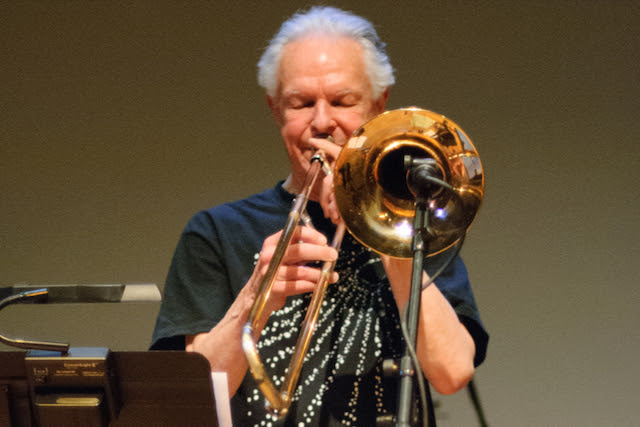
The phenomenon known as Stuart Dempster – trail-blazing composer, trombonist, didjeriduist, Sound Gatherer, and mentor, a.k.a. Fusei (Voice of the Wind) – turned 90 on 7 July. To mark the occasion, the Wayward Music Series is hosting a celebration on 11 July at 4pm at the Chapel Performance Space (4649 Sunnyside Ave. N. in Seattle).
From WMS:
Coming together to listen deeply; to move and to sound playfully, and to attend to a performance in tribute to beloved master musician and teacher, Stuart Dempster. (Please note that the celebration takes place over the course of several hours. No food or drink will be offered at the event, so please plan accordingly. Stuart requests that you bring no presents, just your presence!)
LISTENING TOGETHER (4 – 4:30 PM) Chapel Performance Space at Good Shepherd Center (4th floor)
PLAYING TOGETHER (5 – 6 PM) Picnic shelter in Meridian Park, directly behind/west of Good Shepherd Center (weather permitting; if not, we’ll meet in the Chapel) Please note, no amplified sound permitted in the Meridian Park area.
MERIDIAN EVENT for Stuart Dempster on his ninetieth birthday Chapel Performance Space at Good Shepherd Center (4th floor) (for best results, join us for Deep Listening in the Chapel before MERIDIAN EVENT!)
To celebrate Stu, YOU ARE INVITED To come together To sing To play To dance To listen Spontaneously, improvisingly,
Or
Premeditatedly, composedly, choreographedly, YOU ARE INVITED In whatever mode you choose, to remember what he taught us: YOU ARE INVITED To always listen To enjoy the silence To play the silence To leave space To let your doing be transparent to what everyone else is doing To direct your energy To play with love To listen deeply To direct your energy and play with love towards a specific person or specific persons To listen for the ending
TRANSITION (6:00 – 6:30 PM) Chapel Performance Space at Good Shepherd Center (4th floor)
Video installation by Robert Campbell and ROOM. Please enter and exit as you wish, move about the space comfortably.
ATTENDING TOGETHER (6:30 – 7 PM) Chapel Performance Space at Good Shepherd Center (4th floor)
Byron Schenkman, founder and artistic director of Sound Salon; photo (c) Shaya Lyon
Queer Baroque, the final program of Sound Salon’s season, salutes Pride Month with a blend of 17th-century drama and 21st-century insight to celebrate musical and personal otherness. Two performances: May 30 at 7.30pm at the Royal Room (5000 Rainier Ave S.) and May 31 at 7.00pm at the Good Shepherd Center (4649 Sunnyside Ave N.); tickets are “pay-as-you-wish, “with a suggested price of $36 and a minimum of $1.
Baroque music thrives on extremes. For harpsichordist Byron Schenkman, its emotional volatility and theatrical flair – hallmarks of a musical language that flourished in 17th- and early 18th-century Europe – hold special resonance for contemporary audiences and performers alike.
That belief underpins Queer Baroque, the final program of the season for the chamber music series Sound Salon, which Schenkman (they/them) founded and directs. They will be joined by multi-instrumentalist and composer Niccolo Seligmann (they/them) and male soprano Elijah McCormack (he/him) for two performances to mark the start of Pride Month with an imaginative – and often playful – exploration of identity and otherness through the lens of Baroque music.
The concept for the program goes back to the mid-1990s, spanning a period of profound cultural shifts – both in Seattle’s LGBTQ+ community and in the broader evolution of how queerness, and those who embody it, are seen, represented and understood.
“Thirty years ago, I helped plan a concert called ‘Queer Baroque,’ featuring musicians from Seattle Baroque Orchestra – and it nearly got canceled,” Schenkman recalls. When the presenting board at the time asked them to change the name in order to receive funding, they refused. “It generated so much buzz that the concert ended up being packed and was a big success. But one of the board members resigned over it.”
About a year and a half ago, as Schenkman began planning a version of the program updated to reflect a more expansive understanding of queerness, they assumed the moniker “Queer Baroque” no longer conveyed the edginess it once had. But in light of rising anti-LGBTQ+ rhetoric, particularly targeting trans communities, the title – and the conversation around it – feels urgent again.
Elijah McCormack
“At a time when we see ‘deviants’ scapegoated for so many social ills, I think this is an important program,” says McCormack, a transgender singer who specializes in early music. “Queer identities have been medicalized and classed as inherently disordered. It’s not new for these things to be pathologized or demonized.”
The program combines vocal and instrumental music from the 17th and 18th centuries to consider what it means to be seen as “other.” In the Baroque era, that otherness was often manifested in portrayals of madness in songs and stage works.
“This fascination with madness in the 17th century reflects a change in society’s attitude that led to people perceived as ‘crazy’ being put into institutions – behind bars – where the ‘normal’ people would come to look at them,” says Schenkman, who describes themself as “a queer Jewish keyboard player and scholar.”
By the 19th century, they add, “the idea of madness had become entangled with gender and sexuality: to be overly emotional, feminine or sexually expressive was often pathologized as insanity. Being queer, being feminine and being ‘crazy’ were increasingly seen as overlapping.”
That entanglement between emotional excess and perceived deviance plays out in several of the program’s vocal works. Barbara Strozzi’s cantata L’Astratto is a comic mad scene in which the singer cycles unpredictably through emotions and musical styles, unable to settle on one. “It’s also a kind of self-portrait of someone trying to locate themselves through art,” Schenkman says.
For McCormack, the piece culminates “in a touching sort of lament about the perils of losing yourself, even your own mind, in the love of someone else.”
He also performs Élisabeth Jacquet de la Guerre’s cantata Susanne, a retelling of the biblical story of Susanna and the Elders. “It’s so common for women – and people perceived as women – to be punished for maintaining agency over their own bodies,” McCormack says. “I imagine that, for Jacquet de la Guerre, it was powerful to set a text about a heroine who defies the entitlement of men in authority. It’s still powerful today.”
Another vocal highlight is Henry Purcell’s From Rosy Bowers, a theatrical song in which a chambermaid feigns madness to trick Don Quixote. “Here we have a woman pretending to be crazy to manipulate a character created by a male writer and composer,” Schenkman says. “It’s like putting on a drag show: playing with the stereotypes and tossing them on their heads. Some of that happens musically as well.”
Not all of the program’s queerness is textual or narrative. Some of it lies in performance choices themselves – like Seligmann playing a movement from one of Jacquet de la Guerre’s violin sonatas on the bass viol, a bowed, fretted string instrument from the Baroque era that’s typically used for lower lines. Schenkman likens the transposition to subverting gender expectations: “What’s a high voice supposed to do? What’s a low voice?”
Niccolo Seligmann; photo: Anna Schutz
“This program uses Baroque music to celebrate that queerness is not just one thing,” Seligmann says. “It’s a rich panoply of experiences that intersect with other axes of identity, including the time period.”
Seligmann, whose playing has been widely heard both in live concerts and on soundtracks like the Netflix series The Witcher, also contributes an example of their work as a composer. McCormack will sing a scene from Seligmann’s Julie, Monster: A Queer Baroque Opera, inspired by the life of Julie d’Aubigny (1673-1707), a genderfluid opera diva and swordfighter. Seligmann describes the excerpt as “a queer seduction aria that proposes more egalitarian ways of sharing intimacy,” connecting Julie “with a herstory of gender rebels” and today’s audiences “with queer ancestors for us to honor and celebrate.”
For Schenkman, who has long blended scholarship with activism, the concept of “Queer Baroque” continues to resist classification. “We’re all a little queer, and a little not,” they say. “The problem isn’t difference. The problem is pretending there’s only one normal way to be. I want whoever’s in the room to enjoy looking at different ways people diverge from norms – and celebrate it.”
“I am a religious Russian Orthodox person and I understand ‘religion’ in the literal meaning of the word, as ‘re-ligio’, that is to say the restoration of connections, the restoration of the ‘legato’ of life. There is no more serious task for music than this.” – Sofia Gubaidulina
The great Sofia Gubaidulina has died at the age of 93. She passed away on 13 March at her home in Appen, Germany.
From her publisher, Boosey & Hawkes: “Sofia Gubaidulina, the grande dame of new music, has passed away on 13 March 2025, aged 93, at her home in Appen, near Hamburg in Germany. She was considered the most important Russian composer of the present day and a person who drew inspiration from a deep faith. Her interest in the world, in people and in the spiritual touched everyone who met and worked with her. In her work, she always focussed on the elementary, on human existence and the transformative power of music.
She is like a ‘flying hermit’, said conductor Simon Rattle, because she is always “in orbit and only occasionally visits terra firma. Now and then she comes to us on the earth and brings us light and then goes back into her orbit.” Conductor Andris Nelsons has noted that “Sofia Gubaidulina’s music – its intellect and its profound spirituality – is deeply touching. It really gets under your skin”.
According to NPR: “In a 2017 interview with the BBVA Foundation, Gubaidulina talked about the power of music in sweeping terms. ‘The art of music is consistent with the task of expanding the higher dimension of our lives,’ she said. A deeply religious artist, she once described her writing process as speaking with God.” She also said: “The art of music is capable of touching and approaching mysteries and laws existing in the cosmos and in the world.”
Today Seattle Opera announced the lineup for the company’s first full season with General and Artistic Director James Robinson at the helm.
I’m especially pleased to see Gregory Spears’s Fellow Travelers – more timely than ever – among the three company premieres. Last summer’s Santa Fe Opera season included The Righteous, a collaboration between Spears and poet Tracey K. Smith, and the production knocked me out. Fellow Travelers is set during the McCarthy era and is based on the Thomas Mallon novel about the “Lavender Scare” that affected workers in the federal government.
Budget tightening obviously plays a big role here, but the rest of the season is quite a mixed bag: Seattle Opera’s first venture into Gilbert & Sullivan territory with The Pirates of Penzance; a Richard Strauss rarity, Daphne, but in concert format, which will star Heidi Stober as the mythic protagonist and with David Afkham conducting; and the perennial Carmen, which will star Sasha Cooke in her role debut (alternating with J’Nai Bridges in one of her signature parts). Another plus: Ludovic Morlot will conduct.
So we’re now done to just four mainstage productions, one of them in concert format, and no more season opener in August – when the Ring used to be the center of attention, so long ago.
Here’s the complete program:
Performance Information (see full cast lists at seattleopera.org)
The Pirates of Penzance Music by Arthur Sullivan
Libretto by W.S. Gilbert Conducted by David Charles Abell Directed and Choreographed by Seán Curran October 18, 19, 24, 26, 28, 29, November 1, 2025 McCaw Hall (321 Mercer St, Seattle, WA 98109) seattleopera.org/pirates
Gay Apparel: A Holiday Show
December 12 & 13, 2025 The Opera Center (363 Mercer St, Seattle, WA 98109) seattleopera.org/gayapparel
Daphne in Concert Music by Richard Strauss Libretto by Joseph Gregor January 16 & 18, 2026 McCaw Hall (321 Mercer St, Seattle, WA 98109) seattleopera.org/daphne
Fellow Travelers
Music by Gregory Spears Libretto by Greg Pierce
Conducted by Patrick Summers Directed by Kevin Newbury
February 21, 22, 25, 27, 28, & March 1, 2026 The Opera Center (363 Mercer St, Seattle, WA 98109) seattleopera.org/fellowtravelers
Carmen Music by George Bizet
Libretto by Henri Meilhac and Ludovic Halévy Conducted by Ludovic Morlot Directed and Choreographed by Paul Curran May 2, 3, 8, 9, 10, 13, 16, & 17, 2026 McCaw Hall (321 Mercer St, Seattle, WA 98109) seattleopera.org/carmen