MEMETERIA

Icon

Arts writing by Thomas May

The Isidore Quartet: Another Side of Harmony

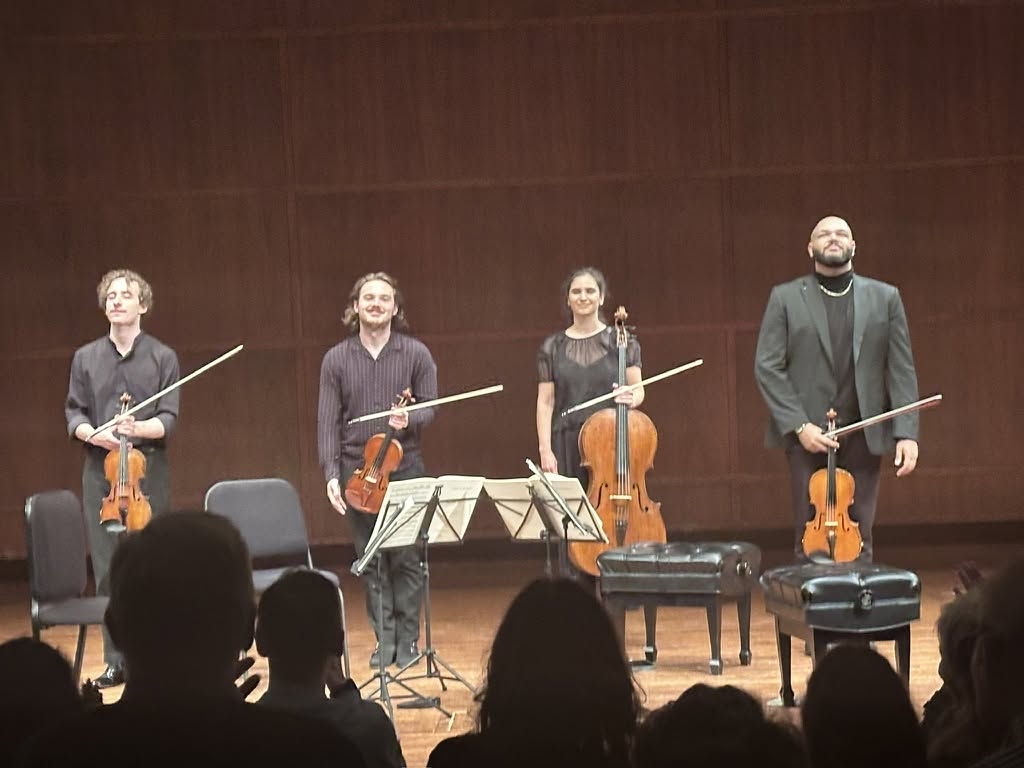
The Isidore String Quartet made a terrific impression Sunday afternoon in Seattle Chamber Music Society’s Signature Series. I last heard these 2022 Banff Competition winners at the 2025 Honens Competition in Calgary, where they partnered with the three finalists in piano quintets. For Seattle-born violinist Adrian Steele, it was also something of a homecoming: he recalled growing up attending Seattle Chamber Music Society concerts in this very same Nordstrom Recital Hall.

This was my first chance to hear them since founding cellist Joshua McClendon departed in September and Clara Abel joined the group. Interestingly, Abel shares with the other members a formative connection to the late Joel Krosnick, who was her teacher and a beloved mentor to the quartet. Judging by their remarkably cohesive playing, they already seem to have developed a strong chemistry in this new formation.

Haydn’s F minor Quartet, the fifth in the Op. 20 set, seemed a particularly inspired choice for the Isidores. They made the music thoroughly their own, with a freedom and spontaneity of interpretation grounded in remarkably close ensemble coordination.

The players relished its enigmas, unexpected harmonic turns, and rhythmic games, especially in the strangely wayward, off-kilter Minuet. Its irregular phrasing and abrupt shifts of mood kept playing tricks on toes tapping along unconsciously. The lilting Siciliano had an understated poignancy, while the finale’s scurrying double fugue had me grinning at Haydn’s contrapuntal ingenuity running riot. (For all his official place in the canon, why does Haydn still turn up so infrequently on on actual programs?)

LA-based composer and pianist Billy Childs wrote his String Quartet No. 4 (“American Mosaic”) for the Isidores. Bringing the program into urgently contemporary territory, Childs describes the work as an attempt to “hold a mirror up to ourselves” and confront America’s painful history of racism. He even assigns symbolic racial identities to the instruments: the two violins representing white America, the viola and cello Black America.

Childs describes the three-movement arc as “a journey from a segregated and antagonistic beginning to an ultimately idyllic and harmonious conclusion.” Yet the work ends on what he calls “a quiet, somber D major triad.” This proved to be more than a fascinating and provocative musical conception on paper: the Isidores brought out the drama in the changing relationships among the four instruments, and the final vision of reconciliation carried more weight than a facile “happy ending.”

The Isidores concluded with an intensely probing performance of the second of Beethoven’s “Razumovsky” Quartets, Op. 59 in E minor, grappling with its oddness just as they had with Haydn’s earlier in the program. I was struck by how charged they made the opening movement feel, with its tense silences, abrupt ruptures, and adventurous harmonic turns. (Haydn was Beethoven’s onetime teacher, of course, and their relationship had its own dissonances.)

The transportive Adagio was worth the price of admission on its own. This is the movement Czerny famously claimed that Beethoven composed while contemplating the starry sky and imagining the music of the spheres. The Isidores let its simple yet vast, hymnlike phrases evoke an otherworldly stillness that served as a foil to the nervous tension that abounds in this quartet.

In the scherzo, they dug into its biting dissonances and nervous rhythms, while the Russian folk tune in the trio introduced a gruffly naïve cheerfulness, made all the weirder by Beethoven’s mischievous contrapuntal treatment. The Isidores also had great fun with the headlong finale and its eccentric harmonic tug-of-war between C major and E minor.

For an encore, the Isidores offered the buoyant third of Frank Bridge’s Three Idylls for string quartet (1906) – a delightful choice, especially since the Seattle Symphony had just given a rare performance of Bridge’s orchestral tone poem Enter Spring.

The Isidores in Banff:

Filed under: Beethoven, Haydn, new music, review, Seattle Chamber Music Society, string quartet, , , , ,

Augustin Hadelich in Lucerne

Augustin Hadelich is of course a familiar and well-loved figure in Seattle, where I last heard him in March in a memorable, thoughtfully programmed recital with Francesco Piemontesi at Meany Center for the Performing Arts. What a pleasure to encounter him in varied contexts at this summer’s Lucerne Festival as ‘artiste étoile.’

The first concert of my visit here brought the Beethoven Violin Concerto with the Berliner Philharmoniker and Kirill Petrenko – a kind of anti-concerto in its resistance to conventional virtuoso display that, paradoxically, became one of the great models for the Romantic violin concerto and that is also extraordinarily difficult to play convincingly.

I was blown away by Hadelich’s signature blend of warmth and poetry, and also by the natural give-and-take between him and this collective of world-class musicians, each with such a strong musical personality. As an encore, he offered his own touching arrangement of Schumann’s Träumerei.

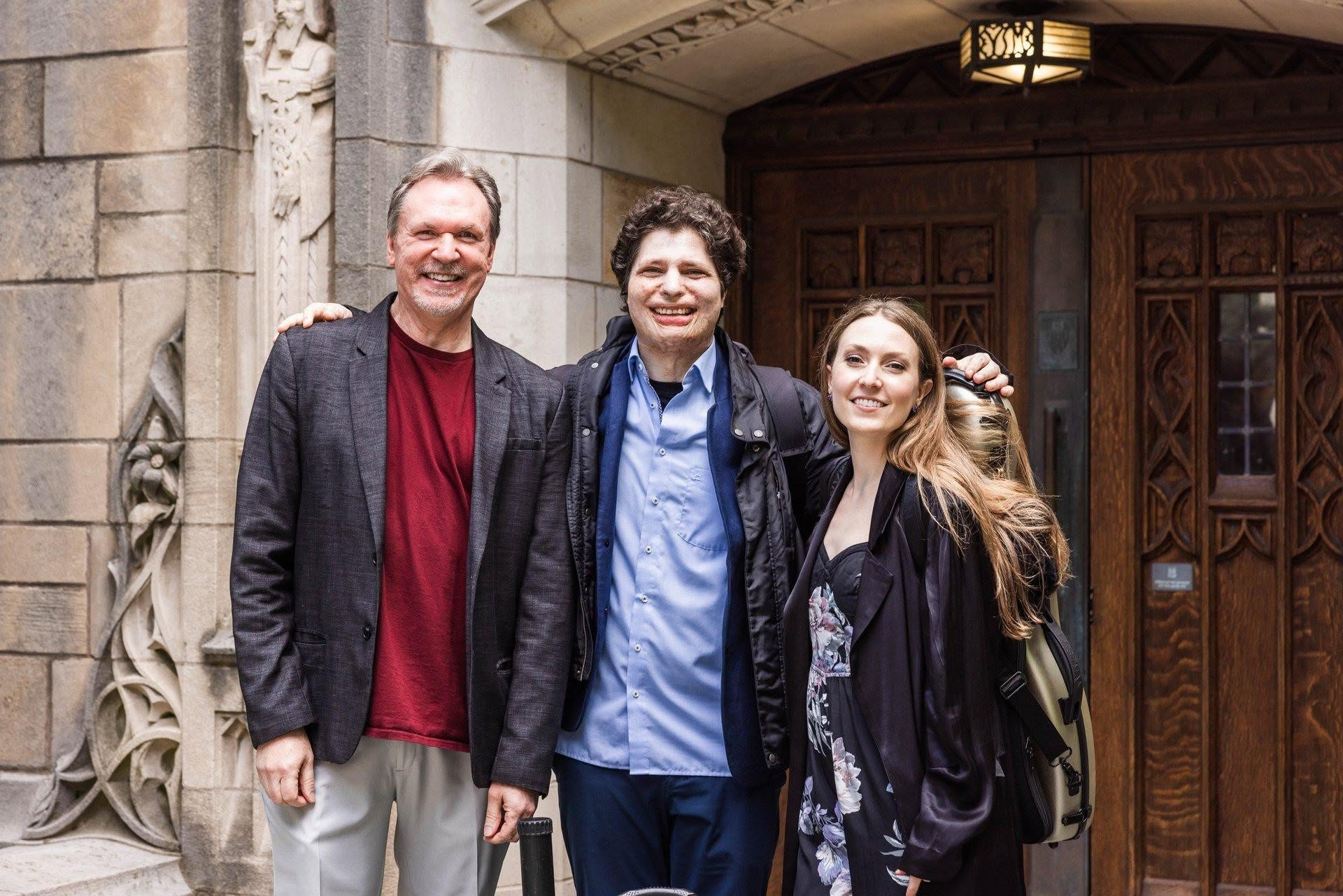
Over the weekend, Hadelich joined with Mark O’Connor and Maggie O’Connor (all pictured here together) for ‘Fiddle Night’ in the smaller venue that is used for many of the Lucerne Festival Academy concerts. The program opened with a set by the O’Connors, charmingly introduced from the stage and including ‘Wildflowers’ as a tribute to Dolly Parton. (Mark O’Connor also played on the original 1987 recording with Parton, Linda Ronstadt, and Emmylou Harris.)

Hadelich then took the stage alone for his arrangement of Howdy Forrester’s ‘Wild Fiddler’s Rag’ – also included on his American Road Trip album – and O’Connor’s ‘Menuhin Caprice,’ written for the Menuhin Competition, a witty take on virtuosity that fuses American fiddling with the classical caprice tradition.

The high point was O’Connor’s calling-card tune, ‘Appalachia Waltz’ – played by all three violinists together as an unhurried, shared meditation that seemed to reflect on Lucerne Festival’s ‘American Dreams’ theme with a certain ache – looking back at what the American dream once promised, and asking whether it still has a future.

Filed under: American music, Beethoven, Lucerne Festival, violinists, , , , ,

Stuart Dempster at 90

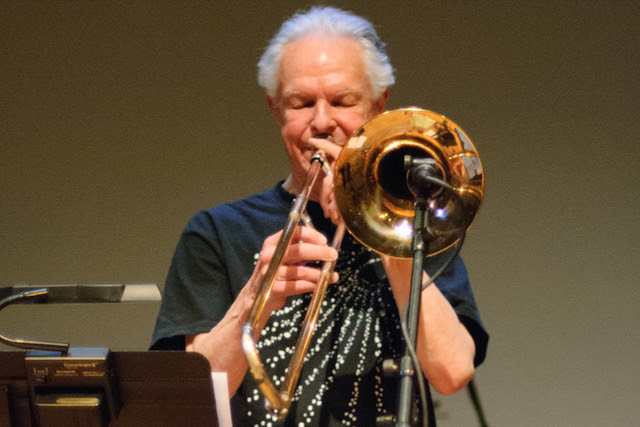
photo: Danette Davis, courtesy of Earshot Jazz

The phenomenon known as Stuart Dempster – trail-blazing composer, trombonist, didjeriduist, Sound Gatherer, and mentor, a.k.a. Fusei (Voice of the Wind) – turned 90 on 7 July. To mark the occasion, the Wayward Music Series is hosting a celebration on 11 July at 4pm at the Chapel Performance Space (4649 Sunnyside Ave. N. in Seattle).

From WMS:

Coming together to listen deeply; to move and to sound playfully, and to attend to a performance in tribute to beloved master musician and teacher, Stuart Dempster. (Please note that the celebration takes place over the course of several hours. No food or drink will be offered at the event, so please plan accordingly. Stuart requests that you bring no presents, just your presence!)

LISTENING TOGETHER (4 – 4:30 PM)
Chapel Performance Space at Good Shepherd Center (4th floor)

Deep Listening session with Brian Pertl and Leila Ramagopal Pertl

PLAYING TOGETHER (5 – 6 PM)
Picnic shelter in Meridian Park, directly behind/west of Good Shepherd Center (weather permitting; if not, we’ll meet in the Chapel) Please note, no amplified sound permitted in the Meridian Park area.

MERIDIAN EVENT for Stuart Dempster on his ninetieth birthday
Chapel Performance Space at Good Shepherd Center (4th floor)
(for best results, join us for Deep Listening in the Chapel before MERIDIAN EVENT!)

To celebrate Stu,
YOU ARE INVITED
To come together
To sing
To play
To dance
To listen
Spontaneously, improvisingly,

Or

Premeditatedly, composedly, choreographedly,
YOU ARE INVITED
In whatever mode you choose, to remember what he taught us:
YOU ARE INVITED
To always listen
To enjoy the silence
To play the silence
To leave space
To let your doing be transparent to what everyone else is doing
To direct your energy
To play with love
To listen deeply
To direct your energy and play with love towards a specific person or specific persons
To listen for the ending

TRANSITION (6:00 – 6:30 PM)
Chapel Performance Space at Good Shepherd Center (4th floor)

Video installation by Robert Campbell and ROOM. Please enter and exit as you wish, move about the space comfortably.

ATTENDING TOGETHER (6:30 – 7 PM)
Chapel Performance Space at Good Shepherd Center (4th floor)

Poem, “Gold and Oak” reading by Brian Komei Dempster

livingROOM, with original ROOM performers Sheri Cohen, Stuart Dempster, Renko Ishida Dempster, John Dixon and Tonya Lockyer, plus guests Loren Dempster, Neal Kosaly-Meyer, David Knott, Margaret Paek, and Steve Peters.

All are invited to linger following the performance to continue the celebration!

Filed under: avant-garde, music news, , , , ,

RIP Sofia Gubaidulina (1931-2025)

“I am a religious Russian Orthodox person and I understand ‘religion’ in the literal meaning of the word, as ‘re-ligio’, that is to say the restoration of connections, the restoration of the ‘legato’ of life. There is no more serious task for music than this.”  – Sofia Gubaidulina

The great Sofia Gubaidulina has died at the age of 93. She passed away on 13 March at her home in Appen, Germany.

From her publisher, Boosey & Hawkes: “Sofia Gubaidulina, the grande dame of new music, has passed away on 13 March 2025, aged 93, at her home in Appen, near Hamburg in Germany. She was considered the most important Russian composer of the present day and a person who drew inspiration from a deep faith. Her interest in the world, in people and in the spiritual touched everyone who met and worked with her. In her work, she always focussed on the elementary, on human existence and the transformative power of music.

She is like a ‘flying hermit’, said conductor Simon Rattle, because she is always “in orbit and only occasionally visits terra firma. Now and then she comes to us on the earth and brings us light and then goes back into her orbit.” Conductor Andris Nelsons has noted that “Sofia Gubaidulina’s music – its intellect and its profound spirituality – is deeply touching. It really gets under your skin”.

According to NPR: “In a 2017 interview with the BBVA Foundation, Gubaidulina talked about the power of music in sweeping terms. ‘The art of music is consistent with the task of expanding the higher dimension of our lives,’ she said. A deeply religious artist, she once described her writing process as speaking with God.” She also said: “The art of music is capable of touching and approaching mysteries and laws existing in the cosmos and in the world.”


Filed under: Gubaidulina, music news, , , , ,

Archive

Enter your email address to follow this blog and receive notifications of new posts by email.