

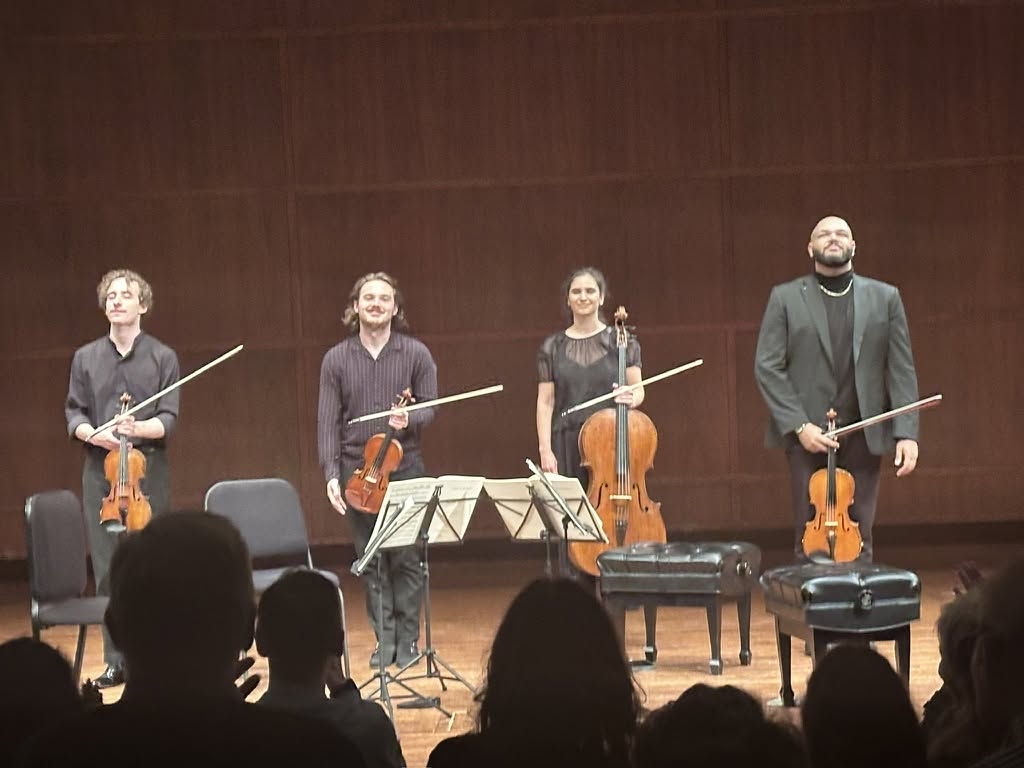
The Isidore String Quartet made a terrific impression Sunday afternoon in Seattle Chamber Music Society’s Signature Series. I last heard these 2022 Banff Competition winners at the 2025 Honens Competition in Calgary, where they partnered with the three finalists in piano quintets. For Seattle-born violinist Adrian Steele, it was also something of a homecoming: he recalled growing up attending Seattle Chamber Music Society concerts in this very same Nordstrom Recital Hall.
This was my first chance to hear them since founding cellist Joshua McClendon departed in September and Clara Abel joined the group. Interestingly, Abel shares with the other members a formative connection to the late Joel Krosnick, who was her teacher and a beloved mentor to the quartet. Judging by their remarkably cohesive playing, they already seem to have developed a strong chemistry in this new formation.
Haydn’s F minor Quartet, the fifth in the Op. 20 set, seemed a particularly inspired choice for the Isidores. They made the music thoroughly their own, with a freedom and spontaneity of interpretation grounded in remarkably close ensemble coordination.
The players relished its enigmas, unexpected harmonic turns, and rhythmic games, especially in the strangely wayward, off-kilter Minuet. Its irregular phrasing and abrupt shifts of mood kept playing tricks on toes tapping along unconsciously. The lilting Siciliano had an understated poignancy, while the finale’s scurrying double fugue had me grinning at Haydn’s contrapuntal ingenuity running riot. (For all his official place in the canon, why does Haydn still turn up so infrequently on on actual programs?)
LA-based composer and pianist Billy Childs wrote his String Quartet No. 4 (“American Mosaic”) for the Isidores. Bringing the program into urgently contemporary territory, Childs describes the work as an attempt to “hold a mirror up to ourselves” and confront America’s painful history of racism. He even assigns symbolic racial identities to the instruments: the two violins representing white America, the viola and cello Black America.
Childs describes the three-movement arc as “a journey from a segregated and antagonistic beginning to an ultimately idyllic and harmonious conclusion.” Yet the work ends on what he calls “a quiet, somber D major triad.” This proved to be more than a fascinating and provocative musical conception on paper: the Isidores brought out the drama in the changing relationships among the four instruments, and the final vision of reconciliation carried more weight than a facile “happy ending.”
The Isidores concluded with an intensely probing performance of the second of Beethoven’s “Razumovsky” Quartets, Op. 59 in E minor, grappling with its oddness just as they had with Haydn’s earlier in the program. I was struck by how charged they made the opening movement feel, with its tense silences, abrupt ruptures, and adventurous harmonic turns. (Haydn was Beethoven’s onetime teacher, of course, and their relationship had its own dissonances.)
The transportive Adagio was worth the price of admission on its own. This is the movement Czerny famously claimed that Beethoven composed while contemplating the starry sky and imagining the music of the spheres. The Isidores let its simple yet vast, hymnlike phrases evoke an otherworldly stillness that served as a foil to the nervous tension that abounds in this quartet.
In the scherzo, they dug into its biting dissonances and nervous rhythms, while the Russian folk tune in the trio introduced a gruffly naïve cheerfulness, made all the weirder by Beethoven’s mischievous contrapuntal treatment. The Isidores also had great fun with the headlong finale and its eccentric harmonic tug-of-war between C major and E minor.
For an encore, the Isidores offered the buoyant third of Frank Bridge’s Three Idylls for string quartet (1906) – a delightful choice, especially since the Seattle Symphony had just given a rare performance of Bridge’s orchestral tone poem Enter Spring.
The Isidores in Banff:
Filed under: Beethoven, Haydn, new music, review, Seattle Chamber Music Society, string quartet, classical-music, music, orchestra, piano, writing

