MEMETERIA by Thomas May

Music & the Arts

Guest Review: World Premiere Staging of The Gospel According to the Other Mary

Mary

I’m deeply grateful to Tom Luce to be able to publish his insightful review of the world premiere of the opera staging of John Adams’s The Gospel According to the Other Mary. Directed by Peter Sellars, the production just opened this past weekend at English National Opera.

Review by Tom Luce:
The Gospel According to the Other Mary
World Premiere Staging of John Adams’s and Peter Sellars’s Masterpiece

On Friday 21 November, English National Opera unveiled its new production of the Adams/Sellars “alternative” version of the crucifixion of Christ. The two-act work, described by its creators as a “Passion Oratorio”, was premiered in a concert performance at Disney Concert Hall by the Los Angeles Philharmonic in May 2012 under Gustavo Dudamel’s baton. The following year came the first semi-staged concert performance, also featuring the LA Philharmonic under Dudamel. That version later toured to New York and Europe (including a stop at London’s Barbican). Dudamel’s interpretation was released on a recording by Deutsche Grammophon earlier this year, so the music has been accessible to the public at large since then.

Directed by Sellars himself, ENO’s production was the work’s first full staging. Along with its two creators, it deservedly received a prolonged ovation from a rapt and obviously much moved audience.

The performance was uniformly excellent, with cast and chorus admirably meeting the challenging mixture of singing, movement, and acting Sellars demands of and inspires from his performers. All the principal singers — Patricia Bardon as Mary Magdalene, Meredith Arwady as Martha, and Russell Thomas the Lazarus — were committed and effective, as were dancers Banks, Stephanie Berge, Ingrid Mackinnon, and Parinay Mehra, who variously shadowed them and contributed other parts to the narrative.

The musical side at ENO was in the hands of Joana Carneiro. Of Portuguese origin, she is better known in the U.S. than in Britain, having for some years been music director of the Berkeley Symphony. Her technical mastery and impassioned commitment to this highly complex score were remarkable. The ENO orchestra played magnificently.

Those familiar with Sellars’ “ritualisations” of the two Bach Passions with the Berlin Philharmonic Orchestra would find nothing to surprise them in his staging. One hallmark is his use of dance, mime, and body movement to externalise and heighten emotion. “Put your body where your belief is”, he says in the ENO’s introductory video. Another is the subtle intermingling of narrative and representation. The main thrust is narrative, but to heighten impact at critical points in the drama, the narrators act out the events — just as the Evangelist in the Berlin Bach Passions both expounds the story and at times impersonates characters — e.g., Peter in denial, or Christ at his death. This subtle shifting of roles keeps crude dramatisation at bay but facilitates a wide variety of dramatic tone and effects. I have not seen anything comparable in other directors’ work; it is one of Sellars’s most skilful and original attributes.

The stage design by George Tsypin, subtly lit by James Ingalls, is spare but eloquent: sand and barbed wire represent a Middle East riven by conflict and oppression, simultaneously biblical and contemporary.

The work juxtaposes and fuses ancient and modern in presenting Mary and Martha as running a hostel for homeless, impoverished, and marginalised people, with Jesus as a mixture of family friend, honoured guest, and spiritual patron. He is also a miracle worker in the raising of their dead brother Lazarus, sacrificial victim of the elites whose power he challenges, and a source of hope for the future of the world.

The literary sources are the Bible — especially St John’s Gospel — supplemented and re-interpreted through modern American cultural figures: poet and author Louise Erdrich, who is partially of native American descent; Dorothy Day of the radical Catholic Worker movement; Rosario Castellanos, the Mexican writer, activist, and diplomat; and the black poet June Jordan (who wrote the libretto for an earlier Adams/Sellars collaboration, I Was Looking at the Ceiling and Then I Saw the Sky).

In the ENO video Sellars also says: “The moment you feminize Christianity and you go into feminine spirituality, you go into a very different space and it operates very differently”. It is of the essence in Sellars’s dramatic work that he sees the cultural myths we have inherited through women’s eyes. This is as much an emotional and dramatic as a political standpoint.

The main originality of his St Matthew Passion ritualisation lies in its inspiration and liberation in the listener and viewer of wider and wilder feelings going well beyond the conventional liturgical responses or the “authentic” musical response to a deeper human involvement in the passion of Christ and its human and political significance. In doing so he responds to the injunction in the very first line of the work: “Come, ye daughters, help me lament”. (The discreet presence in the audience of Mark Padmore, the Evangelist in the Berlin Passions, at Friday’s Gospel premiere served to underline the connection between the Bach and Adams ventures.)

John Adams’s music reaches new levels of emotional profundity, dramatic responsiveness, and absence of mannerism, going even beyond his achievement in The Death of Klinghoffer. There is an extraordinary richness and flexibility of harmony and melody and a fascinating orchestral sound, to which a cimbalom gives an exotic edge without ever sounding kitschy. Amongst many fine moments, the most deeply moving for me is the aria with which the first act ends, sung by Lazarus after the Passover evening: “Tell me, how is this night different? … This is the night we eat the bread of affliction so that evil may turn into good”. Within an orchestral palette evoking a kind of Nachtmusik, Adams here creates a deep and movingly optimistic reflection on the events of the opera. Over many years I have heard nothing finer from a contemporary composer.

With this production English National Opera cements its standing as the world’s most committed John Adams house, having previously mounted Nixon in China and Doctor Atomic and having originated the Klinghoffer production admired recently at the Met.

The work itself will surely take a high place in the canon of works from the last century or so in which great composers address themes of human injustice and inequality. It will be alongside Tippett’s A Child Of Our Time (1944) and his The Knot Garden (1970), an opera featuring a female revolutionary fighter and a mixed-race/same-gender couple, which sadly seems to have slipped out of the repertoire in recent years); Hans Werner Henze’s dramatic cantata The Raft of Medusa; and above all Alban Berg’s Wozzeck. Its full unveiling at last week’s premiere was an event of real significance.

Tom Luce lives in London and Seattle. He has followed musical events for over 50 years. He wrote music reviews for Seattle’s Crosscut.com.

Filed under: American opera, Bach, culture news, directors, John Adams, new music, opera

Bach Meets Dot Matrix Printer

Filed under: Bach, technology

Music for the Day: J.S. Bach/Easter Cantata

Der Himmel lacht, die Erde jubiliert, BWV 31: Nikolaus Harnoncourt and Concentus musicus Wien :

Filed under: Bach

Freezing a Moment of Infinite Possibility

My new feature on Jeremy Denk and his recording of the Goldberg Variations is now available in the Spring 2014 issue of Listen magazine. This one is limited to subscribers, so I can include only the teaser here:

Freezing a Moment of Infinite Possibility
Pianist Jeremy Denk on the stakes of recording Bach’s Goldberg Variations

In his first article for The New Yorker (“The Flight of the Concord,” February 6,
2012), pianist Jeremy Denk distilled the maddeningly quixotic experience of committing his interpretation of Charles Ives’ “Concord” Sonata to disc. Recordings, he mused, are really “manicured artifacts, from which the essential spectacle of human effort has been clipped away.”

One aspect of classical music that can puzzle newcomers is the enormous library of competing versions of the same blockbusters that have been — and continue to be — recorded.

Read the rest by subscribing to Listen here

Filed under: Bach, piano

The Bach Passions Project in Seattle

Passions Project

Over the weekend, Stephen Stubbs and his Pacific MusicWorks company concluded their ambitious Passions Project with performances of the St. John Passion. The project included partnering with the Seattle Symphony for the St. Matthew Passion the previous weekend. Here’s my review for Bachtrack:

Adducing Simon Schama’s comparison of Rubens’s Descent from the Cross with the same subject as painted by Rembrandt, the conductor and Bach authority John Eliot Gardiner has observed that the differences drawn by the art historian – chiefly, between an emphasis on “action and reaction” in the former and “contemplation and witness” in the latter – might broadly be applied to Bach’s two great Passions as well: St John and St Matthew, respectively. Audiences in Seattle have been provided an opportunity to compare and contrast these unfathomably rich works on the basis of live performances of both, presented over consecutive weekends.

continue reading at Bachtrack

Filed under: Bach, Pacific MusicWorks, review, Seattle Symphony

Another Look at Bach

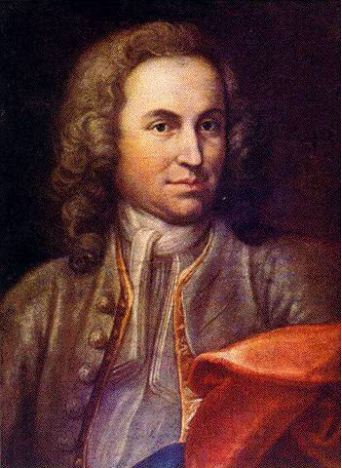
Possibly the young J.S. Bach c. 1715; or possibly not; painting by J. E. Rentsch, the Elder

Possibly the young J.S. Bach c. 1715 — or possibly not; painting by J. E. Rentsch, the Elder

J.S. Bach has been much on my mind of late. I need to make time to plunge into John Eliot Gardiner’s new book on the composer, especially after George B. Stauffer’s review in the recent New York Review of Books has whet my appetite.

In Bach: Music in the Castle of Heaven, Gardiner distills a lifetime of devotion and study to the music of the Thomaskantor (one of the epithets by which Germans refer to Bach). According to Stauffer, this weighty tome basically revolves around the great question of “just how Bach managed to express the inexpressible, especially with regard to death, and what life experiences stood behind his compositional decisions.”

Gardiner recently started serving as president of the Leipzig Bach Archive and has managed to create a controversial portrait by drawing on recent findings of the archive — a portrait dramatically at odds with the longstanding image of an obedient musical citizen:

Moving beyond the hagiographies of the past, he presents a fallible Bach, a musical genius who on the one hand is deeply committed to illuminating and expanding Luther’s teachings through his sacred vocal works… but on the other hand is a rebellious and resentful musician, harboring a lifelong grudge against authority — a personality disorder stemming from a youth spent among ruffians and abusive teachers. Hiding behind Bach, creator of the Matthew Passion and B-Minor Mass, Gardiner suggests, is Bach “the reformed teenage thug.”

What sounds especially fascinating is that, according to Stauffer, Gardiner roots his speculations in the music (though he apparently omits discussion of the instrumental and keyboard pieces), since he views the music as “the anchor to which we can return again and again, and the principal means of validating or refuting any conclusion about its author.”

The result is that Gardiner “forces us to rethink Bach’s life and how adversity and faith affected his vocal compositions. And [he] takes us inside his world, allowing us to see the works from the standpoint of composer, performer, and listener.”

Over at The Guardian, Peter Conrad points out that Gardiner takes Bach’s intense faith for granted in his exploration of the sacred music, yet “he still makes the effort to account for the emotional force and consolatory balm of Bach’s music in ways that are humanly engaging.”

He treats the cantatas as psychodramas, and thinks of the Passions as three-dimensional versions of opera which, rather than exhibiting the vocal and histrionic antics of sacred monsters in a fictional world onstage, address us directly when the soloists perform their hortatory arias and require us, in chorales that were sung by the entire congregation, to participate in Christ’s tragedy and in the divine comedy that is its sequel. Gardiner’s analogy for the way the Passions work comes from a literary form that could not be less spiritually exalted: he draws on theorists of the novel such as Bakhtin to explain the “dialogic threads” and complementary “subjectivities” that Bach draws together, and despite his own orthodoxy he makes frequent allusions to Philip Pullman, for whom art is our demonic repudiation of an oppressive God.

While the title Bach in the Castle of Heaven suggests something emphatically pious, Conrad adds, “Gardiner’s is a festive book, enlivened by the ‘joy and zest’ of Bach’s ‘dance-impregnated music.’ Those dances are sacral but also rowdily profane… Quoting the sociologist Émile Durkheim, he defines religion as a ‘collective effervescence,’ a shared ecstasy – more readily available, perhaps, in the mud at Glastonbury or clubbing under the arches in Vauxhall than at a church service in 18th-century Leipzig.”

Just like Shakespeare, Bach will always be the mirror of our own age as well.

Filed under: Bach, book recs

A Dose of Bach

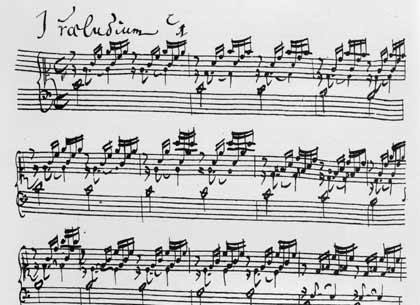
Book I, Prelude No. 1 in C major

Book I, Prelude No. 1 in C major

I’ve referred to my skepticism regarding “best-of-the-year” lists, and I admit I’ve started to feel something similar about New Year’s resolutions. But there’s one resolution I made a few years ago (and I think that was a reboot of an impulse from way, way back) which has begun again, quite expectedly, to fascinate me. Namely, to listen closely to a new prelude and fugue from the Well-Tempered Clavier each day before focusing on other music.

Of course this is merely borrowing an idea that inspired me when I came across it in Pablo Casals’s memoirs (Joys and Sorrows, if I remember correctly). Casals got into the habit of starting each day by playing some Bach at the keyboard — I believe this was before he’d made his own epochal rediscovery of the Cello Suites.

It’s unquestionably a wonderful regimen. I’ve only worked my own way through a humiliatingly small portion of the WTC and am badly out of practice, so close listening will have to substitute. I can’t explain why, but from my substantial treasure of Bach recordings, I’ve gravitated toward Rosalyn Tureck. (I hadn’t realized last month marked the centenary of her birth.)

Like Casals, Tureck — the so-called “high priestess of Bach” — was a key player in reclaiming Bach for 20th-century listeners. It’s hard to imagine that when she was coming of age, Bach was still thought of by many music lovers as the music you played to get your fingers in shape and master coordination.

The Chicago-born Tureck, who liked to hang out with Oxford intellectuals and was friends with Bertrand Russell, represented a dramatically contrasting approach to that of Glenn Gould. The meditative quality she brings to her classic account of the WTC belongs to a class of its own. From the start, Tureck knows how to shine a gentle light on what she calls “Bach’s genius for creating a latent richness, implied rather than stated, within a simple framework.” There she’s referring specifically to the “eternal enigma” posed by the opening C major Prelude: “It can be regarded as very simple or as mysterious as Leonardo da Vinci’s Mona Lisa.”

Here Tureck discusses and illustrates Bach’s enormous influence:

Filed under: Bach

A Soundtrack for Christmas


All right, enough already of the reindeer and sappy carols. Who better to depict the true spirit of the Christmas season than the greatest of them all, J.S. Bach? Jauchzet, frohlocket, auf, preiset die Tage: Even Ebenezer Scrooge couldn’t have resisted.

Here’s Sir John Eliot Gardiner conducting the Monteverdi Choir and the English Baroque Soloists in the so-called Christmas Oratorio BWV 248, that splendid package of six Christmastime cantatas. A very happy Christmas to all!

Filed under: Bach

Archive

Enter your email address to follow this blog and receive notifications of new posts by email.