MEMETERIA by Thomas May

Music & the Arts

Queer Baroque: Sound Salon Explores Identity in Baroque Music

Byron Schenkman, founder and artistic director of Sound Salon; photo (c) Shaya Lyon

Queer Baroque, the final program of Sound Salon’s season, salutes Pride Month with a blend of 17th-century drama and 21st-century insight to celebrate musical and personal otherness. Two performances: May 30 at 7.30pm at the Royal Room (5000 Rainier Ave S.) and May 31 at 7.00pm at the Good Shepherd Center (4649 Sunnyside Ave N.); tickets are “pay-as-you-wish, “with a suggested price of $36 and a minimum of $1.

Baroque music thrives on extremes. For harpsichordist Byron Schenkman, its emotional volatility and theatrical flair – hallmarks of a musical language that flourished in 17th- and early 18th-century Europe – hold special resonance for contemporary audiences and performers alike.

That belief underpins Queer Baroque, the final program of the season for the chamber music series Sound Salon, which Schenkman (they/them) founded and directs. They will be joined by multi-instrumentalist and composer Niccolo Seligmann (they/them) and male soprano Elijah McCormack (he/him) for two performances to mark the start of Pride Month with an imaginative – and often playful – exploration of identity and otherness through the lens of Baroque music.

The concept for the program goes back to the mid-1990s, spanning a period of profound cultural shifts – both in Seattle’s LGBTQ+ community and in the broader evolution of how queerness, and those who embody it, are seen, represented and understood.

“Thirty years ago, I helped plan a concert called ‘Queer Baroque,’ featuring musicians from Seattle Baroque Orchestra – and it nearly got canceled,” Schenkman recalls. When the presenting board at the time asked them to change the name in order to receive funding, they refused. “It generated so much buzz that the concert ended up being packed and was a big success. But one of the board members resigned over it.”

About a year and a half ago, as Schenkman began planning a version of the program updated to reflect a more expansive understanding of queerness, they assumed the moniker “Queer Baroque” no longer conveyed the edginess it once had. But in light of rising anti-LGBTQ+ rhetoric, particularly targeting trans communities, the title – and the conversation around it  –  feels urgent again.

Elijah McCormack

“At a time when we see ‘deviants’ scapegoated for so many social ills, I think this is an important program,” says McCormack, a transgender singer who specializes in early music. “Queer identities have been medicalized and classed as inherently disordered. It’s not new for these things to be pathologized or demonized.”

The program combines vocal and instrumental music from the 17th and 18th centuries to consider what it means to be seen as “other.” In the Baroque era, that otherness was often manifested in portrayals of madness in songs and stage works.

“This fascination with madness in the 17th century reflects a change in society’s attitude that led to people perceived as ‘crazy’ being put into institutions – behind bars – where the ‘normal’ people would come to look at them,” says Schenkman, who describes themself as “a queer Jewish keyboard player and scholar.”

By the 19th century, they add, “the idea of madness had become entangled with gender and sexuality: to be overly emotional, feminine or sexually expressive was often pathologized as insanity. Being queer, being feminine and being ‘crazy’ were increasingly seen as overlapping.”

That entanglement between emotional excess and perceived deviance plays out in several of the program’s vocal works. Barbara Strozzi’s cantata L’Astratto is a comic mad scene in which the singer cycles unpredictably through emotions and musical styles, unable to settle on one. “It’s also a kind of self-portrait of someone trying to locate themselves through art,” Schenkman says.

For McCormack, the piece culminates “in a touching sort of lament about the perils of losing yourself, even your own mind, in the love of someone else.”

He also performs Élisabeth Jacquet de la Guerre’s cantata Susanne, a retelling of the biblical story of Susanna and the Elders. “It’s so common for women – and people perceived as women  – to be punished for maintaining agency over their own bodies,” McCormack says. “I imagine that, for Jacquet de la Guerre, it was powerful to set a text about a heroine who defies the entitlement of men in authority. It’s still powerful today.”

Another vocal highlight is Henry Purcell’s From Rosy Bowers, a theatrical song in which a chambermaid feigns madness to trick Don Quixote. “Here we have a woman pretending to be crazy to manipulate a character created by a male writer and composer,” Schenkman says. “It’s like putting on a drag show: playing with the stereotypes and tossing them on their heads. Some of that happens musically as well.”

Not all of the program’s queerness is textual or narrative. Some of it lies in performance choices themselves – like Seligmann playing a movement from one of Jacquet de la Guerre’s violin sonatas on the bass viol, a bowed, fretted string instrument from the Baroque era that’s typically used for lower lines. Schenkman likens the transposition to subverting gender expectations: “What’s a high voice supposed to do? What’s a low voice?”
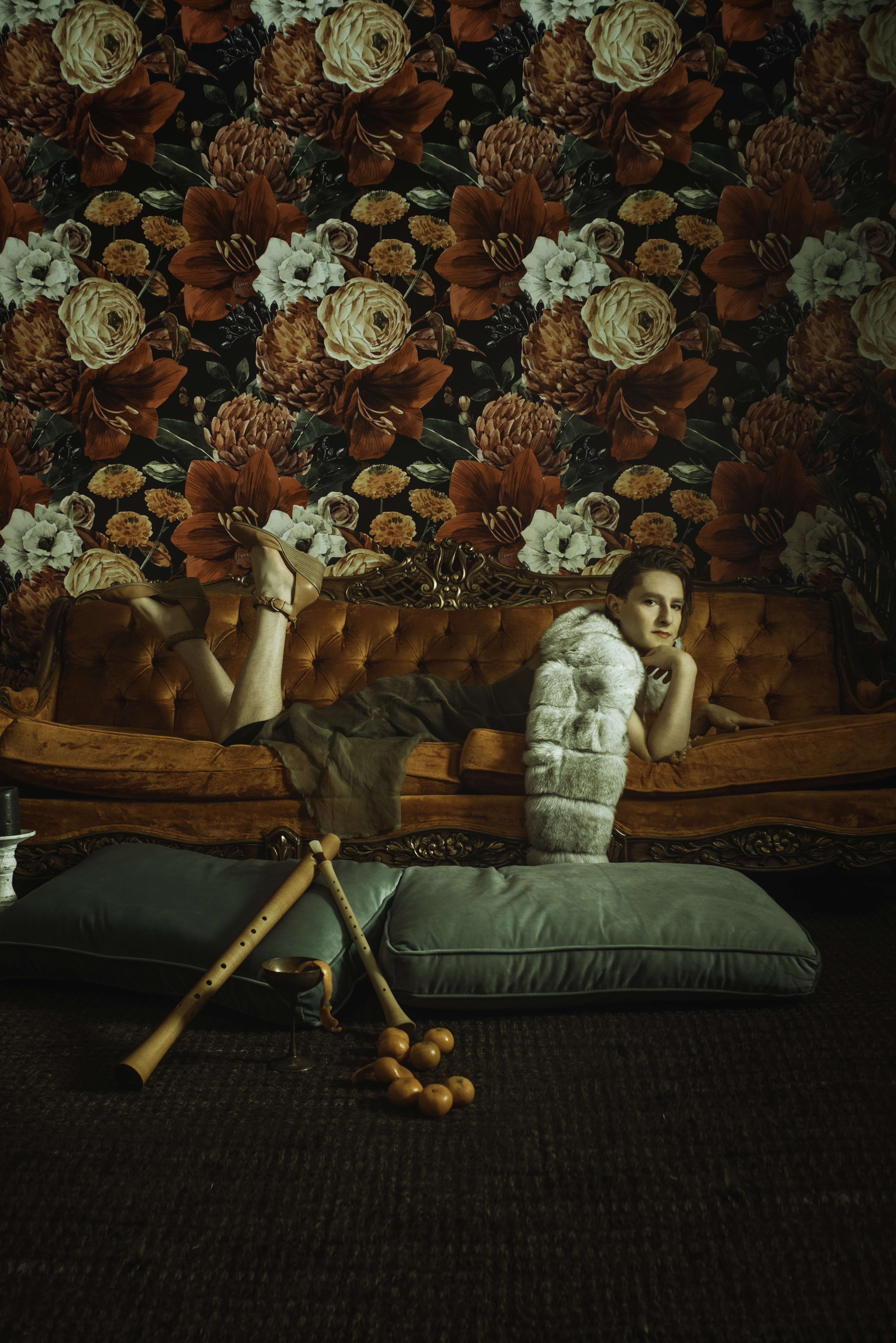
Niccolo Seligmann; photo: Anna Schutz

“This program uses Baroque music to celebrate that queerness is not just one thing,” Seligmann says. “It’s a rich panoply of experiences that intersect with other axes of identity, including the time period.”

Seligmann, whose playing has been widely heard both in live concerts and on soundtracks like the Netflix series The Witcher, also contributes an example of their work as a composer. McCormack will sing a scene from Seligmann’s Julie, Monster: A Queer Baroque Opera, inspired by the life of Julie d’Aubigny (1673-1707), a genderfluid opera diva and swordfighter. Seligmann describes the excerpt as “a queer seduction aria that proposes more egalitarian ways of sharing intimacy,” connecting Julie “with a herstory of gender rebels” and today’s audiences “with queer ancestors for us to honor and celebrate.”

For Schenkman, who has long blended scholarship with activism, the concept of “Queer Baroque” continues to resist classification. “We’re all a little queer, and a little not,” they say. “The problem isn’t difference. The problem is pretending there’s only one normal way to be. I want whoever’s in the room to enjoy looking at different ways people diverge from norms – and celebrate it.”

Filed under: Baroque opera, Byron Schenkman, early music, gay, queer, , , ,

“Infinite Refrain”: Pride 17th-century Venice Style

Featuring countertenor Randall Scotting and tenor Jorge Navarro Colorado, comes the album Infinite Refrain, Music of Love’s Refuge offers a focus on queer relationships and gay love in 17th-century Venice. They collaborate with the Academy of Ancient Music, led by conductor Laurence Cummings, to perform a program celebrating Venice as a place of unusual tolerance in the Baroque era. Infinite Refrain is framed as the journey of two men in love and tells its story through 17th-century music.

“Ironically, it was Venice’s decline as a trading powerhouse that led to its reputation as a Mecca for gay tourism,” writes Clive Paget in the excellent liner notes. “The annual Carnival, with its frenzy of sexual licence and promise of anonymity, had always drawn the crowds, but with the downturn in commercial revenue the authorities were increasingly inclined to turn a blind eye in exchange for a healthy injection of the 17th-century version of the pink pound. And so, something that had been swept under the carpet for over a century became something the Venetians could sell.”

“Onstage in the 1600s, people were playing different genders than they represented in their everyday life,” explains Scotting. “Men were wearing dresses, women were often in men’s suits, male castrati were singing in high voices… so many things were fluid about opera and music at this time.” Navarro Colorado adds: “Many of the duets on the album were also composed to be purposely ambiguous in terms of gender and allowing for queer interpretations so that whoever is listening will feel connected to their message of love.”

Alongside duets by Monteverdi and Cavalli are contemporary premieres of music by little-known composers Boretti, Melani, and Castrovillari, including an impassioned love duet for the mythic lovers Hercules and Theseus — “Se per tè lieto mi lice” (“To be happy for you is precious to me”). “This duet portrays two of the greatest heroes of Greek antiquity matter-of-factly proclaiming their love for each other and it is offered here just as Venetian audiences would have heard it in 1670,” says Scotting.

Filed under: Baroque opera, gay, Venice

Bidding A Baroque Adieu: End Of The McGegan Era At PBO

One of the productions I was most keen on seeing this season is the U.S. stage premiere of Jean-Marie Leclair’s only opera, Scylla et Glaucus: planned as Nicholas McGegan’s spectacular farewell as music director of Philharmonia Baroque — originally planned for later this month.

To mark the occasion, I wrote this profile of this extraordinary artist for Early Music America.

Nicholas McGegan looks back on his 34 years as music director of Philharmonia Baroque Orchestra, a tenure that ended suddenly amid the coronavirus pandemic….

continue

Filed under: Baroque opera, early music, Early Music America, Nicholas McGegan

Vivo in Te

https://www.youtube.com/watch?v=Zc_sCUF9omM

What a pleasure to get to hear Julia Lezhneva and partner in crime Dmitry Sinkovsky again, just a couple months after the Easter Festival in Lucerne. This time was the soprano’s Seattle debut. A heavenly evening of Vivaldi and Handel, with “Vivo in Te” as their encore.

Filed under: Baroque opera, Dmitry Sinkovsky, Handel, Julia Lezhneva, Vivaldi

Eros and Beauty in Juilliard’s La Calisto

1602_calisto_20154016bfinal2Adam Charlap Hyman’s scenic design for Calisto

When was the last time you had a chance to see La Calisto, an opera from the early Baroque by Francesco Cavalli/aka Francesco Caletti-Bruni (1602-1676)?

Leave it to Stephen Stubbs and colleagues to make us realize how much we’ve been missing.

The Seattle-based conductor, lutenist, and early music expert was asked by Juilliard to lead their recent production of La Calisto, which just concluded a brief run of three performances in the school’s intimate Rosemary and Meredith Willson Theater (seating for a maximum of 100).

The result was far more than musical archeology. It also went beyond presenting a platform for talented young Juilliard artists. This was a fully engaging theatrical and musical experience,  one that proved — vividly and gracefully — the undiminished appeal of this material.

La Calisto dates from a fascinating period in early opera, when the newish art form was migrating from private courts into the public theaters of Venice in the mid-17th century. The surprise at Juilliard was how fresh and resonant the work can be when experienced in such a smart, tasteful production. The version of La Calisto presented had been adapted and arranged by Stubbs and director and choreographer Zack Winokur, featuring members of Juilliard Opera and Dance.

Cavalli’s opera of 1651, to a libretto by Giovanni Faustini, repurposes one of the mythic stories of love gone astray from Ovid’s Metamorphoses, fusing it with the (normally unrelated) legend of the handsome shepherd Endymion (Endimione).

What’s most remarkable about the conflation of sources here is the mingling of comic, even ribald, elements with pathos — and this is exactly what Winokur negotiated so effectively and with such winning imagination.

Well before Mozart and da Ponte would hit upon a similarly ambiguous admixture of seria and buffa tonalities in Don Giovanni, Cavalli and Faustini dramatize scenes of lofty emotion and longing side-by-side with the grotesque and sometimes crudely humorous spectacle of gods and demigods crazed by uncontrollable lust.

The latter isn’t limited to the randy half-goat Pan and his merry band of satyrs but extends to Jove himself. We encounter the chief of the gods overcome by desire at first sight of the virgin archer Calisto [one “el” in the Italian, rather than the English “Callisto”].

A follower of the moon goddess and huntress Diana and hence pledged to chastity, Calisto rejects his advances — the libretto includes a witty aside about the pesky side-effects of the free will that Jove has granted his creations — so the god resorts to a transgender disguise as Diana  to con his way. There’s a subtler layer of humor as well, as the hypocrisy of the gods is put on full display.

The opera is framed by a narrative of cosmic happenings, beginning — as if the day after Götterdämmerung — with a visit by Jove, accompanied by Mercury, to check up on an earth devastated by Apollo’s son Phaeton (who, having lost control of the reins of papa’s sun-chariot, had accidentally set the planet on fire).

At the end of the opera, Calisto undergoes an apotheosis into one of the constellations in the heavens. (In Ted Hughes’ rendering of Ovid’s Latin, Calisto — from the Greek for “most beautiful” — is “the Arcadian beauty.”)

But within that framework the opera explores the maddening effects of Eros on humans, demigods, and immortals alike. Jove’s frankly sexual passion for the innocent titular heroine sets in motion the main narrative.

Along with a subplot about Diana’s own weakness for the male counterpart of Calisto — the beautiful shepherd Endimione — it involves a comedy of mistaken identities, confused longing, sexual aggression and rejection — and of course the inevitable blowback from jilted lovers who channel their passion into a lust for vengeance.

At the opera’s midpoint, for example, Jove’s official spouse Juno descends from Olympus to discover hubby’s latest infidelity. Enraged — though Calisto has been the unwitting object of Jove’s desires — Juno cruelly transforms her rival into a bear; physically, though, Calisto retains her human awareness. (“Her lament/Was the roar of a bear – but her grief was human,” in Ted Hughes’s version of Ovid.) Calisto’s second transformation into a heavenly body is Jove’s way of repairing the damage he has caused.

“It seems to me that [librettist Faustini] set out to fashion a show that a modern promoter might describe as ‘a sexy romp’ — with all the tools that he and Cavalli had developed in their previous works. Sexuality and sensuality pervade every corner of the libretto,” notes Stephen Stubbs.

This was Stubbs’s first collaboration with Juilliard students, working a magic similar to what he has achieved in his stagings with University of Washington students (as in Handel’s Semele and Mozart’s The Magic Flute).

Indeed, Winokur’s staging and pacing underscored the playful erotics  — with an arch nod to contemporary sexual politics, but avoiding predictable camp. This was the polar opposite of “stand and sing” opera, of absurdly monumental gestures.

Stage movement was brisk and varied, at times wittily stylized into dance — and in marvelous sync with the lively tempi Stubbs elicited.

The conductor led mostly from the harpsichord, working with a small but colorful and dynamic ensemble comprising a pair of violins and a continuo mixture (lutes, bowed basses, etc.), plus a touch of percussion. The players were members of Juilliard415, the school’s period-instrument ensemble.

La Calisto unfolds place amid a pastoral scene that has just begun to be restored. The setting was elegantly visualized by the design team of Adam Charlap Hyman and Andre Herrero, with landscape painting by Pilar Almon and suggestive lighting by Marcus Doshi.

The energetic cast had been well prepared in the musical rhetoric of Cavalli’s idiom, which quickly (almost unnoticeably) morphs from recitative to arioso to aria or duet — the score features a wealth of duets — with terrific economy. Modest gestures were telling and made their mark.

Particularly outstanding were the Polish countertenor Jakub Józef Orliński as Endimione in the subplot of Diana’s own naughty dalliance. He did justice to what is probably the score’s single most gorgeous piece of music: his praise of Diana in “Lucidissima face.” (Endimione and Diana are the opera’s only couple to enjoy a case of requited love.)

Samantha Hankey amazed with a commanding stage presence and with her ability to persuasively differentiate Diana as lover from the severe Diana who is horrified by Calisto’s confession of love. As Calisto, Angela Vallone sang with unaffected beauty, suggesting the awakening of sensual awareness when her innocent character is duped by Jove in disguise.

Julia Wolcott used her large voice to imposing, regal effect as Juno, hinting at a mesmerizing fusion of an angry Donna Anna with the Queen of the Night. Her appearance — accompanied by a retinue of Furies — inspired the most memorable of Austin Scarlett’s delightful costumes, her towering dress an object of awe in itself.

Excellent contributions were made as well by Xiaomeng Zhang as the sex-starved Giove, while spot-on comic timing was provided by Michael St. Peter as his sidekick Mercurio, who eggs him on to pursue his desires.  Don Giovanni once again came to mind, with Giove as a precursor to the amoral seducer, the procuring messenger god his Leporello.

Shades of A Midsummer Night’s Dream likewise were evoked, though La Calisto concludes not with a smoothing out of the erotic misalliances, but rather with a sublime ensemble ode to the transformed heroine.

–(c)2016 Thomas May. All rights reserved.

Filed under: Baroque opera, Juilliard, review, Stephen Stubbs

Current Playlist: El Maestro Farinelli

As I try to work through some of the titles that have grabbed my attention from the most recent pileup of CD releases:

El Maestro Farinelli with countertenor Bejun Mehta and Pablo Heras-Casado conducting the Concerto Köln. I have yet to hear anything routine from the amazing Spanish conductor. These performances of music by little-heard Baroque opera composers (including Porpora, Hasse, de Nebra, Jomelli, Corradini, Marcolini, and Traetta; there’s also a C.P.E. Bach Sinfonia title “Fandango”) show off the many-faceted Maestro Heras-Casado’s early-music expertise.

The guiding idea behind the program is to retrieve works Farinelli produced during the years he served as an imperial impresario in Madrid and Aranjuez — works long since fallen into oblivion. (Apparently many of these composers’ orchestral scores were destroyed in a palace fire in the 19th century.)

Mehta sings only two numbers (one a brief zarzuela duet with a decidedly non-“HIP” overdubbing of his voice for both parts) but channels all the mystery and charisma of an 18th-century Klaus Nomi for the compelling Porpora aria (“Alto Giove, è tua grazia,” from Polifemo). I wish there were more vocal music here.

Heras-Casado and the players bring stylish, pointed energy to the instrumental selections — the bulk of the material here — but my first impression is that too much of the program may be the 18th-century equivalent of easy-listening music, perky and caffeinated as it is. But what’s wrong with guilty pleasures? (Note: This is Heras-Casado’s debut for Archiv Produktion label just relaunched by Deutsche Grammophon.)

Filed under: Baroque opera, CD review, conductors

Archive

Enter your email address to follow this blog and receive notifications of new posts by email.