Some thoughts on Seong-Jin Cho’s recent Seattle recital:
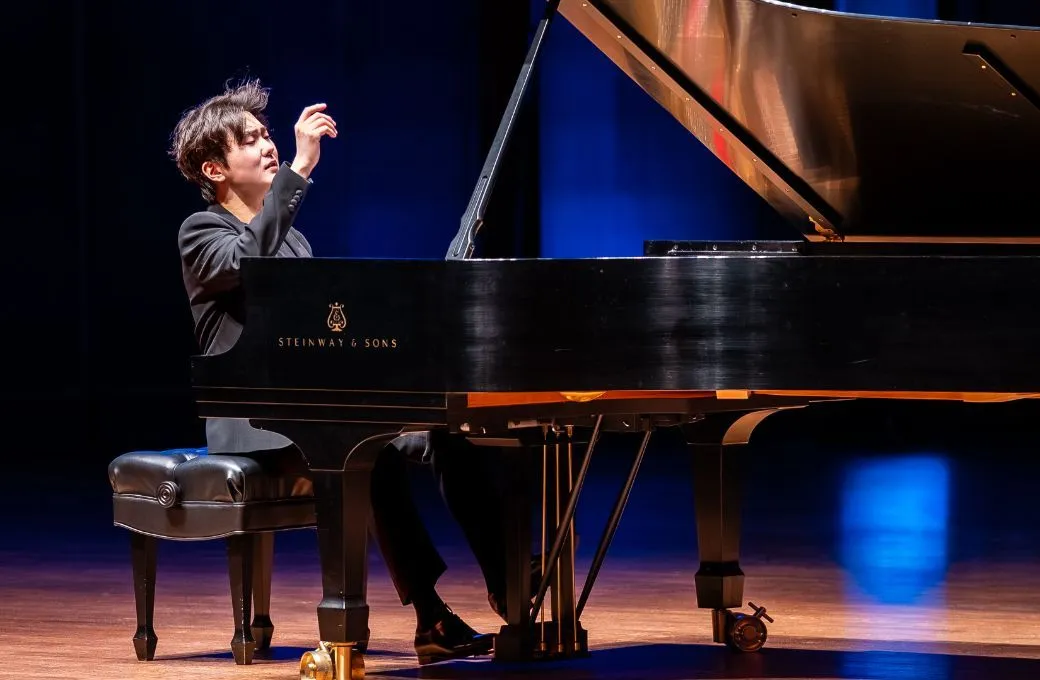
The self-effacing persona Seong-Jin Cho projected from the Benaroya Hall stage throughout his solo recital stood in striking contrast to his musical confidence – a confidence grounded not only in extraordinary technical security but in an evident willingness to take risks. Cho’s sense of interpretive freedom made itself felt from the outset, in a program that invited close attention and repaid it generously…
Jeremy Denk and Richard O’Neill; photo: Jorge Gustavo Elias
Seattle Chamber Music Society presented Richard O’Neill and Jeremy Denk in a sold-out recital Sunday. Here’s my review for The Strad:
Seattle Chamber Music Society brought the inaugural season of its new Signature Series to a compelling close with this sold-out recital by violist Richard O’Neill – best known as a member of the Takács Quartet – and pianist Jeremy Denk.
“You should always try to escape your own success,” Víkingur Ólafsson says. “Because that success so easily turns against you and limits you and your choices and what you want to do next” …
The C major Fantasy for Violin and Piano in Schubert’s manuscript (Wienbibliothek im Rathaus)
My essay for the recital by Leonidas Kavakos and Enrico Pace at the Pierre Boulez Saal on 29 April is here.
Complete program:
Ludwig van Beethoven: Sonata for Violin and Piano in A major Op. 47 “Kreutzer”
Richard Dubugnon: La minute exquise; Hypnos; Retour à Montfort-l’Amaury
Franz Schubert: Fantasy for Violin and Piano in C major D 934
The program that Leonidas Kavakos and Enrico Pace bring to the Pierre Boulez Saal offers three perspectives on the violin–piano duo, from the fire and drama of Ludwig van Beethoven to the rhapsodic lyricism of Franz Schubert—with a contemporary interlude of enigmatic, nocturnal miniatures by the Swiss-French composer Richard Dubugnon….
I spoke with the pianist Jan Lisiecki about his upcoming Beethoven concerto marathon with the Toronto Symphony:
Jan Lisiecki’s immersion in the piano concertos of Ludwig van Beethoven began right at the deep end. Rather than offer his interpretation of just one work, his very first recording of music by the German composer (which appeared in 2019) encompassed nothing less than a complete concerto cycle.
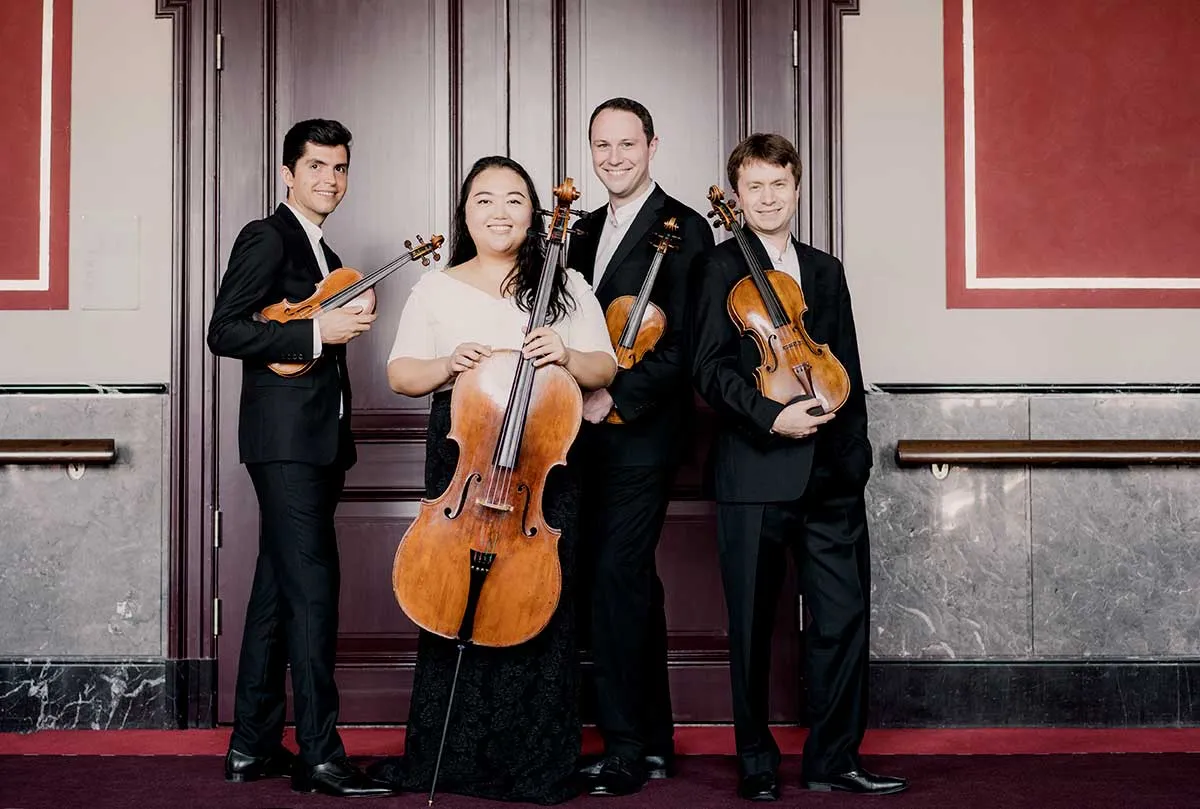
Calidore String Quartet: Ryan Meehan, left, Estelle Choi, Jeffrey Myers, and Jeremy Berry, Photo: Marco Borggreve
I spoke with Calidore Quartet violinist Ryan Meehan about their recording of the complete Beethoven quartets:
To accompany its ongoing release of the complete Beethoven cycle, the Calidore String Quartet has chosen Mark Rothko–like images as cover art: floating fields of color that seem suspended in time. “We’re all huge fans of Rothko’s work,” says violinist Ryan Meehan. “These colors are so bold and sometimes polarizing. Each color creates such a clear feeling on its own, but then as a collective, they also fill the viewer with an intense inner feeling. That’s very similar to Beethoven in that sections can be so contrasting from one to another, but the combination is an experience that you don’t forget.” continue
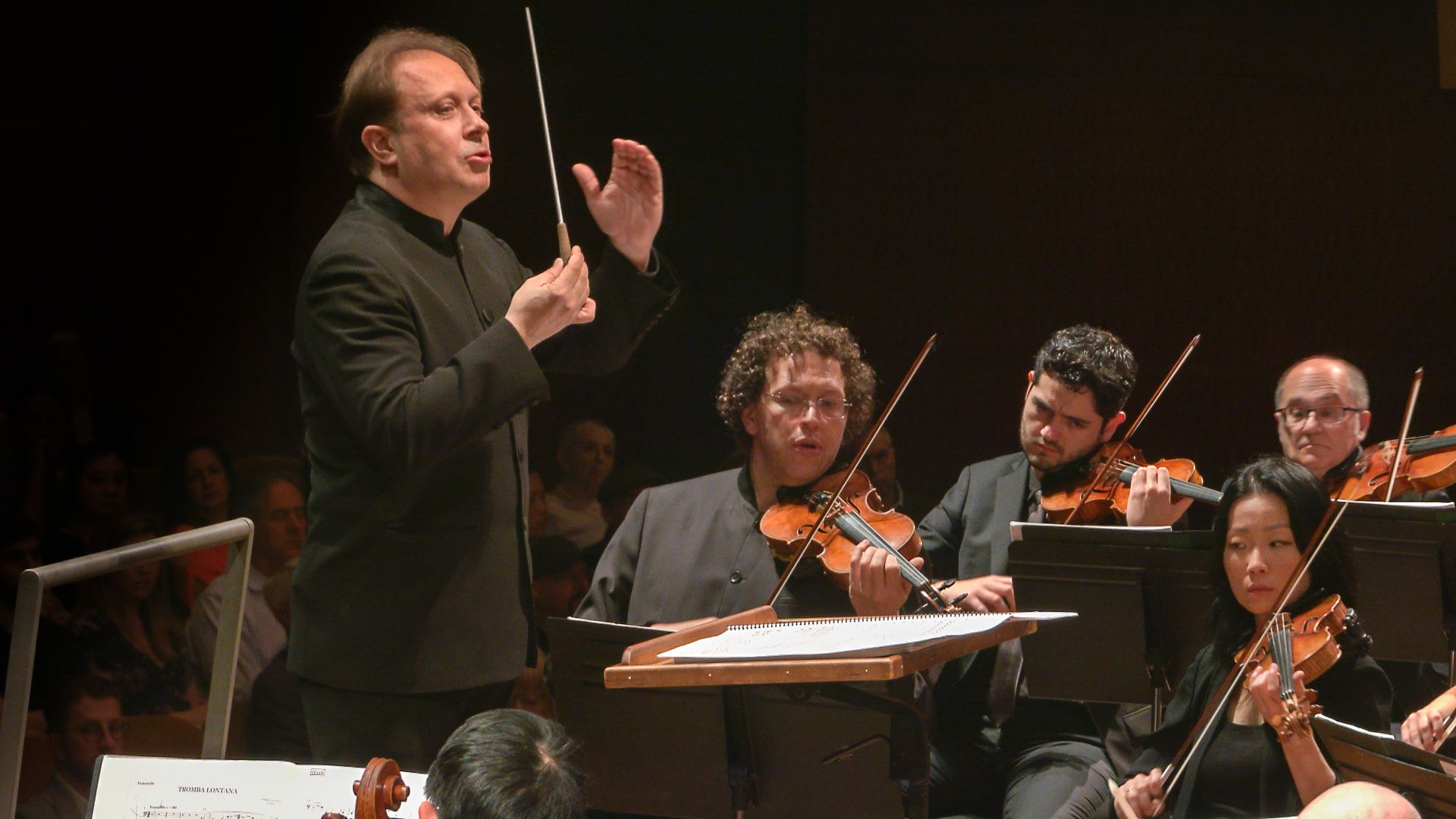
Ludovic Morlot conducting the Seattle Symphony; photo courtesy of the Seattle Symphony
For their second-to-last program of the season, the Seattle Symphony added John Adams’s early breakthrough Harmonium to its repertory with a breathtaking performance led by Conductor Emeritus Ludovic Morlot. During the 1970s, Adams had been building a reputation as an experimental composer doing his own thing in the Bay Area. He had become an advisor on contemporary music to the San Francisco Symphony’s then-music director Edo de Waart and received a commission to write a big choral-orchestral piece to help the orchestra celebrate its first season in Davies Hall, SFO’s new home across the street from the War Memorial Opera House. The premiere in April 1981 was a sensation that launched Adams on his path toward international stardom.
In his guise as a conductor, Adams has paid multiple visits to Seattle to lead the musicians in various of his own compositions and regards the SSO as “an excellent orchestra.” So it was especially satisfying to finally hear the collective forces of the SSO and its Chorale perform this pivotal work from more than four decades ago for the first time.
As it happened, I’d just come from hearing the original septet version of Adams’s 1978 piece Shaker Loops the week before at the Ojai Music Festival (performed by members of the visiting Mahler Chamber Orchestra, with fresh birdsong obbligato from the trees surrounding the outdoor Libbey Bowl). Adams had adopted the idioms of Minimalism in his distinctive, “impure” way in Shaker Loops and does something similar in Harmonium, but working for the first time with the much larger canvas of symphony orchestra and chorus. It was interesting to notice that some of the DNA of Shaker Loops is still present in varied form in Harmonium. At the same time, aspects of the signature language Adams would go on to develop (mostly orchestral, but in some respects choral as well) also appear in this score — certain timbral gestures from the tuned percussion, a shine that anticipates Grand Pianola Music (1982), or the stirring choral “pillars” found in the operas.
But the very fine performance led by Morlot kept me from falling into the trap of viewing a great artist’s early work merely contextually, as a launching pad toward future greatness. Harmonium proved completely compelling on its own terms, a splendidly structured choral triptych that conveys states of transcendence, serene contemplation, and unbridled joy.
Adams initially considered setting texts from the Wallace Stevens collection called Harmonium and then thought of writing for a wordless chorus, relying on their pure sounds, before he found a basis for what he imagined — “human voices — many of them — riding upon waves of rippling sound in John Donne’s “Negative Love” and two poems by Emily Dickinson: “Because I Could Not Stop for Death” and “Wild Nights.”
Morlot showed his sensitive understanding of Adams’s dramatic use of sudden harmonic modulations — at this stage in his career, the composer had been likening it to the process of “gating” in electronic music — and shaped the sense of progressive revelation via negation in the opening Donne section with a tenacious clarity.
The Chorale, excellently prepared by Joseph Crnko, encompassed an enormous sonic spectrum, from mystic whispers to ecstatic, Whitmanesque yawping that sent shockwaves crashing through Benaroya Hall. (Fittingly, the concert had begun with Tromba lontana, an “anti-fanfare” from 1986 in which the composer uses a pair of trumpets to sound an elegiac rather than military mood, calling to mind Whitman’s poem “The Mystic Trumpeter.”) Adams’s guiding image of surging waves of sound came to life most thrillingly in the final “section”Wild Nights” movement, a drastically contrasting juxtaposition with Dickinson’s death meditation preceding it.
Seattle Symphony Chorale plus part of the fabulous SSO brass section; photo courtesy of the Seattle Symphony
One of the most unforgettable moments in Harmonium is the seamless transition between the polar Dickinson poems, in which Adams builds up an irresistible, orgiastic flow of momentum. Beethoven’s Fifth Symphony, which occupied the second half of the program, happens to offer a plausible parallel in the musical “tunnel” that interlinks its last two movements.
Curiously, the program on which Harmonium was given its world premiere in San Francisco also involved a Beethoven pairing: in that case, with the Emperor Piano Concerto No. 5 — a work whose aura Adams confronted the next year in his wonderfully over-the-top Grand Pianola Music. On this occasion, Morlot — in his first reunion with the SSO since the sadly under-attended opening night of the season last September — approached the Beethoven with a clear sense of proportions and architecture. And with a bigger, more-rounded sound overall than in his Beethoven interpretations of several years ago, when he was music director.
Morlot held back from imposing an “interesting” perspective on the score, following Beethoven’s command of a single eighth-note rest between the first two statements, for example. He followed all of the repetitions — including, a bit surprisingly, even in the Scherzo. Still, the vision that emerged was more finale-centric, it seemed to me, with the terseness of the opening movement as a mere station on the way forward rather than an existential state. Despite brisk tempi, Morlot shaped the eccentrically long-spun melody of the Andante’s main theme with style and drew a magnificent dark sheen from the strings in particular, with bold strokes in the finale.
If aspects of the Scherzo felt understated, Morlot steered clear of the feeling of anti-climax that deflates so many renditions of the finale. The return of the ominous Scherzo music actually felt surprising, and the insistent paragraphs of C major brought to mind something of the French Revolutionary era music that was a clear inspiration for the young Beethoven.
Gemma New with Seattle Symphony; photo (c) Ben VanHouten
A few weeks ago, Gemma New led the Seattle Symphony in an interestingly unusual program centered around Vaughan Williams’s Antarctic Symphony. The New Zealand-born conductor made an unexpected return visit this past week, when she agreed to take on another guest program in lieu of Elim Chan, who had been originally scheduled to make her debut with the orchestra but canceled owing to a family emergency.
New had just the week before stepped in for Marta Gardolińska at San Francisco Symphony — where, as in Seattle, she took on the program that had been announced, with no changes. That remarkable confirmation of New’s versatility and grace under pressure enhances her already impressive profile.
Thus New opened the first night of Seattle Symphony’s program (17 May) with a contemporary piece she had to learn under extra pressure: Unsuk Chin’s Subito con forza. The piece — so texture- and idea-rich that the term “concert opener” really doesn’t do it justice — was one of the many commissions around the (ill-fated) Beethoven anniversary year in 2020 for compositions reflecting in some way or other on the legacy of Beethoven.
Chin has described Beethoven as “the first consciously modern composer, in the sense that every piece asked for original solutions, even if this meant breaking through existing forms.” She adds: “What particularly appeals to me are the enormous contrasts: from volcanic eruptions to extreme serenity.” Subito con forza — meaning “suddenly, with power,” a phrase in the style of a Beethovenian musical indication such as “Allegro con brio” for the first movement of the Fifth Symphony — abounds in eruptions and contrasts. The opening gesture, for example, alludes to the Coriolan Overture and then explodes into a parallel but unfamiliar universe of chiming percussion and extended technique and quickly gutters into ghostly shiverings on the strings.
Seeming to explore untapped potential or multiple other directions Beethoven might have followed with his raw material, Chin’s approach differs in fascinating ways from Jörg Widmann’s Beethoven homage Con brio. New elicited a sense of the incandescent fire of Chin’s imagination, harnessed through the composer’s formidable orchestral technique.
It made for a wonderful companion piece to the second half of the program, the Symphony No. 1 by Beethoven himself. The audience was treated to an engrossingly fresh account that conjured a sense of the young composer bursting with ideas and the passion to stake his claim. New avoided the temptation to play up Beethoven as an eccentric flouting convention, which made his surprise moves in this work all the more effective, from the harmonic detour of the opening measures and the dam-rupturing energy of the extended coda in the first movement to the teasing, step-by-step presentation of the finale’s main theme.
The conductor’s style of sweeping, balletic gestures signaled the mellifluous, fully layered sound she elicited from the orchestra, with careful attention to dynamics and inner lines, but nothing over-polite or smoothed over. New was particularly sympathetic to the wit and humor of Beethoven’s First and — abetted by the Benaroya Hall acoustic — emphasized a somewhat brighter sonority overall, with Alexander White’s trumpet part always clearly discernible. She aligned the double basses in a curious configuration on stage left, divided into two subsections stretching to the wall. I couldn’t quite notice a difference in the sound, but I assume it supported a particular balance she was looking for. New left a vivid impression of having something to say with this familiar rep, and I’m eager to hear more Beethoven from her.
James Ehnes and Gemma New with Seattle Symphony; photo (c) Ben VanHouten
The program also offered an account of the Samuel Barber Violin Concerto featuring Jame Ehnes, one of the piece’s most eloquent advocates today. Any chance to hear Ehnes is to be cherished, but this performance struck me as particularly special, with the violinist adding a darker perspective to the work than I’ve heard before. The unwavering technique and consistently beautiful phrasing were there, but Ehnes touched on a more tragic than consoling aspect to Barber’s long-limbed lyricism.
Oboist Ben Hausmann — who also deserves kudos for his significant role in the Beethoven symphony — set the tone for the Andante with a solo of heartrending sincerity, while Ehnes countered with a melody of his own that seemed to have been generated in the moment. The Andante also allowed him to display the full richness of his 1715 “Marsick” Stradivari’s lower range. The frenzied virtuosity of the brief, perpetual-motion finale takes a drastically different turn from the preceding movements but felt like a necessary counterpart to so much lyrical effusion. New gave the orchestra a good deal of leeway, which, aside from a few issues of balance, encouraged an especially engaging rapport with the soloist.
Ehnes offered a substantial encore with his account of Eugène Ysaÿe’s single-movement Sonata No. 3 in D minor for solo violin, matching passion with flawless technique for this music clearly close to his heart.
The Berlin Celebration Concert 1989 – Leonard Bernstein – Beethoven Symphony No 9
Exactly 200 years ago today, on 7 May 1824 at 7pm Vienna time, Beethoven presented a “Grand Musical Academy” at the Theater am Kärntnertor. On the program: the Overture to The Consecration of the House; selections from the recently premiered (in St. Petersburg) Missa Solemnis (Kyrie, Credo, and Agnus Dei); and “a grand symphony with solo and choral voices entering in the finale, on Schiller’s ‘Ode to Joy'” — as the poster described the Symphony No. 9 in D minor, Op. 125.
It was in the works of his last years that Beethoven delved ever more deeply into his subconscious while affirming ever more strenuously the artist’s obligation to use self-revelation as a means toward the achievement of worldwide human harmony. I call this process the universalizing of the intimate. His Missa Solemnis, Ninth Symphony, last three piano sonatas, “Diabelli” Variations for piano, and last five string quartets are above all a search for transcendence. In them, he carried the process of universalizing the intimate as far as and probably farther than any other musician had or has ever done; at the very least — as Maynard Solomon, a lifelong student of the composer’s life and works, has written — in these works Beethoven “forever enlarged the sphere of human experience available to the creative imagination.”
“The question of whether or not we ought to read artists’ lives into their works ceases to matter in Beethoven’s last years. His late works were his life. …”
“In many ways, Beethoven was — is – much more modern than we are. “We live ‘as if,’” says the protagonist of Claire Messud’s novel, The Last Life, “as if we knew why, as if it made sense, as if in living this way we could banish the question and the ‘as if’ness itself, the way we speak and act as if our words could be comprehended […].” Beethoven, in his terrifying isolation and his terrible pride and his unsurpassed capacity to transform experience into organized sound-complexities, went beyond that stage. In the last quartets, and certainly in the Ninth Symphony, he obliterated the ‘as if’ness of comprehension, and then went on to obliterate obliteration — to dance on obliteration’s ashes.”
Kevin John Edusei makes his Seattle Symphony debut conducting Widmann, Strauss, and Beethoven (with Steven Osborne in the Piano Concerto No. 5 in E-flat major); image (c) James Holt
An impressive Seattle Symphony conducting debut last night with Kevin John Edusei on the podium. Absolutely captivating account of Richard Strauss’s Ein Heldenleben, exquisitely tailored to give full weight to the more introspective moments — and reminding us that there’s even a touch of self-doubt in this score. The gorgeously shaped solos from concertmaster Noah Geller were especially thoughtful, while Jeff Fair and the horn section made a spectacular contribution. Overall I found this showcase of sonic theater more moving than usual in its effect.
Scottish pianist Steven Osborne emphasized poetry over heroics in Beethoven’s Emperor Concerto — sheer loveliness in the slow movement, where Edusei’s placement of the strings (basses and cellos to his left) enhanced the finely veiled sound. Osborne played the transition into the finale as if snapping out of a dream. The unannounced encore was apparently music of Keith Jarrett — an unexpected but beautiful choice.
A clever bit of Beethoven-related programming for the opener: German composer Jörg Widmann’s Conbrio, a deliciously paradoxical parody-of-pastiche that is serious and original, never actually quoting Beethoven yet evoking his personality at every turn through abstract gestures — as if trying to recuperate what it all once meant…. Two more chances to hear this excellent concert (Sat evening and Sunday matinee).






 MEMETERIA by Thomas May