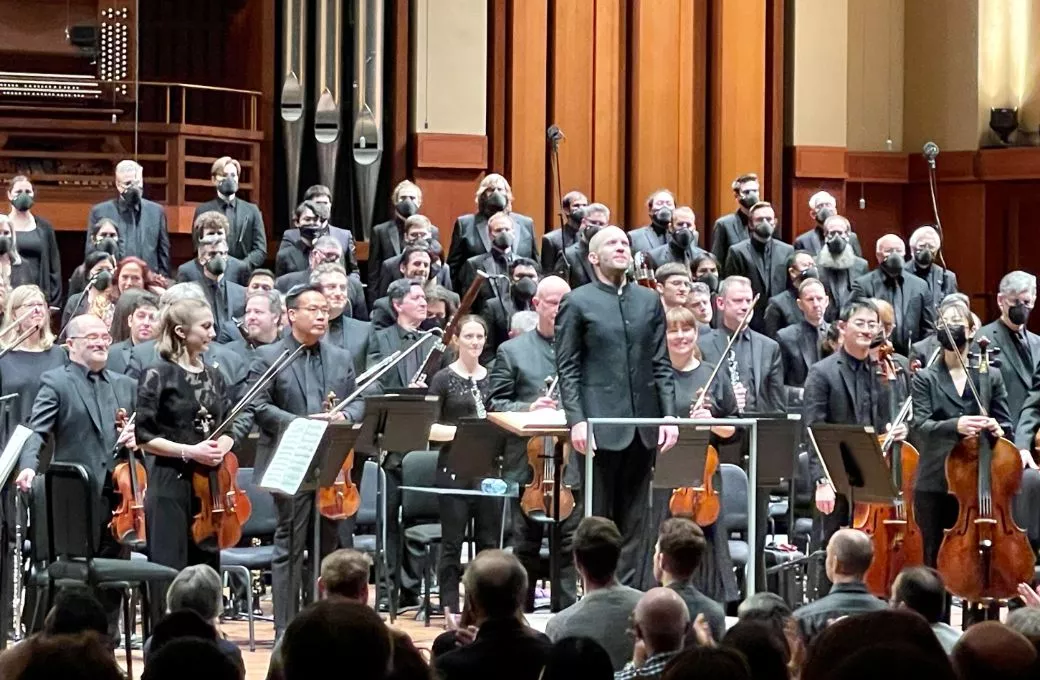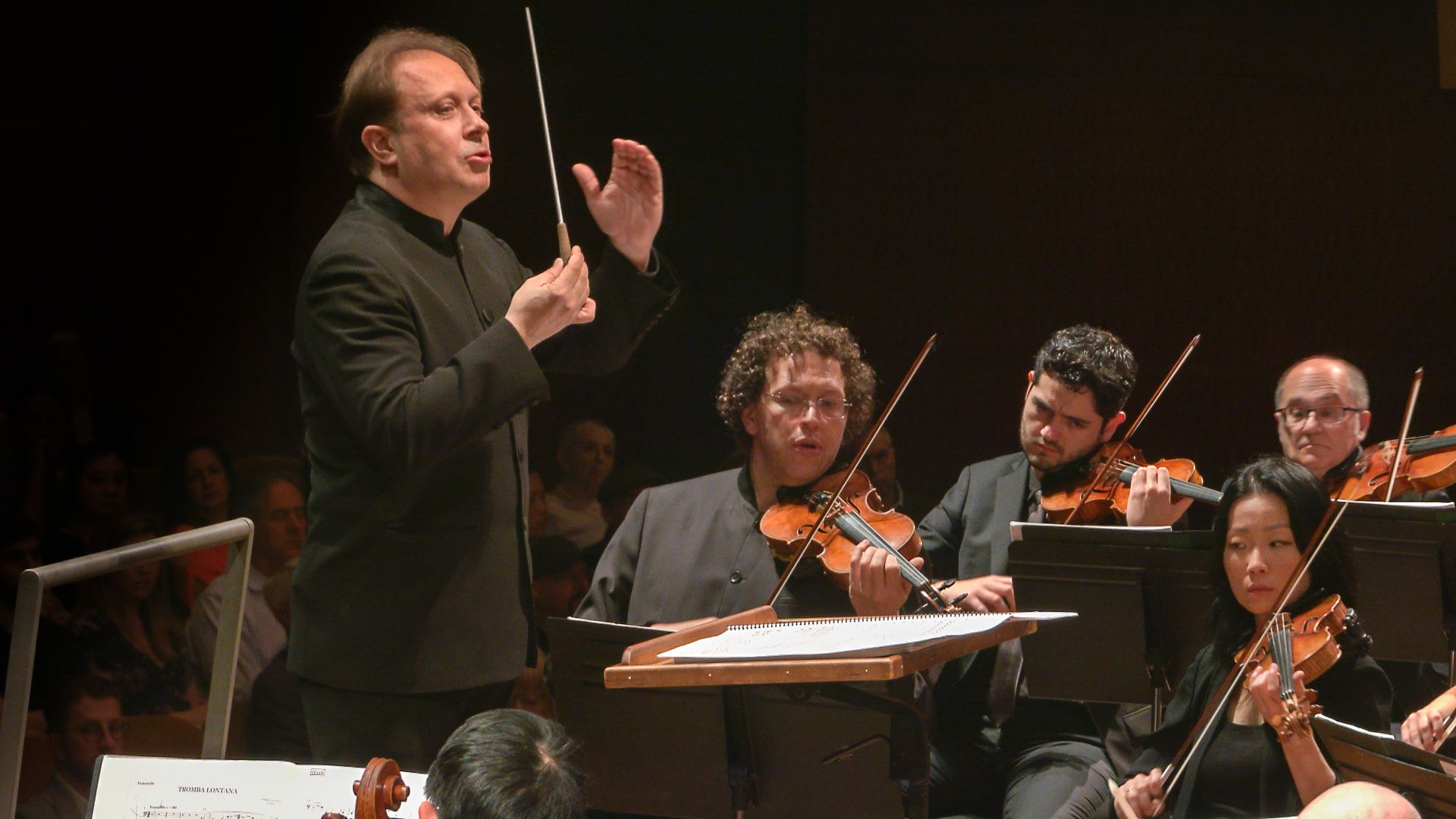
Kevin John Edusei makes his Seattle Symphony debut conducting Widmann, Strauss, and Beethoven (with Steven Osborne in the Piano Concerto No. 5 in E-flat major); image (c) James Holt
An impressive Seattle Symphony conducting debut last night with Kevin John Edusei on the podium. Absolutely captivating account of Richard Strauss’s Ein Heldenleben, exquisitely tailored to give full weight to the more introspective moments — and reminding us that there’s even a touch of self-doubt in this score. The gorgeously shaped solos from concertmaster Noah Geller were especially thoughtful, while Jeff Fair and the horn section made a spectacular contribution. Overall I found this showcase of sonic theater more moving than usual in its effect.
Scottish pianist Steven Osborne emphasized poetry over heroics in Beethoven’s Emperor Concerto — sheer loveliness in the slow movement, where Edusei’s placement of the strings (basses and cellos to his left) enhanced the finely veiled sound. Osborne played the transition into the finale as if snapping out of a dream. The unannounced encore was apparently music of Keith Jarrett — an unexpected but beautiful choice.
A clever bit of Beethoven-related programming for the opener: German composer Jörg Widmann’s Conbrio, a deliciously paradoxical parody-of-pastiche that is serious and original, never actually quoting Beethoven yet evoking his personality at every turn through abstract gestures — as if trying to recuperate what it all once meant…. Two more chances to hear this excellent concert (Sat evening and Sunday matinee).
Conductor Kahchun Wong and Chorus master Joseph Crnko with Seattle Symphony and Chorale and soloists Katie Van Kooten, Sara Couden, Thomas Cooley, and Hadleigh Adams (left to right); image (c) Jorge Gustavo Elias
Seattle Symphony performed its very first concert on this day in 1903: 24 musicians conducted by Harry F. West (details in Greg Lange’s History Link article here).
Meanwhile, the 21st-century incarnation of SSO is ringing in the New Year with guest conductor Kahchun Wong at the helm in performances of Beethoven’s Ninth Symphony. Yes, it has become cliché to do the Ninth at year’s end, but last night’s opening performance for a very full house genuinely stood out as a memorable event — particularly in comparison with the disappointments of last year’s go.
The Singapore-born Wong conducted the entire score from memory, drawing on a fascinating and idiosyncratic repertoire of gestures to communicate with the musicians: sweeping, circular motions, painterly hand waving, finger wiggles, a variety of crouching positions and leaps. It was clear how deeply he has internalized this music, allowing him to keep it flowing on multiple tracks at once. Phrases had compelling, dramatic shape, while he kept the larger arc of each movement, and of the entire Ninth, continually in view. The thunderous dive into the first movement’s recapitulation, for example, was breathtaking — a rare instance where the shift to major sounds not triumphant but catastrophic.
Especially noteworthy: Wong’s astonishing sensitive to dynamics and ability to shape and blend the sound to such fine gradations. Crescendos in the first two movements in particular were extraordinarily effective and dramatic. For the Scherzo, he opted for a somewhat more-measured tempo in lieu of the infernal machine that is frequently whipped into operation, and he likewise steered clear of the speeded-up pacing that has become fashionable for the slow movement, making a proper differentiation between the Adagio and Andante double variations. Nothing extreme, just a thorough immersion in the musical thought and feeling itself. Again, Wong’s loving attention to details of texture — the gentle throb of the violas not as accompaniment but part of the Adagio’s first theme — added immeasurably to this interpretation.
Also in contrast to last year, the Seattle Symphony Chorale sounded much better prepared and present, producing waves of glorious sound, as well as genuine mystery in the section where Beethoven re-enacts Gregorian chant — though the unnecessary use of amplification was an unfortunate choice. The soloists — soprano Katie Van Kooten soprano, alto Sara Couden, tenor Thomas Cooley, baritone Hadleigh Adams — didn’t blend particularly well, though some individual contributions made a powerful impact (especially Cooley’s exhortation in the high-flying march variation).
In Wong’s reading, only the “terror fanfare” that initiates the finale disappointed as too restrained. But his understanding of this massive structure as a miniature drama came through resoundingly, making for the finest overall Ninth I’ve heard in several years. Nothing else shares this program, so the focus is entirely on Beethoven. Even if you think you’ve heard the Ninth enough times for now, this one is worth seeking out. Wong returns to conduct Mahler’s Third in April. And judging from this success, we may be seeing a good deal more of him ….
Lee Mills and Seattle Symphony in Beethoven’s Seventh
UPDATE: This is a fantastic program and well worth seeking out this weekend. I was completely enchanted by João Guilherme Ripper’s touching, witty, sophisticated, and deliciously melodic song cycle based on the poetry of the legendary Vinicius de Moraes. Mills does a great service introducing this prolific Brazilian composer to U.S. audiences — and this is just one peek into the wealth of creativity south of the border that is routinely ignored here. Filling in at the last minute, lyric soprano Tess Altiveros brings passion and humor to her interpretations.
And Mills inspires the SSO to a refreshingly buoyant account of Beethoven’s Sixth. He closely follows the composer’s metronome markings but without sounding rushed or hectic., The result really is akin to breathing in the invigorating freshness of the countryside — and above all elicits the joyful elation of this score.
Two more chances to hear the program: Saturday at 8:00pm and Sunday at 2:00pm.
Lee Mills, who finished his tenure as Seattle Symphony Associate Conductor last season, returns this week to lead the band in what promises to be an interesting program of Beethoven and contemporary composers. We’ll hear the world premiere of Charles Corey’s Together, This Journey, commissioned and composed in collaboration with members of Northwest Center and Best Buddies (originally as part of the 2020 Beethoven Festival) and Brazilian composer João Guilherme Ripper’s Cinco poemas de Vinicius de Moraes. Written for soprano (Tess Altiveros) and orchestra, Ripper’s piece sets five poems by Moraes to sketch out the story of the poet’s life. And Beethoven’s Pastoral Symphony will complete the program.
I wrote a profile of Mills just about a year ago for Musical America.
David Danzmayr and the Seattle Symphony; photo (c) Jorge Gustavo Elias
I closed out 2022 with a review of the Seattle Symphony performing Boulanger and Beethoven:
The tradition of attending performances of Beethoven’s Ninth Symphony around New Year’s in Japan — where it is known simply as daiku — has a counterpart in Seattle. That the score’s epic journey spans such a spectrum of human experience yet culminates in a message of overwhelming affirmation makes the Ninth ideally suited for the Janus duty of casting a retrospective glance over the highs and lows of the year drawing to a close while ringing in the one just beginning with hope-filled anticipation….
Verona Quartet with Anne-Marie McDermott, photo (c) Jorge Gustavo Elias
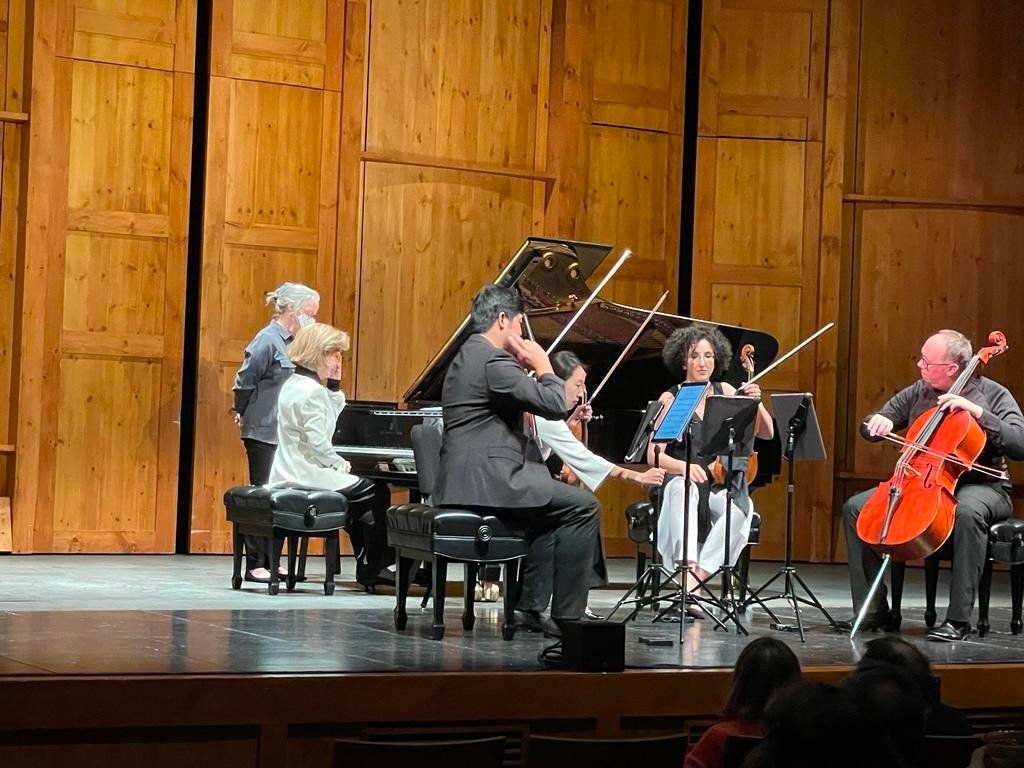
Last night I got my first sample of the chamber side of Bravo! Vail Music Festival with a smart program featuring the Verona Quartet and Artistic Director Anne-Marie McDermott at the keyboard. Puccini’s early “Crisantemi” and the first of Beethoven’s Op. 18 string quartets revealed a flair for finely calibrated ensemble balance and color, with a cross-connection of moods traced between Beethoven’s Adagio and the elegiac Puccini miniature.
For me the highlight was an impassioned performance of Samuel Coleridge-Taylor’s Piano Quintet in G minor, Op. 1 — also a youthful work, in fact written when he was only 18 — for which McDermott joined the Veronese to play the taxing, ever-present piano part with power and poise. Together they made a brilliant case for this shamefully long ignored gem, obviously enjoying the fecundity of Coleridge-Taylor’s imagination. Captivating from start to finish, this is the kind of performance that thankfully is reclaiming his work the repertoire.
And they’re off to an auspicious start… Here’s my review of opening night for Bachtrack:
Nothing could stop this show from going on — not even a popped viola string nearly midway through Béla Bartók’s grueling String Quartet no. 6 at the center of the program that opened the Seattle Chamber Music Society’s 2022 Summer Festival…
There was a lot of excitement in the air at the opening of San Francisco Opera’s new production of Fidelio, which had been delayed for a year for obvious reasons. Here’s my review for Musical America:
My colleague Rudolph Tang has created a film about the reception of Beethoven in the People’s Republic of China featuring an interview with conductor Liang Zhang, whose new Beethoven symphony cycle is the fourth recording of the complete symphonies to be made by musicians from Mainland China.
The documentary is available for free viewing until Friday here.
To mark the occasion, pianist Yael Weiss presents an all-day live marathon here, with guests from around the world, including conversations and performances of Beethoven and newly commissioned works written for the project 32 Bright Clouds: Beethoven Conversations Around the World.
PROGRAM
9am Beethoven and the Global Aspiration for Peace: Yael Weiss and the 32 Bright Clouds Project
10am World Premiere: A conversation with composer Alfred Wong from Hong Kong and the world premiere performance of his piece Passion (connected to Beethoven’s Piano Sonata no. 23 “Appassionata”).
10:30am The Moonlight Sonata and Social Justice: A conversation with Indonesian composer Ananda Sukarlan and performance of his piece No More Moonlight Over Jakarta (connected to Beethoven’s Sonata No. 14 “Moonlight”).
11am Beethoven in Myanmar: A conversation with composer Ne Myo Aung, a performance of his new piece Moha (connected to Beethoven’s Piano Sonata No. 21 “Waldstein”) and a discussion of the Burmese Sandaya piano style.
12pm A Lullaby for Beethoven: A conversation with Turkish composer Aslihan Keçebaşoğlu and a performance of her piece Ninni (connected to Beethoven’s Piano Sonata No. 28 Op. 101).
1pm African Rituals and Dedications: A conversation with South African composer Bongani Ndodana-Breen and a performance of his work Isiko: An African Ritual for Ancestral Intercession (connected to Beethoven’s Piano Sonata no. 29 “Hammerklavier”)
2pm Beethoven and a World Unheard: A conversation with composer Sidney Boquiren from the Philippines and a performance of his piece Unheard Voices (connected to Beethoven’s Piano Sonata No. 7 Op. 10 No. 3)
3pm Painting Beethoven in Afghanistan: A conversation with composer, calligrapher and painter Milad Yousufi from Afghanistan and a performance of his work Willow (connected to Beethoven’s Piano Sonata no. 8 “Pathetique”)
3:30pm New from Guatemala: A conversation with composer Xavier Beteta about his upcoming new work for the 32 Bright Clouds project Noche Profunda (connected to Beethoven’s Piano Sonata no. 5 Op.10 no. 1)
4pm Recordings of Beethoven’s Piano Sonatas, and a Bagatelles project: A conversation with music writer, composer and critic Jed Distler and performances of his Bagatelles
5pm World Premiere: A conversation with composer Bosba about music in Cambodia and a world premiere performance of her work Sovannaphum: Kosal’s Lament (connected to Beethoven’s Piano Sonata No. 11 Op. 22)
6pm After Beethoven, from Iran: A conversation with Iranian composer Aida Shirazi and a performance of her piece Aprés (connected to Beethoven’s Piano Sonata no. 26 “Les Adieux”)
7pm New from Colombia: A conversation with composer Carolina Noguera-Palau about her upcoming new work for the 32 Bright Clouds project, De Adoración Y Espanto (connected to Beethoven’s Piano Sonata no. 31, Op. 110)
7:30pm Demonstrating for Peace: A conversation with Venezuelan composer Adina Izarra and a performance of her piece Arietta for the 150 (connected to Beethoven’s Piano Sonata No. 32 Op. 111)
8pm Closing remarks and Beethoven’s final piano Sonata no. 32 in c minor, Op. 111
Milestone anniversaries are supposed to be predictable events.
And since no figure in the classical music firmament looms as large as Ludwig van Beethoven, the classical music world was counting on the composer’s 250th birthday this year as a major selling point. But coronavirus started wreaking its havoc, and countless Beethoven-related events had to be scuttled — or adapted on the fly to constraints no one could have predicted….