
On the agenda at the Boulez-Saal in Berlin tonight is this program by the West-Eastern Divan Ensemble. It’s an interesting mix of Jörg Widmann, Dvořák, Hindemith, and Enescu. My program notes here.
Filed under: chamber music, Pierre Boulez Saal

February 8, 2023 • 9:38 am Comments Off on West-Eastern Divan Ensemble Tonight in Berlin
On the agenda at the Boulez-Saal in Berlin tonight is this program by the West-Eastern Divan Ensemble. It’s an interesting mix of Jörg Widmann, Dvořák, Hindemith, and Enescu. My program notes here.
Filed under: chamber music, Pierre Boulez Saal
January 28, 2023 • 6:41 am Comments Off on SCMS Winter Festival 2023
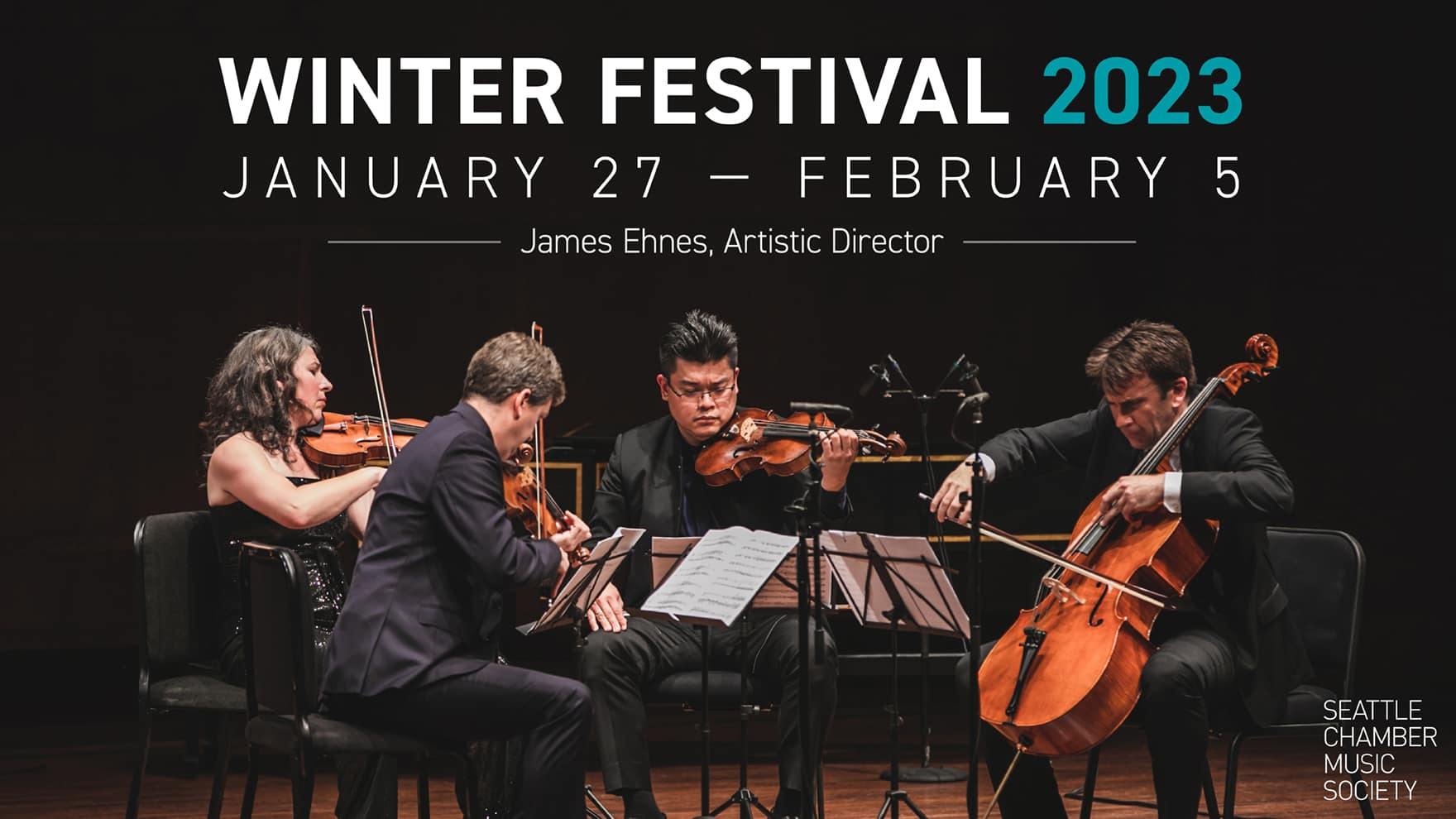
Seattle Chamber Music Society’s 2023 edition of the Winter Festival has started, presenting two weekends of chamber music by Beethoven, Fanny Mendelssohn, Ravel, William Grant Still, Julia Perry, et al. plus a new work by contemporary American composer Jeremy Turner, who is especially known for his TV and stage scores.
The second weekend of concerts includes the local premiere (Feb. 3) of Turner’s Six Mile House for clarinet, violin, piano, and cello. which was inspired by the Charleston, SC-based urban legend about Sweeney Todd-ish murders said to have been committed by an evil innkeeper couple.
SCMS Artistic Director James Ehnes will be onstage for the three concerts of the second weekend, playing works by Brahms, Shostakovich, and César Franck. And a free prelude recital is open to the public before each concert — no ticket required. Here’s the free prelude lineup:
January 27 – 6:30PM
Richard Strauss: Violin Sonata, Op.18
Arnaud Sussmann, violin
Jeewon Park, piano
January 28 – 6:30PM
Franz Schubert: Fantasie in F minor, D. 940
Dmitri Shostakovich: Piano Trio No. 2 in E minor, Op. 67
SCMS Academy Musicians
January 29 – 2:00PM
Sergei Prokofiev: Piano Sonata No. 6, Op. 82
Adam Neiman, piano
February 3 – 6:30PM
Julia Perry: Prelude
William Grant Still: Three Visions
George Gershwin: Rhapsody in Blue, solo version 1924
Andrew Armstrong, piano
February 4 – 6:30PM
Ludwig van Beethoven: Piano Trio in C minor, Op. 1 No. 3
SCMS Academy Musicians
February 5 – 2:00PM
Franz Joseph Haydn: String Quartet in F minor, Op. 20, No. 5
James Ehnes and Amy Schwartz Moretti, violins;
Che-Yen Chen, viola; Edward Arron, cello
Filed under: chamber music, James Ehnes, Seattle Chamber Music Society
December 27, 2022 • 2:38 pm Comments Off on Byron Schenkman & Friends: Beethoven, Carlos Simon, and more
Byron Schenkman & Friends continue their 10th-anniversary season with a program on Thursday, 29 December (at 7pm at Benaroya Hall), juxtaposing the piano trio format with lieder. Beethoven’s Archduke Trio, a pinnacle of the piano trio from 1810-11, will be heard alongside 2021 Sphinx Medal of Excellence winner Carlos Simon‘s luminous be still and know, a composition from 2015 inspired by an interview with Oprah Winfrey. Filling out the program are songs by Beethoven, Mozart, and Schubert featuring vocalist Martin Bakari, winner of the 2018 George London Competition.
The complete program is as follows:
be still and know for piano trio
Abendempfindung (“Evening Thoughts”) (K. 523)
Zufriedenheit (“Contentment”) (K. 473)
Du bist die Ruh (“You are Repose”) (D. 776)
Adelaide, op. 46
Allegro moderato
Scherzo
Andante cantabile, ma però con moto
Allegro moderato
Filed under: Byron Schenkman, chamber music
August 28, 2022 • 11:33 am Comments Off on Music on the Strait 2022
The 2022 Music on the Strait season began on Friday (see above) with a spotlight on the extraordinary flutist Demarre McGill, who was featured in works by Debussy and Amy Beach in the opening night program. Joining McGill were violinists Elisa Barston and James Garlick (Music on the Strait’s co-artistic director) violist David Auerbach, cellist Efe Baltacıgil, and pianist Jeremy Denk (2022 special guest artist), who will perform César Franck’s Piano Quintet in F minor.
The festival takes place on Washington’s beautiful Olympic Peninsula over two weekends, from 26 August to 3 September:
ROSTER OF 2022 ARTISTS:
VIOLIN: Elisa Barston, Kyu-Young Kim, James Garlick
VIOLA: David Auerbach, Richard O’Neill
CELLO: Efe Baltacıgil, Sæunn Thorsteinsdóttir
FLUTE: Demarre McGill
PIANO: Jeremy Denk, George Li
COMPOSER-IN-RESIDENCE: Paul Chihara
Filed under: chamber music, music news, Music on the Strait
July 26, 2022 • 10:53 am Comments Off on Chamber Music at Bravo! Vail
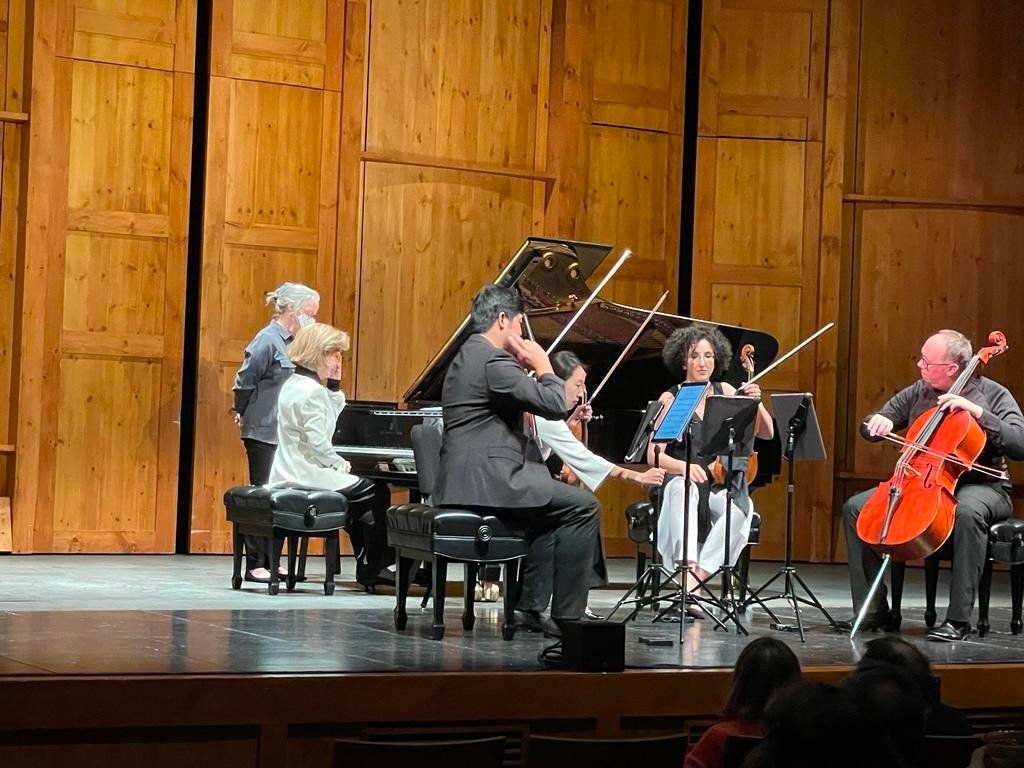
Last night I got my first sample of the chamber side of Bravo! Vail Music Festival with a smart program featuring the Verona Quartet and Artistic Director Anne-Marie McDermott at the keyboard. Puccini’s early “Crisantemi” and the first of Beethoven’s Op. 18 string quartets revealed a flair for finely calibrated ensemble balance and color, with a cross-connection of moods traced between Beethoven’s Adagio and the elegiac Puccini miniature.
For me the highlight was an impassioned performance of Samuel Coleridge-Taylor’s Piano Quintet in G minor, Op. 1 — also a youthful work, in fact written when he was only 18 — for which McDermott joined the Veronese to play the taxing, ever-present piano part with power and poise. Together they made a brilliant case for this shamefully long ignored gem, obviously enjoying the fecundity of Coleridge-Taylor’s imagination. Captivating from start to finish, this is the kind of performance that thankfully is reclaiming his work the repertoire.
Filed under: Beethoven, Bravo! Vail Music Festival, chamber music, Puccini, Samuel Coleridge-Taylor
July 1, 2022 • 1:35 am Comments Off on A Double Portrait: Johannes Brahms & Jonathan Woody
Here’s an online concert well worth taking the time to enjoy. Byron Schenkman & Friends, presents A Double Portrait: Johannes Brahms & Jonathan Woody, a program that includes the world premiere of Jonathan Woody’s nor shape of today to celebrate the LGBTQ+ community (first performed on 22 May 2022).
Also the first commission by Byron Schenkman & Friends, Woody composed nor shape of today to a text by Raquel Salas Rivera, a queer Puerto Rican and Philadelphian of non-binary gender. His new work is a response or companion piece to Brahms’s Op. 91 songs for alto, viola, and piano.
Jonathan Woodley has provided this commentary on his new work: “In composing this piece, I very much wanted to consider it a companion to Johannes Brahms’s Two Songs for Voice, Viola and Piano, op. 91. The Brahms songs deal with longing–the longing for stillness, for respite from the tormented mind, and in the case of the second Brahms song, Geistliches Wiegenlied (Sacred Lullaby), the longing of Mary to protect her child from the tribulations he eventually must face. In our twenty-first century existence, many individuals still experience a longing for a place to belong, and I was struck by the similarity between these Romantic sentiments and the experience of trans and non-binary individuals, who face relentless pressure to conform to outdated norms surrounding gender and identity in our supposedly modern world. The poet Raquel Salas Rivera writes in a deeply moving and eloquent way about these experiences, and his poetry struck me as perfectly situated to answer the Brahms songs on poems by Rückert and Geibel (a paraphrase of a poem originally in Spanish by Lope de Vega). Rivera writes in both English and Spanish, and the fluidity between the two languages was an inspiration to me in creating this song. I attempt to emulate Salas Rivera’s fluidity in gender and language by incorporating a fluidity in musical idiomatic expression; at times nor shape of today sounds like Romantic music, like Baroque music, and like music of the 21st century. While I don’t share the experience of those with trans and non-binary identities, I hoped to capture the sense of longing that so many human beings feel to belong, to be loved, and to be safe.”
Complete Program:
Intro 1:10 – Jonathan Woody: stone and steel 8:45 – Johannes Brahms: Sapphic Ode, Op. 94, no. 4 11:53 – Franz Schubert: Song of Old Age, D. 778 17:20 – Johannes Brahms: Intermezzo in A, Op. 118, no. 2 24:01 – Johannes Brahms: Lullaby, Op. 49, no. 4, for voice and piano 26:21 – Johannes Brahms: Two Songs for voice, viola, and piano 39:14 – Jonathan Woody: nor shape of today.
Filed under: Byron Schenkman, chamber music, commissions
March 19, 2022 • 1:28 pm Comments Off on Les Six-and-a-Half: Chamber Concert
On 23 March 2022, Orca Concerts series presents an evening of French and Brazilian chamber music featuring clarinetist Sean Osborn, pianist Angela Draghicescu, and Seattle Symphony musicians Ben Hausmann (oboe) and Luke Fieweger (bassoon). Titled Les Six-and-a-Half, it’s quite an interesting program: Germaine Tailleferre: Sonata champêtre (1972); Heitor Villa-Lobos: Trio for Oboe, Clarinet, and Bassoon (1921); Darius Milhaud: Duo concertante (1956); and Francis Poulenc: Trio pour hautbois, basson, et piano, FP 43 (1926).
The performance will be at the Chapel Performance Space at the Good Shepherd Center at 4649 Sunnyside Ave. N. in Seattle. Tickets General: $30, Senior: $20, Student and Under 19: FREE.
From the press release: “Les Six was a collective of composers in France in the early 20th-century, organized in part by philosopher Jean Cocteau and composer Erik Satie. Their neo-classic style of composition embraced lightness, charm, melody, and was also a reaction to the excesses of Wagner and Impressionists like Debussy. Heitor Villa-Lobos’s Trio from 1921 employs sophisticated overlapping rhythms, ostinato, and melodic fragments for an otherworldly sense of place.”
Filed under: chamber music, music news
August 17, 2021 • 7:07 am Comments Off on Music on the Strait: Opening Weekend, Part 2 (at Concerts in the Barn)

For the first time since it began in 2018, Music on the Strait (MOTS) is partnering this summer with Concerts in the Barn to present a third performance for each of the festival’s two weekends. Scheduled for Sundays in Quilcene (about an hour southeast of Port Angeles), these concerts repeat one of the Friday/Saturday programs and are available to the public on a free/pay-what-you-can basis (prior registration required).
Determined to have the full experience of MOTS both at its Port Angeles venue (Peninsula College’s Maier Hall) and at the Barn, my partner and I caught the Takács Quartet on Sunday afternoon in its repeat of Friday’s opening program. Connected with the Concerts in the Barn series is a moving story of its own involving reconciliation with the descendants of the Japanese American family who had owned the land before they were forced into internment camps in the Second World War. Alan Iglitzin, the legendary violist who founded the Port Townsend-based Olympic Music Festival and cofounded the Philadelphia Quartet, established the series in 1984 in an abandoned dairy barn at Trillium Woods Farm near Quilcene (venue pictured above and just below).
With the Takács, MOTS’s co-founder, the Grammy Award-winning violist Richard O’Neill, was able to present what he has been up to most recently as the newest member of that revered ensemble. He offered some prefatory comments recalling his epiphany in this very space, as a youngster spellbound in the audience on July 3, 1993, when he heard a performance of the Death and the Maiden Quartet and realized he wanted to spend his life making music like this. O’Neill gave a touching tribute to Iglitzin (who remains active as he heads into his 90s), pointing out how his efforts have left a lasting imprint.

We found a comfortable spot atop a hay bale for the first half and tried out the loft in back for the second; the acoustics were consistently warm, natural, direct. As far as could be ascertained, this was the first time the Takács Quartet was performing in an actual barn (though O’Neill and violinist Harumi Rhodes had individually appeared in the same space before). The relaxed setting, with audience reclining on the grass outside and listening via speakers, was inversely proportional to the intensity of involvement in the music-making (for the Takács and audience alike).
The program presented three hefty staples of the repertoire, in the process tracing a branch of the Viennese Classical tradition and an early modern offshoot. Melancholy and subdued serenity took the lead at the start of Haydn’s F minor Quartet from the genre-defining Op. 20 set of 1772.
Edward Dusinberre’s exquisite descants in the slow movement had the flexibility of first-rate jazz, blooming across the basic lilt of the siciliana, while ensemble ebb-and-pull at a breakneck pace imbued the double-fugue finale with thrilling emotion. From this kind of realization, it became understandable how Beethoven would later mine such potential from what must have seemed, to contemporaries, the hopelessly antiquated constraints of string counterpoint.
Gears were immediately shifted for Ravel’s sole essay in the genre, the early Quartet in F major from 1903, both modeled on and knowingly independent of Debussy’s contribution from a decade before. O’Neill’s rich, demonstrative viola personality — amply on display as Ravel’s writing ventures ever further into timbral experiment — was but one strand of a winningly characterful account. At one moment of mysterious tremoli, a dulcet breeze wafted through the open barn doors and across the space, a perfectly timed accompaniment.
Time and again, as in András Fejér’s superbly articulated solo work in the cello-centered variation of the second movement of the Schubert, the Takács demonstrated their winning secret of accommodating strikingly individual voices while maintaining coherence and unity of purpose as an ensemble. This is, in large part, the result of the sort of close listening that allowed such an impressive display of dynamic range and control in the Assez vif, as well as such infinite tenderness amid the tempo changes of Ravel’s slow movement.
An intriguingly balletic quality enriched the final movement. Dance of a far more dreadful vividness was the driving force in the last two movements of Schubert’s Death and the Maiden from 1824, to which the concert’s second half was devoted.

But the Takács set the stage with a surprising take on the opening movement: here, they almost downplayed the obvious drama and emphasized melodic consolation instead, clinging to Schubert’s Siren-like phrases as if to a life raft. As the afternoon sun stole through a crack in the wood above the players, a gleam briefly lit up the body of Fejér’s cello during the variation movement from which Schubert’s Quartet got its nickname; later, the whispered violin-and-viola reprise of the theme was as chilling as a prolonged death rattle.
The final tarantella kept looping back in terrifyingly relentless repetitions, a nightmare Groundhog Day with no escape in the Takács’ feverish, sweat-soaked rendition.
There is one more weekend to experience the 2021 Music on the Strait Festival; both programs feature Jeremy Denk, James Garlick, Ani Aznavoorian, and Richard O’Neill. Friday’s concert (20 August) is titled A Belated Beethoven Celebration; on Saturday (21 August), the Barn-Burning Brahms finale presents music by Jessie Montgomery, Paul Hindemith, and Johannes Brahms, which will be repeated Sunday (22 August) at 2pm as part of the Concerts in the Barn series in Quilcene.
–Review (c) 2021 Thomas May — All rights reserved
Filed under: chamber music, Music on the Strait, review
August 15, 2021 • 6:32 pm Comments Off on Music on the Strait: Opening Weekend, Part 1
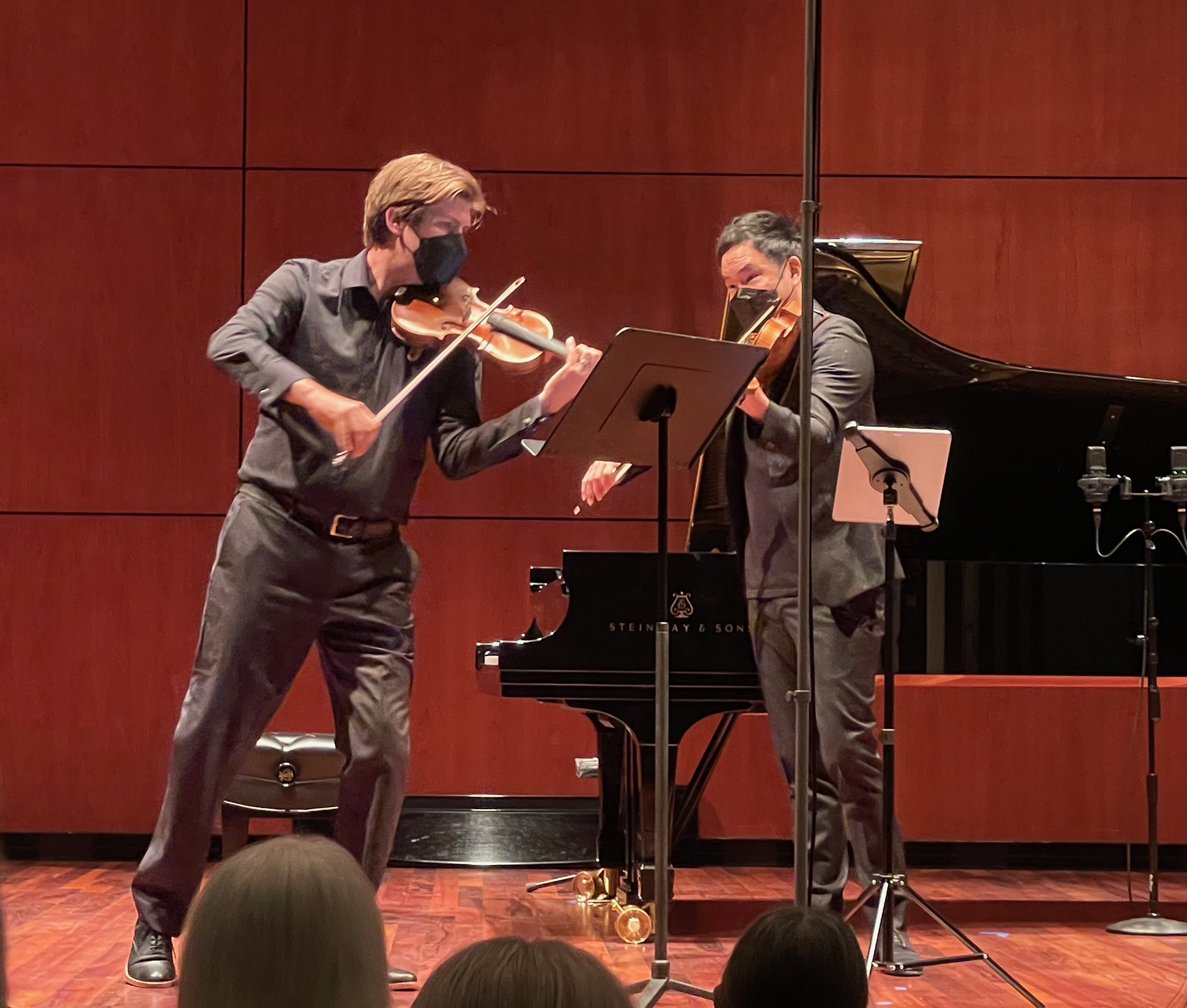
In 2018, local sons James Garlick and Richard O’Neill together founded Music on the Strait (MOTS) in partnership with the Port Angeles Symphony, as a summer chamber festival in Port Angeles. The aim is to make chamber music performed by artists of international caliber accessible to residents of the Olympic Peninsula. This marvel-filled region on the “other side” of Puget Sound — paradise for nature lovers — is surprisingly close to Seattle but vastly distant in ethos and even climate. Though only 80-something miles away, Port Angeles requires a substantial day trip from the Emerald City (via either a ferry ride or a longer detour by land).
The prolonged, silent fermata caused by the pandemic intruded after just two years of building up momentum (though Music on the Strait was able to produce two live-stream programs over the past year). Even so, MOTS pulled off an inspired and inspiring opening weekend with a return to live performance at Maier Hall on the main campus of Peninsula College located in Port Angeles. It’s a small, warm, intimate space ideal for chamber music and seemed to be pulsating with anticipation as the audience gathered on Saturday night for the second program of this opening weekend (the first I was able to catch). MOTS required vaccination cards as well as masks, and patrons effortlessly complied.
Garlick is a violinist who hails from Port Angeles itself but is currently based in Minneapolis, while the violist O’Neill, a native of nearby Sequim, has long been a regular presence at the Seattle Chamber Music Society festivals. Earlier this year, O’Neill joined the storied Takács Quartet and won his first Grammy Award for Best Classical Instrumental solo (for his recording of Christopher Theofanides’s Viola Concerto).

The two MOTS cofounders and artistic directors started off the program with a duo for their respective instruments by the Norwegian composer, conductor, and violinist Johan Halvorsen — or rather, Halvorsen’s late-Romantic elaboration on the Sarabande from Handel’s D minor Harpsichord Suite. The harmonic sequence is mighty reminiscent of the ear-wiggy La Folia craze that took Europe by storm centuries ago — hence the nickname “Handel’s Folia” — but Halvorsen’s treatment engraves the music with a tremendously “non-HIP” solemnity that requires its own historically informed practice, so distant has this Victorian era aesthetic become. It was intriguing to hear (and see) Garlick and O’Neill exchange and fuse their notably different playing styles and gestural languages.

Jeremy Denk has close ties to MOTS — he was a featured artist in the inaugural season — and he is cast in a central role in the 2021 edition as well. Though his mask made him appear slightly surreal in the heat of the moment (especially given his fondness for turning from the Steinway to glance at the audience or, later, his fellow musicians), the pianist’s gregarious, stimulating, and entertaining artistic personality was fully on display. Denk prefaced his account of J.S. Bach’s G major Partita No. 5, BWV 829, by describing it as the work of a “wicked, smiling, rambunctious rapscallion” who delighted in confounding the church elders with wild modulations and far-roaming fantasies. And that was just how he played the Partita, emphasizing every moment of wit and invention with a willful, winning eccentricity. It seemed very much of our time, of a desperate need to accentuate how music matters, even at its most playful. Amid all the frolicking, the Sarabande had a directness that was deeply touching.
Denk approached the final Gigue as if it were a study for late Beethoven (admittedly, easier to do with Bach-on-piano). Similarly, he found in Thomas “Blind Tom” Wiggins’s The Battle of Manassas a provocatively avant-garde take on program music and a fascination for sound collage and cluster chords decades ahead of Charles Ives. The piece also calls for spoken (shouted) “tags” from the pianist, with Denk briefly pulling down his mask to announce such events as the approach of the Southern Army in this extraordinary evocation of the 1861 victory of Confederate forces in the First Battle of Bull Run — a musical equivalent of the once-popular panorama paintings that were 19th-century precursors to film.
The Battle of Manassas was part of a set that included Samuel Coleridge-Taylor’s transcription of They Will Not Lend Me a Child (Op. 59, no. 4), played with spacious grandeur and an affectionately meditative account of Scott Joplin’s 1907 Heliotrope Bouquet (cowritten with Louis Chauvin), culminating in one of the North American Ballads by the late Frederic Rzewski. Denk chose Winnsboro Cotton Mill Blues, inspired by a folk song connected to the labor struggle of textile workers at a South Carolina plant in the 1930s. Rzewski’s grinding, machine-like ostinati suggested a provocative counterpart to the “Blind Tom” Wiggins piece — in both cases, Denk thundered relentlessly from the lower depths, using the keyboard to transport us inside the action. But the victory in Rzewski’s mini-epic is intensely rewarding: the emergence of song, of humanity, that hoists itself above brutal, indifferent implacability.
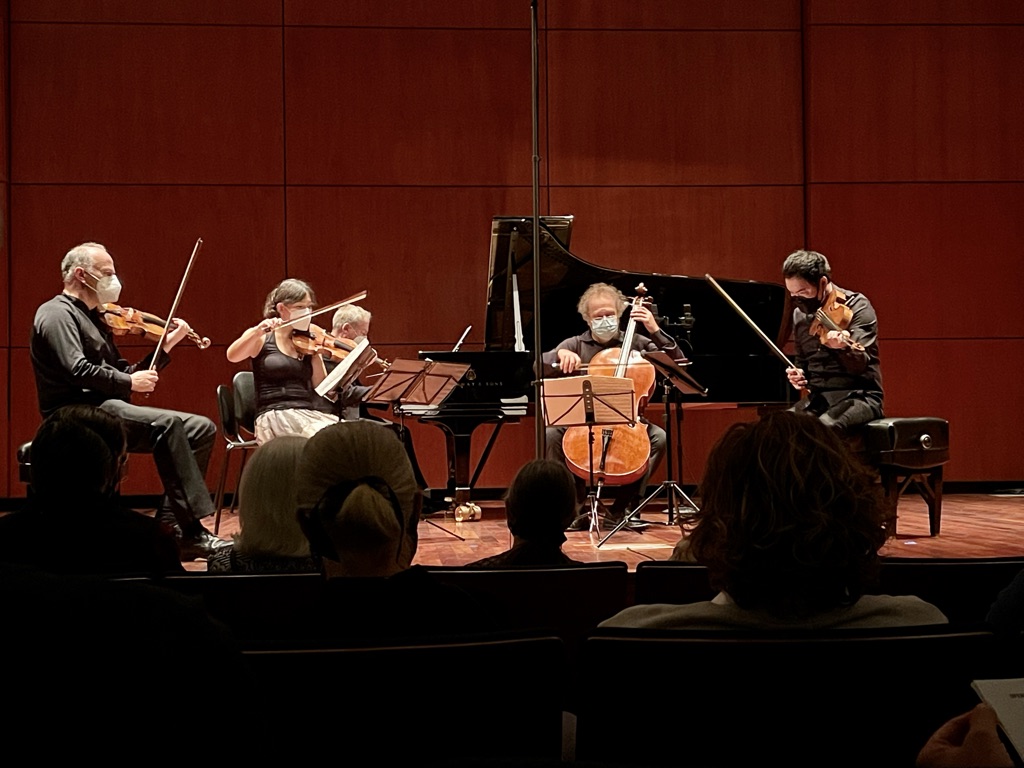
Denk joined with the Takács Quartet — another clear win for this edition of MOTS — in a deep dive into Robert Schumann’s Piano Quintet, Op. 44 (which the Takács has recorded with Marc-André Hamelin). They reveled in the enormous diversity of this pathbreaking score’s emotional terrain, at times stretching the flexibility of its language to a near-breaking point. The opening movement, with its outsize exuberance, plummeted into gloom in the funeral march that ensues and which they rendered with a powerfully effective slow burn — seemingly encapsulating the composer’s polar extremes. It’s become a challenge not to read a subtext of our recent collective suffering into these familiar musical journeys — in this case, the nervous pauses and pent-up tensions of the march seemed especially telling. The Scherzo, effusive and ebullient, helped light the way back toward a hope that took root in the finale’s polyphonic splendor, brightening into plausible joy.
–(c)2021 Thomas May — All rights reserved
Filed under: chamber music, Music on the Strait, review
March 27, 2021 • 11:02 am Comments Off on Tribute to Clara Schumann
On Sunday 28 March at 5pm PST, Port Angeles’s Music on the Strait — the Strait of Juan de Fuca, that is — presents Tribute to Clara Schumann from the shores of Lake Sutherland. The performers include co-artistic director James Garlick (violin), Saeunn Thorsteindottir (cello), Orion Weiss (piano), and Nathan Hughes (oboe). Violist and Music on the Strait co-artistic director Richard O’Neill, who just won the Best Classical Instrumental Solo Performance Grammy Award, will introduce. The concert can be accessed for free here.
Program:
Clara Schumann: Three Romances for Violin and Piano, Op 22
Robert Schumann: Three Romances for Oboe and Piano, Op 94
Johannes Brahms: Wiegenlied and Liebestreu arr. for Cello and Piano
Clara Schumann: Piano Trio, Op 17
My story for the New York Times on Clara Schumann’s 200th birthday can be read here.
Filed under: chamber music, music news
 Arts & Culture Stories from NPR
 MEMETERIA by Thomas May