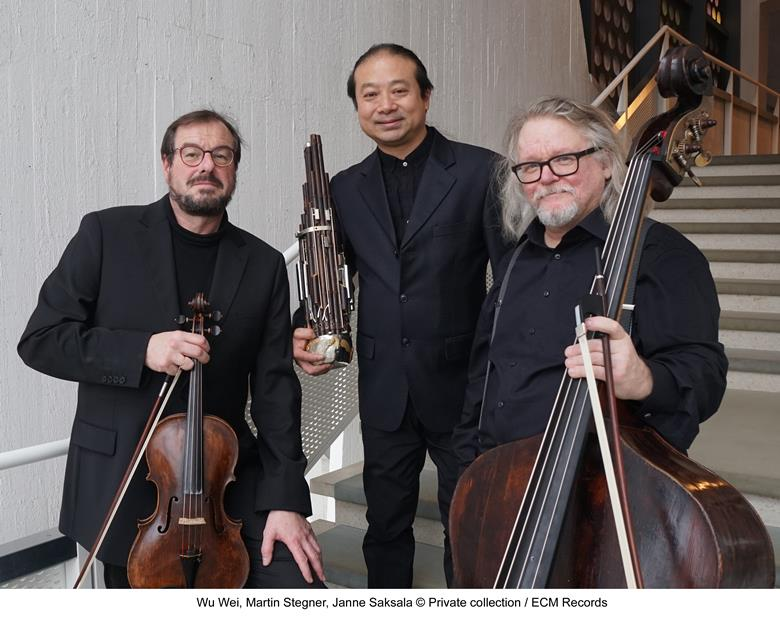
The Berliner Philharmoniker violist Martin Stegner discusses reimagining early music for sheng, viola and double bass on Pur ti miro, an ECM New Series release bringing together Wu Wei (sheng), Stegner and Janne Saksala (double bass) in an unconventional but remarkably cohesive trio. continue
Rachell Ellen Wong and MOTS co-director James Garlick
Music on the Strait is giving itsfirst-ever concert on period instrumentson Sunday 14 December in Sequim on the beautiful Olympic Peninsula. This looks to be a lovely program, featuring Baroque violinist Rachell Ellen Wong, harpsichordist David Belkovski, and their Twelfth Night Ensemble in music by Telemann, Purcell, Vivaldi, Corelli, Johann Friedrich Fasch, and Francesco Durante.
The performance is Sun 12/14 at 4pm at Trinity United Methodist Church in Sequim:
Tickets starting at $5 with our Pay What Makes You Happy pricing
Telemann | Sonata No 4 in A Minor Henry Purcell | Suite from Amphitryon Antonio Vivaldi | Violin Concerto in E Minor, RV 278 Archangelo Corelli | Concerto grosso in G minor “Christmas Concerto” Johann Friedrich Fasch | Sonata No 5 in D Minor Francesco Durante | Concerto for 2 Violins, Viola, and continuo in G Minor Antonio Vivaldi | Sonata No. 12 in D Minor, RV 63, “La Follia”
Rachel Podger with members of Tafelmusik; photo: Jorge Gustavo Elias
Early Music Seattle presented a stimulating evening with Tafelmusik and the inimitable Rachel Podger. My review for The Strad:
Early Music Seattle, the region’s principal presenter of period performance, welcomed Tafelmusik for the Seattle stop on its twelve-city tour of the North American West Coast – aptly titled ‘Brilliant Baroque’. With principal guest director Rachel Podger leading from her baroque violin, the sixteen-member ensemble offered a sequence of works shaped, in part, by an aesthetic of translation and rearrangement – whether from solo to chamber forces or from the opera stage to more intimate instrumental settings. continue
A recent performance of Bach’s “Markus Passion” in New York City featured Chatham Baroque and soloists (left to right, front row) Cody Bowers, Pascale Beaudin, Joseph Marcell, James Reese and… (Tatiana Daubek)
Sacred music lay at the heart of Johann Sebastian Bach’s creative life. His vast output includes hundreds of choral works written for the principal churches in Leipzig, Germany, where he oversaw musical programming….
Byron Schenkman, founder and artistic director of Sound Salon; photo (c) Shaya Lyon
Queer Baroque, the final program of Sound Salon’s season, salutes Pride Month with a blend of 17th-century drama and 21st-century insight to celebrate musical and personal otherness. Two performances: May 30 at 7.30pm at the Royal Room (5000 Rainier Ave S.) and May 31 at 7.00pm at the Good Shepherd Center (4649 Sunnyside Ave N.); tickets are “pay-as-you-wish, “with a suggested price of $36 and a minimum of $1.
Baroque music thrives on extremes. For harpsichordist Byron Schenkman, its emotional volatility and theatrical flair – hallmarks of a musical language that flourished in 17th- and early 18th-century Europe – hold special resonance for contemporary audiences and performers alike.
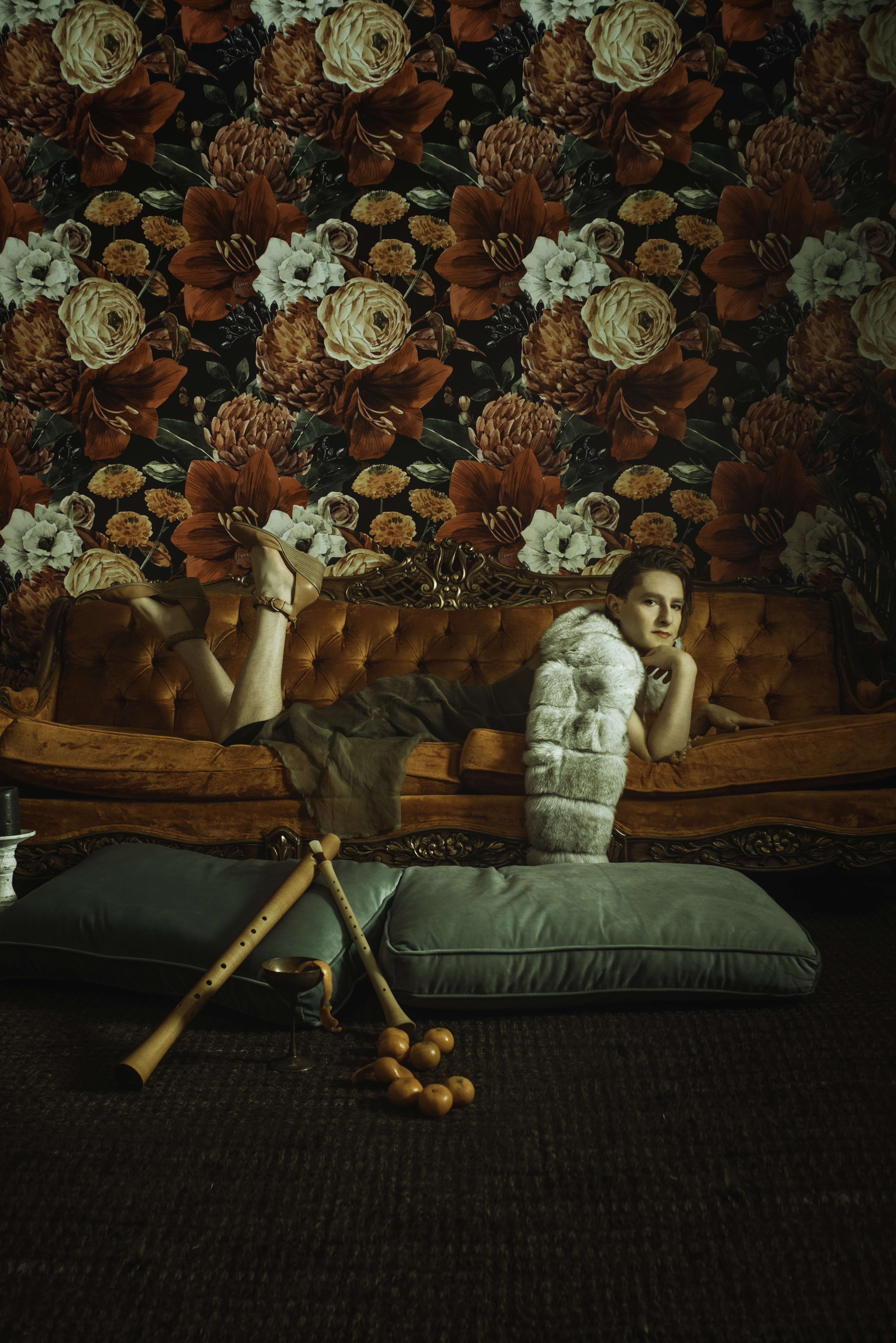
That belief underpins Queer Baroque, the final program of the season for the chamber music series Sound Salon, which Schenkman (they/them) founded and directs. They will be joined by multi-instrumentalist and composer Niccolo Seligmann (they/them) and male soprano Elijah McCormack (he/him) for two performances to mark the start of Pride Month with an imaginative – and often playful – exploration of identity and otherness through the lens of Baroque music.
The concept for the program goes back to the mid-1990s, spanning a period of profound cultural shifts – both in Seattle’s LGBTQ+ community and in the broader evolution of how queerness, and those who embody it, are seen, represented and understood.
“Thirty years ago, I helped plan a concert called ‘Queer Baroque,’ featuring musicians from Seattle Baroque Orchestra – and it nearly got canceled,” Schenkman recalls. When the presenting board at the time asked them to change the name in order to receive funding, they refused. “It generated so much buzz that the concert ended up being packed and was a big success. But one of the board members resigned over it.”
About a year and a half ago, as Schenkman began planning a version of the program updated to reflect a more expansive understanding of queerness, they assumed the moniker “Queer Baroque” no longer conveyed the edginess it once had. But in light of rising anti-LGBTQ+ rhetoric, particularly targeting trans communities, the title – and the conversation around it – feels urgent again.
Elijah McCormack
“At a time when we see ‘deviants’ scapegoated for so many social ills, I think this is an important program,” says McCormack, a transgender singer who specializes in early music. “Queer identities have been medicalized and classed as inherently disordered. It’s not new for these things to be pathologized or demonized.”
The program combines vocal and instrumental music from the 17th and 18th centuries to consider what it means to be seen as “other.” In the Baroque era, that otherness was often manifested in portrayals of madness in songs and stage works.
“This fascination with madness in the 17th century reflects a change in society’s attitude that led to people perceived as ‘crazy’ being put into institutions – behind bars – where the ‘normal’ people would come to look at them,” says Schenkman, who describes themself as “a queer Jewish keyboard player and scholar.”
By the 19th century, they add, “the idea of madness had become entangled with gender and sexuality: to be overly emotional, feminine or sexually expressive was often pathologized as insanity. Being queer, being feminine and being ‘crazy’ were increasingly seen as overlapping.”
That entanglement between emotional excess and perceived deviance plays out in several of the program’s vocal works. Barbara Strozzi’s cantata L’Astratto is a comic mad scene in which the singer cycles unpredictably through emotions and musical styles, unable to settle on one. “It’s also a kind of self-portrait of someone trying to locate themselves through art,” Schenkman says.
For McCormack, the piece culminates “in a touching sort of lament about the perils of losing yourself, even your own mind, in the love of someone else.”
He also performs Élisabeth Jacquet de la Guerre’s cantata Susanne, a retelling of the biblical story of Susanna and the Elders. “It’s so common for women – and people perceived as women – to be punished for maintaining agency over their own bodies,” McCormack says. “I imagine that, for Jacquet de la Guerre, it was powerful to set a text about a heroine who defies the entitlement of men in authority. It’s still powerful today.”
Another vocal highlight is Henry Purcell’s From Rosy Bowers, a theatrical song in which a chambermaid feigns madness to trick Don Quixote. “Here we have a woman pretending to be crazy to manipulate a character created by a male writer and composer,” Schenkman says. “It’s like putting on a drag show: playing with the stereotypes and tossing them on their heads. Some of that happens musically as well.”
Not all of the program’s queerness is textual or narrative. Some of it lies in performance choices themselves – like Seligmann playing a movement from one of Jacquet de la Guerre’s violin sonatas on the bass viol, a bowed, fretted string instrument from the Baroque era that’s typically used for lower lines. Schenkman likens the transposition to subverting gender expectations: “What’s a high voice supposed to do? What’s a low voice?”
Niccolo Seligmann; photo: Anna Schutz
“This program uses Baroque music to celebrate that queerness is not just one thing,” Seligmann says. “It’s a rich panoply of experiences that intersect with other axes of identity, including the time period.”
Seligmann, whose playing has been widely heard both in live concerts and on soundtracks like the Netflix series The Witcher, also contributes an example of their work as a composer. McCormack will sing a scene from Seligmann’s Julie, Monster: A Queer Baroque Opera, inspired by the life of Julie d’Aubigny (1673-1707), a genderfluid opera diva and swordfighter. Seligmann describes the excerpt as “a queer seduction aria that proposes more egalitarian ways of sharing intimacy,” connecting Julie “with a herstory of gender rebels” and today’s audiences “with queer ancestors for us to honor and celebrate.”
For Schenkman, who has long blended scholarship with activism, the concept of “Queer Baroque” continues to resist classification. “We’re all a little queer, and a little not,” they say. “The problem isn’t difference. The problem is pretending there’s only one normal way to be. I want whoever’s in the room to enjoy looking at different ways people diverge from norms – and celebrate it.”
From left: Debra Nagy, Tekla Cunningham, Danielle Reutter-Harrah, David Morris, Tyler Duncan and Ross Gilliland perform at the Whidbey Island Music Festival, founded and directed by Cunningham. Cunningham is also founder and director of the new… (Dennis Browne)
The brilliant violinist, artistic director, and educator Tekla Cunningham has been extra-busy of late laying the groundwork for a promising new venture that launches this weekend. I had the privilege to speak with Tekla about the inspiration behind the Seattle Bach Festival:
For Tekla Cunningham, music happens in the connections — not only between the notes but between the humans who produce and experience them. … continue
In March, Xian Zhang will conduct Seattle Symphony in Gustav Holst’s “The Planets” — her first program with the orchestra since she was announced as its next music director. (Courtesy Seattle Symphony)
Here’s a brief list of suggestions — far from exhaustive — for Seattle area music lovers for the first months of 2025:
Stepping into a new year means embracing its promises but also facing its challenges. Fortunately, the performing arts offer a reliably inspiring source of motivation. Following are some recommendations — by no means exhaustive — of classical music events to mark on your calendar for the coming months. May you find them inspirational in the new year…. continue
Lionel Meunier and his vocal and period instrument ensemble Vox Luminis make their Pacific Northwest debut this weel with a program of sacred music by Claudio Monteverdi. Presented by Cappella Romana, there will be performances in Portland on 6 November and in Seattle on 7 November, both at 7.30pm (St. Mary’s Cathedral in Portland and St. Demetrios Greek Orthodox Church in Seattle); tickets here.
French conductor and baritone Lionel Meunier counts among the most influential figures in today’s historical performance and choral scenes. He founded Vox Luminis (“Voice of light”) in Belgium in 2004, having studied at the Institut Supérieur de Musique et Pédagogie in Namur.
Vox Luminis comprises a core ensemble of vocal soloists specializing in English, Italian, and German repertoire from the 17th and early-18th centuries; depending on the repertoire, they are supplemented with solo instruments, an extensive continuo, or a complete orchestra.
Artist in residence at Concertgebouw Brugge, Vox Luminis has earned international acclaim for its signature sound, with each voice emerging in a solo light while being able to fuse with the others “into one luminous fabric of sound.” The ensemble performs some 70 concerts a year and boasts an award-winning discography.
Meunier has put together a program of sacred music by Monteverdi, mostly from his later collection Selva morale e spirituale (“The Virtuous and Spiritual Forest”), which was published in 1640-41 in Venice. They will also present a couple of motets and the instrumental and vocal versions of the echo motet O bone Jesu o piissime Jesu (“O good Jesus, have mercy on us”).
PROGRAM:
Gloria (SV 258) from Selva morale e spirituale
Dixit Dominus II (SV 264) from Selva morale e spirituale
Beatus vir I (SV 268) from Selva morale e spirituale
O bone Jesu o piissime Jesu (SV 313) (instrumental version)
Adoramus te Christe (SV 289) from Libro primo de motetti, Giulio Bianchi
Cruxifixus (SV 259) from Selva morale e spirituale
Laetaniae della Beata Vergine (SV 204) from Libro secondo de motetti, Giulio Bianchi
O bone Jesu o piissime Jesu (SV 313) (vocal version)
Magnificat I (SV 281) from Selva morale e spirituale
Claudio Monteverdi was born in Cremona, the son of a surgeon and apothecary. Although there is no record of him being a member of the city’s cathedral choir, the young Monteverdi received his first composition lessons from its maestro di cappella Marc’Antonio Ingegneri, whose teachings he acknowledged in his first publications.
Monteverdi was clearly a precocious talent. His first publication, the three-voiced Sacrae cantiunculae (1582), was printed when he was just 15 years old. After attempts to find employment in Verona and Milan, he was eventually appointed as a viol player at the court of Vincenzo I Gonzaga, Duke of Mantua. It was in Mantua that he first began to experiment with the contemporary forms of liturgical music and develop a novel approach that united elements of the musical past and present, while offering glimpses of the future. This balance between tradition and innovation was epitomised in his much-loved Vespro della BeataVergine of 1610. His compositional achievements undoubtedly helped him in 1613, when he advanced to the prestigious post of maestro di cappella at Venice’s Basilica di San Marco, where he would remain until the end of his career.
The majority of the repertoire contained within this programme is drawn from three publications: the Selva morale e spirituale(‘Moral and Spiritual Forest’), published in 1640, and Giulio Bianchi’s two books of motets, both of which were published in 1620. The Selva morale e spirituale was a retrospective anthology that drew together some of his most innovative and successful music from his time in Mantua alongside his more recent Venetian work. It includes a mass, several psalm and Marian hymn settings, as well as two separate Magnificats. Bianchi was a cornettist and composer, who was also born in Cremona and led the wind band at Mantua alongside Monteverdi.
The seven-voiced setting of the Gloria is thought to have originally been part of a large-scale mass written by Monteverdi in 1631 to commemorate the end of the Italian Plague of 1629-31 (also known as the Great Plague of Milan). The plague brought great devastation to northern Italy and is thought to have killed up to 50,000 people in Venice alone. Monteverdi divides the Gloria into five distinct sections, closely following the sense of the text. Over the course of the piece, individual voices and pairs of voices emerge from the main texture with flashes of rapid coloratura, to participate in a compelling musical dialogue with the violins.
Dixit Dominus is the first psalm of the evening office of Vespers on Sundays and feast days. As part of the San Marco liturgy, Vespers services on special occasions saw the uncovering of the Pala d’Oro, the exquisite gold high altar at the far east end of the church. To accompany this, sixteenth-century Venetian composers normally produced lavish eight-voice, double-choir settings of the Dixit Dominus. While this second setting by Monteverdi is scored for eight voices, he does not stick to a rigid division between two ensembles. Instead, he uses the forces in a series of different combinations to depict the psalm’s lucid imagery — for example, using the full ensemble to terrifying effect in the stile concitato (‘agitated style’) section at the words Confregit in die irae suae reges (‘The Lord shall strike through kings in the day of his wrath’), but then suddenly paring back, in complete contrast, to a pair of soprano voices for the beginning of the following verse.
One of Monteverdi’s best-known later sacred works, Beatus vir (his first of two settings of Psalm 111) was actually based on a secular canzonetta Chiome d’oro, which was included in his Seventh Book of Madrigals (1619). In Beatus vir, Monteverdi borrows the charm and naïveté of his earlier work, originally addressed to the beauty of a lover’s physical features, to convey the blissful assurance of the faithful man that fears God and obeys his commandments.
Adoramus te, Christe was included in Bianchi’s first book and is a simple but heartrending setting of a text from the Hours of the Cross in devotional Books of Hours. Its opening statement, ‘We adore you, O Christ’, is tinged with bittersweetness, effected by Monteverdi’s unconventional use of dissonances, but the closing statements of Miserere nobis (‘Have mercy on us’) bring comfort and solace in the ending.
In addition to the simple four-part mass setting published in the Selva morale, Monteverdi also includedsome more modern alternative settings that could be substituted for sections of the mass. This short Crucifixus setting is one such alternative. It is cast in a much more modern style, with its descending chromatic line giving it a distinctly different character to the ordinary of the mass, which remained very consciously within the parameters of the stile antico.
There was a conspicuous increase in expressions of Marian devotion in Venice from 1571, after the city’s victory over the Turkish navy at the Battle of Lepanto, with Pope Pius V attributing the victory to the intervention of the Virgin Mary. As part of this, musical settings of the Litany became popular. Monteverdi’s setting of the Litany of Loreto, the Litaniae della Beata Vergine, was printed in Bianchi’s second book. Between the opening Kyrie eleison and the closing Agnus Dei, the Litany consists of a sequence of invocations addressed to the Trinity and then to Mary, as mother, virgin, saint and queen. The music is relatively simple and it is likely the piece was intended to be sung in procession.
O bone Jesu was actually first printed outside Italy, in a collection entitled Promptuarii musici issued by the German composer Johannes Donfrid in Strasbourg in 1622. A simple setting for two sopranos and continuo of a devotional hymn text, it is an example of the so-called ‘echo motet’, whereby the first voice sings a phrase that is immediately repeated by the second voice, before the pair join together to elaborate and extend the melodic materials. Growing out of a fairly sparse opening, the piece builds cumulatively in intensity, culminating in the final invocation, Salva me (‘save me’).
Following the five psalms at Vespers, the Magnificat featured as the centrepiece of the liturgy, being sung as the altar was censed. This eight-voice setting is the first of two contained within the Selva morale e spirituale.Breaking the text down into a series of standalone sections, Monteverdi explores its vivid imagery in a number of fresh ways. The stile concitato is introduced once again with the words Fecit potentiam in brachio suo (‘He hath showed strength with his arm’). In juxtaposing these modern forms of expression with elements of the musical past, in the shape of short fragments of plainsong and imitative polyphony, Monteverdi demonstrates his unique ability to make the unfamiliar seem somehow familiar. These truly immersive soundworlds must have been utterly entrancing to seventeenth-century ears — but they remain no less captivating to contemporary audiences.
Sound Salon (the series formerly known as Byron Schenkman & Friends) has a lovely program coming up Sunday evening: English Baroque love songs for voice, oboe, viol, and harpsichord. Sweeter than Roses (the title of the program, taken from a Henry Purcell song), presents soprano Grace Srinivasan, oboist Curtis Foster, Adaiha MacAdam-Somer on viol, and artistic director Byron Schenkman on harpsichord in music not only by Purcell and Handel but by such less-familiar figures as Elisabetta de Gambarini, John Stanley, and William Babell (all associated with Handel’s work), as well as by Thomas Arne and Ignatius Sancho, who escaped enslavement and became “a successful businessman, published author and composer, and champion for the abolition of slavery,” as Schenkman notes.
Seattle Baroque Orchestra offers a program this weekend of J.S. Bach cantatas. Titled Jubilation and Redemption, the concert features the Portland-based soprano Arwen Myers as the soloist in Jauchzet Gott in allen Landen, BWV 51, and Mein Herze schwimmt im Blut, BWV 199, with SBO’s Baroque trumpet expert Kris Kwapis directing the ensemble. Part of the Early Music Seattle season, the concert takes place Saturday 4 November at 7.30pm at Bastyr University Chapel and Sunday 5 November at 2pm at Nordstrom Recital Hall at Benaroya Hall.
Kris Kwapis on Bach’s cantatas as a “treasure trove for trumpet”:
While a fair number of monumental works written by J. S. Bach are among the typical Baroque canon, at least among the reach of the enthusiastic readers of this blog, specific works among the catalog of cantatas tend to be lesser known and subsequently not as frequently programmed. Most attentive audience members are at least familiar with the larger pieces such as the Mass in B Minor, Magnificat, and Christmas Oratorio, which, of course, are outstanding works of art that also happen to have wonderful (and delightfully challenging!) trumpet parts. But the cantatas, perhaps because Bach wrote around 300 during his lifetime, are sometimes overlooked….



 Tickets starting at $5 with our Pay What Makes You Happy pricing
 free Livestream on the MOTS website at




 MEMETERIA by Thomas May