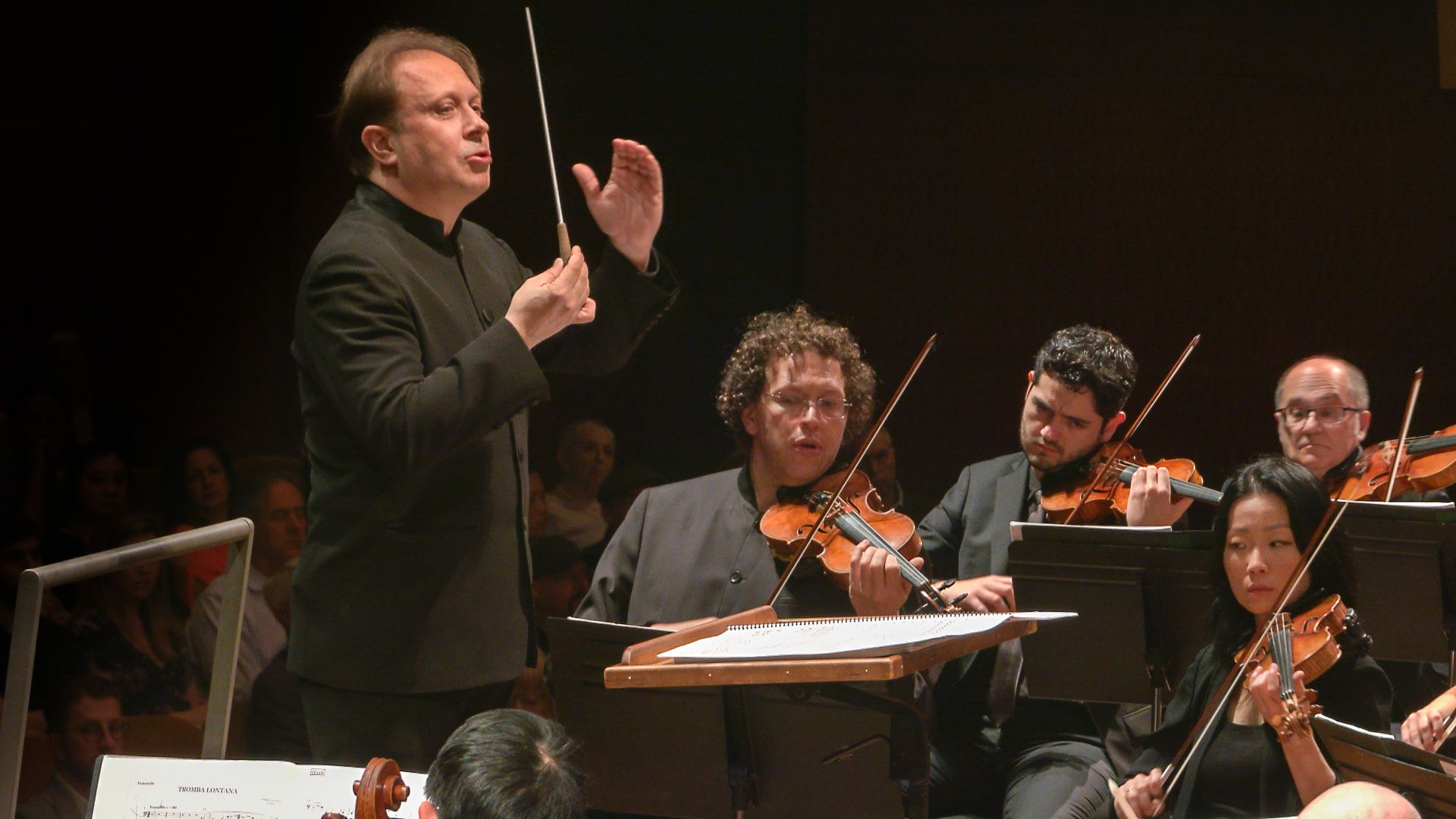
Ludovic Morlot conducts the Seattle Symphony, with soloist Demarre McGill
With Seattle Symphony on the cusp of a new chapter – music director designate Xian Zhang takes the reins in September – this season-closing program offered a vivid snapshot of the ensemble’s artistic breadth. …
Ludovic Morlot’s return to Seattle Symphony during the first month of this already profoundly troubled year has been a balm, offering some reassuring proofs of music’s ability to uplift in times of uncertainty and upheaval. Earlier in January, he led members of Seattle Symphony at Seattle Opera in an immersive account of the second part of Les Troyens, the grandest and yet most personal of Berlioz’s masterpieces at Seattle Opera.
Even without full staging, this performance of the “Carthage” part of the epic opera was spellbinding from start to finish. Incredibly, Seattle Symphony’s conductor emeritus insisted on continuing with the engagement despite losing his home and entire musical archive to the recent wildfires in the LA region.
The connection they made with Berlioz’s multi-dimensional score turned out to be the perfect preparation for this weekend’s all-French program back in the concert hall. Fauré’s Suite from Pelléas et Mélisande instantly brought back treasured memories of Morlot’s early years with the orchestra. (They recorded it on their all-Fauré album on Seattle Symphony’s in-house record label in 2014.)
Morlot also reminded us of his commitment to contemporary composers. It’s always a risk-taking venture, but one that during his tenure resulted in some wonderful new music by John Luther Adams, for example. He led pianist Jean-Yves Thibaudet and principal harp Valerie Muzzolini in the world premiere of Hanoï Songs, a duo concerto commissioned from French composer Benjamin Attahir that strives for a Ravelesque combination of fantasy and meticulous clarity.
The best part of the program was the all-Ravel second half. Introduction and Allegro, written as a showpiece for the double-action pedal harp, benefited from Morlot’s gently fluctuating sonic choreography, subtly balancing ensemble and soloist. Muzzolini, now fully in the spotlight, played with luminous charm.
Morlot then led the orchestra in the complete Mother Goose — not just the suite but the expanded ballet score that Ravel fleshed out with connecting material to create a more coherent sense of narrative. It was sheer bliss to experience how deftly Morlot conjured each atmosphere, leaning into exquisite sound colors that were both transparent and intricate while articulating the score’s rhythmic subtleties with grace. The musicians played with rapt attention and obvious enjoyment.
Much more than an endearing string of fairy-tales, Morlot’s MotherGoose conveyed an opera’s worth of emotions, along with a sense of tonal refinement that has deepened and matured. The concluding “Enchanted Garden” at times even radiated an almost “Parsifal”-like serenity that, for some precious minutes, kept the chaos outside at bay.
Ludovic Morlot conducting the Seattle Symphony; photo courtesy of the Seattle Symphony
For their second-to-last program of the season, the Seattle Symphony added John Adams’s early breakthrough Harmonium to its repertory with a breathtaking performance led by Conductor Emeritus Ludovic Morlot. During the 1970s, Adams had been building a reputation as an experimental composer doing his own thing in the Bay Area. He had become an advisor on contemporary music to the San Francisco Symphony’s then-music director Edo de Waart and received a commission to write a big choral-orchestral piece to help the orchestra celebrate its first season in Davies Hall, SFO’s new home across the street from the War Memorial Opera House. The premiere in April 1981 was a sensation that launched Adams on his path toward international stardom.
In his guise as a conductor, Adams has paid multiple visits to Seattle to lead the musicians in various of his own compositions and regards the SSO as “an excellent orchestra.” So it was especially satisfying to finally hear the collective forces of the SSO and its Chorale perform this pivotal work from more than four decades ago for the first time.
As it happened, I’d just come from hearing the original septet version of Adams’s 1978 piece Shaker Loops the week before at the Ojai Music Festival (performed by members of the visiting Mahler Chamber Orchestra, with fresh birdsong obbligato from the trees surrounding the outdoor Libbey Bowl). Adams had adopted the idioms of Minimalism in his distinctive, “impure” way in Shaker Loops and does something similar in Harmonium, but working for the first time with the much larger canvas of symphony orchestra and chorus. It was interesting to notice that some of the DNA of Shaker Loops is still present in varied form in Harmonium. At the same time, aspects of the signature language Adams would go on to develop (mostly orchestral, but in some respects choral as well) also appear in this score — certain timbral gestures from the tuned percussion, a shine that anticipates Grand Pianola Music (1982), or the stirring choral “pillars” found in the operas.
But the very fine performance led by Morlot kept me from falling into the trap of viewing a great artist’s early work merely contextually, as a launching pad toward future greatness. Harmonium proved completely compelling on its own terms, a splendidly structured choral triptych that conveys states of transcendence, serene contemplation, and unbridled joy.
Adams initially considered setting texts from the Wallace Stevens collection called Harmonium and then thought of writing for a wordless chorus, relying on their pure sounds, before he found a basis for what he imagined — “human voices — many of them — riding upon waves of rippling sound in John Donne’s “Negative Love” and two poems by Emily Dickinson: “Because I Could Not Stop for Death” and “Wild Nights.”
Morlot showed his sensitive understanding of Adams’s dramatic use of sudden harmonic modulations — at this stage in his career, the composer had been likening it to the process of “gating” in electronic music — and shaped the sense of progressive revelation via negation in the opening Donne section with a tenacious clarity.
The Chorale, excellently prepared by Joseph Crnko, encompassed an enormous sonic spectrum, from mystic whispers to ecstatic, Whitmanesque yawping that sent shockwaves crashing through Benaroya Hall. (Fittingly, the concert had begun with Tromba lontana, an “anti-fanfare” from 1986 in which the composer uses a pair of trumpets to sound an elegiac rather than military mood, calling to mind Whitman’s poem “The Mystic Trumpeter.”) Adams’s guiding image of surging waves of sound came to life most thrillingly in the final “section”Wild Nights” movement, a drastically contrasting juxtaposition with Dickinson’s death meditation preceding it.
Seattle Symphony Chorale plus part of the fabulous SSO brass section; photo courtesy of the Seattle Symphony
One of the most unforgettable moments in Harmonium is the seamless transition between the polar Dickinson poems, in which Adams builds up an irresistible, orgiastic flow of momentum. Beethoven’s Fifth Symphony, which occupied the second half of the program, happens to offer a plausible parallel in the musical “tunnel” that interlinks its last two movements.
Curiously, the program on which Harmonium was given its world premiere in San Francisco also involved a Beethoven pairing: in that case, with the Emperor Piano Concerto No. 5 — a work whose aura Adams confronted the next year in his wonderfully over-the-top Grand Pianola Music. On this occasion, Morlot — in his first reunion with the SSO since the sadly under-attended opening night of the season last September — approached the Beethoven with a clear sense of proportions and architecture. And with a bigger, more-rounded sound overall than in his Beethoven interpretations of several years ago, when he was music director.
Morlot held back from imposing an “interesting” perspective on the score, following Beethoven’s command of a single eighth-note rest between the first two statements, for example. He followed all of the repetitions — including, a bit surprisingly, even in the Scherzo. Still, the vision that emerged was more finale-centric, it seemed to me, with the terseness of the opening movement as a mere station on the way forward rather than an existential state. Despite brisk tempi, Morlot shaped the eccentrically long-spun melody of the Andante’s main theme with style and drew a magnificent dark sheen from the strings in particular, with bold strokes in the finale.
If aspects of the Scherzo felt understated, Morlot steered clear of the feeling of anti-climax that deflates so many renditions of the finale. The return of the ominous Scherzo music actually felt surprising, and the insistent paragraphs of C major brought to mind something of the French Revolutionary era music that was a clear inspiration for the young Beethoven.
Ludovic Morlot conducts the SSO and soprano Alexandra LoBianco in excerpts from Götterdämmerung; photo (c)Brandon Patoc
My Bachtrack review of opening night at Seattle Symphony, which paired pieces played on the orchestra’s first-ever concert in 1903 and at their concert inaugurating Benaroya Hall 25 years ago. The fact that about two-thirds of the seats remained empty didn’t dampen the musicians’s spirits, but what a pity that so many missed out on a substantial, gloriously played program — not the lineup of frothy showpieces that orchestras so often put together for their season curtain raiser.
Review:
Though it ended with the downfall of a whole civilization, the Seattle Symphony’s opening-night concert radiated the excitement of a brand new season just getting under way, with all its attendant fresh hopes.
Ludovic Morlot conducting the Seattle Symphony with soloist Jan Lisiecki in Grieg’s Piano Concerto; image (c) Brandon Patoc
Several times during Seattle Symphony’s concert last night, it felt like a time machine had whisked us back a few years to the Ludovic Morlot era. The orchestra reunited with its former music director last weekend on opening night and is continuing the collaboration for the first full concert of the season’s subscription series. And they’ve managed to reactivate something of the chemistry that made their first seasons together so exciting.
You could sense it in the joyful enthusiasm with which they brought to life the opening piece, Tidalwave Kitchen, by Gabriella Smith. For the second time in a row this month, Morlot and the SSO launched a concert with music by a young woman composer inspired by the West Coast’s natural beauty — last Saturday, it was the world premiere of PNW native Angelique Poteat’s Breathe, Come Together, Embrace. So far as I know, Tidalwave Kitchen marked the first time the SSO has performed music by Smith, who hails from Berkeley and was mentored early on by John Adams.
In a short introduction onstage, the talented young composer remarked that it was in this piece that she first had the reassurance of arriving at her own voice. Smith wrote it a decade ago, prompted during her student years on the East Coast by intense homesickness for the “beautiful and dramatic landscape of the Northern California coast” where she’d grown up.
Smith elaborates in her composer’s note on the memories of that landscape that inspired her: “hikes shrouded in fog, tide pooling on the rocky beaches, and sitting by the Pacific listening to the hallucinatory sounds of the ocean, the keening gulls, pounding surf, sizzling of sand and sea foam, drifting in and out of fog and clarity, order and randomness, reality and imagination.”
The resulting music paints no pretty postcard but is an immersive, sensory-rich orchestral fantasia, unpredictable yet persuasive in its wildly dramatic mood swings. Smith seems to want to embrace the world the way a Mahler born into the 21st century might have set out to do so, using post-Minimalist devices to power up and take flight.
Fragments of a stable melody (or hymn?) want to coalesce at several points but remain shrouded by the almost-psychedelic haze of Smith’s timbral palette. A raucously festive outburst arrives at the climax, but its brash exuberance spills over into something vaguely ominously manic and then subsides.
Over the summer, Morlot conducted the San Francisco Symphony in Tidalwave Kitchen, and he elicited palpable excitement from the SSO. It’s one thing to possess the keen musical imagination on display in this music, but Smith also shows a remarkable technical command of the resources of an orchestra, making the piece especially apt as a concert curtain raiser. I hope we get to hear more of her music in Benaroya Hall.
Morlot will conduct his new orchestra (the Barcelona Symphony) in another piece by Smith later in October. Incidentally: this sought-after composer will be on the panel for the New York Times Events-sponsored seminar A New Climate exploring collective responses to climate change (October 12 in San Francisco).
Raucous, fiery energy likewise abounded in Jan Lisiecki’s account of the competitive folk dancing that drives the finale of Grieg’s Piano Concerto. Returning to the Benaroya stage following his inspired contribution to the opening night concert, Lisiecki approached the familiar concerto from an almost dizzying plenitude of perspectives.
His variety of tonal colors was spellbinding: the thunderous chords of the massive first movement cadenza thrilled with power and accuracy, while the plaintive trains of the Adagio breathed the poetry of Lisiecki’s most personally inflected Chopin. It was especially nice to hear his rendition of Chopin’s posthumously published Nocturne in C minor as an encore, where he distilled that poetry to its most concentrated essence. I was also struck by the quality of his partnership with Morlot and the orchestra as he responded to the phrasings of individual players, such as the idyllic interlude flutist Jeffrey Barker shaped in the finale.
The extreme pianissimos Lisiecki drew out of the Steinway foreshadowed the drama whipped up in the second half of the program. Morlot led the SSO in Tchaikovsky’s PathétiqueSymphony back in 2014 (when it was similarly paired with new music — a piano concerto by Alexander Raskatov). Eight years on, to my ears there is no doubt that his understanding of this music has deepened and darkened. His command of the larger span of Tchaikovsky’s design has strengthened as well.
The opening lamentation — expressively phrased by bassoonist Luke Fieweger, in one of several outstanding cameos from across the SSO’s ranks — set the terms of the drama as effectively as a memorable establishing shot by a seasoned director. Morlot outlined the long first movement’s disparate sections with a clarity that underscored the emotional polarities of Tchaikovsky’s enigmatic final symphony.
However, I found something lacking in the middle movements. The tricky meter of the second movement waltz came off sounding slack, even a bit sloppy, while the swaggering march in the third movement needed a tighter rein to wield its full irony. But Morlot inspired the most moving playing of the evening in the Requiem-like finale, building by subtraction so that the pitiless subsidence of Tchaikovsky’s conclusion overwhelmed with its negation.
The program will be repeated Friday and Saturday.
Review (c) 2022 by Thomas May. All rights reserved.
Former Seattle Symphony music director Ludovic Morlot returned to conduct Messaien’s ‘Des canyons aux étoiles…‘ (Photos by James Holt / Seattle Symphony)
I reviewed an extraordinary (and rare) performance of Messiaen by Ludovic Morlot and Seattle Symphony for Classical Voice America:
SEATTLE — For their recent reunion, Ludovic Morlot and the Seattle Symphony put aside the familiar repertoire to offer a program devoted entirely to Olivier Messiaen’s vast, 12-movement work inspired by the landscape of the American West, Des canyons aux étoiles…. The experience was blissfully unique, reminiscent of similarly rare outings during Morlot’s eight-year tenure as music director (2011-19) that have not faded from memory: a riotous Varèse Amériques early on, the collaborations with John Luther Adams, semi-staged Ravel and Stravinsky — and, indeed, other Messiaen performances, including the orchestra’s first encounter with the Turangalîla Symphony….
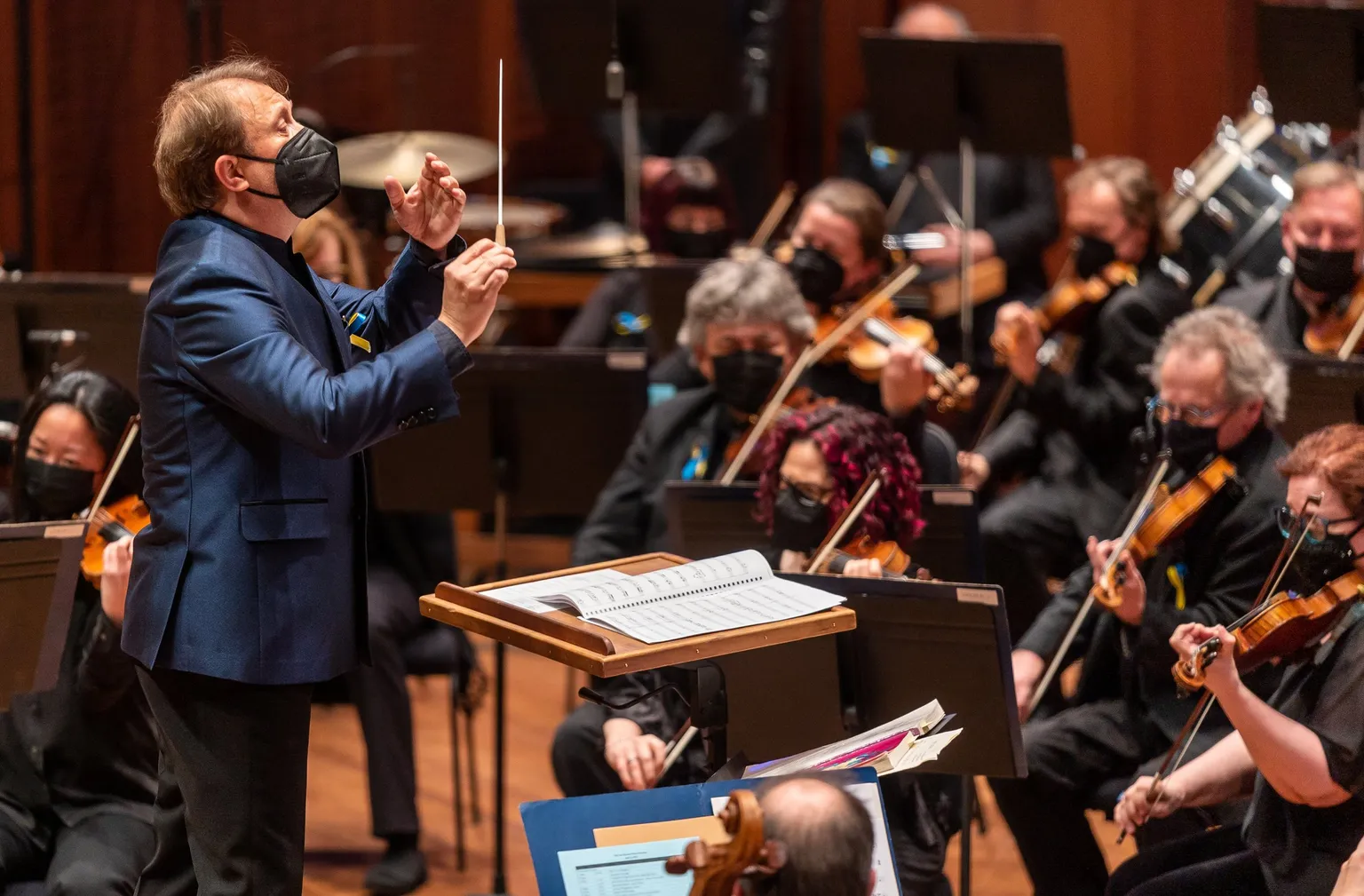
Ludovic Morlot conducts the Seattle Symphony in The Mayors’ Concert for Ukraine and Refugees Worldwide earlier this year. (James Holt / Seattle Symphony)
Tonight Ludovic Morlot rejoins the Seattle Symphony for the first of two performances of one of Messiaen’s Des canyons aux étoiles… I spoke to the conductor about the program for The Seattle Times:
A new chapter in Ludovic Morlot’s relationship with the Seattle Symphony is underway.
Now holding the title of conductor emeritus, Morlot has chosen some unusual fare for his concerts on June 2 and 4: the orchestral epic “Des canyons aux étoiles …” (“From the Canyons to the Stars …”) by Olivier Messiaen, which will be presented in a multimedia presentation accompanied by video projections by Deborah O’Grady.
Ludovic Morlot reunites with the Seattle Symphony (image: Nick Klein)
For the second installment in the Seattle Symphony’s Sibelius cycle, emeritus conductor Ludovic Morlot rejoined the orchestra to lead a program centered around the Second Symphony. The occasion inspired some spectacular, edge-of-your-seat playing on Thursday night.
The concert started off with another in the series of commissions of new works from contemporary composers that find a way to “relate” to each of the Sibelius symphonies. In February, when the cycle launched with the Sibelius First (conducted by the talented Ruth Reinhardt), the pairing presented an intriguingly provocative new piece by Ellen Reid. The Puerto Rican composer Angélica Negrón faced the challenge of responding to what is, for many Sibelius fans, the best-loved of the seven symphonies. ColorShape Transmission, the result, offers an imaginatively fresh take on the phenomenon of acoustic space and the orchestra as a kind of mobile aural sculpture. Negrón spins her vast array of forces into a kaleidoscope of mysterious timbres, rapturously sustained clusters, and subtle echo and richochet effects. The impression of a ritual or procession brought to mind the mystery of the Second Symphony’s Andante, with its walking bass and swelling hymn.
I seem to recall that this program had originally been planned to include Sibelius’s Violin Concerto with Isabelle Faust. She was the soloist in Stravinsky’s contribution to the genre instead, but it was a wonderful match and proved captivating from first note to last. Faust displayed multiple personalities, all equally convincing, in Stravinsky’s one-of-a-kind take on the concerto idea: alternately cheeky, heart-breaking, whimsical, and invigorating. Morlot’s tenure with the SSO included some especially memorable encounters with Stravinsky, so it was gratifying to find him shedding light on a different aspect of the composer, tending so carefully to his piquant timbral combinations of woodwinds and soloist; concertmaster Noah Geller matched Faust’s ravishing tone in the duet between both violinists in the Capriccio finale.
But what left the most resounding impression was the epic sweep conveyed by the Second Symphony. In this account, Morlot navigated the SSO through Sibelius’s drastic transformations of landscape with a convincing sense of purpose. Sunlight shifting on the meadows, impending storms, glorious new vistas opened up — the sonic imagery flowed generously, but Morlot shaped its ebbs and flows with architectural understanding, aside from the occasional haze produced by a passing sonic imbalance. He homed in on Sibelius’s use of tension and release to thrilling effect.
In his excellent program notes, Christopher DeLaurenti points out that Sibelius had little use for the political purposes which his work seemed to serve, while at the same time hinting at the Second’s uncanny relevance for the terrible present moment. Its premiere in 1902, he writes, “was welcomed by the Finnish public as a missive of nationalist resilience against their Russian overlords.” He also quotes the composer’s friend and champion Robert Kajanus hailing the Second as “a broken-hearted protest against all the injustice that threatens at the present time to deprive the sun of its light and our flowers of their scent.” Grasping the music’s agonized heroism, this performance invested the final moments of the Second with cathartic grandeur.
The full program will be performed again on Saturday, 9 April, at 8pm. If you need a dose of hope, don’t miss it.
Nostalgic clip from October 2009, when Ludovic Morlot was rehearsing with the Seattle Symphony
Congratulations to Ludovic Morlot, Conductor Emeritus of Seattle Symphony, who has just been named music director of the Barcelona Symphony Orchestra. His tenure startsSeptember 2022 for an initial four seasons. He succeeds Kazushi Ono.
From the press release:
Morlot will conduct a minimum of eleven weeks a year. Ambitious plans together will include an increased digital presence, CD recordings, international residencies, talent development and youth programs, and a commitment to expand the permanent symphony orchestra size. His appointment is the culmination of a three-year search process, and follows conducting weeks with the orchestra in December 2020 and then again last month.
Robert Brufau, the Director of L’Auditori, stated that ‘with Ludovic Morlot at the helm, the OBC reaches an international level to defend the role that symphonic music has to play in the 21st century. Morlot has proven his capacity to promote the artistic growth of large groups that, thanks to his leadership, have achieved great success. Modernity and rigour are part of his DNA as an artist, and this is evident in everything he does, from management to the stage with full awareness of the challenges of modern society’.
Morlot remains Associate Artist of the BBC Philharmonic Orchestra, and Conductor Emeritus of the Seattle Symphony – an honorary title bestowed on him for the extraordinary achievements of his eight years as the orchestra’s Music Director.
The public of Catalonia will next be able to enjoy Ludovic Morlot’s artistry in the week of 17 January at L’Auditori, conducting the Barcelona Symphony in works by Bach, Betsy Jolas, Schumann, Carter, and Mahler, with the pianist Pierre-Laurent Aimard as guest soloist.
Saturday evening, 28 August, at Seattle Center, starting at 7pm, Seattle Opera returns to performance with a live audience with a “Welcome Back Concert” consisting of highlights from Die Walküre. More than 2,000 people are expected to attend this special outdoor opera performance, which I’m chagrined I will have to miss.
It’s sold out but jumbo screens will allow anyone who strolls down to the Seattle Center Campus to enjoy the performance at various non-ticketed areas.
The cast: Angela Meade, Eric Owens, Alexandra LoBianco (most recently Seattle Opera’s Tosca), Raymond Aceto, and Brandon Jovanovich. The Seattle Symphony Orchestra will be led by the group’s former leader MaestroLudovic Morlot.






 MEMETERIA by Thomas May