I covered a very unusual approach to Mahler’s Das Lied von der Erde for Musical America. This remarkably original staging by Yuval Sharon and the Chile-based Teatrocinema Company was performed this past weekend by the Los Angeles Philharmonic and Gustavo Dudamel, with soloists Russell Thomas and Tamara Mumford. [review behind paywall]
In 1888, the twenty-something Mahler played the first movement of his Second Symphony on the piano for conductor Hans von Bülow, an important early mentor. Bülow was famous for, among other things, introducing the world to a score once regarded as “unplayable”: Wagner’s epochal “Tristan und Isolde.”
Seattle Symphony and Seattle Symphony Chorale; (c) Brandon Patoc
The road leading to the fusillade of bright, brisk chords at the end of Mahler’s Fifth Symphony – which concluded Seattle Symphony’s current season – was unusually long and winding. And dark … continue reading
The autograph piano score of the first of Mahler’s Kindertotenlieder, “Nun will die Sonn’ so hell aufgeh’n,” has been discovered and identified, reports Deutsche Welle. Identified by musicologist Berthold Over, the rediscovered score — in the possession of an anonymos private owner — is the missing part of the puzzle in the chronology of Kindertotenlieder‘s creation.
Mahler wrote three of the five songs comprising Kindertotenlieder in the summer of 1901 and then resumed the cycle in 1904, when he wrote the other two directly into the orchestral score, skipping the process of writing out a preliminary piano score. The orchestral scores from 1904 and two of the handwritten piano scores from the 1901 songs were preserved, but up to now there had been no trace of the one missing score.
According to DW: “The discovery of that fifth song — No. 1 in the official sequence — means ‘that it’s now possible to say which three were composed in 1901 and which two in 1904,’ Over explained to DW. ‘Establishing the chronological order of Mahler’s works is sometimes difficult because he didn’t date his manuscripts.'”
Alexander Odefey has a fuller report (in German) here.
Gustavo Dudamel and the Los Angeles Philharmonic will perform Mahler’s Ninth Symphony at Benaroya Hall. (VERN EVANS PHOTO)
The charismatic conductor makes his first-ever Seattle stop with the Los Angeles Philharmonic for a one-night performance of Mahler’s profoundly moving Ninth Symphony.
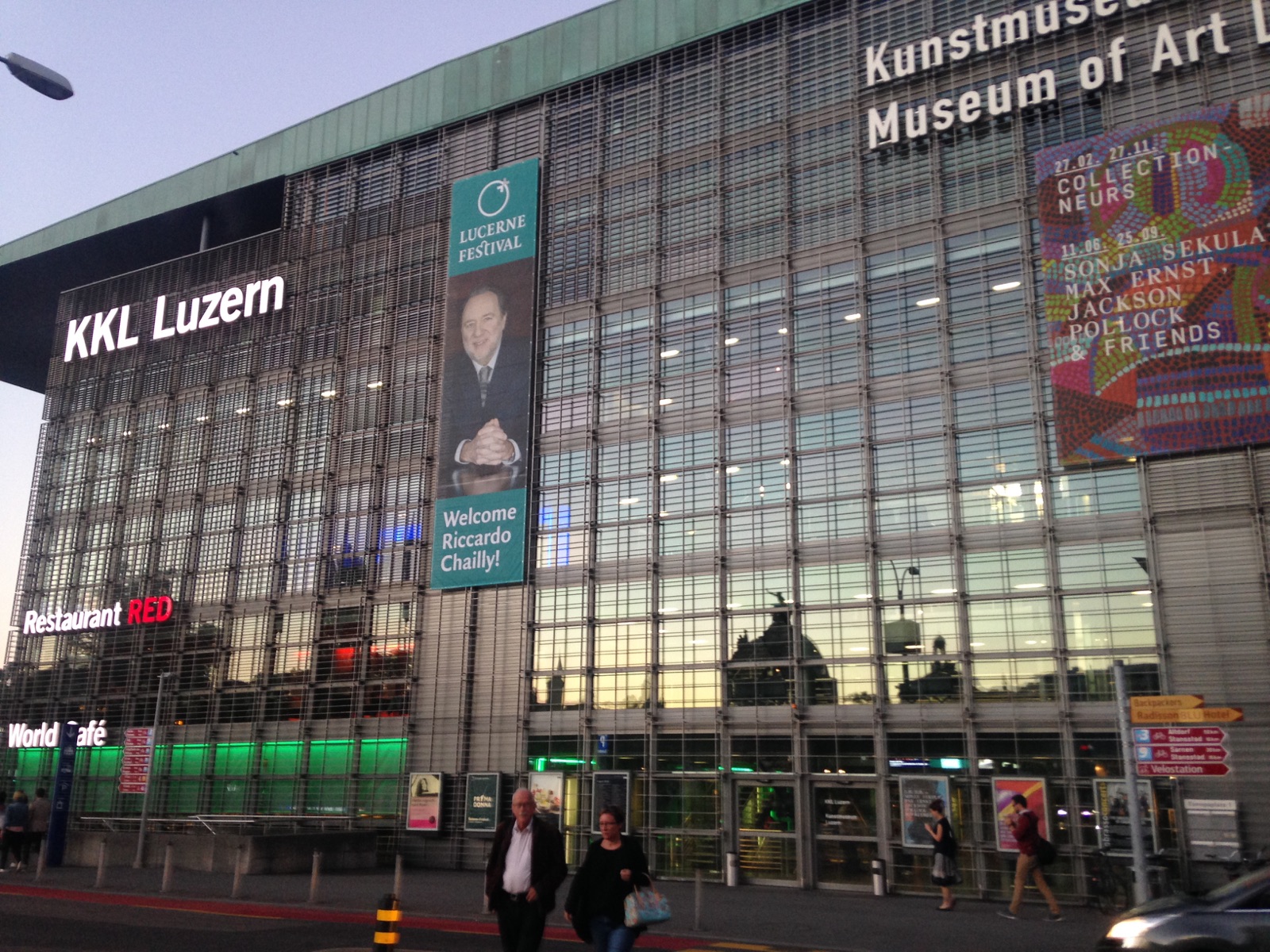
Swiss Radio and Television has now posted the opening concert of Riccardo Chailly’s debut with the Lucerne Festival Orchestra.
Chailly opened the 2016 Summer Festival on 12 August with a rousing performance of Mahler’s Eighth Symphony: the one work missing from the late Claudio Abbado’s otherwise complete Mahler cycle with his beloved LFO.
The broadcast also includes a 10-minute portrait of the conductor with interviews by way of a prelude.
Christian Wildhagen, an expert on the Eighth (he wrote a dissertation about the work), covered Chailly’s interpretation for the Neue Zürcher Zeitung:
Chailly, der aus früheren Aufführungen so umfassende praktische Erfahrungen mit dem Stück hat wie kaum ein anderer Dirigent, erkennt das Problem und versucht zu dämpfen, wo immer es geht. Doch prompt verheddert er sich in dem Paradox, das er selbst so trefflich mit den Worten umschrieben hat, man müsse mit dieser Musik fliegen und doch mit beiden Beinen kontrolliert auf dem Podium stehen. Die Kontrolle des gewaltigen Apparats gelingt bereits mehr als achtbar, das Fliegen hingegen nicht.
[…]
Chailly deutet diese Vertonung der Schlussszene aus Goethes «Faust» völlig zu Recht als sakrale Oper – angesiedelt auf einer rein imaginären Theaterbühne, aber mit halbszenischen Momenten wie der Erscheinung der Mater Gloriosa (Anna Lucia Richter mit etwas zu irdischem Tonansatz in der Höhe) auf der Orgelempore, wo am Schluss beider Teile auch jeweils das Fernorchester seinen «Auftritt» hat.
My review of this weekend’s Mahler 3 by Gustavo Dudamel and the Los Angeles Philharmonic is now posted on Bachtrack:
No work is more emblematic of Mahler‘s symphonic philosophy than the Third. Or at least that version of his philosophy filtered by Sibelius, who recollected Mahler’s words decades after their meeting in 1907, long after his colleague’s death: ‘The symphony must be like the world. It must embrace everything’.
But it was another Mahlerian statement that Gustavo Dudamel’s interpretation with the Los Angeles Philharmonic brought to mind – a statement reported by his confidante Natalie Bauer-Lechner referring specifically to the Third Symphony when it was still a work in progress: ‘To me, “symphony” means constructing a world with all the technical means at one’s disposal’.




 My
My 
 MEMETERIA by Thomas May