
I’m still digesting Akropolis Performance Lab’s recent production, Ecce Faustus, which is now tangling in my head with Mahler’s Eighth. I need to sort this out.

February 25, 2016 • 9:59 am Comments Off on Faust on the Brain
I’m still digesting Akropolis Performance Lab’s recent production, Ecce Faustus, which is now tangling in my head with Mahler’s Eighth. I need to sort this out.
November 24, 2015 • 7:51 am Comments Off on A Noble Attempt: Thomas Dausgaard Leads the Seattle Symphony in Mahler’s Tenth

Thomas Dausgaard
© Ulla-Carin Eckblom
Can we really claim that there is a Mahler Ten? Opinions remain sharply divided among the most fervent Mahlerians. Some refuse to consider the proposition of performing even the first movement of the composer’s final, unfinished symphony – let alone any of the various attempts to construct a performable whole using the extensive sketches Mahler left behind at his death in 1911.
Filed under: conductors, Mahler, review, Seattle Symphony
August 23, 2015 • 11:40 am Comments Off on Dancing Mahler’s Seventh
The idioms of dance — and their metaphorical significance — are a substantial component of Mahler’s vocabulary. Curiously, though, Mahler was known to be indifferent to the traditional art of ballet. (In fact one of the scandals stirred up during his tenure as director of the Vienna Hofoper involved a disagreement with the official ballet master over the casting of a dancer in a production of Auber’s La Muette de Portici.)
But an evening of choreography to the elusive Seventh Symphony? That’s what Martin Schläpfer designed in 2013 for the company he directs, the Düsseldorf-based Ballett am Rhein. Titled Seven, with Wen-Pin Chien conducting the Royal Scottish National Orchestra, the production is playing as part of the Edinburgh International Festival this month.
Some reactions:
The switches of mood, the interruptions to themes, the unexpected instrumentalisation in Mahler all find visual echoes: you never know whether dancers will be in pointe shoes, soft shoes or jackboots, or which members of a group or a trio are going to go off with one another, or whether a romantic relationship is about to turn sour or a violent relationship sweet.
–Hanna Weibye, The Artsdesk
Martin Schläpfer, in his choreography for “Seven,” is clearly of the heroes-and-shipwreck school. His epic staging of Mahler’s Seventh Symphony is structured as a journey, in which dancers, shod in boots, ballet shoes or with naked feet, move through a picaresque variety of situations, the choreography’s imagery vividly shaped by the colours and rhythms of the score….But the work’s strengths are undercut by its failure to engage with the score’s deep musical structure. Schläpfer choreographs in blunt emphatic bursts that illuminate the surface of the score but not its architecture.
–Judith Mackrell, The Guardian
There isn’t an explicit narrative to Schläpfer’s vision, but themes of human relationships seem to hold centre stage. We see couples and small groups coming together to react to one another for a time, but mostly it ends in hostility or outright rejection. Partners are swapped and traded with casual indifference and, particularly in the outer movements, Schläpfer explores the impact on those rejected, most often women….Importantly, however, Schläpfer’s choreography is inherently musical. He has thought deeply about Mahler’s score and presented a sequence of movement that seems an extension of the action in the pit…
–Simon Thompson, Seen and Heard International
Filed under: ballet, Edinburgh International Festival, Mahler
June 22, 2015 • 8:28 pm Comments Off on Morlot’s intimate view of Mahler’s panoramic Third in Seattle
My latest review has now been posted on Bachtrack:
With the seemingly boundless D major chord that ends Mahler’s Third Symphony as final benediction, the departing audience encountered a series of suspended chimes in gentle tintinnabulation: part of a recent installation in Benayoya Hall’s grand lobby by Trimpin, Seattle Symphony’s composer-in-residence.
continue reading
Filed under: Ludovic Morlot, Mahler, review, Seattle Symphony
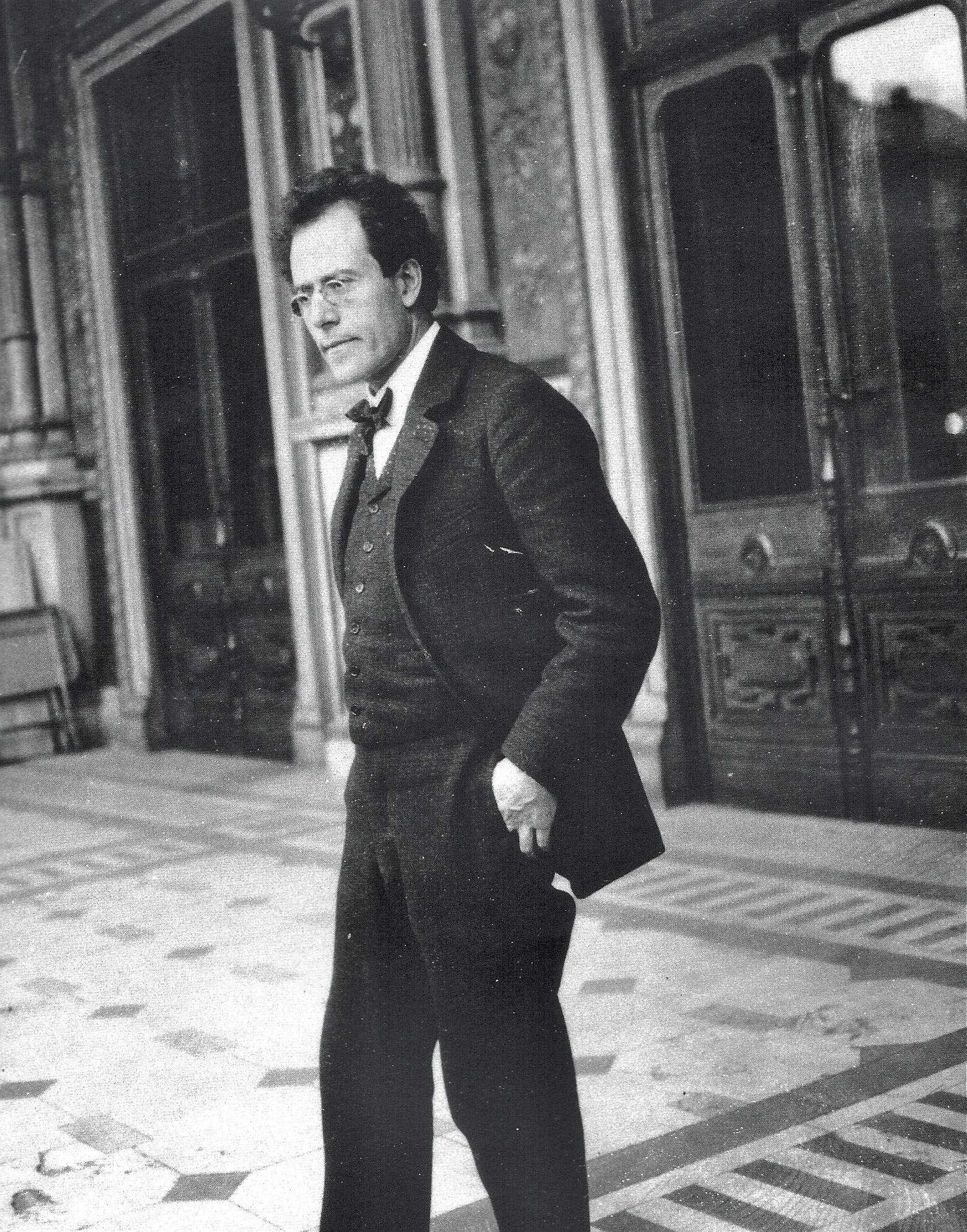
May 19, 2015 • 8:23 am Comments Off on Gustav at an Angle

Gustav Mahler by Auguste Rodin (1909); bronze (National Gallery of Art)
Filed under: Mahler, photography
May 6, 2015 • 5:36 am 1

This week’s National Symphony program pairs Sibelius and Mahler, with Christoph Eschenbach conducting.
Here’s a debate from the Talk Classical site pitting the two composers against each other as symphonists:
Two of the greatest symphonists of the 20th century…but who is greater?
Sibelius and Mahler both took on the symphony with quite different philosophies. In their famous exchange, Sibelius said: ” I admire the symphony’s style and severity of form, as well as the profound logic creating an inner connection among all of the motives,” whereas Mahler said: “The symphony is like the world; it must embrace everything.”
Who is right here? Both? Neither?
As an admirer of both symphonists, my vote goes to Sibelius. While Sibelius’s seven symphonies often lack a sort of “hysteria” and hyper-emotion that one encouters in Mahler, his works can still certainly elicit strong emotional responses. And he does this within fairly strict means, concentrating the musical rhetoric so every theme, phrase, motive and note seems to be concentrated with meaning.
Plus, Sibelius seems to have a masterful handle on the symphonic form, which I think is important here. A symphony is not a suite or a rhapsody; it, by its very definition, has rules and conventions. Sibelius seems to take the symphony head on and make music that adheres to the “severity of style.” whereas Mahler seems to go more rhapsodic and bend the rules quite a bit more.
Not that there is anything intrinsically wrong with that; again, I love Mahler’s symphonies. But from a technical standpoint, Sibelius seems to understand symphonic form much better.
Obviously, there are no right or wrong answers here; not one of us can say definitively who is the greater. But I think a civil and respectful discussion on this would be most interesting!
Filed under: Mahler, National Symphony, Sibelius
August 19, 2014 • 1:34 am Comments Off on Prom 40: Haitink and the LSO Trace a Mahlerian Journey through Childhood Innocence

Here’s my review for Bachtrack of Bernard Haitink’s Saturday concert with the London Symphony Orchestra (Prom 40):
Having celebrated his 85th birthday this past March, Bernard Haitink continues to demonstrate that he profits from the advantages of age whilst commanding the deftness of a conductor decades his junior. His programme at the Proms on Saturday evening with the London Symphony Orchestra offered musical perspectives on youthfulness and memory by way of Schubert and Mahler, culminating in the songs of innocence and experience of which the latter’s Symphony no. 4 in G major is woven.
Filed under: conductors, Mahler, review, Schubert
July 7, 2014 • 8:31 am Comments Off on Mahler Composing
In this excerpt from John Adams’s review of Jens Malte Fischer’s Mahler biography, it’s intriguing to see what one great composer zeroes in on when describing the creative process of another:
When [Mahler] composed he did it in a white heat, sketching the outlines of his large symphonic forms in a hasty shorthand scrawl, going as fast as his quicksilver mental powers allowed him, usually during all-too-brief summer “vacations” in picturesque alpine settings. A symphony might be composed in the course of one or two of these summer retreats.
But the painstakingly detailed writing out and preparation of performance materials would occupy him for another two or more years before the work would be publicly performed. He was in every sense what we’d now call a control freak. He insisted on conducting all first performances, often treating early rehearsals as a further composing phase, trying out this and that effect on often hapless and confused orchestra members.
His printed scores are full of admonitions to the performers. Musical ideas are marked with emphatic underlinings, accents, and notational and verbal reminders that seem to shout at or plead with the performer to do exactly as the composer wanted. Mahler, long used to dealing with careless or indifferent musicians, appears to have had little faith in the ability of future generations to get his music right.
What would Mahler have thought about his interpreters today? Which ones would have pleased him most — or displeased him least?
Filed under: creativity, John Adams, Mahler
January 20, 2014 • 8:31 am Comments Off on R.I.P. Claudio Abbado (1933-2014)

Claudio Abbado (1933-2014)
What terribly sad news to wake up to: today Claudio Abbado died at his home in Bologna. He was 80. This should be a front-page news story instead of just a link on the New York Times homepage.
Michael Haefliger, the director of the Lucerne Festival, pays homage to the musician who was a central musical pillar of the festival. The Maestro gave his final concerts leading the elite Lucerne Festival Orchestra, one of the ensembles he was acclaimed for founding:
“Wanderer, there are no paths. There is only wandering.” This quotation, which Claudio Abbado’s long-time friend, the Italian composer Luigi Nono, discovered on the wall of a monastery in Toledo, might also serve as an emblem for the life of Claudio Abbado: not to map out one’s life according to certain paths but rather to proceed, to live, and to remain open to experiencing what is new. In other words, a pathless wandering and searching. In just this sense Claudio Abbado always “pathlessly” sought out the new and unknown in his creative work, and he did so right up until the last second of his very full and fascinating life.
Allan Kozinn describes his self-effacing tendencies:
Mr. Abbado was also known for his disdain for the trappings of a modern, media-driven conducting career. As communicative as his podium manner was, through much of his career he seemed slightly awkward coming on and off the stage. Explaining this in a 1973 interview, he likened himself to the conductor Hans Knappertsbusch, whose habit was to refuse curtain calls.
“I used to be somewhat like that,” he said. “Now I take the time to be polite. Look, I like the reaction of the audience. I’m not sincere if I don’t say that, but it still embarrasses me to take bows. I’m not a showman. I hate all that.”
It was a point of pride for him that he never actively sought the music directorship of any orchestra. But directorships came his way anyway.
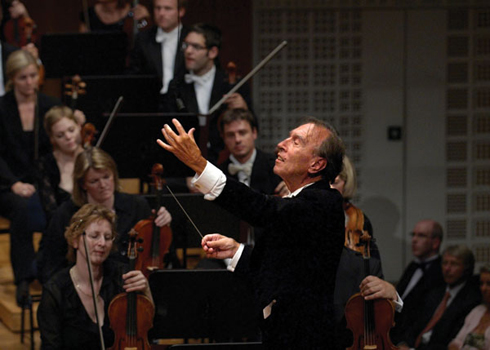
Abbado in Lucerne
Included among the in-depth coverage at The Guardian is Tom Service’s eloquent appreciation of Abbado and the “life-changing events” that were his concerts:
The Lucerne project was the zenith of a life in music that had as its essential credo a word that you don’t always associate with conductors, those supposed tyrants of the podium: “listen”… The message of listening was about encouraging every player in the huge ensemble needed to play Mahler’s symphonies to listen to one another, to know the score as well as he did. Their performances of all but the 8th, which Abbado didn’t have the chance to play in Lucerne, are the most revelatory and moving Mahler performances of recent decades – arguably ever.
[…]
[W]ith those musicians in Lucerne, Abbado was able to lift the veil on some other realm of experience, to put us in touch with a larger mystery even than the notes the orchestra was playing.
[…]
[His final Lucerne concert] was a communion between Abbado and his players of devastating intimacy and astonishing emotional bravery, which asked the most profound questions about what the musical experience, and even what life might be about, with its beginnings and unfinished endings, its questions and unfilled answers, its sounds and its silences. Abbado’s concerts weren’t mere performances of pieces of music, they were searing, transformative existential journeys. That they have come to an end is an unimaginable loss.
Filed under: conductors, Mahler, memorial
November 8, 2013 • 2:39 pm 2
It’s good to have Ludovic Morlot back in town for his first Seattle Symphony program since September’s marvelous all-Ravel feast. And there’s been a lot of interest building up for this week’s offering, since – well, that’s usually the case with a Mahler symphony (even if the over-programming of Mahler in general is tempting burnout), but all the more since Maestro Morlot has been approaching this rep with understandable caution.
But first to the program’s “hors d’oeuvre,” Nos. 1-4 of the Notations by Pierre Boulez. This is prime Morlot territory: thrillingly prismatic music, brimming with intellectual and sensual complexities that complement rather than cancel each other out. The orchestra, massively expanded and crowding the entire stage to realize Boulez’s scoring requirements, played the first four of this set of miniatures originally written as a sequence of 12 for solo piano (back in 1945). Boulez began revisiting these early works decades later and so far has completed orchestral elaborations of seven of them. In their orchestral guise, they resemble lavish plants grown from the starker seeds of the piano originals.
Morlot gave a brief, excellent introduction to their concept and design and paired each of the four with renditions of the originals by pianist Kimberly Russ. I’ve never understood why some of my fellow critics kvetch about this sort of commentary from the podium during a concert. Morlot’s manner isn’t even remotely condescending, and he’s able to home in on a few pregnant details that really do enhance listening.
And Boulez is hardly a familiar quantity in Seattle. This was the first time I’ve heard the SSO grapple with music by the French maverick; is it possible Boulez has never been programmed in its history? Quel scandale! Regarding his ongoing investigation of French musical tradition with the orchestra, Morlot remarked that to overlook Boulez would be like visiting Paris “and not going to see the Eiffel Tower.”
The pieces in Notations – all related to a shared 12-note theme – are epigrammatic and fleeting, yet so frighteningly complicated in their working out (the articulation of harmonic, rhythmic, and textural layers) that it’s like a speeded-up musical Big Bang, tracing vast consequences from simple origins. Or so it seemed in Morlot’s meticulous account. Most impressive for me was his ability to convey a graspable sense of passion and drama alongside Boulez the “researcher” of sounds.
In his “Ask the Artist” conversation after the concert, Morlot mentioned that he’d initially hoped to get Boulez to come to Seattle to conduct this program himself, thus giving the SSO a direct connection to the tradition Boulez still embodies. (Now 88, the French maestro’s health essentially precludes such travel.) Yes, irony of ironies, the firebrand revolutionary of yore is one of the last keepers of a tradition connected both to French modernism from Debussy onwards and to Schoenberg and his Vienna colleagues. (Berg was particularly fascinated by the music of Mahler’s Sixth Symphony.)
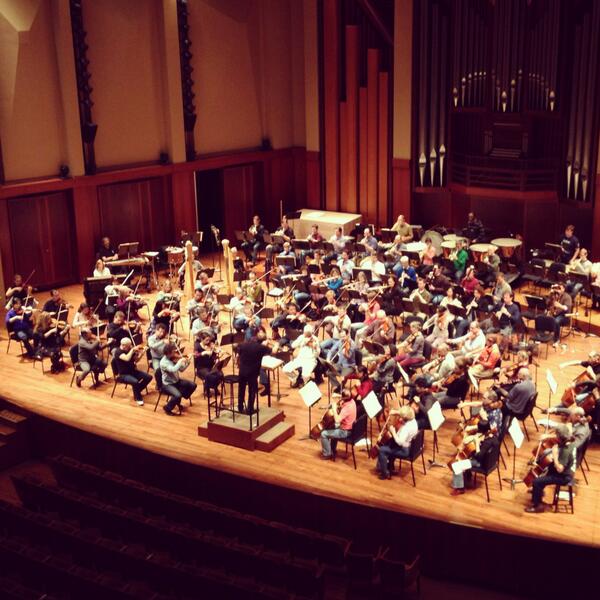
Morlot and SSO rehearsing Mahler 6
I found this interpretation of the Mahler Sixth only halfway satisfying – and, oddly, in a completely unpredicted way. Long one of the most marginalized of his symphonies, the Sixth has actually received a good deal of advocacy over the past 15 years or so. Michael Tilson Thomas inaugurated his complete cycle with the San Francisco Symphony with No. 6 (on September 12, 2001, no less), winning a Grammy. Since that year the SSO’s conductor laureate Gerard Schwarz has led two Mahler Sixths (2001, 2008).
Presenting the Boulez as an entrée results in the interesting effect of seeing the orchestra downsize a tad for the Sixth, which happens to employ the largest orchestra Mahler ever called for (in purely instrumental terms – obviously excluding the Eighth, with its ginormous choral forces). The SSO even managed to procure one of the cowbells originally used for the premiere in 1906. (I’ve got to investigate that back story.)
Yet just a few paces into the grim straitjacket march-time opening the first movement, Morlot uncharacteristically failed to achieve the sort of sonic balance you can usually count on him to effect – a tremendously challenging task in this score, to be sure. Morlot’s modus operandi in general is precisely not to go for the obvious “throughline” but to tune us in to the nuances of multiple layers and textures interacting, but too many of the accents seemed tentative, a “work in progress,” so that the players got bogged down in local details and the big picture lost focus.
Breathtaking, sensitively shaped moments awaited in the enormous development section – it’s like a dream sequence escaping from the harsh “real world” surrounding it – and, along with many admirable solos, concertmaster Alexander Velinzon’s contributions enraptured the ear. Still, as a whole the first movement lacked the persuasiveness and sheer, unrelenting terror it needs to set the symphony on course.
The Scherzo sounded even more bogged down by moment-to-moment bursts of color and emotion without a convincing larger context: all-too-careful playing that just didn’t take fire with any sense of risk. But with the Andante – Morlot chose Mahler’s original order for the inner movements – the long delay until reaching this oasis paid off. The SSO became not just thoroughly engaged, but convincing and supremely eloquent. Morlot took a relatively rapid pace, allowing the beauty of this music to breathe as simply as a song instead of relying on exaggerated distensions.

Cowbells used by Seattle Symphony (including one from 1906 premiere of No. 6)
And then what really took me by surprise: in every live performance of the Sixth I’ve heard, it’s in the immense sound world of the finale that everyone loses steam, exhausted and struggling just to make it through. But this was the most exhilarating playing of the evening, starting with the hallucinogenic sweep of colors with which Mahler launches this enigmatic movement.
Here Morlot guided the musicians through an enthralling labyrinth of events which really did begin to cohere and connect. In the coda, the threnody of brass sustained enough mystery to hint, however slightly, at a possible hopeful outcome so that the shock of Mahler’s most tragic symphonic ending had a thrilling dramatic impact.
A quick note on the other chief musicological controversy – besides the order of the movements – which is part of the Sixth’s performance tradition. Morlot chose the version with two rather than three “hammerblows” in the finale, later explaining that withholding the third ax-like shattering intensifies the suspense. The two blows we heard were in any case both sonically and visually memorable, thanks to the impressive box and hammer percussionist Michael Werner (see video at top).
There’s one more chance to experience this program live: on Saturday, 9 November 2013, at 8.00 pm. Tickets here.
(C) 2013 Thomas May. All rights reserved.
Filed under: Mahler, review, Seattle Symphony
 Arts & Culture Stories from NPR
 MEMETERIA by Thomas May