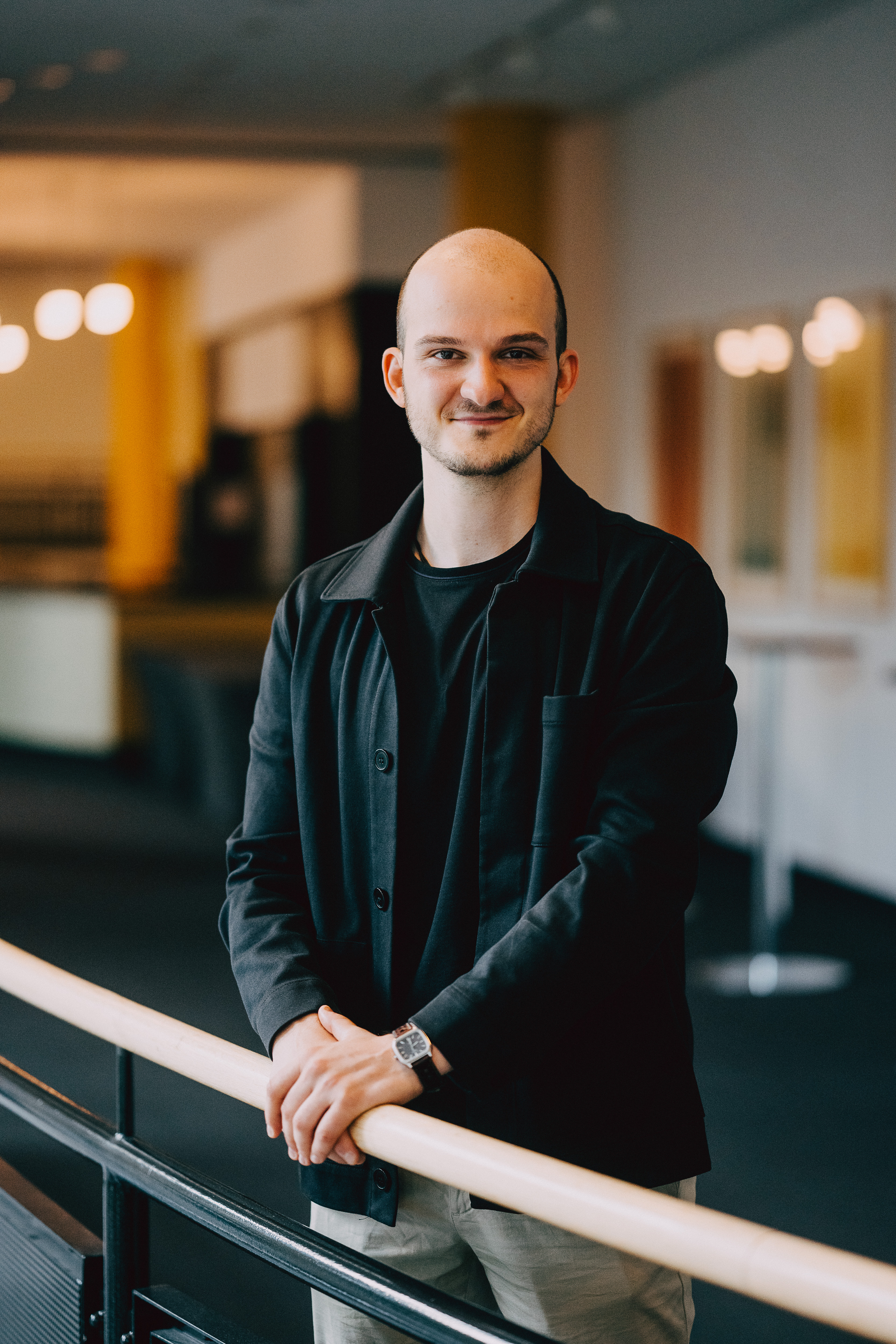
I wish the timing did not coincide with a very busy festival season, which means I won’t be able to explore this new adventure in Portland. But the two productions that OrpheusPDX is offering in August look very interesting. The company’s second season will offer Mozart’s 1775 opera seria Il re pastore (3 and 6 August) and Nico Muhly’s Dark Sisters (24 and 27 August). (I well recall Vancouver Opera’s production of Muhly’s fascinating opera, which I reviewed in December 2015 for Musical America.) All performances will take place in Portland State University’s 475-seat Lincoln Performance Hall.
Portland Opera’s former General Director Christopher Mattaliano founded OrpheusPDX last year and operates the company “without an office and via lots of Zoom calls. Its model is to honor tradition and explore new directions,” he says, creating a space “where opera gets intimate.”
UPDATE: Here’s a link to Medici.tv’s recorded livestream of the closing concert.
The Italian conductor Giuseppe Mengoli has been announced as the winner of the 2023 Mahler Conducting Competition, which confers a cash prize of 30,000 euros. The competition was held in Bamberg, Germany, from 7 to 13 July, with a repertoire including Mahler’s Seventh Symphony (from which different movements were played in each round), as well as Haydn’s Symphony No. 92 in G major (first round), Bernd Richard Deutsch’s Con moto, which was commissioned by the Bamberg Symphony and given its world premiere and (second round), Berg’s Seven Early Songs (semi-final), and Stravinsky’s Violin Concerto (final round).
The sold-out concluding concert of the competition will take place on Saturday, 15 July, with Mengoli leading the Bamberg Symphony. The program consists of Mahler’s Symphony No. 7, Haydn’s Symphony No. 92, and Berg’s Seven Early Songs, with Thomas Hampson as the soloist; Mengoli will record with the Bamberg Symphony next season.
Second place went to the Japanese American conductor Taichi Fukumura, who received 20,000 euros. In third place was the German conductor Georg Köhler, who was awarded a cash prize of 10,000 euros. Additionally, a new prize was introduced this year: Best Conducting of Contemporary Composition, which confers an award of 7,500 euros (donated by the Mahler Foundation). This was awarded to the American conductor Kevin Fitzgerald.
The Mahler Competition was founded in 2004 by the Bamberg Symphony and its principal conductor at the time, Jonathan Nott, and takes place every three years. The inaugural winner was Gustavo Dudamel. More candidates than ever before applied for the 2023 competition: there were 350 applicants, of which almost 20% were women; 16 male and 4 female conductors were selected and invited to Bamberg.
Until recently, Mengoli held the position of Assistant Conductor to Lorenzo Viotti at the Netherlands Philharmonic Orchestra and the Dutch National Opera in Amsterdam. In May 2023 he joined the artistic team for the Orchestre National de France new production of La Bohème at the Theatre de Champs-Elysees leading stage rehearsals and assisting Lorenzo Passerini. This summer he will be assisting at the Salzburg Festival, and he will work with the SWR Symphonieorchester in the upcoming season.
In May 2022, Mengoli assisted Lorenzo Viotti in Lisbon preparing as well as conducting the Gulbenkian Orchestra in Schoenberg’s Pelleas et Melisande. In October 2022, he made his debut with the Nederlands Kamerorkest and soloist Leonard Elschenbroich conducting the world premiere of Willem Jeths’s Cello Concerto No. 2 at the Cello Biennale 2022 in Amsterdam. He stepped in to prepare Beethoven’s Fifth with the Solistes Européen Luxembourg at very short notice, which led to an invitation to join the orchestra again for upcoming projects.
Mengoli’s conducting career began as a result of his experience as a concertmaster in youth and professional orchestras from the age of 19. Since then he has worked with Oleg Caetani, Daniel Barenboim, Christoph König, and John Axelrod and with such orchestras as the Real Orquesta Sinfonica de Sevilla, Oslo Opera House, LaVerdi Symphony Orchestra, and the Royal Opera House. In 2018 he made his conducting debut with the Gustav Mahler Jugend Orchester in Bad Schandau. During this time, he also served as concertmaster of the GMJO and as a substitute in orchestras like the Konzerthaus Orchester Berlin and Rundfunk Sinfonieorchester Berlin.
Winner of several international competitions as a violinist, he completed his violin studies cum laude and with special mention. Alongside the violin, Mengoli studied percussion, piano, and trumpet, and he has also worked as a composer and arranger of jazz. Having obtained his bachelor’s degree in orchestra conducting, he is currently pursuing his master’s degree at the Franz Liszt Academy in Weimar with Nicolás Pasquet and Ekhart Wycik and is regularly working with such orchestras as the Staatskapelle Weimar, the Jenaer Philharmonie, and the Thüringen Philharmonie Gotha.
Seattle Chamber Music Society Artistic Director and violinist James Ehnes (left) with colleagues. SCMS’ Summer Festival runs July 3-28. (Jenna Poppe)
I suggested some unmissable programs in this year’s edition off the 2023 Summer Festival, which lasts throughout July:
Changes have been afoot since the Seattle Chamber Music Society returned to a full live season — from a roving concert truck to a new center located downtown — but what remains a constant is the embarrassment of riches that its Summer Festival offers throughout the month of July.
This summer’s program of 71 BBC Prom concerts, performed mainly in London’s Royal Albert Hall, start this coming Friday, 14 July, and end with the communally remarkable Last Night on 9 September. All will be audibly accessible across the world online on BBC Sounds. Many will thus remain available for up to 30 days after their actual performance.
Characteristically, the orchestral and choral performers include ensembles from across the UK — whether run by the BBC itself — including the Chineke! Orchestra, Europe’s first majority Black and ethnically diverse orchestra. Several from abroad are among the offerings — Berlin, Boston, Bremen, Hungary, France and Switzerland.
Program details are accessible here. It’s hard to recommend individual events from so superb a total, but a few seem especially worth mentioning: on 23 July: Beethoven’s Choral Symphony and a new work, “Meditations on Joy,” by Helen Grime — pieces which will dramatically illustrate the idea that joyful music is valuable to mental health; 25 and 26 August: two fine concerts by the Boston Symphony; 27 August: Mahler’s Symphony 9 with the London Symphony Orchestra under Sir Simon Rattle; and 3September: a concert performance of Berlioz’s phenomenal but rarely done opera The Trojans, conducted by its probably finest interpreter, Sir John Eliot Gardiner.
From Bridge Records, whose catalogue includes a recording of W.T. Matiegka’s Six Sonatas, op. 31, performed on a Viennese style guitar by David Starobin:
“Wenzel Thomas Matiegka (1773-1830) was born in the town of Choceň in the Kingdom of Bohemia, then part of the Habsburg monarchy. Matiegka became an accomplished pianist while reading law at the University of Prague. After legal employment in the service of Prince Ferdinand Kinský, Matiegka moved to Vienna and was quickly acknowledged as a leading composer of solo and chamber music featuring the guitar. Young Franz Schubert arranged and re-scored Matiegka’s Notturno, op. 21, adding an exceptionally elaborate cello part. On 6 July 2023, in Matiegka’s native Choceň, performances and celebrations are scheduled to honor the city’s native son on his 250th birthday.“
Starobin regards Matiegka’s sonatas as “in their time, the pinnacle of expression on the guitar, offering the most detailed notation of both articulation and character–a clear window onto performance style in the era of Beethoven and Schubert.”
“These works unfold with a spectrum of creative possibility, especially in Starobin’s eloquent hands. The guitarist brings refinement to every turn of phrase, whether the music is marching, dancing or crying. This recording is a swansong to savor.” – Donald Rosenberg, Gramophone
Christina Scheppelmann, General Director of Seattle Opera. Photo by Philip Newton
Seattle Opera announced today that its general director, Christine Scheppelmann, will take on the reins at La Monnaie/De Munt in Brussels, Belgium, in 2025, after her five-year contract in Seattle concludes.
“I love being here,” Scheppelmann toldSeattle Times‘ Janet I. Tu. “But they made me an offer I couldn’t refuse.”
Scheppelmann is the fourth general director in the company’s history. Her final season will therefore be the already announced 2023-24 season, which begins in August.
Regarding the search for Scheppelmann’s successor, Seattle Opera indicated only this: “Seattle Opera’s Board of Trustees is committed to continuing to produce the highest-quality artistic experiences and programming with artists from around the world. The board invites the community to celebrate the achievements of Scheppelmann’s tenure and looks forward to new artistic and programming opportunities that will grow opera audiences for the future.” Meanwhile, Seattle Symphony continues to lack a music director — that search is still under way, with no update on its progress.
“Under Scheppelmann’s leadership, the company produced a world premiere, launched cornerstone programs, expanded its community partnerships, and brought over 100 new artists to Seattle for company debuts, with nearly 50 coming from abroad,” according to Seattle Opera’s press release.
“Leading Seattle Opera is a tremendous opportunity,” said Scheppelmann, who came to Seattle from the Gran Teatre del Liceu in Barcelona. “The company boasts an incredible staff, orchestra, chorus, and crew, as well as a wonderful, supportive audience, all of whom I will miss greatly. I love this city and the opera community in this region, which has welcomed me wholeheartedly. I could not pass up the opportunity to lead one of the great European opera companies while also being closer to my family. But for now, there is much work to do and more opera to come in the year ahead, and I look forward to sharing what we have in store.”
“Seattle Opera has been fortunate to collaborate with a general director of Christina’s caliber, and thanks to her leadership, the company is well positioned to build on its successes,” said Board President Lesley Chapin Wyckoff. “That Christina has accepted an offer to head one of Europe’s most important opera companies is a testament to her abilities and her excellent work in Seattle, which has ensured a bright, promising future for Seattle Opera. We could not be more proud of what she has accomplished here and we wish her the best in this exciting new opportunity.”
On 9 June 1921, Prague’s State Opera hosted the Czech premiere of Arnold Schoenberg’s early masterpiece Gurre-Lieder, based on a 14th-century Danish legend. For the first time in 102 years, the State Opera will again present the work on Tuesday, 20 June 2023 at 19:00 Prague time. Details here.
Schoenberg’s mammoth score calls for a small army: almost 250 singers and instrumentalists will be on hand, including the Prague Radio Symphony Orchestra and the Norwegian Radio Orchestra, with Petr Popelka conducting.
This is a co-production between the National Theatre Opera and the State Opera, Musica non grata, Prague Radio Symphony Orchestra and Norwegian Radio Orchestra. Performed in the German original, with Czech surtitles. Part of the Musica non grata project, the program will contribute to the celebrations marking the centenary of Czech Radio.
“The inclusion of the Gurre-Lieder in the Musica non grata cycle and its return to the State Opera is entirely logical, as it was at this very venue, formerly the Neues deutsches Theater, where, on 9 June 1921, the masterpiece received its Czech premiere, conducted by Alexander Zemlinsky, one of Musica non grata’s central figures,“ said Per Boye Hansen, Artistic Director of the National Theatre Opera and the State Opera. Arnold Schoenberg worked on the monumental cantata on and off for 11 years, starting in 1900 and finishing in 1911. The Gurre-Lieder was first performed on 23 February 1913 in Vienna under the baton of Franz Schreker. It is based on Jens Peter Jacobsen’s 1868 poem cycle Gurresange, inspired by the medieval Danish legend, set at the Gurre Castle, telling the tragic love story of King Waldemar and his mistress Tove Lille (Little Tove), murdered by Queen Helvig. The grief-stricken King curses God and is consequently condemned to fly for ever with his dead minions through the night sky, seeking his beloved Tove, who has transfigured through the magnificence of Nature. Schoenberg’s cantata features some 35 leading motifs depicting not only the main characters but also natural phenomena (sunset, sunrise, galloping horses, etc.) and a variety of emotional states (desire, affection, fear, mourning, etc.). Noteworthy too is the fact that in the Gurre-Lieder Schoenberg employed for the very first time the Sprechgesang, a “spoken singing” technique. “I find it immensely exciting that at the time when Schoenberg shocked the world with Pierrot lunaire, ushering in a brand-new musical-aesthetic style, in the Gurre-Lieder he brought to bear to great acclaim for the last time the Late-Romantic idiom of the early 20th century,” Per Boye Hansen added.
Stellar Czech and foreign singers will appear at the State Opera. The solo parts in the Gurre-Lieder have been assigned to artists of such renown as Michael Weinius, a regular guest at the Wiener and Bayerische Staatopers; the Grammy Award winner Dietrich Henschel; the German soprano Susanne Bernhard; the Norwegian baritone Yngve Søberg, a finalist of the prestigious International Hans Gabor Belvedere Competition; and the Czech mezzo-soprano Štěpánka Pučálková. Schönberg’s gigantic cantata will be performed by a formidable body of almost 250 vocal and instrumental forces, including the Prague Radio Symphony Orchestra (SOČR), the Norwegian Radio Orchestra (KORK), the Czech Philharmonic ChoirBrno and the Slovak Philharmonic Choir, conducted by Petr Popelka, Music Director of the SOČR and the KORK. “I deem the Gurre-Lieder one of the most marvellous compositions in the history of music, the crowning glory of the entire evolution of tonality, hence I feel greatly honoured to have been afforded the opportunity to conduct a performance of it. I also cherish the fact that, after more than a hundred years, we will bring the Gurre-Lieder back to the venue where it was presented under Alexander Zemlinsky. The SOČR and the KORK are top-notch European orchestras, and I believe that binding together their singular energies will enrich their players musically and personally, giving rise to a truly remarkable experience,” Petr Popelka pointed out.
The performance in Prague of the Gurre-Lieder is a co-production between the National Theatre Opera and the State Opera, the Prague Radio Symphony Orchestra, the Norwegian Radio Orchestra and the Musica non grata cycle, funded by the Embassy on the Federal Republic of Germany to the Czech Republic. The concert on 20 June at the State Opera will be broadcast live from 7 pm on Czech Radio Vltava and the Norwegian radio channel NRK P2. The evening will be recorded by Czech Television. “Rarely indeed is a work of this magnitude performed in Prague, or anywhere else for that matter. We are talking decades. For the members of the orchestras it may even be a once-in-a-lifetime opportunity. Fortune dealt us a kind hand and, owing to many favourable circumstances, we can perform the famous opus within the celebrations of the centenary of Czech Radio. I believe that the radio and television recordings, as well as the audio document of the concert, will offer music lovers the possibility to acquaint themselves with this extraordinary piece,” Jakub Čížek, Director of the SOČR, added.
Gurre-Lieder 20 June 2023, State Opera, 7 pm Music: Arnold Schoenberg (1874–1951) Text: Robert Franz Arnold (1872–1938), based on a poem cycle by Jens Peter Jacobsen (1847–1885)
Conductor: Petr Popelka Prague Radio Symphony Orchestra Norwegian Radio Orchestra Czech Philharmonic Choir Brno Chorus master: Petr Fiala Slovak Philharmonic Choir Chorus master: Jozef ChabroňWaldemar: Michael Weinius Tove: Susanne Bernhard Wood Dove: Štěpánka Pučálková Peasant: Yngve Søberg Klaus the Jester: Kevin Conners Speaker: Dietrich Henschel
Happy 100th birthday, San Francisco Opera! Friday night’s big celebration concert, writes Joshua Kosman was “an aptly celebratory evening — warm, communal and full of sparkling music to help observe the landmark. It also augured well for the company’s future in an uncertain environment.”
San Francisco Opera’s “100th Anniversary Concert” bows with Karita Mattila, Brandon Jovanovich, Daniela Mack, Lawrence Brownlee, Ailyn Pérez, Michael Fabiano, Susan Graham, Lucas Meachem, Nina Stemme, Brian Mulligan, Patricia Racette, Russell Thomas, Heidi Stober, Christian Van Horn, and Adela Zaharia with the San Francisco Opera Chorus. Photo: Drew Altizer Photography
Composer Wang Lu, whose “The Nothing Man and Other Tales” will have its premiere with Seattle Modern Orchestra June 3. (Matt Zugale)
This weekend, Seattle Modern Orchestra gives the world premiere of Wang Lu’s The Nothing Man and Other Tales. I wrote about this wonderful composer for TheSeattle Times:
“I’ve always been interested in storytelling,” says composer and pianist Wang Lu. “We all crave stories.”
Wang’s latest composition, “The Nothing Man and Other Tales,” taps into this human hunger by recounting a series of stories she discovered in a children’s book that her daughter has been enjoying. Her musical treatment transforms these tales into adventures for adult ears.
Drawn from Ovid’s retelling of the myth of Venus and Adonis in Metamorphoses and Shakespeare’s Venus and Adonis, Sciarrino’s new opera is a meditation on love and death. The cast features American countertenor Randall Scotting in the role of Adonis, who is pursued by Venus, the goddess of love, sung by soprano Layla Claire. Staatsoper Hamburg’s General Music Director, Kent Nagano, conducts and Georges Delnon directs.
“Adonis is probably the liveliest character in the whole opera,” says Scotting. “He is youthful, boisterous, and concerned only with hunting and making love. The music Sciarrino composed for him really embodies these qualities, especially in his big hunting scene. There are aspects of the opera everyone will recognize, but it also feels new and relevant today.”
an atmospheric and inventive opera that often surrounds the audience in the nuanced sounds of the natural world. Mimicking the cycle of life and death, sounds arise from nothing and just as quickly disappear, leaving the listener engaged, interested, and waiting on the edge of their seats for the next surprise. ‘Adonis is probably the liveliest character in the whole opera. He is youthful, boisterous, and concerned only with hunting and making love. The music Sciarrino composed for him really embodies these qualities, especially in his big hunting scene. There are aspects of the opera everyone will recognize, but it also feels new and relevant today,’ said Scotting of his role in the opera.
From the Staatsoper Hamburg site:
“Sounds from the silence. They come closer, move and dissolve into darkness. Their nature is being and non-being, coming into being and passing away – the same as all living beings in the eternal illusion of life and death. They are sounds as they surround people, a music close to nature. They tell of mythical figures: Venus and Mars, who once begat Cupid. Cupid, who is now to avenge his betrayed father. The beautiful Adonis, whose love for Venus is his undoing. And above all: the monster who knows no affection, no love, no hate, least of all himself. It waits, unknown and deadly, maltreated by the voices of the world. An ancient story winds through the thicket of mythological entanglements and finds new paths. Who will triumph, love or death?”