
Musical America is featuring cellist Seth Parker Woods as New Artist of the Month for October. My profile here.
Filed under: Musical America

September 30, 2017 • 3:02 pm 1
Musical America is featuring cellist Seth Parker Woods as New Artist of the Month for October. My profile here.
Filed under: Musical America
August 1, 2017 • 7:56 am Comments Off on Reena Esmail: Musical America‘s New Artist of the Month
 The remarkable young composer Reena Esmail is Musical America‘s New Artist of the Month for August 2017:
At Chorus America’s annual conference this past June in Los Angeles, a general session devoted to the topic “The Medicine of Music” featured a singalong demonstration of a new interactive choral work titled Take What You Need. It wasn’t only the members of Street Symphony and the Urban Voices Project, a community choir of singers from LA’s Skid Row neighborhood, who appeared transformed as they sang this music by Reena Esmail. The large audience of choral professionals from around America joined in, visibly moved by this confirmation of musical meaning.
“It was such a powerful moment, because I’ve always wanted my music connect people to one another,” Esmail told me in a recent interview.
As Composer-in-Residence with Street Symphony (cofounded by LA Philharmonic violinist Vijay Gupta as a project to bring music to the homeless population), Esmail created the anthemic Take What You Need last year as a vehicle for the disenfranchised from the Skid Row community to join with professional musicians and tell their deeply moving personal stories. Following the model of the Kronos Quartet’s Fifty for the Future Initiative—in which Esmail herself has participated—Street Symphony recently made the piece available for free use to community organizations (on the website http://twyn.info/), who are encouraged to adapt it to accommodate specific performers and contexts.
“It started as a piece for string quartet and four singers but now there arrangements for everything from piano and one singer to orchestra and double choir. Even down to the very practical compositional choices, this piece is designed to value the needs of musicians and community alike, and to allow a warmth and mutual understanding to develop between them,” says Esmail.
A consistent focus of the work by this 34-year-old composer has been on mediating between cultural contexts that are normally kept separate. In 2016 she produced her most ambitious score to date, the oratorio This Love Between Us, on a co-commission from Juilliard 415 and Yale’s Schola Cantorum. Setting statements from the canonical texts of seven major religious traditions of India, This Love underscores “how each of these faith traditions approaches the topics of unity, of brotherhood, of being kind to one another” and blends Indian and Western classical styles in unique ways for each section. Writing it during the 2016 U.S. presidential election period added a layer of urgency and purpose, adds the composer.
Another major achievement of the past year has been the world premiere of her Clarinet Concerto, which Esmail wrote for the Albany Symphony and soloist Shankar Tucker. “In most situations, I am the conduit between Western and Indian music, but occasionally I get to work with a musician who has that dual training and can cross over like I do.” Esmail also enjoys an ongoing relationship with the Albany Symphony—next year will unveil another new commission, for Hindustani vocalist and orchestra, as part of their American Music Festival—which means, she says, that “I know the musicians, so I feel comfortable inviting them to try new ways of playing, and to join with me as I explore the spaces between these two musical worlds.”
Esmail refers to her unique manner of collaboration, which sets aside the abstract and instead is tailored to the character and knowledge of the performers she works with: “Western notation alone does not convey everything I want to share with my musicians. So I often make a recording of myself singing key melodic phrases as part of the ‘score.’ Indian music is essentially taught by call and response, and I want the Western performers to have a chance to interact with my work in that same way.”
The result is a 21st-century conception of what it means to “compose” music: “Our world is now connected to the point that the score doesn’t have to be limited to what can be written on paper. I want musicians to remain grounded in their own technique, but then to explore how that technique can enable them to move into new spaces.”
It’s a process that came in handy when Esmail was asked to collaborate with David Harrington of Kronos and violinist Kala Ramnath to shape Amrit (one of the works included in Kronos’ Fifty for the Future open library of a new repertoire for our time). “I was literally sitting between these two musical luminaries, translating between them in real time. It felt like I was translating between the leaders of two great nations, trying to convey their thoughts to one another in a way that felt direct but respectful, that acknowledged and honored the values of both of their musical traditions.”
Esmail spent most of her early life navigating between siloed cultural identities. She grew up in Los Angeles, her father a Muslim from Pakistan and her mother a Catholic raised in Kenya. “Because of my Indian diaspora background, I often felt that my choice to be a Western musician separated me from my cultural heritage. That is why so much of my work now exists between the traditions of Western and Indian classical music. I am often the musical Other in both directions: as the representative of Indian music among Western musicians or vice versa.”
But Esmail has turned this into a creative advantage—both for herself and for the performers she works with: “When you take a step outside of a single system of music, it allows you think a little more broadly, and to use your perspective to draw together groups of people who wouldn’t otherwise interact with each other.”
Although her parents are not musical, they encouraged Esmail to pursue her obvious passion. Initially she fashioned herself after singer-songwriters and Broadway composers before gravitating to classical piano, which remained her focus through high school, until she was accepted as a composition major at Juilliard. “One of my teachers at the LA County High School for the Arts saw that I was wired like a composer, even though I’d barely written any formal music at that point.”
After Juilliard, Esmail went on to Yale’s graduate program in composition. Her thesis was on collaborative practices between Hindustani and Western music, which she continues to foster through Shastra, an organization she cofounded with Payton MacDonald to encourage this cross-cultural work among musicians. Esmail speaks of her most significant mentors in terms of family: “Susan Botti is my composer-mom. She immediately understood who I was in a way no one else had up to that point. And Aaron Jay Kernis is my composer-dad. He knows how to ask exactly the right questions, and has often believed in my ideas before I did.”
A Fulbright to India proved revelatory. She studied Hindustani vocal music with sitarist Gaurav Mazumdar (whose appearance this month on the BBC Proms spotlights the connections between Philip Glass and Ravi Shankar) but also traveled far and wide across the country, interacting with professional musicians and local street musicians alike.
“I grew up bilingual, in an Indian family. But studying Indian music in India, in the only place in the world where I am not a minority, allowed me to engage deeply on so many levels. It gave me an irreplaceable sense of identity and belonging. I strive to recreate that feeling in the music I write.”
One upcoming project that especially excites Esmail is a piano trio she is writing for cellist Joshua Roman and his new music series at Seattle’s Town Hall. “While I divide my time equally between orchestral, choral, and chamber music, I think my voice as a composer feels most like a chamber music voice. I’m so drawn to this exchange and dialogue that happens in small ensembles, to this kind of intimate interaction between people.”
See profile at Musical America
Filed under: Musical America, new music, profile
July 28, 2017 • 7:49 am Comments Off on The Apple of His Eye: Review of The (R)evolution of Steve Jobs

EDWARD PARKS (STEVE JOBS) AND JONAH SORENSON (YOUNG STEVE JOBS) PHOTO CREDIT: KEN HOWARD FOR SANTA FE OPERA, 2017
My review of the new Mason Bates/Mark Campbell opera is now out on Musical America:
SANTA FE, N.M.—“Hope or hype? … Score or snore?” Early into The (R)evolution of Steve Jobs, the snappy questions pour out in rapid-fire succession from an ensemble attending the first public announcement of the iPhone in 2007.
Filed under: American opera, Mark Campbell, Mason Bates, Musical America, review, Santa Fe Opera
June 8, 2017 • 10:19 am Comments Off on Spoleto Festival USA: Relishing the Challenge

Adrian Angelico (Marquise de Merteuil) and Christian Miedl (Valmont); photo by Leigh Webber Photography
Part Two of my report on the 2017 edition of Spoleto Festival USA is now live on Musical America (subscription required):
CHARLESTON, SC—Last year marked the 40th anniversary of Spoleto Festival USA, but this year’s edition underscores what I regard as one of the festival’s most admirable traits: a refusal to rest on laurels. Spoleto took a notable dare in programming Luca Francesconi’s profoundly unsettling Quartett among this summer’s opera offerings.
Filed under: Musical America, new music, review, Spoleto Festival USA
June 6, 2017 • 6:54 am Comments Off on Spoleto Festival USA: Historical Contexts, Contemporary Impulses
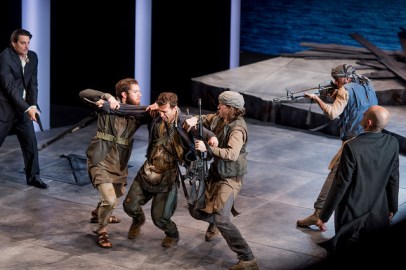
Vivaldi’s Farnace starring Anthony Roth Costanzo at 2017 Spoleto Festival (first-ever fully staged production in U.S.); photo by Leigh Webber Photography
Part One of my report on the 2017 edition of Spoleto Festival USA is now live on Musical America (subscription required):
CHARLESTON, SC—Spoleto Festival USA has a way of weaving the threads of history into fascinating, unexpected patterns. The 450-seat Dock Street Theater [below], where Vivaldi’s Farnace is now receiving a superlative production, sits on the site of a theater that initially opened in 1736—just nine years after Vivaldi introduced the work at the Teatro Sant’Angelo in his native Venice.
Filed under: Musical America, review, Spoleto Festival USA
March 18, 2017 • 9:54 am Comments Off on Dinner at Eight Fails to Sate the Appetite
My Musical America review of the new opera Dinner at Eight by composer William Bolcom and librettist Mark Campbell is now live (behind the MA paywall).

Filed under: American opera, Minnesota Opera, Musical America, review, William Bolcom
November 22, 2016 • 7:20 am Comments Off on Jaap van Zweden Takes the New York Philharmonic for a Test Drive

Last week Jaap van Zweden conducted the New York Philharmonic in their first concert together since he was named Alan Gilbert’s successor as music director (starting in the 2018-19 season).
The program was a rich one: the Prelude to Wagner’s Lohengrin, Tchaikovsky’s Fourth Symphony, and the New York premiere of a brand-new viola concerto, Unearth, Release, by the highly talented young LA-based composer Julia Adolphe.
My review for Musical America has now been posted (behind the usual paywall):
NEW YORK—Four-and-a-half years after making his New York Philharmonic debut, Jaap van Zweden ascended the podium on Thursday for his first concert with the orchestra since being appointed …
Filed under: Musical America, new music, New York Philharmonic, review, Tchaikovsky, Wagner
October 6, 2016 • 8:48 am Comments Off on Don Pasquale and Andrea Chénier at San Francisco Opera

In addition to Bright Sheng’s Dream of the Red Chamber, I reviewed September’s other two productions at San Francisco Opera: a winning Don Pasquale (in which Larry Brownlee made his company debut) and a weak Andrea Chénier. The review is online at Musical America (subscription required):
SAN FRANCISCO—Was it merely coincidence or a cleverly tucked-away reference by way of programming? Regardless, San Francisco Opera opened its new season with a trio of operas in rotation … »Read
Filed under: Lawrence Brownlee, Musical America, review, San Francisco Opera
October 3, 2016 • 7:22 am 1

Pureum Jo as Dai Yu (c)Cory Weaver/San Francisco Opera
My review of the world premiere production of Bright Sheng’s Dream of the Red Chamber at San Francisco Opera has now been posted on Musical America (behind paywall):
SAN FRANCISCO—By its very nature, opera is a medium well-suited to synthesizing widely varied traditions into fascinating new hybrids. Dream of the Red Chamber, which received its world premiere production by San Francisco Opera in September, seeks to adapt one of the most beloved works of Chinese literature to the musical and theatrical dimensions of Western opera.
Filed under: Musical America, review, San Francisco Opera
October 1, 2016 • 6:43 pm 1
Here’s my profile of the highly talented conductor Pablo Rus Broseta for Musical America. He’s the featured new Artist of the Month for October 2016. Congratulations, Pablo!
It’s a couple days before the season officially begins with an ambitious program, and Seattle Symphony Associate Conductor Pablo Rus Broseta is monitoring the sound balance from the hall during the first full rehearsal. A lot is at stake. Following the glitz and good will of the SSO’s gala opening a few days ago, this concert represents a sort of manifesto of the orchestra’s programming philosophy under Music Director Ludovic Morlot.
Filed under: conductors, Musical America, Seattle Symphony
 Arts & Culture Stories from NPR
 MEMETERIA by Thomas May