Out today is the third installment in Ekkozone Records’ series of recordings devoted to the music of Roger Reynolds, as active as ever at 91. The strikingly original works here include WISDOM’s Sources, which grew out of Reynolds’s longstanding creative friendship with violinist Irvine Arditti, and ‘O’o’ – named for the now-extinct Hawaiian bird and written for flutist Robert Aitken. Danish percussionist and producer Mathias Reumert has been documenting Reynolds’s music in this remarkable series.
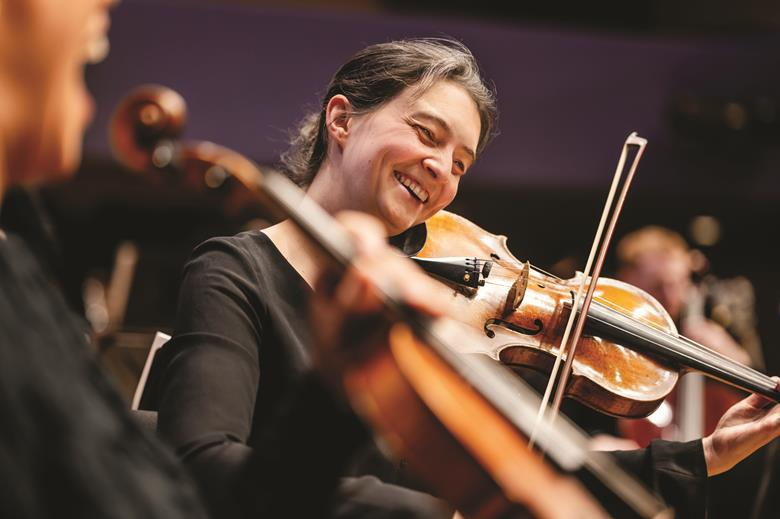
I spoke with Minnesota Orchestra principal violist Rebecca Albers for The Strad about preparing the North American premiere of Donghoon Shin’s Threadsuns – a viola concerto inspired by Paul Celan’s poetry, which she performs this weekend. Fabien Gabel conducts. Given everything happening in Minnesota right now, the piece feels heartbreakingly timely.
In a moving decision, the Minnesota Orchestra also announced a change to the program in response to tragedy in the community. Opening the concerts is the Adagietto from Mahler’s Symphony No. 5, offered in memorial for Alex Pretti and Renee Good, and shared “with love for our audience and our beautiful city” on a program that explores resilience and the search for “songs to sing” amidst darkness.
A new Stradinterview with Gil Shaham about Premieres, his forthcoming album of violin concertos written for him by Scott Wheeler, Bright Sheng, and Avner Dorman:
Premieres, Gil Shaham’s new release on Canary Classics, brings together three violin concertos written expressly for him and realised in close collaboration with conductor Leon Botstein and The Orchestra Now. Recorded at Bard College’s Fisher Center, the album reflects a network of long-standing artistic relationships and a shared belief in the concerto as a living, evolving form…
To open the season this weekend, Franz Welser-Möst leads the Cleveland Orchestra and Chorus in the American premiere of Austrian composer Bernd Richard Deutsch’s ambitious, nearly-hour-long Urworte, which sets Goethe’s famous stanzas to music.
Movements:
Daimon: Dämon (Demon)
Tyche: Das Zufällige (The Accidental)
Eros: Liebe (Love)
Ananke: Nötigung (Necessity) —
Elpis: Hoffnung (Hope)
Sunday’s concert will be livestreamed on Adella, digital home of The Cleveland Orchestra.
My introduction to the work can be found in the Cleveland Orchestra program notes here.
Composers often set aside ideas that strike them in a flash of inspiration, waiting until the right moment arrives to wrestle them down in detail and give them an enduring form. For Bernd Richard Deutsch, one such idea was to write a work exploring the elemental forces that shape our lives…. continue
And it begins! Ojai Music Festival launches its 79th edition today, 5 June, and will be streaming the concerts at Libbey Bowl on the OMF homepage at OjaiFestival.org and on the festival’s YouTube channel.
Writing the OMF program notes is always an immersive experience, but this year’s festival programming by Music Director Claire Chase has proved to be the most fulfilling since I began writing for the festival. The 2025 edition also carries a bittersweet resonance since Artistic and Executive Director Ara Guzelimian just announced that he will conclude his tenure with the 2026 OMF.
So many highlights to look forward to over this extended weekend, which showcases the incredible community of fellow artists with whom Claire Chase has chosen to collaborate. In the spotlight tonight are Marcos Balter and his epic Pan – a signature contribution to Chase’s ongoing Density 2036 project – and Annea Lockwood’s bayou-borne, an homage to the late Pauline Oliveros, her close friend, mentor to Chase, and a tutelary spirit watching over the music-making at Ojai.
San Francisco Symphony just gave the world premiere of Before we fall, Anna Thorvaldsdottir’s new cello concerto for Johannes Moser, with Dalia Stasevska on the podium.
My behind-the-scenes feature on its creation is the current Strings magazine cover story.
Here’s Lisa Hirsch’s review for the San Francisco Chronicle:
“Thorvaldsdottir’s new cello concerto, Before We Fall, is a banger, sonically and intellectually, dense with ideas and meriting repeat hearings. It launches explosively, which is not an unusual strategy for a concerto, but don’t be misled. This isn’t a conventional soloist-versus-orchestra showdown…. continue
Third Coast Percussion with guest artist violinist Jessie Montgomery. (Marc Perlish)
I spoke with Third Coast Percussion’s David Skidmore about their upcoming program on 3 May at Meany:
Think percussion is just about hitting things? Think again.
With instruments that shimmer, thrum, ping and even gurgle underwater, Third Coast Percussion has spent the past 20 years expanding horizons for what a percussion ensemble can do. The Chicago-based quartet returns to the University of Washington’s Meany Center for the Performing Arts on May 3 as part of a milestone anniversary tour….
Xian Zhang, Seattle Symphony music director designate, conducts the Symphony in its “Holst: The Planets” program March 27. (James Holt / Seattle Symphony)
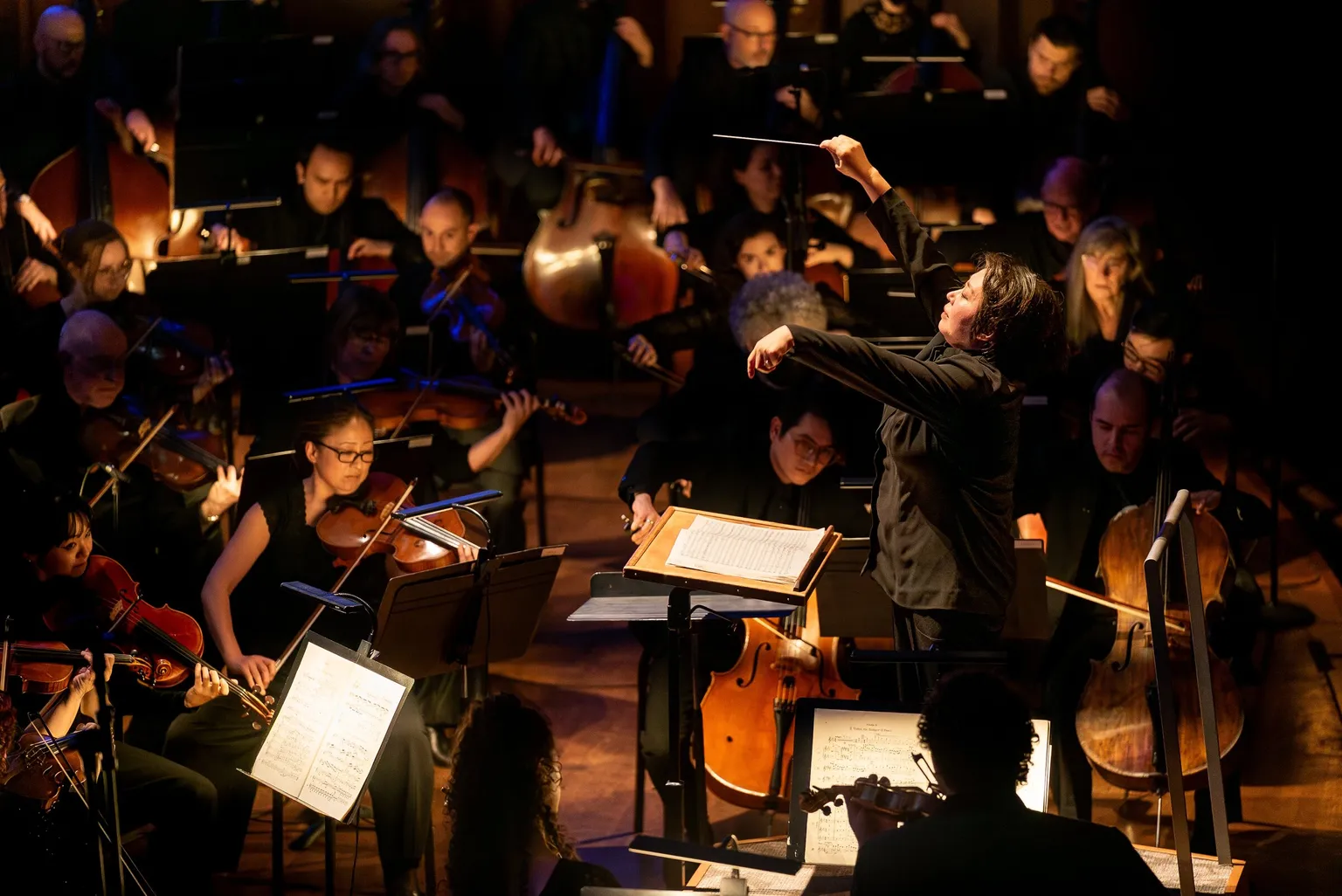
I reviewed Xian Zhang’s first concert with Seattle Symphony since being named music director designate :
With just a few gestures, Xian Zhang began conjuring a cosmos.
Returning to Benaroya Hall for her first full program since being named Seattle Symphony’s incoming music director, Zhang drew the nearly sold-out concert hall Thursday night into her orbit with her focused, magnetic conducting.
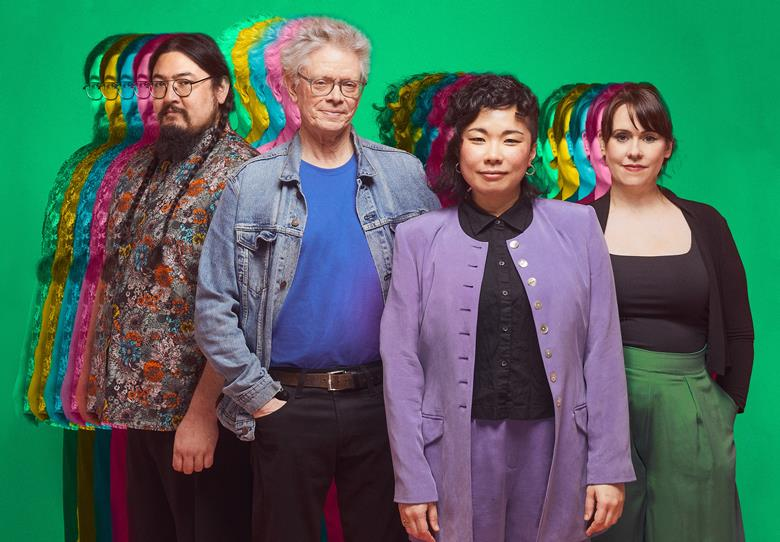
A new interview for The Strad: I spoke with Ayane Kozasa and Paul Wiancko of the Kronos Quartet about the dramatic change in the ensemble’s lineup that began with the current season:
Having celebrated its 50th anniverary last season, the Kronos Quartet has already begun its latest chapter with a dramatic change in the ensemble’s makeup. Longtime members John Sherba (violin) and Hank Dutt (viola) retired at the end of June, leaving violinist David Harrington, who founded Kronos, as the sole remaining member from the early years. Dutt had been part of Kronos since 1977, while Sherba joined them in 1978. Cellist and composer Paul Wiancko began his relationship with the quartet in 2019 and took the place of Sunny Yang in February 2023. Violinist David Harrington, who founded Kronos, is the only member who now remains. ..
Michael Mayes (David), Brenton Ryan (CM), and Greer Grimsley (Paul) in The Righteous; photo by Curtis Brown for the Santa Fe Opera
I reviewed Santa Fe Opera’s The Righteous for Musical America. The latest in the company’s distinguished history of commissions, The Righteous is an ambitious collaboration between composer Gregory Spears and poet-librettist Tracy K. Smith. The opera unfolds across the span of the Reagan era and features a large cast to tell the story of a charismatic Southwestern preacher who gets elected as state governor:






 MEMETERIA by Thomas May