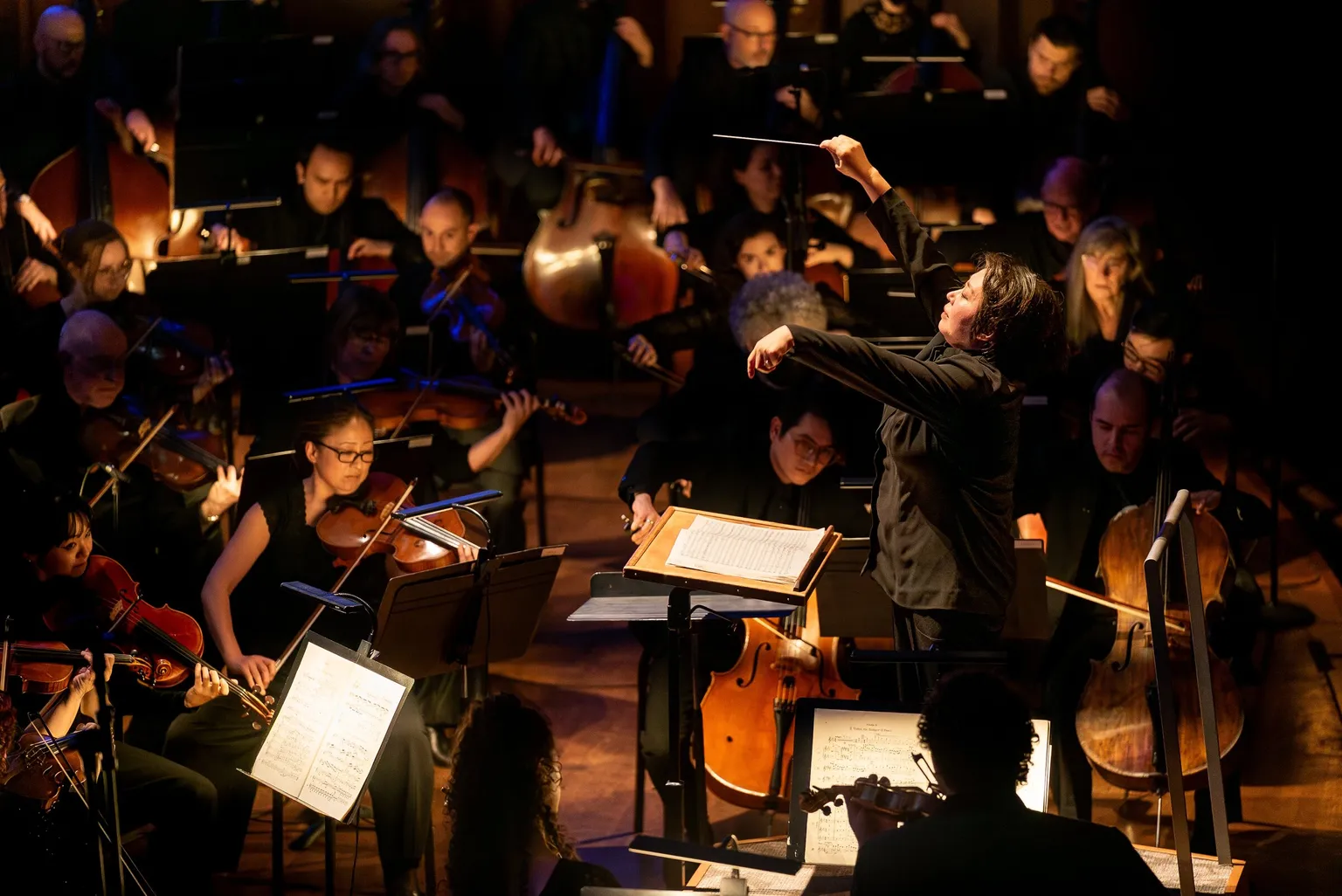
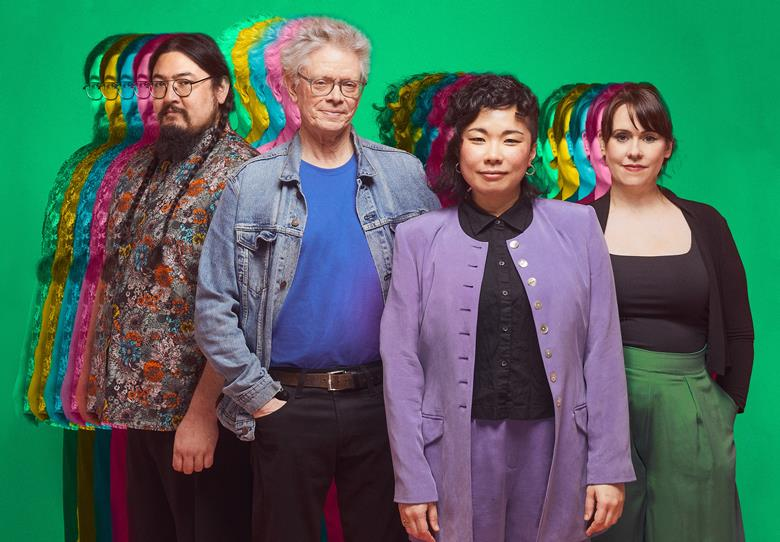
San Francisco Symphony just gave the world premiere of Before we fall, Anna Thorvaldsdottir’s new cello concerto for Johannes Moser, with Dalia Stasevska on the podium.
My behind-the-scenes feature on its creation is the current Strings magazine cover story.
Here’s Lisa Hirsch’s review for the San Francisco Chronicle:
“Thorvaldsdottir’s new cello concerto, Before We Fall, is a banger, sonically and intellectually, dense with ideas and meriting repeat hearings. It launches explosively, which is not an unusual strategy for a concerto, but don’t be misled. This isn’t a conventional soloist-versus-orchestra showdown…. continue
Third Coast Percussion with guest artist violinist Jessie Montgomery. (Marc Perlish)
I spoke with Third Coast Percussion’s David Skidmore about their upcoming program on 3 May at Meany:
Think percussion is just about hitting things? Think again.
With instruments that shimmer, thrum, ping and even gurgle underwater, Third Coast Percussion has spent the past 20 years expanding horizons for what a percussion ensemble can do. The Chicago-based quartet returns to the University of Washington’s Meany Center for the Performing Arts on May 3 as part of a milestone anniversary tour….
Xian Zhang, Seattle Symphony music director designate, conducts the Symphony in its “Holst: The Planets” program March 27. (James Holt / Seattle Symphony)
I reviewed Xian Zhang’s first concert with Seattle Symphony since being named music director designate :
With just a few gestures, Xian Zhang began conjuring a cosmos.
Returning to Benaroya Hall for her first full program since being named Seattle Symphony’s incoming music director, Zhang drew the nearly sold-out concert hall Thursday night into her orbit with her focused, magnetic conducting.
A new interview for The Strad: I spoke with Ayane Kozasa and Paul Wiancko of the Kronos Quartet about the dramatic change in the ensemble’s lineup that began with the current season:
Having celebrated its 50th anniverary last season, the Kronos Quartet has already begun its latest chapter with a dramatic change in the ensemble’s makeup. Longtime members John Sherba (violin) and Hank Dutt (viola) retired at the end of June, leaving violinist David Harrington, who founded Kronos, as the sole remaining member from the early years. Dutt had been part of Kronos since 1977, while Sherba joined them in 1978. Cellist and composer Paul Wiancko began his relationship with the quartet in 2019 and took the place of Sunny Yang in February 2023. Violinist David Harrington, who founded Kronos, is the only member who now remains. ..
Michael Mayes (David), Brenton Ryan (CM), and Greer Grimsley (Paul) in The Righteous; photo by Curtis Brown for the Santa Fe Opera
I reviewed Santa Fe Opera’s The Righteous for Musical America. The latest in the company’s distinguished history of commissions, The Righteous is an ambitious collaboration between composer Gregory Spears and poet-librettist Tracy K. Smith. The opera unfolds across the span of the Reagan era and features a large cast to tell the story of a charismatic Southwestern preacher who gets elected as state governor:
A toast to the luminously imaginative composer and musical thinker Roger Reynolds, who celebrates his 90th birthday today — and is still going strong. Within this year alone, the Pulitzer Prize-winning composer has presented his latest opus, KNOWING / NOT KNOWING, described by Ken Herman as “a 21st-century secular oratorio … that deftly fuses recorded and live media, alternates chorus and the spoken word, and juxtaposes live drama with instrumentalists in order to pose probing questions about the nature and range of human knowledge.” (Here’s a vimeo link to an excerpt from KNOWING/NOT KNOWING.)
As Roger Reynolds continues into his tenth decade, the urge to extend the limits of musical perception and meaning beyond those previously known remains as powerful a motivation as ever.
In March, the Center for New Music and Associated Technologies (CNMAT) and the Department of Music at the University of California, Berkeley, presented a colloquium and concert celebrating this milestone birthday year. The Center describes Reynolds, who has also been an influential mentor at UC San Diego for more than half a century, as “a composer, writer, producer, and mentor, pioneer in sound spatialization, intermedia, and algorithmic concepts … [and] an inveterate synthesizer of diverse capacities and perspectives. … [His] projects with individual performers and ensembles, theater directors, choreographers, and scientists involve challenging interpersonal collaborations.” He has been, for decades, a sought-after mentor at UC San Diego.”
Some (by no means all!) other recent projects include his latest “sharespace” work, Persistence(for cello and computer musician), the ongoing Passage series, and Xenakis Creates in Architecture and Music: The Reynolds Desert House, a collaborative book exploring the evolution of a house design by the Greek composer/architect for him and his partner Karen. Reynolds is also a member of the international, Montréal-based consortium ACTOR, and the originator of the Bridging Chasms initiative, which seeks to improve cross-disciplinary communications. He was inducted into the American Academy of Arts and Letters in 2023.
Reynolds has also been collaborating with the Danish percussionist, and conductor, and producer Mathias Reumert on the release of no fewer than four new albums. The first two these, Wind Concertosand Watershed V, have already been released on Reumert’s Ekkozone label; still to be released later in the year are The Promises of Darkness and Watershed V/’O’o.
Here’s a link to the booklet essay I wrote for the extraordinary two-CD set For a Reason, which appeared last year on neuma records. (The neuma label, which prizes itself on offering “food for the mind’s ear,” has an extensive catalogue of music by Reynolds.) For a Reason includes examples of Reynolds’s longstanding collaborations with violinist Irvine Arditti (whose own eponymous string quartet celebrates its 50th anniversary this year) and percussionist Steven Schick.
On Tuesday 16 April, the Iranian American composer Gity Razaz’s new song cycle Flowing Down the Widening Rings of Being will be introduced to Seattle. The program, at 7.30 at Meany Center on the University of Washington Campus, is being presented by the Israeli Chamber Project with Lebanese American tenor Karim Sulayman.
Flowing Down the Widening Rings of Being is based on poetry and prose of Rumi and Rainer Maria Rilke and is scored for tenor, violin, viola, cello, clarinet, harp, and piano. Commissioned by the Israeli Chamber Project. Gity Razaz, who was born in Tehran in 1986 and now lives in New York, is deeply influenced by the constantly changing, at times tumultuous, realities of the world, including her identity and personal journey as an immigrant. This process of what Razaz describes as “uprooting and rebuilding” occupies much of her work, resulting in music that is emotionally charged and dramatic, while still maintaining mystery and lyricism. Her compositions are her means of responding to a hyperactive, disconnected world and offering transformation to listeners.
In an interview with I Care If You Listen, Razaz says why she chose to juxtapose the two poets in her new song cycle: “Rumi and Rilke lived about 700 years apart and on nearly opposite sides of the earth, and with completely different religious backgrounds. Yet their philosophical and imaginative perspectives on some of the most existential topics in the history of mankind are eerily similar. In the poems selected for this project, I was attracted to the almost identical poetic imagery they both used in the poems which I ended up selecting for this project: they both use the imagery of ‘widening rings and circles’ to describe life and existence. Rumi calls for embracing uncertainty and living the ‘questions,’ ‘flowing down the always widening rings of being’ while Rilke acknowledges life’s unyielding truth, and moves through it with the confession that ‘I live my life in widening circles.’ . . ”
Composer William White and librettist Jillian White on the creation of Cassandra
Harmonia Orchestra & Chorus will present an ambitious program on 6 April that includes not only surefire works by Bernstein and Gershwin but a major world premiere titled Cassandra — the largest work to date composed by Harmonia’s music director, William White. The concert takes place at 7:30 p.m. at the Shorecrest Performing Arts Center (15343 25th Ave NE, Shoreline). Tickets here.
Harmonia will pop the cork with Bernstein’s effervescent Candide Overture and then add to the global celebrations marking the centennial of Rhapsody in Blue this year with a performance featuring the young New York pianist Joseph Vaz.
Filling the concert’s second half is Cassandra, an “opera-oratorio” in two acts about the mythic daughter of Trojan King Priam, a seer whose knowledge of what is to be is dismissed by everyone as the result of a curse imposed by Apollo. At the end of the Trojan War, whose terrible destruction she foresaw, Cassandra is taken captive back to Greece by Agamemnon and slaughtered by his wife Clytemnestra.
For the title role, White has cast Ellaina Lewis (recently seen at Seattle Opera in Blue and Malcolm X); the rest of the cast includes mezzo-soprano Melissa Plagemann, tenor Brendan Tuohy, and baritone Zachary Lenox.
Of the musical style, the composer writes:
“The chorus is given music that emphasizes its narrative role: it mostly sings in unison, evoking the declamatory sound of an Ancient Greek chorus. There are several moments where the chorus takes the role of “the people” (in “Agamemnon’s Return,” for example). They are also folded into the orchestration as “vocal instruments” (much in the manner of Holst’s The Planets or Ravel’s Daphnis et Chloé).
Cassandra’s prophetic utterances are given a mystical halo of sound in the orchestra and chorus with the use of string harmonics, tinkly percussion (finger cymbals, triangle, crotales), uncanny warbling by the choral sopranos and altos, and a low piccolo that doubles all of her mystical incantations. The horrors that Cassandra describes are accompanied by thick chords in extremely dissonant clusters.
The score makes extensive use of Danny Elfman–style “Batman chords”: brass-dominated figures that make huge crescendos before being violently cut off. The orchestra is given two extended passages: “The Trojan Horse” and “The Journey Across the Sea” (the interlude between Acts I and II, which offers the one extended instrumental solo, a plaintive song for the English horn).
The climax of Act I, “The Destruction of Troy,” is the most extensive number in the piece, a dissonant, mixed-meter orgy of sonic annihilation.
Aside from Stravinsky and Herrmann, many of my usual musical influences make themselves known: Alfred Schnittke, Stephen Sondheim (as in Sweeney Todd), Gustav Holst, Mozart–Handel–Vivaldi (“Clytemnestra’s Rage Aria”), Carl Orff and Béla Bartók.”
The rest of White’s extensive commentary on the piece can be found here.
Quynh Nguyen with the London Symphony in the world premiere recording of Paul Chihara’s Concerto-Fantasy
This year’s edition of the Celebrate Asiaconcert presented by Seattle Symphony marks the 16th season of this annual tradition. Associate Conductor Sunny Xia will helm the orchestra in a program of works by two very special composers with Seattle connections, as well as classics by Beethoven and Grieg. The concert takes place on Sunday 28 January 2024 at 4pm at Benaroya Hall. Tickets are available to purchase here. There will also be a Celebrate Asia Market starting at 3pm before the concert and after the performance, featuring the Seattle International Lion Dance Team (at 3pm) and CHIKIRI and The School of TAIKO (post-concert).
The extraordinarily precocious Korean American composer August Baikis a graduate of the 2022-2023 SSO Young Composers Workshop, where his Chuseok Overture for Orchestra was first introduced. The Young Composers Workshop is a unique program that give students the opportunity to workshop compositions with an experienced local composer and Symphony musicians.
The wonderful Paul Chihara‘s new Piano Concerto-Fantasy will receive its US premiere, with Vietnamese American pianist Quynh Nguyen as the soloist. Chihara was born in 1938 in Seattle (and was forced with his family to live in an internment camp in Minidoka, Idaho, during the Second World War as a result of Executive Order 9066). Chihara wrote Piano Concerto-Fantasy for Quynh Nguyen as part of an intensive recent collaboration involving her recording of his complete piano works on the Naxos label. She gave the world premiere in October 2022 with the Vietnamese National Symphony at the Hanoi Opera House as part of a concert commemorating normalization of US-Vietnam diplomatic relations.
Chihara found inspiration for Piano Concerto-Fantasy “in traditional Vietnamese melodies and modes, as well as his own experiences composing scores for television and film about the Vietnam War,” according to Quynh Nguyen. The music, she adds, “embodies a sense of longing for the peaceful past and for the future and its possibilities. The piece is virtuosic and intensely melodic with French and Eastern harmonies and jazz-tinged sections, and phrases reminiscent of Russian classical works. These elements are juxtaposed within the story, reflecting my personal journey of studying music in Vietnam, Russia, France, and the United States, and how their diverse cultures have shaped my life. The concerto reinforces how music transcends politics, language and culture.”
The program will also include Beethoven’s Leonore Overture No. 3 and Grieg’s Peer Gynt Suite.
Guest conductor Dalia Stasevska leads the Seattle Symphony and electric bass soloist Lauri Porra; photo (c) Brandon Patoc
My review of this weekend’s program with guest conductor Dalia Stasevska:
Having missed Stasevska’s SSO debut in March 2022 — a week after Putin invaded Ukraine, the country in which she was born — I was particularly interested in experiencing what all the fuss is about firsthand. Her ability to transmit a sense of focused, joyful discovery while shaping a performance impressed me. The charisma is real. …