Starting today, Pierre Boulez Saal in Berlin is presenting a four-day Festival of New Music, which will juxtapose online premieres with works by the hall’s namesake.
Curated by Daniel Barenboim and Emmanuel Pahud, the programs — presented in the the Frank Gehry-designed space — are being streamed on the Boulez-Saal Facebook page as well as on its YouTube channel. These programs will then remain available, free on-demand, for 30 days.
In honor of George Walker’s birthday — he would have turned 98 on Saturday — here’s my profile for the New York Times published last year, ahead of the posthumous premiere of his Sinfonia No. 5.
Deeply entrenched racism drove Walker away from his career as a concert pianist to the solitary existence of a composer. This extraordinary musical personality was shamefully neglected throughout his long life yet continued producing intricate, masterfully wrought scores. Here’s hoping that Walker’s upcoming centennial will be the catalyst needed for a wholesale engagement with his rich oeuvre.
Learn more about composer (and bass-baritone and actor) Damien Geter‘s remarkable new work, An African American Requiem, in my cover story for the current issue of Chorus America’s The Voice, which explores this and other examples of “secular requiems” by contemporary composers (starts on p. 26).
The world premiere by Portland’s Resonance Ensemble, which commissioned the work, was originally scheduled for May but had to be postponed because of the pandemic. Resonance now plans to give the premiere on 22 January 2021.
On Thursday through Sunday, 11-14 June, Ojai Festival presents a virtual edition of what was to have been its 74th festival. Artistic Director Chad Smith and Music Director Matthias Pintscher curated a splendid program, with Olga Neuwirth and Steve Reich as special featured guests. This also would have marked the Ojai debut of the Ensemble intercontemporain — of which Pintscher is current director and which was founded by his mentor Pierre Boulez, a longtime presence at Ojai.
This is my own first year of being associated with Ojai, so this cancellation has hit me especially hard. But you’ll have a chance to hear Ara Guzelimian, incoming Artistic Director, in some wonderful conversations with Pintscher, Neuwirth, Reich, and members of the Calder String Quartet.
You can read my program essay here. My program notes for each event are linked on the respective pages.
Another installment in my reporting on the 2019 Beijing Music Festival. There was a strong emphasis on opera this year, which I looked at in this story for the January 2020 edition of Opera Now.
Have you heard the wonderful music of Luís Tinoco? I invite you to try out the latest album of his work, Archipelago, recently released on the Odradek label.
I first encountered this excellent Portuguese composer and acclaimed radio host — who grew up in the post-revolution generation — in the early Morlot days with Seattle Symphony, when they played FrisLand, a kind of orchestral ode to Bill Frisell. (FrisLand is available, along with such works as Tinoco’s Cello Concerto, on his previous Odradek album, The Blue Voice of the Water).
Tinoco, 50, has written some pieces for the stage as well as vocal and orchestral works. Archipelago focuses on chamber pieces featuring percussion and surveys Tinoco’s musical language over the past two decades.
The composer’s father was a professional painter and an amateur jazz musician, and the obvious camaraderie Tinoco enjoys with the Porto-based Drumming Grupo de Percussão (Drumming GP) — though he himself is not a performer — suggests an intriguing blend of working with a classical chamber ensemble and a tight-knit jazz band.
Drumming GP, led by Miquel Barnat and celebrating its 20th anniversary this year, has earned a strong reputation for its boundary-crossing projects. Tinoco first collaborated with the group when they commissioned him in 2003, and he dedicates to them the album’s culminating work, Steel Factory (another of the several pieces they have commissioned from him over the years).
Archipelago was recorded in the monastery of São Bento da Vitória in Porto. The album is also available in 5.1 surround, so you can immerse yourself entirely in the expert production by sound engineers Hugo Romano Guimarães and Santi Barguñó.
Tinoco has included several pieces from the early 2000s. The opening track, Short Cuts, revisits his 2004 saxophone quartet, refashioned here for percussion. Already in this early stage of his career, Tinoco was developing a language centered on deftly channeled currents of energy, here intensified through the alluring timbral combinations he has devised anew for the percussion ensemble.
Another early piece, the circular Ends Meet, is for marimba and string quartet and was originally written for the percussionist Pedro Carneiro. Tinoco derives fascinating dramatic impulses from the combination of these sound worlds over the course of this four-movement piece as it continually revisits material from different perspectives.
Mind the Gap from 2000, is the earliest piece here, a product of Tinoco’s years as a postgraduate student in London, and charts a variety of journeys with solo marimba.
If Tinoco’s neatly chiseled rhythmic patterns evoke a sense of distances traveled, the recent Genetically Modified Fados (2018, a commission from Drumming GP) oscillates back and forth in time. Tinoco juxtaposes music for percussion quartet with archival recordings of Portuguese Fado featuring male and female singers. These faded, embedded artefacts strip away any sentimentality from the nostalgia. The radiant ghostliness of the triptych’s third panel, Camellias, is especially spellbinding.
In Zoom in – Zoom out, another Drumming GP commission (2010, dedicated to Bernat), Tinoco turns to the popular music of Brazil subliminally by alluding to its rhythmic patterns and melodic structures. It is scored for a trio playing vibraphone, two marimbas, and two bass drums.
The most recently composed music is the title track (2019, also dedicated to Bernat), which is for solo vibraphone and eight wah-wah tubes. Archipelago is a stunningly beautiful poem made of subtly timed resonances, exquisitely micro-tonal differentiations in the tuning of the tubes, and a carefully calibrated dramaturgy of varying mallets and bowings (and even hands). Archipelago submerges the listener in a hauntingly liquescent environment. Add it to your list of evocative water musics.
Archipelago also makes for a fascinating contrast with the grand finale and longest track, Steel Factory (2006). In this piece for an ensemble of steel drums, Tinoco again foregrounds his music of energy, starting with deep, ominous pulsations that set the stage for its highly theatrical gestures. The sound world here also incorporates bongos and steel bars (sixens) and elicits an astonishing variety, later building to a thrillingly clangorous climax.
Almost a year ago, the New York-based composer Michael Vincent Waller told me about a new album he had in the works. The topic came up when I interviewed him for Musical America, which featured Waller as January’s new artist of the month.
The album, titled Moments, came out just last month on the Unseen Worlds label and offers a wonderful entrée into Waller’s musical world. His third album to date, it comprises 18 miniatures, 13 of them for solo piano, the other 5 for vibraphone.
Waller continues his collaboration with R. Andrew Lee, whose sensitive performances at the keyboard were featured on his preceding album, Trajectories (along with the phenomenal cellist Seth Parker Woods). The percussionist William Winant, a well-known personality in avant-garde circles, plays the pieces for vibraphone.
“One thing I’m trying to explore as an artist is the organic, intuitive sense we have about experiences — the human subtext to what is happening in the music, in its colors, harmonies, and melodies,” the composer explained during our talk last year. In Moments, he has distilled a range of experiences with an open-hearted, intimate honesty that resonates long after the ebb and flow of his compositions’ physical sounds.
It’s not necessary to know any of the autobiographical stories or family relationships and loved ones Waller memorializes here to be moved by the emotions they elicit. On another level, Moments pays gentle tribute to musical figures who are part of a generally known cultural repertoire. “For Pauline,” for example, referring to the late Pauline Oliveros, was prompted by her death in November 2016. Its bell-like chords in alternating registers concentrate the attention on the taken-for-granted miracle that is harmony, effecting an experience of “new sound.”
Similarly, the sounds of the piano itself begin to reassemble into something not-quite-familiar. This lays the ground for the wonderful effect of the vibraphone’s first entrance well into the album (in a kind of mini-suite comprising four of the miniatures and titled “Love”).
In the spirit of Oliveros and the philosophy of what she called “deep listening,” Waller composes with a deceptive simplicity. His aesthetic relies on — and expands from — a generous patience familiar from practices of meditation and mindfulness. These “moments” radiate a fullness that belies their duration — most of the pieces are between just two and three minutes long.
La Monte Young was a formative influence who opened Waller up to new ways of perceiving the materials of a composition — indeed, the phenomenon of sonority itself. Erik Satie and Morton Feldman are some of the other musical spirits evoked by various Moments. The final piece, “Bounding,” even alludes to a mainstay of Western music history, the descending “lamento” chord progression that has taken countless forms, from flamenco to the opening of Philip Glass’s Satyagraha).
But none of these are derivative or reduced to cliches. Waller’s use of the most elemental materials and gestures combines reflective process with an unironic, unconditional sharing of self and soul that I find deeply moving.
Waller again turns to the photographer Phill Niblock — as he does on his previous two albums — for the striking cover image of Moments. An LP edition is also available, and the record includes insightful commentary by Tim Rutherford-Johnson and liner notes by “Blue” Gene Tyranny.
The program on Sunday evening at Octave 9 kept dividing and subdividing: into unexpected new components, speech shadowed by its melody mirror, natural acoustics haloed with electronic auras, philosophical speculation married to folk-simple parable. This was an evening of musical mitosis that showcased the work of Kate Soper. An extraordinarily original composer, performer, writer, and theater artist, Soper is drawn to the enigma-rich threshold between speech and song — and what she describes as “the slippery continuums of expressivity, intelligibility, and sense, and the wonderfully treacherous landscape of the human voice.”
If that sounds awfully cerebral, in practice it was utterly engaging, fascinating, illuminated by shards of insight and beauty. Joined by Sam Pluta, a fellow composer and sound artist who contributed electronic textures and improvisations on the live sound from his laptop, Soper performed her ongoing project Dialogues. I couldn’t tell whether this incorporates, like a Russian Easter egg, her earlier pieces The Fragments of Parmenides and The Understanding of All Things (based on a Kafka text) — or whether these are meant to be regarded as a suite of sorts, somehow interconnected.
In any case, the performance started out in a lecture-presentation mode, as if Soper, in speaking voice, intended to deliver a lecture. But as the ideas began to soar, the presentation and their modes started shifting into new realms. Seattle Symphony’s new Octave 9 space was just right for the theatricalization, with Pluta’s electronic manipulation enhanced by visualizations that fluctuated across the curved screen behind the performers.
Soper’s method is to compile literary and philosophical texts, which she rearranges in collages that incorporate her own reflections. These she sets to music across a performative spectrum ranging from rhetorically emphatic narration to singing with extended vocal techniques, at times accompanying herself at the keyboard.
The Octave 9 performance underscored Soper’s special attraction to the classical world, with fragments from the pre-Socratic philosopher Parmenides serving as the centerpiece, “filled in” with a haunting setting of the W.B. Yeats poem “For Anne Gregory” to enhance her reflections on the metaphysical speculations — tantalizingly incomplete — of Parmenides.
The interplay between rational, logical argument and immediately graspable flashes of (irrational?) beauty emerged as a subtext. The “Way of Appearance,” paradoxically, beckoned — dazzling with its “empirical noise” — as a possibly even more alluring path than the timeless, invariable “Way of Truth” posited by the extant fragments of Parmenides’ great poem On Nature (which itself, as Lucretius later did, uses the vehicle of art for the philosopher’s message).
This will be a good season to discover the world of this amazing artist. In Seattle, Seattle Modern Orchestra will present Kate Soper’s Ipsa Dixit on June 5 and 6. This is a chamber music theater piece for voice, flute, violin, and percussion that was a Pulitzer Prize finalist in 2017.
Soper also recently announced that her new opera, a treatment of the French medieval allegory-poem The Romance of the Rose, will be premiered April 2-5 on Montclair State University’s Peak Performances series.
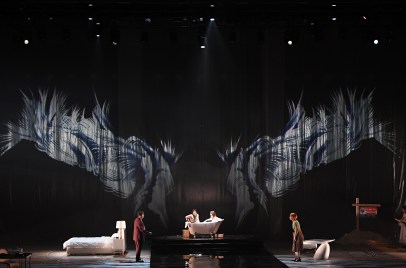
Du Yun’s “Angel’s Bone,” in its premiere production in the People’s Republic of China (photo credit: Beijing Music Festival)
Earlier this month, I visited the 22nd annual Beijing Music Festival. Here’s my report for Classical Voice North America, with a focus on BMF’s emphasis on new music under the dynamic leadership of Shuang Zou (now in her second year as the festival’s artistic director):
“Golden Week” is the name for the national holiday period held in the People’s Republic of China at the beginning of October. This year, it also signaled an earlier-than-usual start to the annual Beijing Music Festival (BMF) — the country’s largest and most extensive festival devoted to classical music…



 MEMETERIA by Thomas May