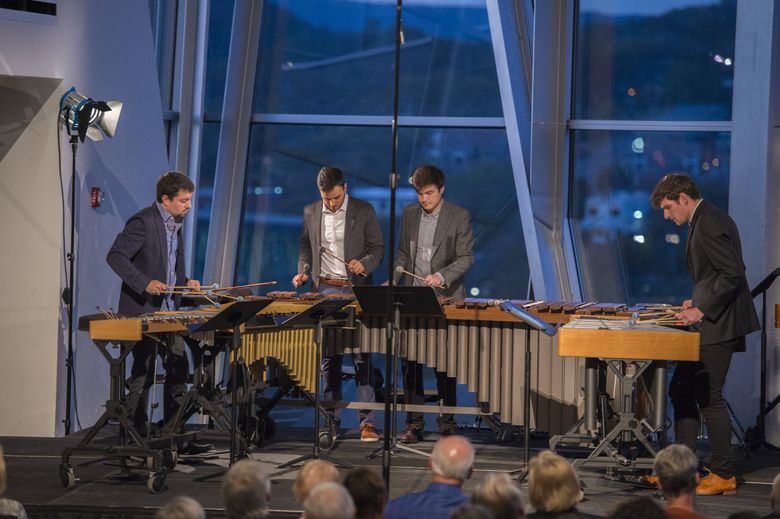
Sandbox Percussion is scheduled to perform Andy Akiho’s “Seven Pillars” in Seattle on Dec. 3 and in Olympia on Dec. 4. (Daniel Ashworth)
Seven Pillars, an epic for percussion quartet by the marvelous composer Andy Akiho, receives its live performance world premiere this weekend in Seattle by the Sandbox Percussion ensemble. My story for The Seattle Times:
“The spirit of percussion opens everything,” musician John Cage once declared. He had in mind the way percussion music can open the door to unaccustomed ways of listening — and even of perceiving the environment around us…..
And this weekend brings another not-to-be-missed percussion classic: Michael Gordon’s hour-long Timber, for six players, which is being presented by Base: Experimental Arts + Space: 6520 5th Avenue South, #122nd, Seattle, WA 98108 on Dec 4 and 5 at 3 and 8pm. Features a six-player instrument built by local master carpenter Isaac Anderson & light design by Kevin Blanquies.
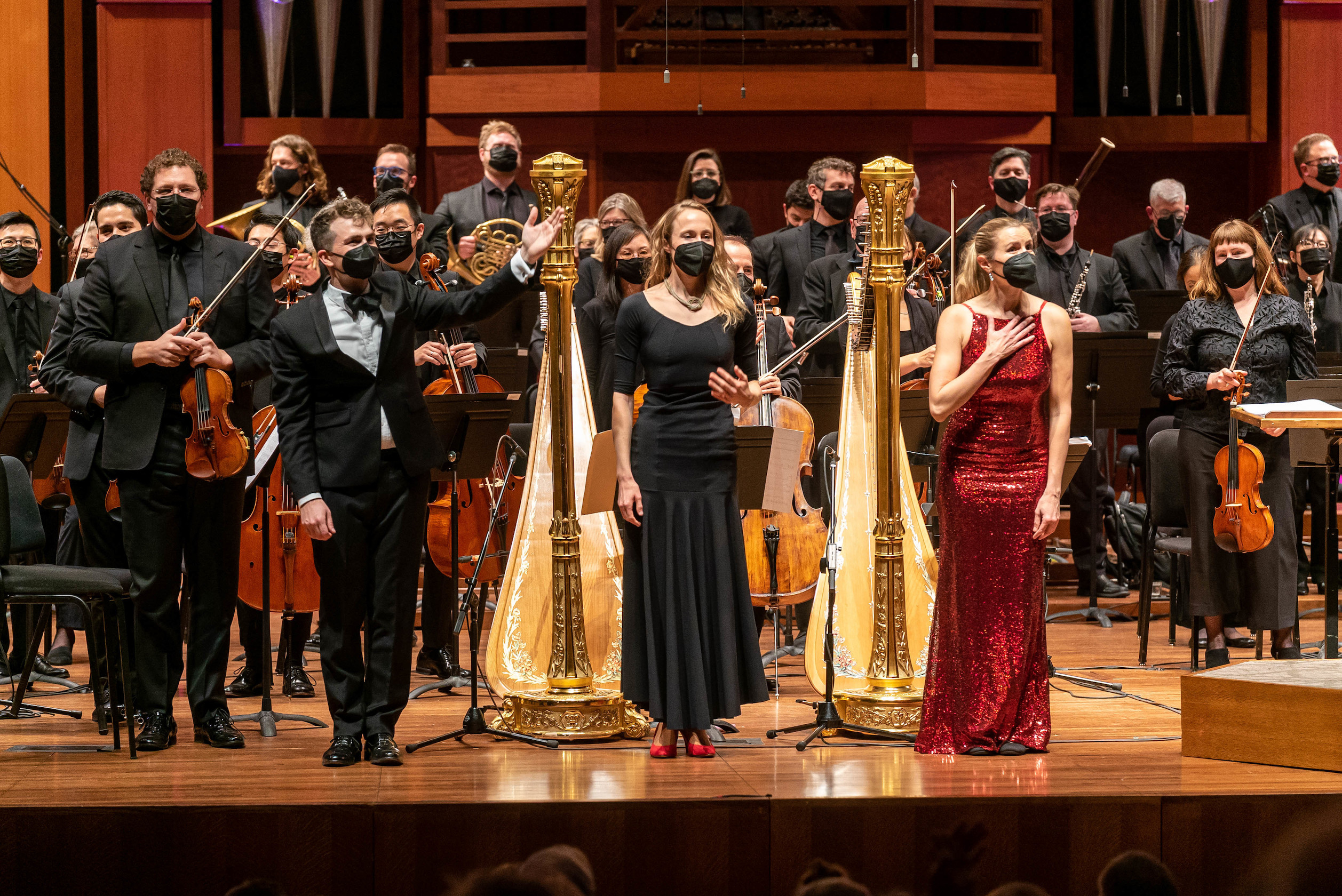
Lee Mills with soloists Hannah Lash and Valerie Muzzolini and the Seattle Symphony (photo: James Holt / Seattle Symphony)
I reviewed Seattle Symphony’s latest program: a world premiere of a new double harp concerto by Hannah Lash and Amy Beach’s “Gaelic” Symphony:
SEATTLE — An unexpectedly last-minute round of musical chairs reshuffled the lineup for one of the most unusual and original programs of the Seattle Symphony season. As a double harp concerto, Hannah Lash’s The Peril of Dreams, an SSO commission, in itself represents a rarity in the orchestral literature. That it was paired with the seldom-programmed “Gaelic” Symphony by Amy Beach made the occasion all the more remarkable….
This weekend, Lucerne Festival will launch the first edition of its Forward Festival devoted to contemporary music. Members of the international Lucerne Festival Academy network have spearheaded this new fall initiative, which has been curated by a team of 18 members. The organizing theme is “networks” and the process of forging connections and achieving closer communication with the audience.
The opening event pays tribute to the late Louis Andriessen Friday evening, 19 November, at 10:00 pm CET, with a raucous performance of Workers Union (video intro here).
Winnie Huang will create 10-minute performances for just one guest at a time throughout the festivaland Annea Lockwood’s Water and Memory and Michael Pisaro’s ricefall will similarly engage listeners. In, ricefall, for example, the participants let grains of rice trickle like rain onto various objects and surfaces, enabling an immersive and meditative sound experience. Olga Neuwirth was inspired by Ray Bradbury’s science fiction story “The Long Rain” to create her work of spatial music Construction in space: The sound is in motion, with the audience located right in the middle. Pauline Oliveros’ Out of the Dark, performed in complete darkness, is also conceived as spatial music and, like Lockwood, aims at “deep listening”: the listeners immerse themselves in the time-space continuum of the sound and become part of it.
A new piece by the Swiss percussionist and composer Jessie Cox will also be premiered — one of six works commissioned by the curatorial team to explore and exploit the architecture and acoustics unique to the KKL Concert Hall. “Networks” are additionally at the center of the various models of musical self-organization which Luis Fernando Amaya’s Tinta Roja, Tinta Negra, José-Luis Hurtado’s Retour, and George Lewis’s Artificial Life 2007 explore in open scores that work with improvisational elements.
This week’s concerts — which were originally scheduled to introduce Francisco Coll’s violin concerto for Patricia Kopatchinskaja — are instead presenting the PNW premiere of Fandango by the Mexican composer Arturo Márquez, written for Anne Akiko Meyers (shown in the video above performing the premiere of Adam Schoenberg’s Orchard in Fog with the San Diego Symphony and Sameer Patel).
Meyers premiered Fandango to acclaim in August at the Hollywood Bowl, with Gustavo Dudamel leading the Los Angeles Philharmonic. The Seattle Symphony, led by guest conductor Giancarlo Guerrero, is performing the concerto again on Saturday at 8.00pm PST, along with Rachmaninoff’s SymphonicDances and Rossini’s Overture to Semiramide.
SSO is also making the stream of Thursday’s performance available to watch until 14 October here (Fandango starts at 18:15).
“The Fandango is known worldwide as a popular Spanish dance and specifically, as one of the fundamental parts (Palos) of flamenco. Since its appearance around the 18th century, various composers such as S. de Murcia, D. Scarlatti, L. Bocherini, Padre Soler, W. A. Mozart, among others, have included Fandango in concert music. What little is known in the world is that immediately upon its appearance in Spain, the Fandango moves to the Americas where it acquires a personality according to the land that adopts and cultivates it. Today, we can still find it in countries such as Ecuador, Colombia and Mexico, in the latter and specifically in the state of Veracruz and in the Huasteca area, part of 7 states in eastern Mexico, the Fandango acquires a tinge different from the Spanish genre; for centuries, it has been a special festival for musicians, singers, poets and dancers. Everyone gathers around a wooden platform to stamp their feet, sing and improvise tenth-line stanza of the occasion. It should be noted that Fandango and Huapango have similar meanings in our country.
In 2018 I received an email from violinist Anne Akiko Meyers, a wonderful musician, where she proposed to me the possibility of writing a work for violin and orchestra that had to do with Mexican music. The proposal interested and fascinated me from that very moment, not only because of Maestra Meyers emotional aesthetic proposal but also because of my admiration for her musicality, virtuosity and, above all, for her courage in proposing a concert so out of the ordinary. I had already tried, unsuccessfully, to compose a violin concerto some 20 years earlier with ideas that were based on the Mexican Fandango. I had known this music since I was a child, listening to it in the cinema, on the radio and listening to my father, a mariachi violinist, (Arturo Márquez Sr.) interpret huastecos and mariachi music. Also since the 90’s I have been present admiring the Fandango in various parts of Mexico. I would like to mention that the violin was my first instrument when I was 14 years old (1965), curiously, I studied it in La Puente California in Los Angeles County where fortunately this work will be premiered with the wonderful Los Angeles Philharmonic under the direction of my admired Gustavo Dudamel. Beautiful coincidence as I have no doubt that Fandango was danced in California in the 18th and 19th centuries.
Fandango for violin and orchestra is formally a concerto in three movements:
Folia Tropical
Plegaria (Prayer) (Chaconne)
Fandanguito
The first movement, Folia Tropical, has the form of the sonata or traditional classical concert: Introduction, exposition with its two themes, bridge, development and recapitulation. The introduction and the two themes share the same motif in a totally different way. Emotionally, the introduction is a call to the remote history of the Fandango; the first theme and the bridge, this one totally rhythmic, are based on the Caribbean “Clave” and the second is eminently expressive, almost like a romantic bolero. Folias are ancient dances that come from Portugal and Spain. However, also the root and meaning of this word takes us to the French word “Folie”: madness.
The second movement: Plegaria pays tribute to the huapango mariachi together with the Spanish Fandango, both in its rhythmic and emotional parts. It should be noted that one of the Palos del Flamenco Andaluz is precisely a Malagueña and Mexico also has a huapango honoring Malaga. I do not use traditional themes but there is a healthy attempt to unite both worlds; that is why this movement is the fruit of an imaginary marriage between the Huapango-Mariachi and Pablo Sarasate, Manuel de Falla and Issac Albeniz, three of my beloved and admired Spanish composers. It is also a freely treated chaconne. Perhaps few people know that the Chaconne as well as the Zarabanda were two dances forbidden by the Spanish Inquisition in the late 16th and early 17th centuries, long before they became part of European baroque music. Moreover, the first writings on these dances place them in colonial Mexico of these centuries.
The third movement “Fandanguito” is a tribute to the famous Fandangito Huasteco. The music of this region is composed of violin, jarana huasteca (small rhythm guitar) and huapanguera (low guitar with 5 orders of strings) and of course accompanies the singing of their sones and the improvisation sung or recited. The Huasteco violin is one of the instruments with the most virtuosity in all of America. It has certain features similar to baroque music but with great rhythmic vitality and a rich original variety in bow strokes. Every Huasteco violinist must have a personal version of this son, if he wants to have and maintain prestige. This third movement is a totally free elaboration of the Huasteco Fandanguito, but it maintains many of its rhythmic characteristics. It demands a great virtuosity from the soloist, and it is the music that I have kept in my heart for decades.
I think that for every composer it is a real challenge to compose new works from old forms, especially when this repertoire is part of the fundamental structure of classical music. On the other hand, composing in this 2020 pandemic was not easy due to the huge human suffering. Undoubtedly my experience with this work during this period has been intense and highly emotional but, I have to mention that I have preserved my seven capital principles: Tonality, modality, melody, rhythm, imaginary folk tradition, harmony and orchestral color.”
I’m looking forward to Houses of Zodiac: Poems for Cello, the first album collaboration between Paola Prestini and former Kronos Quartet cellist Jeffrey Zeigler (her husband).
Zodiac presents Zeigler’s performances of Prestini’s solo cello works, along with poetic interludes featuring the writings of Anaïs Nin (which are read by Maria Popova of Brain Pickings fame), Pablo Neruda, Brenda Shaughnessy, and Natasha Trethewey. The album also includes Prestini’s score for We Breathe Again, an award-winning documentary performed by musicians Tanya Tagaq and Nels Cline and others.
Filmmaker Murat Eyuboglu has additionally created a full-length film featuring dance and choreography by Butoh master Dai Matsuoka and New York City Ballet soloist and “Rogue Ballerina” Georgina Pazcoguin.
Both sites will have a link to donate to the artists. Performed live on The Royal Room stage, following all Washington State Department of Health guidelines.
The lineup of performers includes:
Members of Seattle Chamber Players Seattle Modern Orchestra Laurie DeLuca Dave Sabee Mikhail Schmidt Byron Schenkman Angelique Poteat Kin of the Moon (Heather Bentley, Leanne Keith, Kaley Eaton) Cristina Valdes Beth Fleenor Chuck Deardorf Wayne Horvitz Jarrad Powell Jovinos Santos Neto Michael Partington Agata Zubel Claire Chase And many more…
The obituary I wrote following Paul’s untimely death on 13 March is here.
Here’s my preview of a remarkable collaboration between American Modern Opera Company and the Philharmonia Baroque, reshaped by the pandemic interruption:
After nearly a year of postponement, Stanford Live prepares to present the Philharmonia Baroque Orchestra & Chorale‘s collaboration with the American Modern Opera Company. The No One’s Rose, a project created in a moment of prevailing uncertainty about the identity of art, uses the poetry of Holocaust survivor Paul Celan as a framework to reflect on creating art as a community in the face of overwhelming loss and despair…
For MaerzMusik 2021, Bang on a Can has curated a special edition of its online Bang on a Can Marathon: four hours of live performances from both sides of the Atlantic. Bang on a Can Marathon Live Online – MaerzMusik Edition will be presented by Berliner Festspiele on Sunday, 21 March 2021 from 3pm-7pm ET.
The Bang on a Can Marathon is one of many events taking place during the MaerzMusik Festival 2021, running March 19-28. MaerzMusik 2021 aims at providing a variety of online experiences: world premieres recorded with state-of-the-art 360° camera and 3D sound technology, binaural audio streams, live-streamed concerts, pre-produced concert films, music videos, documentaries, lectures and talks.
In addition to the artists of the Bang on a Can marathon, works by Jessie Cox, Halim El-Dabh, Jessica Ekomane, Beatriz Ferreyra, Carlos Guitérrez, Sofia Jernberg, Marisol Jiménez, Hannah Kendall, Daniel Kidane, Tania León, Bernard Parmegiani, Éliane Radigue, Manuel Rodríguez Valenzuela, and many others can be experienced.
These digital productions are connecting the physical locations Haus der Berliner Festspiele, Chamber Music Hall of the Philharmonie, Zeiss-Großplanetarium, SAVVY Contemporary, silent green, Wissenschaftskolleg zu Berlin, Université du Québec à Montréal, and Schloss Rheinsberg, as well as private apartments and studios around the world where music, language, and moving images are being created for this festival. The full festival programming is available here: www.berlinerfestspiele.de/maerzmusik-en
The Bang on a Can Marathon is free to watch, but viewers are encouraged to consider purchasing a ticket. Doing so helps Bang on a Can and MaerzMusik to pay more players, commission more composers, and make more music.
Bang on a Can Marathon Live Online – MaerzMusik Edition
Set times are approximate and subject to change.
3PM NEW YORK | 8PM BERLIN
Daniel Bernard Roumain Why Did They Kill Sandra Bland? performed by Arlen Hlusko
Arnold Dreyblatt
Mazz Swift
Rohan Chander△ or THE TRAGEDY OF HIKKOMORI LOVELESS from FINAL//FANTASY performed by Vicky Chow
4PM NEW YORK | 9PM BERLIN
Kristina WolfeListening to the Wind performed by Molly Barth
Miya Masaoka
Aeryn Santillandisconnect. performed by Ken Thomson
Adam Cuthbert
5PM NEW YORK | 10PM BERLIN
Ken ThomsonBirds and Ambulances performed by Robert Black
Tomeka ReidLamenting G.F., A.A., B.T., T.M. performed by Vicky Chow
Steve ReichVermont Counterpoint performed by Claire Chase
Some thoughts on the wonderful and irreplaceable Paul Taub. May his memory be a blessing.
An internationally acclaimed flutist and pioneer of Seattle’s new music community, Paul Taub died at his home in Seattle on March 13 after a heart attack. He was 68.
Paul Taub’s last performances were with the organist Joseph Adam, on 26 February 2021 as well as in the video shown above, which premiered online on 28 February but was prerecorded for a program titled Solo Flute Spectacular. For the latter program, he played from Barang I (1974) by Barbara Benary (1946-2019) and the Air in G Minor (1947) by Lou Harrison (1917–2003).
His very last live performance took place on 26 February at Seattle’s St. James Cathedral. For this live concert stream, titled A Musical Prayer, Paul and Joseph Adam performed the following program:
Jehan Alain, arr. Marie-Claire Alain: Trois Mouvements for flute and organ Alan Hovhaness: Sonata for Ryūteki and Shō, or Flute and Organ Julie Mandel: Every Monday for flute alone (world premiere) Anna Bon di Venezia: Sonata No. 1 in C major, Op. 1, No. 1 for flute and organ
Two of the most famous names in the classical canon — Beethoven and Ravel — appear on the program for Seattle Symphony’s upcoming livestream on Feb. 25. But the concert’s opening work was written by a composer, currently 36 years old, whose boldly individual, exquisitely crafted music sounds completely at home in their company…
And some excerpts that got cut from the published version:
In addition to her orchestral music, Jonathon Heywqrd conducted the Royal Opera House production of “The Knife of Dawn” and has been entrusted with the premiere of her opera-in-progress “Tan-Tan and Dry Bone.” The new opera is based on an Afrofuturist story and is being written for the experimental vocalist and movement artist Elaine Michener.
Heyward points out that Kendall’s gifts as a storyteller echo Ravel and his ability in the Mother Goose Suite “to encapsulate vivid worlds through texture.” With Beethoven’s Piano Concerto No. 4, which will feature Seattle favorite Conrad Tao as the soloist, he emphasizes the role of the very short slow movement and its powerful contrast with “this gargantuan first movement and jubilant finale.The sense of stillness, of time stopping here, is another thing that Hannah does amazingly in her work.”