If you can’t make the world premiere of Dreamers this weekend by composer Jimmy López and playwright Nilo Cruz, don’t miss the live stream of Sunday afternoon’s concert (3pm West Coast time). Esa-Pekka Salonen is the conductor.
For more background, here’s my preview of a work that could not be more timely.
This afternoon, in Seattle Symphony’s new Octave 9 space, Derek Bermel and friends present Brooklyn to Ballard. The program, featuring cellist Seth Parker Woods, pianist Ethan Iverson, and Seattle Symphony musicians, will focus on the permutations of jazz and its inspiration on a wide range of composers. Bermel additionally collaborates with Seattle-based visual artist Barbara Earl Thomas.
Many thanks to flutist extraordinaire Paul Taub for making this memorable portrait concert of Pēteris Vasks happen, together with the Baltic Arts Northwest Council and the Nordic Museum. Despite the ongoing Seattle snowmageddon, with a fresh onslaught starting mid-afternoon, the matinee event proceeded as planned.
The 72-year-old Latvian composer was in attendance and warmly thanked Taub and his fellow musicians for their heartfelt renditions of his music. Joining Taub were the Skyros Quartet (Sarah Pizzichemi, Rachel Pearson, Justin Kurys, and Willie Braun), the chamber vocal Mägi Ensemble, and Travis Gore on double bass.
Beginning with Taub’s enchanting account of Ainavar ar putniem (Landscape with Birds) from 1980, the program offered an excellent sampling of pieces solo and chamber, vocal and instrumental. Travis Gore played the solo Bass Trip (2003), and the Mägi Ensemble gave the U.S. premiere of the version for women’s voices of Plainscapes (which exists in versions for 8-voice choir plus violin and cello as well as piano trio); they were accompanied by Pizzichemi on violin and Braun on cello. The Mägis also sang a set of folk songs — including the cycle Dzimtene (Motherland) — that display Vasks’s intriguing treatment of archaic material and technique.
I especially loved the solo Sonata (1992) for flute/alto flute and how Taub sensitively conveyed Vasks’s musical “borrowings” from nature, from bird calls and animal sounds. Similar devices grace the String Quartet No. 2 (1984), titled Vasaras dziedājumi (“Summer Tunes”). The Skyros wove its alluring atmospheres, suggesting the connections between the composer’s well-known reverence for nature and his spirituality in this pantheistic soundscape, touched too by genuine melancholy.
From an interview with Vasks quoted in the program notes by Guntis Šmidchens: “Right now it seems to me that there is so little time left, I have to write about light and faith. All the dramas and complications, let’s leave those aside … Music must knock you out of the everyday. But the main thing is that this doesn’t lead to collapse, that after the shock there should be spiritual purification… There’s a feeling that our life is too lukewarm. Lacking ideals, lacking faith. If you have no faith, how can you live?”
Caroline Shaw, Jonathan Biss, and Ludovic Morlot with Seattle Symphony; photo (c) Brandon Patoc
My coverage of recent world premieres by Caroline Shaw and Kinan Azmeh has now been posted at Musical America.
SEATTLE—As Ludovic Morlot’s final season at the helm of the Seattle Symphony gets closer to the final stretch, his legacy of nurturing new music is coming into sharper relief. The SSO’s last two programs in particular—otherwise so strikingly different in character and mood—each unveiled commissions that took the form of brand-new concertos of genuine distinction: Watermark, Caroline Shaw’s score for pianist Jonathan Biss; and a moving work composed by and for the brilliant clarinetist Kinan Azmeh.
Kinan Azmeh with Seattle Symphony and Ludovic Morlot premiering his new Clarinet Concerto; photo (c) Brandon Patoc
Composer Michael Vincent Waller: photo by Alan Del Rio Ortiz
Congratulations to Michael Vincent Waller on being selected Musical America‘s New Artist of the Month at the start of 2019. Here’s my profile of this talented young composer:
The contemplative aura that gently emanates from Michael Vincent Waller’s music suggests a hard-won focus on the essential, distilled from long decades of reflection and experience. But the composer was already shaping this unique sound world while still in his 20s. Now 33, he’s poised for a breakout moment as his work draws increasing attention from international new music circles.
Enraged Alcina (Jacqueline Horner-Kwiatek, mezzo-soprano) casts a curse on the love of Angelica (Sharon Harms, soprano) and Medoro (Brian Jeffers, tenor); from Jonathan Dawe’s Cracked Orlando: dramma per musica e fractals at Juilliard, 2017; photo by Nanette Melville
My story on the creative connections between early music performers and contemporary composers is the current cover story in Early Music America Magazine‘s fall 2018 issue:
When early and new music intersect, alliances are opening up a sense of fresh potential for both sides …
I finally had a chance to listen to Sustain, the major new Andrew Norman piece, thanks to the Los Angeles Philharmonic’s online, on-demand (free) broadcast of the 4 October 100th-anniversary season kickoff concert, conducted by Gustavo Dudamel.
The entire program is terrific: Esa-Pekka Salonen’s LA Variations and the Beethoven Triple Concerto on the first half, with Sustain, an LA Phil commission and receiving its world premiere here, filling the second. But you should especially get excited about Norman’s composition. It’s a big piece, ambitious, visionary, otherworldly, spun from fascinating aural patterns that seem to wormhole and teleport across vast astronomical spaces.
Such purposeful originality here: the multilayered connotations of the title are by no means merely incidental. There’s no question now that Norman is a major, significant voice. Especially given its spatial conception, Sustain obviously has to be experienced live. But I highly recommend checking out the broadcast while it’s still available as a temporary compromise.*
Mark Swed writes: ” In an exceptional feat of musical transformation, we wind up in an indefinable new dimension. This is something new.”
And in theNew York Times, Seth Coulter Walls discerns “a sublime new direction for the composer”: “Over the final third of ‘Sustain,’ this unusual merger between restraint and hyperactivity could hypnotize … Even when the dynamic level increases to an undeniable roar, there is a smoothness to the piece.”
*Look for the little link button (a bit hard to find) on this page, right below the words “in case you missed it – or want to relive the magic – we’re bringing it to you here on KUSC.org on demand!”
Enraged Alcina (Jacqueline Horner-Kwiatek, mezzo-soprano) casts a curse on the love of Angelica (Sharon Harms, soprano) and Medoro (Brian Jeffers, tenor); from Jonathan Dawe’s Cracked Orlando: dramma per musica e fractals at Juilliard, 2017; photo by Nanette Melville
My story on the creative connections between early music performers and contemporary composers is the current cover story in Early Music America Magazine‘s fall 2018 issue:
When early and new music intersect, alliances are opening up a sense of fresh potential for both sides …
Here’s a recital debut I’m especially looking forward to: Seth Parker Woods at the Performance Chapel. My Seattle Times story on this remarkable cellist.
Performances by Chicago-based cellist Seth Parker Woods are not only ear-opening: They expand your perceptions of his instrument’s identity itself.
My story for the Seattle Times on Aaron Grad’s Strange Seasons, which will receive its world premiere this weekend:
Stories of falling head over heels for an instrument are not unusual. What is unusual is love at first sight — or sound — when that instrument is the theorbo….





 Enraged Alcina (Jacqueline Horner-Kwiatek, mezzo-soprano) casts a curse on the love of Angelica (Sharon Harms, soprano) and Medoro (Brian Jeffers, tenor); from Jonathan Dawe’s Cracked Orlando: dramma per musica e fractals at Juilliard, 2017; photo by Nanette Melville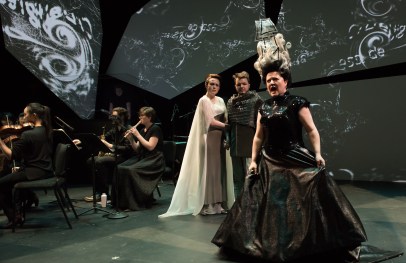


 MEMETERIA by Thomas May