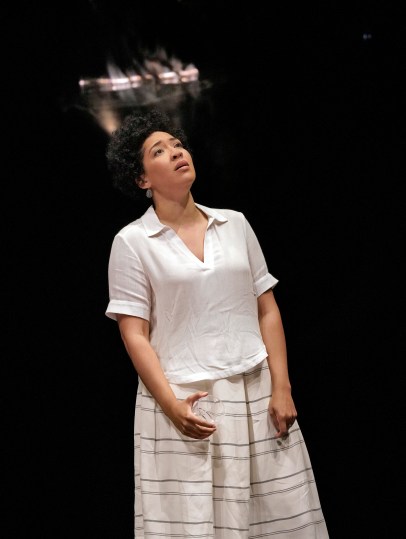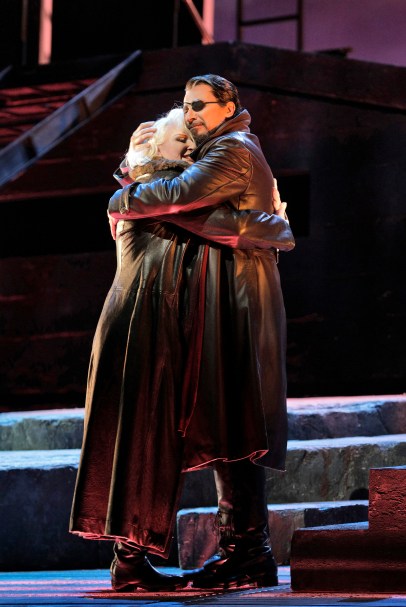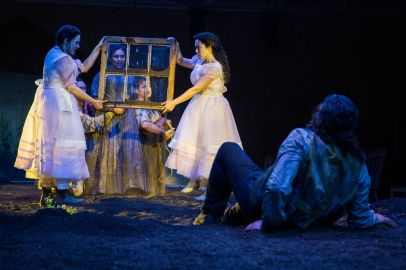
Opera Omaha production of Proving Up, photo (c) Emily Hardman
Missy Mazzoli’s opera Proving Up, which just opened at Columbia University’s Miller Theater, made a strong impression on me when I got to see the premiere staging by James Darrah at Opera Omaha’s ONE Festival in the spring. Here’s what I wrote for Musical America:
April 27, 2018
Proving Up both opened and closed ONE Festival—I saw the final performance, on April 22—and the production was specially tailored to its non-traditional location in a gallery space at KANEKO, a set of warehouses in Omaha’s historic Old Market district that have been converted into the headquarters of the artist Jun Kaneko.
In this followup to their acclaimed collaboration Breaking the Waves (also directed by Darrah), Mazzoli and Vavrek have again hit pay dirt, crafting a suspenseful, gripping, and unsettling work of music theater. In the synergy achieved at ONE with an imaginative design team, a first-rate cast, and the International Contemporary Ensemble (ICE) led with complete commitment by Christopher Rountree, they have also created another durable proof of the vitality of contemporary opera.
Proving Up draws on material notably different from the Lars von Trier-inspired Breaking the Waves. Mazzoli remarked in a talkback discussion after the performance that she wanted to explore the impact of the American Dream on those who have been motivated to follow its promise but ended up failing. The mortgage crisis and Occupy Wall St. movement provided initial impulses, but the last U.S. presidential election—and the questions it raised about American values and myths—naturally left an imprint on Mazzoli’s and Vavrek’s ideas.
The opera adapts a short story published by the American writer Karen Russell in her 2013 collection Vampires in the Lemon Grove. Set “somewhere in the plains of the young State of Nebraska” just after the Civil War, Proving Up centers around the ordeal of the Zegner family, who have taken the risk of leaving the settled East Coast behind to claim their parcel of land according to the promise of the Homestead Act.
Actual ownership can only be gained after a five-year period by following a set of stipulations, including the (fictive) requirement to have a home with a glass window. Pa Zegner has managed to obtain this holy grail and agrees to share it with his neighbors so that together they can “prove up” and obtain their deeds from the awaited government inspector. How he came by the coveted window is the dark counterstory, suggesting an array of related but inconclusive narratives of retribution, vengeance, or patterns of a fateful curse.
On the surface, it operated like a gothic horror tale; but thanks to Vavrek’s well-constructed libretto and Mazzoli’s memorable characterizations—as well as the pacing and deft use of symbolism in Darrah’s staging—Proving Up had a compelling mythic resonance.
For the KANEKO space, Adam Rigg designed a 72-foot-long runway box filled with dirt as the stage—a vast grave encompassing the two small graves of the Zegner daughters. This stage divided the audience, which sat on a motley collection of old chairs, into two halves facing each other.
Wooden panels at one end formed the house and, at the other, made a sculptural formation hinting at the distant horizon. The ICE players were seated in full view on the latter side, with Rountree facing the singers (and audience). Pablo Santiago’s lighting was especially outstanding: following the spirit of the production as a whole, he recalibrated its traditional mood-setting role, making it an active character that refracted the narrative’s sustained sense of foreboding.
Mazzoli’s score for a Turn of the Screw-like chamber ensemble (three winds, two brass, a percussionist, piano/harpsichord, harp, and strings, with vernacular sonorities like harmonica used in unexpected ways) proved resourceful, original, and effective. She evoked various aspects of the natural landscape—above all a sense of dryness corresponding with the drought that contributes to the Zegners’ doom—but also convincingly depicted the extreme emotional states to which this small cast of characters is driven.
Mazzoli showed a gift for giving her characters personality with her vocal writing, using exaggerations of range to powerful effect for the terrifyingly mysterious Sodbuster (Andrew Harris) who looms in the final scenes. John Moore conveyed the ruthless drive of the patriarch but also made him pitiable, while Talise Trevigne covered a vast emotional spectrum in solos that laid bare Ma Zegner’s anguish and anger alike. In a multilayered performance, Michael Slattery captured the mixture of innocence, curiosity, and fear of the youngest son Miles, who is entrusted with the task of sharing the window. Abigail Nims and Delaram Kamareh sang in haunting harmonies as the ghostly Zegner daughters, and Sam Shapiro acted the non-singing role of the incapacitated older son.
The story’s local color has obvious relevance for audiences in the American heartland who may have descended from 19th-century homesteaders. But Proving Up is made with the imagination and purpose to speak to anyone capable of being moved by the larger questions it raises. The production’s next stop will be in New York in September; redesigning it for the Miller Theatre space promises to be an epic challenge in itself.
Filed under: American opera, Missy Mazzoli, Musical America, review