MEMETERIA by Thomas May

Music & the Arts

The Place That Is Not the Place: An Evening with Richard Maxwell

Richard-Maxwell-The-Evening

He’s been the darling of the experimental theater scene in New York for well over a decade. Last year he received the Spalding Gray Award, which honors genuinely maverick work in the theater. This weekend Seattleites have a chance to experience the latest commission by playwright and director Richard Maxwell and his New York City Players ensemble.

It’s a piece called The Evening and is being presented by On the Boards — part of the consortium that conferred the Award — following its world premiere as part of the Walker Art Center’s Out There arts festival last month in Minneapolis.

Although Maxwell has been engaged by On the Boards before (Drummer Wanted 12 years ago, back when Lane Czaplinski took over as artistic director), last night’s Seattle premiere was my first encounter with his work.
And it’s a signature of Maxwell’s theater that it sends you out into the night with the feeling that you’ve just recalled an interesting dream and now have the work of trying to figure out why it interested you and whether it’s meant to “tell” you something — or just happens to be an arresting collage of images that won’t stop flickering in your mind.

The Evening involves a cast of three characters interacting in a depressing dive bar. Beatrice (Cammisa Buerhaus) tends bar and manages the sexual advances of the hedonist Cosmo (Jim Fletcher) as well as the petulant neediness of her sorta ex-boyfriend Asi (Brian Mendes), a washed-up fighter managed by Cosmo.

Framing this “slice of life” core of The Evening is a monologue delivered by Buerhaus: she reads from a diary documentation of a (Beatrice’s?) father’s dying days, a text replete with high-flown poetic cadence and rhetoric. Then comes the pseudo-“naturalist” dialogue of the bar sequence, followed by another poetic flight — this time rendered visually, after the bar stage set has been pointedly struck and deconstructed by stage hands. The Beatrice character cocoons herself in snow-expedition wear and disappears into the now heavily fogged upstage region, where we imagine isolated wintry mountains.

During the bar sequence we learn that bartender Beatrice (who also works as a stripper) yearns to get away from it all and head to Istanbul. Testosterone-addled Asi has just won a fight but knows he is unhappy, and he can’t seem to win Beatrice back, but he doesn’t want her to go. Track suit-clad, cheesy gold chain-adorned Cosmo confines his interest in life to drinking, getting high, insulting Asi, and making the moves on Beatrice.

The characters voice a Three Sisters-ish longing to go “there,” to escape. But Cosmo at least seems content with the bar — the drab-minimalist brown wall set and slightly menacing lights are Sascha van Riel’s design — and even finds it a kind of paradise. Cosmo’s also the one who first notices the live music (written by Maxwell) that becomes part of the action when a trio of musicians walk in and start that evening’s gig. He tries to incorporate the music into his exchanges with Asi and Beatrice.

Is this coda meant to be a vision of the adventure Beatrice pursues after bringing the situation at the bar to a violent denouement? Was it her father who died, as recounted in the “prologue,” thus lending a layer of motivation to her need to snap out of the hopeless humdrum patterns we see in the more Edward Hopper-esque scenes?

Ah, there’s the rub: Maxwell’s dramaturgy is neo-Brechtian in that it de-familiarizes the familiar by highlighting its theatricality. The whole business of “motivation” becomes suspect, just as the seemingly “real-life” setting deliberately draws attention to the artifice of its naturalism. The actors deliver lines that can make sense from moment to moment but that add up to a maze of non-sequiturs and repeated patterns. And Maxwell plays with the compositional cliché of the triangle, with the archetypes that get triggered from seeing the clues he gives us to each character.

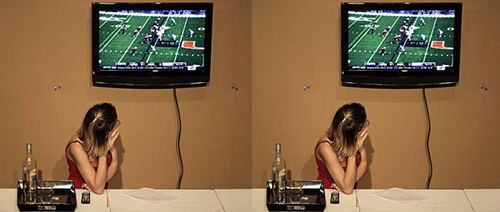
The apparently “realistic” throughline in The Evening, which we’re so conditioned by TV and mainstream film to expect, to be served, is a decoy. (There’s even a TV set hoisted above the bar showing a sports channel as part of the set, but it acquires a Big Brotherish aura as the play continues.)

We become frustrated by the lack of all the rest following suit (understandable motivation, easy-to-read cause and effect etc.) — which is exactly what Maxwell seems to be aiming for. It reminds me of the effect of hyper-realist paintings: beneath the shimmering, “life-like” detail, a kind of uncanny valley opens up where we find ourselves in a twilight zone. The zone of evening.

So The Evening exaggerates realism to undermine it. And even the framing parts seem to be “placeholders” for the deeper aspects of an evening in the theater: these are the “visionary” parts that are meant to endow the proceedings with meaning, the “take-away” that tells us our time was well spent.

Yet in just 60 minutes — the duration of The Evening — the theatrical trickster Maxwell lays out a crossword puzzle of clues, teases, resemblances, and images that isn’t meant to be solved. What’s also striking is the pivotal role of audience response. Last night a fair group of spectators seemed bent on “figuring it out” by chuckling and guffawing as if Maxwell were merely endeavoring parody of theatrical clichés — turning the experience at times into a kind of meta-sitcom.

I found that adversely affected the haunting strangeness of The Evening — an attempt to re-familiarize what’s happening onstage. Sure, Cosmo might be a sloppy, self-satisfied creep — or, rather, Fletcher plays Cosmo playing that archetype — but Maxwell constructs a context for these characters that speed-bumps our knee-jerk tendency to read them as we would read a group of people when, say, we stroll into a bar for the evening. It’s the empty spaces that are left to resonate — and, as Beatrice/Buerhaus remarks in the opening section, meditating on the father’s death, “they say that atoms are made of 99.9% empty space.”

If you go: Richard Maxwell’s The Evening plays at On the Boards through this weekend, 100 West Roy Street. After the Friday performance there will be a post-show discussion with Richard Maxwell and Todd London; following Sat’s performance the musicians will continue with post-show music. Tickets here.

(c)2015 Thomas May. All rights reserved.

Filed under: On the Boards, playwrights, review, theater

Berlioz’s Roméo et Juliette Symphony toute entière

Berlioz

Hector Berlioz didn’t even know English when he saw his first stagings of Shakespeare in 1827 in Paris, performed by a British company on tour. But it didn’t matter. “Shakespeare, coming upon me unawares, struck me like a thunderbolt,” he later recalled. “The lightning flash of that sublime discovery opened before me at a stroke the whole heaven of art, illuminating it to its remotest depths.”

Those reverberations mixed with the young French artist’s discovery of the Beethoven symphonies around the same time. And both epiphanies propelled Berlioz along his adventurous course as a musical revolutionary.

The work that fuses Berlioz’s reimagining of what a symphony could be with his Shakespearean obsession is Roméo et Juliette. Last night the Seattle Symphony performed RnJ in its entirety — to my knowledge, for the first time in their history. Ludovic Morlot led the expansive forces called for by the score: three vocal soloists, chorus, and orchestra (in this case splitting the first and second violins to left and right). There’s even a touch of acoustical “space music” in the positioning of a brief double choir offstage.

It’s a mammoth score (all told, around an hour and a half — not counting the intermission that was inserted here after the “Queen Mab Scherzo”). The instrumental sections are played as a kind of abridged suite often enough, but encountering the whole megillah is a rarity that brings home how radical were Berlioz’s ideas about music and its relation to text and drama. The result is that RnJ is more or less an acknowledged masterpiece that contains some of this genius’s finest music, yet, oddly, as a whole the work remains more often talked about than heard.

Following Maestro Morlot’s work with specific composers since his tenure began here has been fascinating — and the Berlioz thread has proved particularly satisfying artistically (La Damnation de Faust in his first season, an electrifying Symphonie fantastique this time last year).

Morlot and his musicians are showering love on Roméo et Juliette. Sorry if that sounds schmaltzy, but there’s really no other way to put it: the breathtaking precision of their dynamic shadings, the intensified expressivity, their Zen-like focus on detail, the awareness of complicated, even contradictory emotions in this score.

Berlioz carries further the idea from the finale of Beethoven’s Ninth of the instruments trying to break out into words by doing the opposite: after an orchestral introduction — the discipline of fugal writing paradoxically depicts violent disorder and passion — he stages an overall summing up of the play’s main action in a prologue “act” that features chorus and two soloists positioned behind the strings. (Sylvie Brunet-Grupposo contributed her velvety mezzo and tenor Kenneth Tarver sang with elegant fervor.)

But already you sense the instruments straining to take over the telling, with solemn, commanding rebukes from trombonist Ko-ichiro Yamamoto and the brass ensemble standing in for the Prince of Verona. And Berlioz reserves the most sublime passages for his orchestra, above all in the scene of Romeo alone and the nocturne of the young lovers meeting in the garden of the Capulet residence, beneath Juliet’s balcony. The woodwinds played with soulful poignance, with admirably individualized phrasing from Mary Lynch on oboe and clarinetist Ben Lulich; bassoonist Seth Krimsky sustained a mood of deep, anxious melancholy later in the Tomb Scene.

(The playing was so precise and riveting that I encountered a novel torture to add to the usual litany of cell phones, coughers, page-turners, seat kickers, and other occupational hazards of the concert hall: the penetrating sound that a pair of leather shoes squeaking against each other can generate, as a patron helpfully demonstrated during one of the score’s most heartbreaking moments.)

Morlot tenderly shaped the ebb and flow of the scène d’amour, with its sudden pullings-back and renewed outbursts of pained passion. Richard Wagner (Berlioz’s junior by a decade) was there at the historic premiere of this “symphonie dramatique” in Paris in 1839, and it was an epiphany for Little Richard as well.

It’s enlightening to compare/contrast the passionate melody of this music with its transmogrification in Tristan: the Classical transparency of Berlioz’s sensibility survives his most radical harmonic ideas, so that the French composer’s love music still betrays a moving awareness of limits and fragility that is a far reach from the oceanic transports Wagner permits his lovers to experience.

The players’ crisp focus on detail paid off richly, too, in the gorgeously nimble, ear-tickling “Queen Mab Scherzo” — Berlioz’s rendition, purely through the means of orchestral language, of Mercutio’s ingenious speech about the “fairies’ midwife.” Jeff Fair’s horn solo was outstanding, and Michael Werner’s light-as-a-feather pings on hand-held crotales echoed dreamily against infinitesimally delicate pizzicati. The rehearsals must have been incredibly focused, resulting in a lightning speed tempo and crystal-clear textures that throw the sheer weirdness of this music in high relief.

It should be noted that the text set by Berlioz — no mean wordsmith himself — originated in his own paraphrasing and rewriting, only loosely based on Shakespeare’s original; he had the poet Émile Deschamps craft this into a libretto, thus avoiding direct “competition” with Shakespeare’s verse. The “words” and actions of the lovers themselves are reserved strictly for the orchestra to impart.

Another highlight was Juliet’s Funeral March and the Tomb Scene (in the third part or “act,” which was performed after the intermission). A smaller subset of Joseph Crnko’s Seattle Symphony Chorale had appeared for the narrative of the Prologue. Here they came out in full force and sang with clarity and power. The restraint of their single repeated unison E gave way to emotion-laden elegy, its resplendent polyphony expertly balanced.

Arguably the lengthy finale is the weak link in Berlioz’s conception of this symphony-opera-oratorio hybrid. All the pain, longing, and ecstasy — and violence — that lead to the denouement feel swept aside in a superficially rousing reconciliation, the most overtly operatic scena of the work. Here Berlioz gravitates more obviously back toward the Beethovenian Ninth model of a choral finale. Baritone David Wilson-Johnson — filling in at the last minute — delivered the significant part of the peace-maker Friar Laurence with flair and charisma.

But Berlioz knew that “the very sublimity of this love” is beyond words, though not beyond expression. To access this he focuses in Roméo et Juliette on, as he described it, “the language of instruments, a language richer, more varied, less restricted, and thanks to its very indefiniteness, incomparably more potent.”

There’s one more chance to hear this performance of Berlioz’s Roméo et Juliette: Saturday 14 February 2015 at 8 pm at Benaroya Hall. Tickets here.

UPDATE: I asked SSO staff about an odd commotion that took place just as concertmaster Alexander Velinzon came out. A man started shouting something in an agitated voice (I couldn’t make out what he was saying) and walked up the aisle holding a pen and pointing it at one of the ushers. Apparently police were notified and came to Benaroya Hall after the gentleman had exited the hall. I’m told there were no other problems and that he was given a refund for the ticket he had purchased.

On Twitter, Terry Miller wondered whether the disturbance was from the Montague or Capulet side.

(C)2015 Thomas May. All rights reserved.

Filed under: Berlioz, conductors, review, Seattle Symphony

Ivesian Revelations from Morlot and the Seattle Symphony

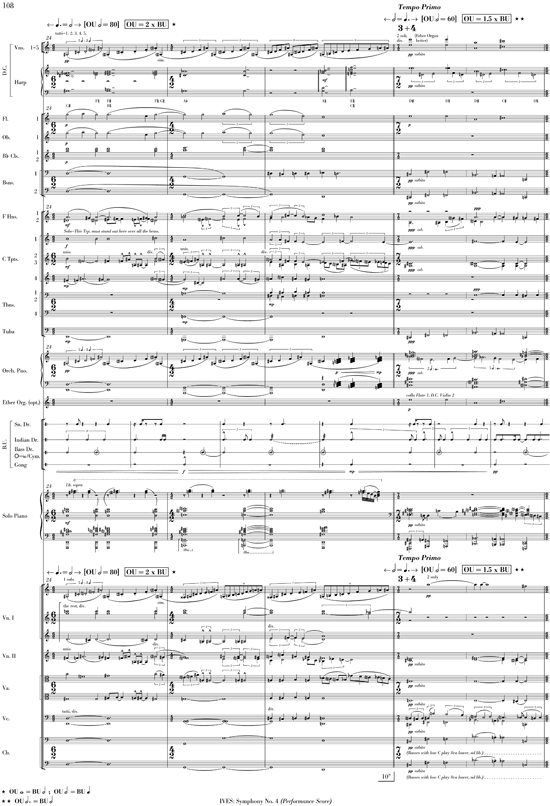
page from score of Ives/4th Symphony

page from score of Ives/4th Symphony

The last time Ludovic Morlot led the Seattle Symphony in a Charles Ives symphony (the Second), he paired it with Rachmaninoff’s Third Piano Concerto (and got pulses running with the Overture to Leonard Bernstein’s musical Candide as a curtain raiser).

I can’t say I get the connections he apparently sees between the conservative Russian and his maverick American contemporary. Maybe the idea is to add still another layer of meta-contrast on top of the already explosively varied mixtures that comprise Ives’ sound world. In any case, this week’s program brings another Rach-Ives pairing.

It was heartening to encounter such an unpredictable interpretation of Rach 3 in last night’s performance (I believe the third time in as many years that Morlot has conducted the work here). Though the previous Rachmaninoff-meets-Ives effort (back in June 2012) had featured the ever-fascinating Stephen Hough as the soloist, the Third Piano Concerto sounded a bit undercooked, the rapport between pianist and orchestra undeveloped.

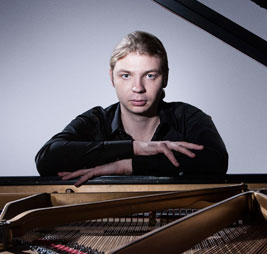
Some unusual angles were explored by the young Russian pianist Denis Kozhukhin. One of the Mighty Four pianists who took part in the complete Rachmaninoff piano concerto cycle at Benaroya two years ago in January (playing the Fourth Concerto), Kozhukhin has a straightforward, unexaggerated presence at the keyboard, concentrating his (and our) attention solely on the music.

kozhukhin_267

What particularly stood out in approach were the glistening, spun-silk textures in the Intermezzo and above all in the final movement. Kozhukhin executed these with such flawless grace I wished the massive chordal climax in the first movement — which was underpowered and lacked profile — had set up an even starker contrast to his gravity-defying elegance. Along with nuanced phrasing of the most lyrical moments, Kozhukhin showed a penchant for the giddier flights in Rachmaninoff’s writing. This reached a state of outright exuberance (ultimately downplaying the composer’s luxuriant moodiness) in the culmination of the finale, where a magnificent rallying of forces between the piano and orchestra joyfully reforges the theme that opens the Concerto.

Despite troublesome issues of coordination and balance between the orchestra and Kozhukhin (the Rach seemed frankly underrehearsed), Morlot coaxed a richly burnished sound from the players — particularly the string ensemble — and the wind solos gently underscored Kozhukhin’s feeling for the melodic currents amid the galaxies of notes in the solo part. (Question: When was the last time Seattle audiences didn’t leap up to give a standing ovation to a visiting soloist?)

Rach 3 was of course the audience-luring part of the program, but the real reason not to miss it is the opportunity to encounter a live performance of the Fourth Symphony, that great Ivesian summa. As fas as I can tell, this was the SSO’s first time performing the work. (You can still catch it on Saturday night, 31 January.)

The Ives Fourth is something like the symphony’s version of The Great American Novel — which is to say, in terms of its aspirations and the impossibility of living up to them. The particulars of its scoring — the need for four conductors to orchestrate the simultaneous offstage performing forces, six keyboards (in this case, with the bells Ives asks for sampled from a keyboard), enlarged onstage orchestra and chorus — sometimes tempt people to describe it like some kind of concert hall circus act. (After all, the moniker “Symphony of A Thousand” was just a marketing ploy to drum up interest in Mahler’s Eighth Symphony, whose premiere around the time Ives was working in earnest on his Fourth — in 1910 — turned out to bring Mahler his greatest success as a composer during his own lifetime.)

In fact, for all the Mahlerian comparison that might be made with Ives, the latter’s Fourth Symphony is quite modest in duration (its length comparable to that of a Classical symphony). But its blend of familiar (even “homey”) elements with the most audacious complexities immediately forces the listener out of easy-going habits. And that gives it an enormous resonance, a field of implications, that may seem disproportionate to the dimensions of the composer’s architecture. Yet it all results in a thrilling rush — and a reset/reboot to your thinking about what music can do.

As he has shown with other musical pioneers like Edgard Varèse, Morlot has an impressive grasp on just that essential point. He knows that behind the show biz factor of all the paraphernalia, the bells and whistles, this is composing at its most ambitious — thinking in music the way writers, philosophers, scientists think with their respective tools.

Ives Concert

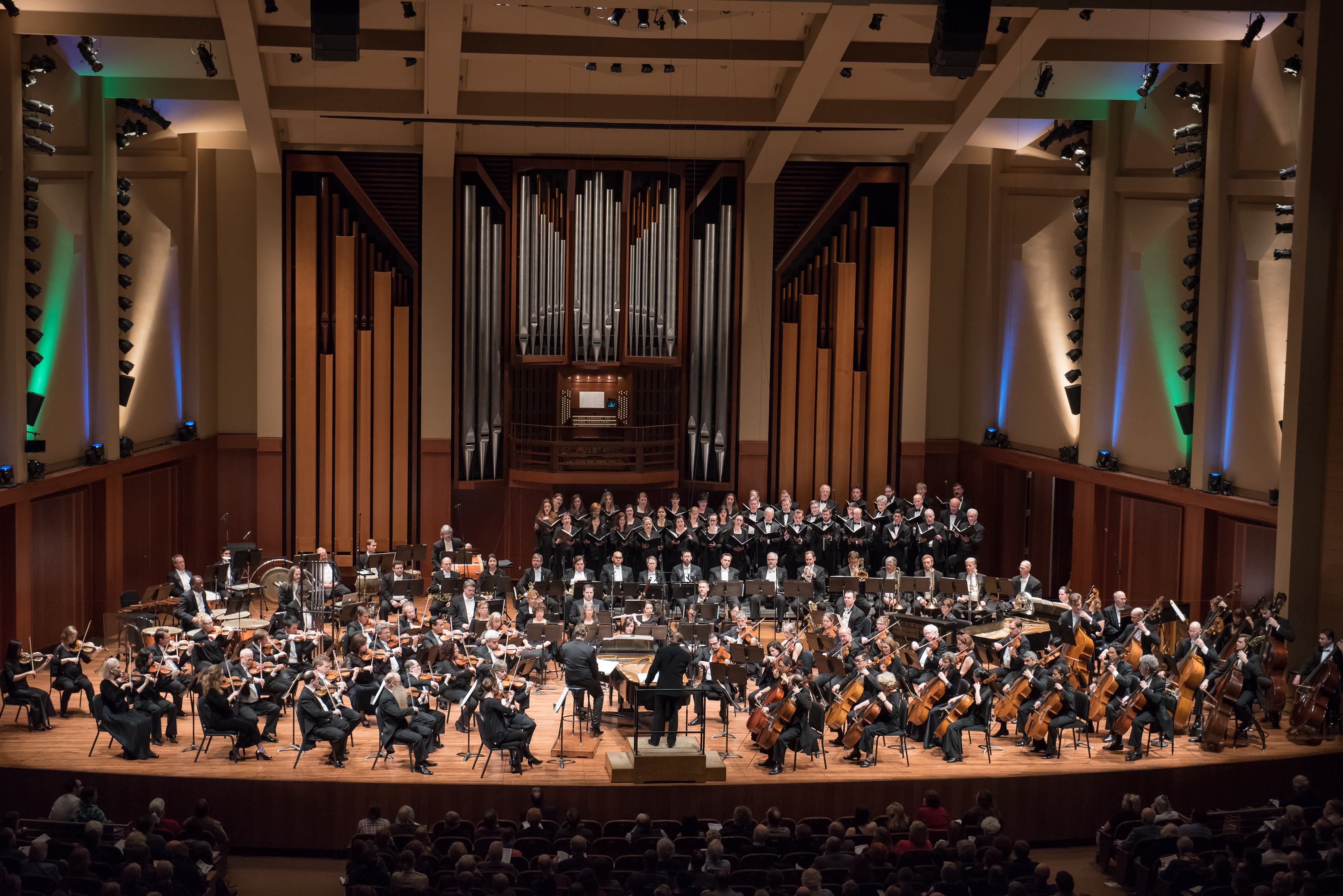
By way of a preface, Morlot gave a fairly extensive “show and tell” intro to the piece. He introduced his fellow conductors: Stilian Kirov, who shares the stage with him, positioned a bit further upstage; Julia Tai, heading the ethereal combo of strings, harps, and partially quarter-tone-tuned piano; David Alexander Rahbee coordinating the battalion of offstage percussion for the last movement (described in the score as a “subterranean percussion ensemble”); and Joseph Crnko, who had prepared the Seattle Symphony Chorale in advance. Morlot also illustrated examples of Ives’ radical concept of polyphonic layering and simultaneous, clashing sound worlds, remarking that “this incredible complexity is built up from the simplest basic elements.”

That dialectic of simplicity-complexity informed Morlot’s own overall vision of the Fourth. Instead of presenting a mere jumble of jarring contrasts, he clearly elicited the sense of enigma that is posed in the brief, preludial opening movement — the enigma that is the engine of this work and that successive movements try to “answer.” The simple hymn tune sung by the chorus in the first movement (“Watchman, tell us of the night”) signals a pilgrimage for meaning. But that pilgrimage soon goes astray — or wanders off into directions unforeseen and unforeseeable. As he molded the music’s progress, at times I noticed Morlot using conducting gestures I’ve never seen him make before.

In Morlot’s interpretation, “the searching question” that we “ask of life” (as the composer described his “program”) has to take account of all of it: the mystical meditations of the otherworldly (and offstage) strings and harps, the bright noon of chaotically colliding marches and cheerful anarchy in the second movement (Ives’ “Comedy”), the sober, ordered fugue of the third (more wonderful string ensemble playing here), and the cosmic rhythms that set the finale in motion.

Ives may have intended the more conventional beauty of the “religious” answer offered by the third movement to be heard as parody (perhaps like Strauss in the parallel section of Also Sprach Zarathustra?) — much as the “Comedy” of the second affectionately parodies secular, civic life. Morlot allowed all of these attempts to get at “the searching question” to have their say, as if each represents the answer at the moment it holds the stage. The outsize, raucous, yawping vitality of the second movement was overwhelming, a forerunner of the spell of sonic ecstasy-from-noise that later technology would allow rock and other popular genres to exploit.

Brandon Patoc Photography

Brandon Patoc Photography

The accumulated energy of the final movement had the effect of an epiphany. In his terrific commentary on the Fourth, Michael Tilson Thomas (a longstanding Ives champion) describes the offstage percussion as “the ticking of the universal clock” and captures what it is that makes Ives’ vigorous dissonances so revelatory:

It’s typical for Ives to represent this most exalted moment of spiritual search in ever more dissonant and blaring sound…. This to me has always suggested the Mount Sinai aspect of spiritual revelation. Man searches and searches, [but] as he gets too close to the divine it is more than he can bear, the sounds and the harmonies are just too much…. We have to turn away and a few little tendrils of singed nerve endings then lead to the beginnings of the long, luminous coda.

Morlot and the SSO are recording these performances for eventual release as part of their complete cycle of Charles Ives symphonies on the in-house label. Inevitably there will be details that come across with more refinement on the recording than they do in the concert hall. But there’s no substitute for the live experience — above all in a work so reliant on an acoustically spatial concept of symphonic abundance. To have both to compare is ideal.

(c)2015 Thomas May. All rights reserved.

Filed under: Ives, pianists, Rachmaninoff, review, Seattle Symphony

To Moscow, Moscow, Moscow!

ThreeSisters

About 10-15 years ago, it seemed one of the big trends around Chekhov productions was to ratchet up the comedy. All that tristesse and Russian pathos had become so clichéd that directors tried to outdo one another in getting audiences to laugh — too often by hard-hitting with effects that were more vulgar sit-com-y than Chekhovian non-sequitur (Kulygin’s “nonsense”).

So it intrigued me to notice some of the audience bafflement during intermission at last night’s preview of The Three Sisters in a new production by the Seagull Project soon to open at ACT Theatre. “It sounds like theater of the absurd,” insisted the woman next to me. “You can’t keep it straight what they want!”

Not humor and laughs, but frustration over the confusion of tone — which is exactly what makes Chekhov, and in particular The Three Sisters, such a formidable challenge to direct. Not the relaxed “plotlessness,” but the matter of tone For all the self-congratulation we hear about how our we “break down barriers” nowadays, so many are still glued to obvious genre distinctions: is it supposed to be a comedy? a tragedy? avant-garde? (I sensed similar reactions recently to Seattle Shakespeare’s Measure for Measure, that notorious “problem play.”)

For me, the two characters who most successfully establish real Chekhovian ambiguity in John Langs’s thoughtful production (using Carol Rocamora’s translation) — though the director relies a bit too much on leitmotivic tics that turn characters into caricatures — are CT Doescher’s poignantly resigned but cheerful Tusenbach and the intelligent, suave, but gently bitter Vershinin of David Quicksall.

Julie Briskman comes closest to getting the Chekhov chiaroscuro as the oldest sister, Olga. Her mood swings feel more integrated and organic, whereas they come across as merely “quirky” in several other characters’ portrayals. Alexandra Tavares’ Masha is especially compelling in her “stolen moment” of brief happiness with Vershinin. Sydney Andrews conveys the woozy longing of Irina as a young woman on the cusp of adulthood in the first act; her later development still seems to be a work in progress. John Abramson’s captures the proto-Uncle Vanyan angst of their brother Andrey Sergeevich as he tries to put up a bold front in the face of his crushing disappointments.

Hannah Victoria Franklin plays up Natalya’s bossy boorishness and her independent streak, but the class resentment that fuels her seems lost in translation. Recently seen doing good work in New City Theater’s Hamlet, Brandon J. Simmons takes a more straightforwardly comic approach as Kulyigin but gives his pomposity an awkward edge that pays off well in his final scene with Masha.

Langs is particularly good at organizing this talented cast in the larger ensemble scenes; he’s not able to solve the complex issues of Chekhov’s tempo and pacing from these to intimate encounters — but this will probably improve as the production matures. He neatly frames the play with marching scenes featuring the army arriving at and then departing from the provincial garrison town where the Prozorov family languishes. They stomp in to the beating of a big bass drum, automatons ready for the call of duty; but at they end we see them marching in silent slow motion far upstage — and can imagine them heading straight for the trenches of the First World War.

Among the delights of this production are the design elements: Jennifer Zeyl’s birch-framed set with tricky Chekhovian seasonal changes beautifully established by Robert J. Aguilar’s lighting. Robertson Witmer’s soundscape brings out the full range of Chekhov’s “score” — in this play whose subtexts include a major role for sounds: the forest echoes, a flock of birds passing, the wind, the magic of the spinning top given as a gift to Irina by the aging army doctor Chebutykin (such a powerful symbol of frenzied but futile action).

There’s another Chekhovian music in Péter Eötvös’ gorgeous opera distilled from the play:

Filed under: Chekhov, directors, opera, review, theater

Sublime Salonen from the Seattle Symphony and Jennifer Koh

Jennifer Koh; © Juergen Frank

Jennifer Koh; © Juergen Frank

My latest review:

It’s not unusual for Ludovic Morlot to offer a spirited brief introduction to a particular piece. But at the top of last night’s Seattle Symphony concert, the maestro was eager to elucidate a rationale threading together the motley menu of Samuel Barber, Esa-Pekka Salonen, and a Tchaikovsky warhorse: essentially, the proposition that all three works represented personal responses to periods of challenge or even crisis.

continue reading

Filed under: new music, review, Seattle Symphony, Tchaikovsky

Dazed, Confused, and Lovestruck: Twelfth Night at Seattle Shakespeare

Jay Myers as Orsino and Allie Pratt as Viola. Photo by John Ulman.

Jay Myers as Orsino and Allie Pratt as Viola. Photo by John Ulman.

“Why, this is very midsummer madness!” exclaims Countess Olivia in the middle of Twelfth Night — just as the whirligigs of the plot against Malvolio start cranking away. Olivia’s normally uptight steward has been set up to believe his boss is suddenly overcome with uncontrollable passion for him and is putting on a display that makes for one of the most outrageously funny scenes in all Shakespeare.

But Malvolio’s (David Quicksall) crazed behavior is easily matched by the antics indulged in by Olivia herself (Elinor Gunn) in Seattle Shakespeare Company’s deliriously unconventional new production, which opened this past weekend and which plays through Nov. 16 at the Center Theatre at Seattle Center. Visiting director Jon Kretzu approaches Twelfth Night as if it were a vastly elaborated version of the nocturnal spell cast in the Bard’s decade-earlier A Midsummer Night’s Dream. Just about everyone seems to wander about in a woozy haze of confused, mismatched desire.

continue reading

Filed under: directors, review, Shakespeare

The Rake’s Revels: Don Giovanni Parties It Up in Seattle

Photo (c) Elise Bakketun

Photo (c) Elise Bakketun


Here’s my Bachtrack review of the current Don Giovanni revival in Seattle:

Mozart’s drama about the legendary rake’s egress launches the first season under Seattle Opera’s new general director, Aidan Lang. However, the production originated here in 2007, and the current revival had of course been scheduled well in advance. In other words, it makes no statement about the new Lang era but is instead a reverberation of the Speight Jenkins years.

This production mines the comic possibilities inherent in the essentially picaresque, stop-start narrative pieced together by Da Ponte. The Overture, with its apocalyptic opening section introducing a cheerful, buffa main course, has always posed a musical conundrum, the solution to which, as in Tristan und Isolde, remains deferred until the end of the opera. Yet in Seattle’s McCaw Hall, those foreboding first chords have the effect rather of parentheses, of a statement that’s easily shunted aside until the topic comes up again, in rather nonsequitur fashion, during the grand finale.

continue reading

Filed under: Mozart, review, Seattle Opera

Seattle Symphony’s Dvořák-Fest Begins

Daniil Trifonov: (c) Dario Acosta

Daniil Trifonov: (c) Dario Acosta

My review of the Seattle Season’s opening concert of the season — including pianist Daniil Trifonov’s spectacular SSO debut — is now live on Bachtrack:

Music by Antonín Dvořák was included on Ludovoc Morlot’s first-ever programme leading the Seattle Symphony, which took place in October 2009. At the time – two years before coming on board as music director – Morlot was a visiting conductor, and he offered the barest sampling of his thoughts on Dvořák (three of the Legends).

continue reading

Filed under: conductors, piano, review, Seattle Symphony

William Tell at the Edinburgh International Festival

My review of William Tell, given a concert performance by Gianandrea Noseda and the Teatro Regio Torino at Edinburgh’s Usher Hall, is now live on Bachtrack:

A conspiracy theorist might ponder whether the programming of William Tell during the final week of the 2014 Edinburgh International Festival, the day after the Salmond-Darling Scottish independence debate on the BBC, was intended as a propaganda move in support of the “yes” campaign.

Certainly the fervour of the opera’s grand finale, as the Swiss rise up in triumphant revolt against their hated imperial overlords, is so palpably rousing as to make one at least question the commonplace assumption of Rossini’s indifference to political matters.

And in a coincidence sure to fuel our conspiracist’s fantasies, the Milanese censor gave the green light for the opera’s staging at La Scala – several years after its 1829 première in Paris – only on condition that the setting be changed to Scotland, with the protagonist restyled as “Guglielmo Vallace”, and a name change from Gualtiero to “Kirkpatrick”.

continue reading

Filed under: conductors, opera, review, Rossini

Prom 40: Haitink and the LSO Trace a Mahlerian Journey through Childhood Innocence

1097-6621-prom40_camilla_tilling_bernard_haitink

Here’s my review for Bachtrack of Bernard Haitink’s Saturday concert with the London Symphony Orchestra (Prom 40):

Having celebrated his 85th birthday this past March, Bernard Haitink continues to demonstrate that he profits from the advantages of age whilst commanding the deftness of a conductor decades his junior. His programme at the Proms on Saturday evening with the London Symphony Orchestra offered musical perspectives on youthfulness and memory by way of Schubert and Mahler, culminating in the songs of innocence and experience of which the latter’s Symphony no. 4 in G major is woven.

continue reading

Filed under: conductors, Mahler, review, Schubert

Archive

Enter your email address to follow this blog and receive notifications of new posts by email.