My review of the concluding concert of the 2014 Summer Festival is now on Bachtrack:
The days are starting to grow noticeably shorter in the Pacific Northwest, and the end of the month-long Seattle Chamber Music Society Summer Festival brings yet another wistful reminder that we’re now facing the season’s inexorable downward slope. An immersive atmosphere of four weeks of three concerts each (plus free prelude recitals and additional events) gives the festival much of its flavour, making one all the more reluctant to bid adieu.
It’s been a month especially generous in discoveries, from the world première of an imaginatively crafted single-movement piano trio commissioned from Derek Bermel (with the Saramago-inspired title Death with Interruptions) to a welcome dose of vocal chamber music gems and other rarities mixed in with more standard fare.
On Saturday night the festival drew to a close with a typically diverse roster of musicians (totalling 15 over the course of the concert).
Tomorrow will mark the first anniversary of Memeteria. I wouldn’t believe it if I didn’t have the archives to the right to prove it — this year has been a whirlwind. A huge thanks to all my readers for taking the time to visit. I hope you will continue to come back and would love to hear from you.
And how’s this for unplanned synchronicity: my very first piece was a report on the opening of the Seattle Chamber Music Society’s Summer Festival. And my latest offering is a review of one of the 2014 Summer Festival’s concerts. To wit:
For 33 summers now, the Seattle Chamber Music Society (SCMS) has been presenting an extensive festival that now ranks as a particularly desired destination for musicians on the summer chamber circuit across North America. This latest edition is off to an especially invigorating start. For their part, the audiences tend to be uniformly enthusiastic and devoted, but last night’s performances met with vociferous approval that reached the extreme end of the applause-meter.
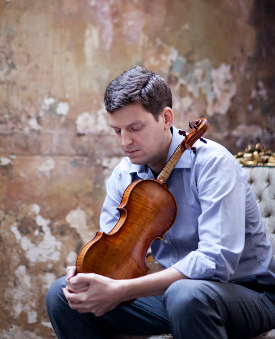
The unusual programme design – juxtaposing Stravinsky’s infrequently heard Octet for Winds with bread-and-butter classics by Mendelssohn and Beethoven – is a signature of James Ehnes, now in his third year as SCMS’s artistic director.
My review of the Seattle Symphony’s final concert of the season:
The past few months have brought the ensemble far more exposure than usual (an appearance at Carnegie Hall, a concert for the League of American Orchestras, the launch of an in-house label): its appetite for new challenges seems unstoppable.
So it’s hardly surprising that music director Ludovic Morlot is concluding the current season with an all-out marathon of orchestral virtuosity. The program of Stravinsky’s three pre-First World War ballet scores for the Ballets Russes in their entirety lasts close to three hours and, out of necessity for the players, requires two intermissions. It drew what appeared to be a close-to-packed house.
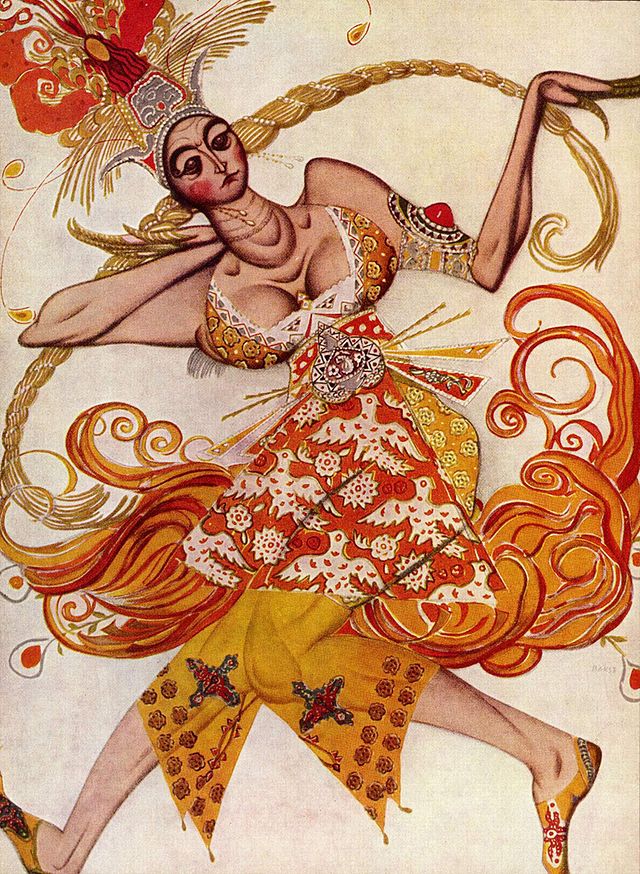
No matter how well we think we know this music, the opportunity to hear the young Stravinsky’s three iconic ballets back to back is bound to prompt new perspectives. And Morlot’s deeply sensitive interpretation of the uncut, sumptuous score for The Firebird (1910) did precisely that – all the more so since, only two weeks before, he’d led the SSO in the complete Daphnis et Chloé, also for the Ballets Russes, which was premiered in 1912, the year between Petrushka (1911) and The Rite of Spring (1913).
Talk about keeping the pressure on: Only last month the Seattle Symphony and music director Ludovic Morlot journeyed to Carnegie Hall for an unusually high-stakes concert and attracted a good deal of press coverage — not least because one of the works featured had just won the Pulitzer Prize in music (John Luther Adams’s Become Ocean, a Seattle Symphony commission). Thursday night’s all-French program meanwhile attracted special scrutiny from movers and shakers throughout the American orchestral scene.
This time the ensemble was playing on its home turf at Benaroya Hall, where it welcomed a sizable number of guests in town for the annual conference of the League of American Orchestras. Under the slogan “Critical Questions/Countless Solutions”, some 1,000 participants representing the breadth of America’s orchestral life had flocked to Seattle. Their mission: to brainstorm ways to engage audiences more meaningfully. Ideas ranged from more innovative concert formats and digital initiatives to suggestions for making orchestras “the heartbeats of our cities”, as Morlot put it.
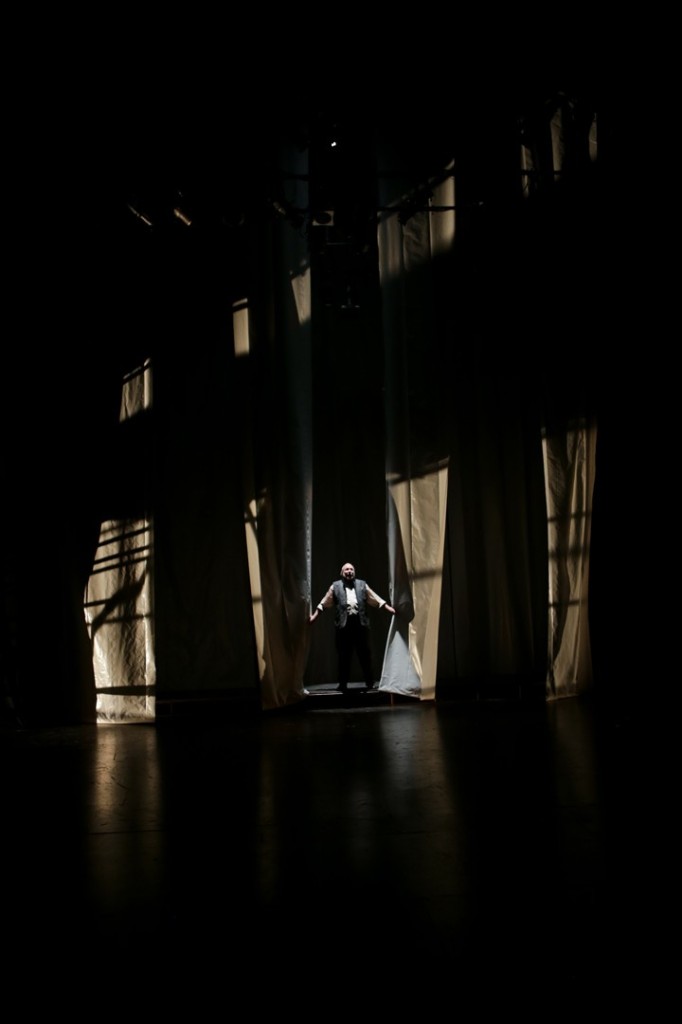
“Blow, winds, and crack your cheeks!” Dan Kremer as King Lear; photo by John Ulman
To grapple with the challenge of staging King Lear has to be the Shakespearean equivalent of trying to produce an entire Ring cycle. The play is so vast, so all-encompassing, its web of theatrical and emotional motifs so intricately woven, that it’s no wonder old-fashioned — well, OK, ancient — critical opinion deemed the play simply “too huge for the stage” (A.C. Bradley).
But visionary productions over the past century have dispelled that misgiving. Or maybe it’s just that the course the world itself has undergone makes us more receptive to Lear‘s devastating dramatic truths. Sometimes it almost seems as if Shakespeare had written the script for our times — and we’re just bumbling along, trying to act it out. Things don’t just fall apart; they coil toward entropy.
In Seattle Shakespeare’s new production, the play’s apocalyptic dimensions are essentially eclipsed by the familial — and all-too-familiar — realism of dysfunctional relationships and personal psychology.
Linda K. Morris, Patrick Allcorn, and Dan Kremer; photo by John Ulman
Director Sheila Daniels conceives the tragedy as an intimate echo chamber of unstable characters who are progressively losing it. What they undergo entails a series of variations on the theme of Lear’s crack-up. Scene by scene (with the whole divided here into three acts), their attempts to impose order on events, to get closer to their desires, become increasingly desperate. The overriding impression isn’t so much of the grim inevitability of consequences — Shakespeare’s merciless updating of classical “fate” — as of psychological meltdown.
As the ex-monarch, Dan Kremer underscores this approach through the unpredictable variability of his temper. It works very well for the first sections of the play — particularly in how it clarifies the relationship between Lear and his daughters that has already charted the course of the tragedy long before it begins.
We see how Goneril (Linda K. Morris) and Regan (Debra Pralle), given neatly differentiated portrayals here, aren’t just self-serving but have been brought up to fear daddy’s mercurial outbursts. Elinor Gunn’s Cordelia shows a steely stubbornness she must have learned first-hand. That’s what keeps her from seeing the danger she puts herself in — not a martyr complex to speak truth to power.
As for their husbands, while the Duke of Cornwall compresses into a sadistic psychopath (Gordon Carpenter), Shakespeare gives amplitude to the Duke of Albany (Patrick Allcorn) to grow in self-awareness and influence.
What lacks the needed emotional force are the actual climaxes marking each way-station in Lear’s descent. Kremer’s scene on the heath becomes just another fit, his verbal torrent more a fest of self-pity. By the same token, the Lear Kremer depicts in the final scenes fails to stir any deeper pity than he already has at the beginning of his long humiliation.
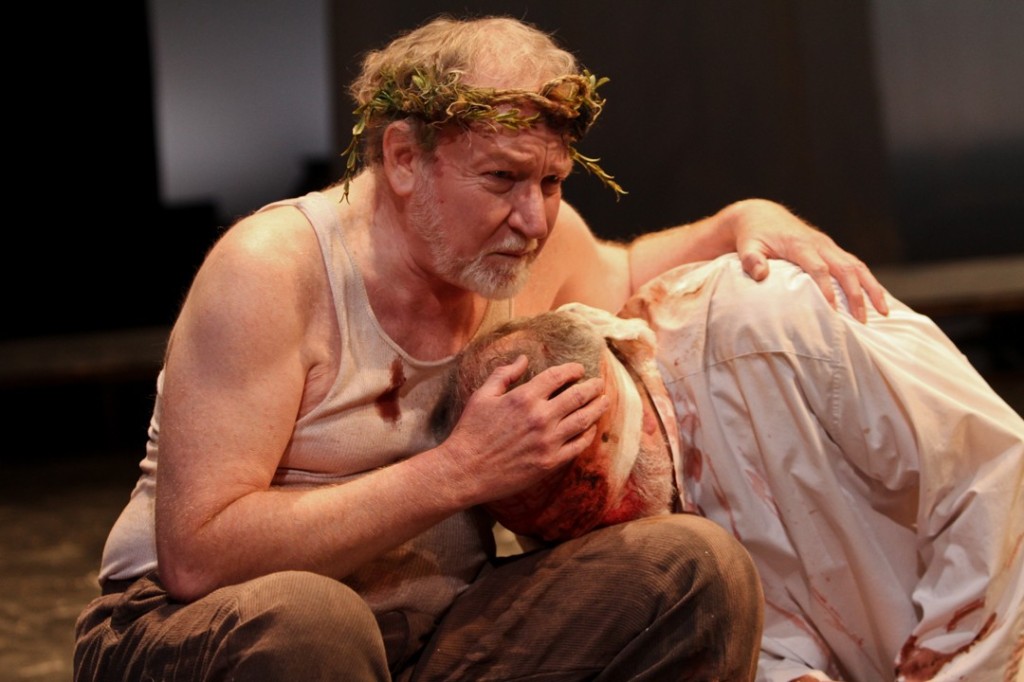
Kremer is more compelling in his interactions with “the other half” — with the fellow victims of ruin who never seem to faze him as they cross his path and all head toward the final confrontations at Dover. His reunion scene with the blinded Gloucester (Michael Winters) is especially resonant in its unsettling blend of horror and comic absurdity.
Dan Kremer and Michael Winters; photo by John Ulman
Some stand-out performances by others in the cast tilt the focus of the play in interestingly unexpected directions. Eric Riedmann’s chillingly embittered Edmund — possibly the most accomplished single interpretation — conveys the malign intelligence of a Iago yet always feels human. It’s one of Daniels’ strengths to clarify each character’s motivations in a way that makes them psychologically persuasive, further emphasizing the intimacy of family connections in this production.
Riedmann moreover revels in Shakespeare’s poetry, articulating its sonorities and rhythms with a relish and variety I wish were not otherwise the exception in this cast. The only misstep is the close-to-campy exaggeration of the sexual dalliance between him and Regan.
Linda K. Morris and Eric Riedmann; photo by John Ulman
Winters makes Gloucester’s wishful gullibility work, and the scenes with his two sons are among the most vividly realized. In his guise as Poor Tom, Jorge Chacon draws on physical hints he’s shown us as the nervous if good-natured Edgar.
King Lear is notable for the overdetermination of the fool archetype. Along with the official fool (Todd Jefferson Moore), the disguised Kent (played as a “Duchess” by the splendid Amy Thone) and Poor Tom on the heath reinforce the fool’s function of bearing witness to the truth as they retreat most deeply into their roles. Thone and Jefferson have a winning dynamic together and help re-introduce some of the play’s larger perspectives — particularly, its obsession with the power of language to shape reality, both positively and negatively. This is what gives the humor they interject its edge.
After all, they continue to subject Lear to the treatment that outraged him when it came from Cordelia. But even to “speak what we feel” is a kind of rhetoric, if the mirror side of Lear’s fulminations and curses. Language is the one thing the dispossessed king is left with — the very language he obviously abused throughout his reign.
Dan Kremer, Craig Peterson, Sophie Paterson, Amy Thone, and Jonathan Crimeni; photo by John Ulman
The scenic conception is notably weak and lags far behind the many fine nuances of the ensemble’s acting. Daniels, who collaborated with set designer Craig Wollam, opts for a colorless, ultra-minimalist playing space with a backdrop of hanging plastic and linen sheets and a scaffold that rolls to and fro. It is a way of making the stage the world, but the process of stripping away so essential to the play’s arc has already happened by the start.
Melanie Burgess’s abstract-pattern, cheerless costumes seem out of sync with the high contrasts of Jessica Trundy’s lighting. I do like the effect of cruel illumination upon the arrival at Dover, but the veer toward a horizontal Rothko glow at the end puzzles. Robertson Witmer picks up on the script’s references to drums to create a sternly percussive sound design.
Seattle Shakespeare Company’s production of King Lear plays through May 17 at the Cornish Playhouse (formerly Intiman) at Seattle Center, Wed. – Sun. Tickets here or call 206 733-8222.
My review of this week’s Seattle Symphony program, with guest conductor Stéphane Denève and pianist Paul Lewis, is now live on Bachtrack:
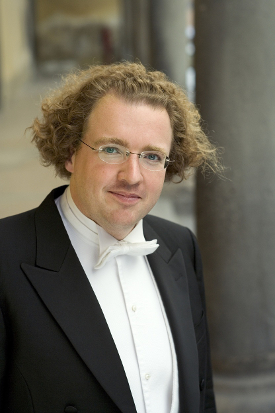
This week’s Seattle Symphony programme brings the third and last of the current season’s co-commissions — all of which are United States premières — with The Death of Oscar by James MacMillan. Music director Ludovic Morlot led the SSO in the previous two (Pascal Dusapin’s violin concerto Aufgang and Alexander Raskatov’s piano concerto Night Butterflies); for the MacMillan, Stéphane Denève, a champion of the composer since his tenure with the Royal Scottish National Orchestra, was on hand as guest conductor. Denève had also premièred The Death of Oscar in November in Stuttgart, where he currently helms the Stuttgart Radio Symphony Orchestra.
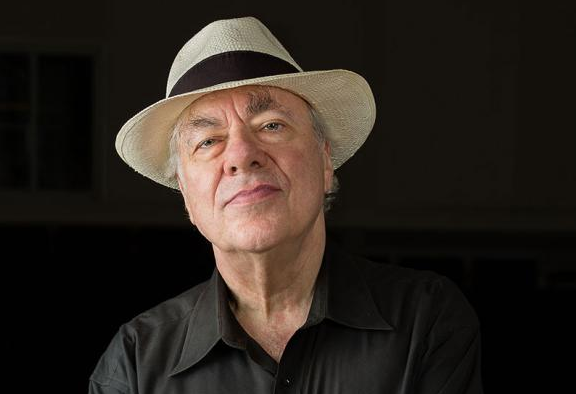
Can there be any better therapy than to spend an evening with Richard Goode in recital? I mean therapy here not as some kind of temporary balm but as a restorative of a sense of musical health. Mr. Goode’s playing, for me, is able to reaffirm the essential values that make music such an indispensable part of life.
It’s admittedly hard not to wander into Ye Realme of Hyperbole when attempting to convey just what it is that makes Mr. Goode’s pianism so damn appealing. But after two blissful hours of listening to Mr. Goode at Meany Hall — his program this week was part of the University of Washington’s World Series and followed — I emerged invigorated and more alert to the unique qualities as well as the originality of the three composers Mr. Goode juxtaposed in his recital.
His program framed the early Romanticism of Robert Schumann’s Op. 6 Davidsbündlertänze (1837) with two examples from the early 20th century: selections from Leoš Janáček’s cycle On an Overgrown Path (published in 1911) and the first book of Claude Debussy’s Préludes (1910). All three call for innovative approaches to keyboard sonority and form alike.
Mr. Goode’s musicianship proves so enthralling in large part thanks to the sense of conviction undergirding his interpretations. Now 70, Mr. Goode plays with all the intensity of someone eager to share the miracles of a new composer he’s freshly discovered, whose code he’s just cracked. There was never even a hint of “getting through” this or that thorny passage using tricks worked out decades ago. Of lazy habits or complacent readings I could detect not a trace.
And that means being unafraid to push in surprising directions (particularly in the Schumann) so as to risk a certain emphasis or refine a structural insight. The curious thing is that Mr. Goode’s fearlessness isn’t reckless or arrogant — on the contrary, it’s simultaneously reassuring. I repeatedly enjoyed the illusion of being treated to a private performance in a salon, with the pianist showing off something exciting he couldn’t keep from sharing.
So in the Schumann, for example — he played the entire 18-piece cycle from memory — Mr. Goode emphasized the fantastical contrasts of Schumann’s bipolar alter egos. His remarkable feel for dynamics allowed for maximal, shocking antitheses: heaven-storming attacks followed a second later by eerie, muffled scamperings. Here was composition as the art of non-transition: rather than smooth over the rapid shifts of thought, Mr. Goode sought out the emotional logic within Schumann’s mercurial, wildly roaming imagination.
But Mr. Goode avoiding invoking the cliché of the “unstable” Schumann, as if this music foreshadows his mental breakdown. This he accomplished largely by digging in to the pockets of humor which abound in Schumann’s score.
The more serenely lyrical dances, meanwhile, carried over echoes of the calm, knowing simplicity that radiates from the Janácek with which the program opened. Mr. Goode chose four pieces from the first book of On an Overgrown Path. I felt fortunate to be hearing these, performed by this particular pianist, so soon after experiencing Peter Brook’s The Suit at Seattle Rep.
Janácek’s pared-down lines and poignant, clutter-free harmonies suddenly seemed to share a kinship with Brook’s enigmatic clarity. Through the briefest of gestures — the mere wisp of an interval as ostinato, for example — Mr. Goode’s sensitive reading conveyed all the compressed density of meaning of a Webern score.
When Mr. Goode returned for the program’s second half, I admit wondering how he could possibly elicit a connection between the Debussy and what we’d previously heard. His Schumann was clearly forward looking, far ahead of his time, while his Janácek breathed nostalgia free of sentimentality with its elegiac, backward glances.
Soon it became clear that the connection was in Debussy’s own startling contrasts — spread out though they are over far larger scales — and in those evanescent, painterly gestures of a measure or two that suddenly illuminate an entire prelude. The spangle of notes at the keyboard’s uppermost extremity which ends Les collines d’Anacapri, for instance, glittered with an almost psychedelic vividness. And with La fille aux cheveux de lin, Janácek’s unfeigned simplicity was again recalled.
I found much of Mr. Goode’s Debussy refreshingly unconventional. In lieu of the intensely sensual, “sonorous poetry” you often hear in accounts of the Préludes, Mr. Goode showed off the solid construction of Debussy’s thinking with rhythmic acuity and clearly articulated voicings (his pedal technique is superb). Humor, again, was given its due, along with the proto-jazz elements that Debussy annexes to his vocabulary.
l to r: Nonhlanhla Kheswa, Rikki Henry, Raphaël Chambouvet, and Ivanno Jeremiah, in Peter Brook’s The Suit. Photo: Pascal Victor, ArtcomArt.
“Truth in theatre is always on the move. As you read this book, it is already moving out of date. it is for me an exercise, now frozen on the page. but unlike a book, the theatre has one special characteristic. It is always possible to start again. In life this is myth, we ourselves can never go back on anything. New leaves never turn, clocks never go back, we can never have a second chance. In the theatre, the slate is wiped clean all the time.” — from Peter Brook’s The Empty Space
Brook’s insights into theatrical reality have meanwhile kept the director himself perennially relevant, despite the inevitable backlash and challenge from younger artists who take his innovations for granted. Consider the theatrical reality he creates in The Suit, which just opened at Seattle Repertory Theatre.
With extraordinary economy — and in dramatic contrast to popular culture’s fixation on psychological realism and “virtual reality” — The Suit centers on one of the most paradigmatic of all stories and yet fills it with surprise, sorrow, and revelation. It is the immemorial story of love given and love taken away — the story of jealousy, revenge, and the patterns of cruelty that link our social, political, and private selves.
In other hands, it might be easy to be misled by the brevity and light touch of this play — it lasts a mere 75 minutes or so — into regarding The Suit merely as a sad and wistful tale, or perhaps a rather slight essay in pathos benefiting from the vibrancy of its South African “local color.” A trio of actors and a trio of musicians together recount the story of a young married couple, Matilda (“Tilly”) and Philemon. Soon after Philemon introduces us to his happy life with Tilly, he’s informed by a friend that she’s been cheating on him. He rushes home, discovering the suit left behind by Tilly’s fleeing (and disrobed) lover. As punishment, Philemon insists that she pretend the suit is her lover, in the flesh, and react as she would to a third person who has now settled in with them.
But it would take the theatrical equivalent of tone deafness to remain impervious to the deeper realities sounded in Brook’s remarkably potent blend of narrative, acting, stage movement, and live music. Simplicity, that hallmark of so much great art, becomes all the more effective when allied with this degree of nuance and ambiguity.
Peter Brook. Photo: Colm Hogan
The source of this unforgettable theatrical experience is a story by the tragically short-lived South African journalist and fiction writer Daniel Canodoce “Can” Themba (1924-1968). His short story was posthumously adapted for the famous Market Theatre in early-1990s Johannesburg by Mothobi Mutloatse and Barney Simon.
Over the years, Brook and Marie-Hélène Estienne, his longtime partner, further honed and directed this material in keeping with the aesthetic of Brook’s Paris-based company, Théâtre des Bouffes du Nord. The show currently on tour across the U.S. represents a more-recent adaptation (in English) of an earlier Brook staging and is receiving its West Coast premiere in Seattle Rep’s presentation.
Themba wrote the The Suit in the 1960s in the wake of the brutal destruction by South Africa’s apartheid government of the black community of Sophiatown. From this thriving though impoverished suburb of Johannesburg, many residents were “resettled” into the sprawling shantytowns of Soweto.
Not that life was easy in 1950s Sophiatown, where one of Themba’s characters recounts a Sunday being denied the right to celebrate with other worshipers by racist church gatekeepers. But it represents a comparative Eden, and this takes on a domestic guise at the beginning of the play in the private idyll as depicted by Philemon (Ivanno Jeremiah). He greets each morning as “a daily matutinal miracle” that reinforces his love for his young wife, Matilda (Nonhlanhla Kheswa).
l to r: Nonhlanhla Kheswa and Ivanno Jeremiah in Peter Brook’s The Suit. Photo: Pascal Victor, ArtcomArt.
Here Brook’s method is already apparent. The most minimal of details — framed by a minimalist set of bright wooden chairs, a table, and rolling clothes racks and Philippe Vialatte’s versatile, effective lighting — evoke a world that is simultaneously specific and timeless. Brook refuses to allow us to settle into the complacent (and apolitical) attitude of abstracted “universality”; at the same time, he has no intention to preach a didactic lesson about oppression whose moral we already know (another form of complacency).
And so one dimension of the scene that Philemon so charmingly lays out for us feels like something between folk and fairy tale. But as The Suit progresses, Brook clarifies the dangers and humiliations of his social milieu. Philemon commutes on a bus to his job as a lawyer’s secretary, meets with one of his friends (Jordan Barbour, in a variety of roles) in a speakeasy, where the government’s increasingly harsh racist policies are discussed. A trio of musicians (guitarist Arthur Astier, keyboardist Mark Christine, and trumpet player Mark Kavuma) provides an ongoing level of commentary with powerful music interludes designed by Franck Krawczyk. On occasion they also play minor roles. The pared-down aesthetic here similarly draws a great deal from the elegantly simple cues of Oria Puppo’s costumes.
By the devastating final tableau, you realize how complex and multilayered are the threads Brook has woven underneath the simple facade of the narrative. There’s a recognition of the recurrent elements of human nature — and yet this story could happen only in the most extreme circumstances of oppression and cruelty.
Jeremiah’s demeanor in his first scenes as Philemon is so disarming we spend the rest of the play trying to square it with the humiliation and psychological pain he’s willing to inflict on his beloved Tilly. Barbour’s depictions of a large cast of characters, from Philemon’s “realistic” friend to a flirtatious townswoman at the play’s climactic party, contain an enthralling study in the art of transition and theatrical timing. But alongside even such excellence, Kheswa’s transformation from a bored, doted-on wife to a woman cornered into hopeless desperation is a rare theatrical achievement in its power to shock and move. The visual of the opening returns full circle, but the light-as-a-feather story with which we began is now freighted with the most intricate emotional counterpoint.
As to the actual score, Krawczyk’s choices and arrangements are uncannily effective. Among the pieces the musicians perform are some Schubert references (his song “Serenade,” intoned by an accordion, and the ominous tread of “Death and the Maiden”), a lovely and lilting Tanzanian song (sung by Kheswa), and a chillingly detached version of “Strange Fruit” (featuring Barbour). At the end Christine softly plays the music of one of the most moving arias from Bach’s St. Matthew Passion (given just a few weeks ago by the Seattle Symphony).
What we’re left with are gnawing questions of who is to blame, who could have changed, how could the tragedy which had begun like a comedy have been averted — for in theater, as Brook tells us, the slate is wiped clean all the time.
Just before the performance, Jerry Manning and Benjamin Moore of Seattle Rep and Josh LaBelle of Seattle Theatre Group spoke about their partnership to bring this tour of The Suit to Seattle. I very much share the sense of gratitude they expressed that Seattle was able to host Brook’s The Tragedy of Hamlet back in 2001 — among the most indelible memories of my theater-going life — and that this city is again giving a platform to his work. You really should try to see this one — more than once, if possible.
The Suit runs through Sunday, April 6, at Seattle Rep’s Bagley Wright Theatre. Tickets here.
Not until the morning of the day before their concerts this week with the Seattle Symphony did conductor and soloist meet for the first time, yet the shared sympathy and depth of understanding they together brought to their interpretation of Béla Bartók’s Violin Concerto no. 2 made this the richly satisfying highlight of the Seattle Symphony’s program.
Over the weekend, Stephen Stubbs and his Pacific MusicWorks company concluded their ambitious Passions Project with performances of the St. John Passion. The project included partnering with the Seattle Symphony for the St. Matthew Passion the previous weekend. Here’s my review for Bachtrack:
Adducing Simon Schama’s comparison of Rubens’s Descent from the Cross with the same subject as painted by Rembrandt, the conductor and Bach authority John Eliot Gardiner has observed that the differences drawn by the art historian – chiefly, between an emphasis on “action and reaction” in the former and “contemplation and witness” in the latter – might broadly be applied to Bach’s two great Passions as well: St John and St Matthew, respectively. Audiences in Seattle have been provided an opportunity to compare and contrast these unfathomably rich works on the basis of live performances of both, presented over consecutive weekends.









 MEMETERIA by Thomas May