MEMETERIA

Icon

Arts writing by Thomas May

Thielemann’s Bayreuth Ring

ring

The Bayreuth Festival season is approaching, so I dug up an old review (published on Artsatl.com) of Christian Thielemann’s Bayreuth Ring from 2008, which originally came out on Opus Arte:

It’s no coincidence that the technologically forward-looking Opus Arte — an early adopter of the high-definition DVD and Blu-ray formats — here documents the current Bayreuth “Ring” via good old-fashioned CDs. In fact, this set marks the company’s first foray into the CD market. The stage direction by octogenarian German playwright (and opera novice) Tankred Dorst, which revolves around the idea of the modern and mythological worlds coexisting in parallel universes, has gained few fans since the production was unveiled in 2006. Instead, the real buzz around this “Ring” has focused on what Thielemann and the orchestra accomplish.

continue reading

Filed under: Bayreuth Festival, review, Ring cycle, Thielemann, Wagner

A Gorgeous Chamber Music Première in Seattle

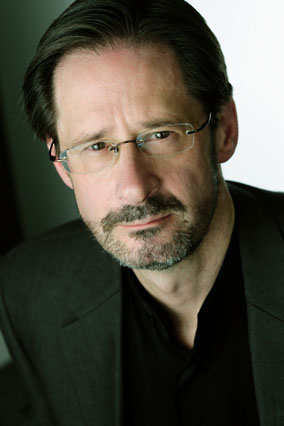
Steven Stucky; photo (c) 2005 Hoebermann Studio

Steven Stucky; photo
(c) 2005 Hoebermann Studio

Along with its mix of well-known and unusual repertoire, the Seattle Chamber Music Society annually commissions a brand-new work for its Summer Festival. Monday evening’s programme unveiled the selection for 2015: Cantus by the Pulitzer Prize-winning composer Steven Stucky, who has gained prominence primarily as an instrumental and choral composer. (His first opera – a brilliantly witty yet at the same time touching one-act buffa to Jeremy Denk’s libretto improbably “dramatising” Charles Rosen’s The Classical Style – will receive its full stage première next week at the Aspen Festival.)

continue reading

Filed under: American music, Brahms, chamber music, commissions, Mendelssohn, review, Seattle Chamber Music Society, Steven Stucky

An Unusual and Moving Evening at Seattle’s Summer Chamber Music Festival

Nicholas Phan

Nicholas Phan

New Bachtrack review:

The second week of the Seattle Chamber Music Society’s month-long Summer Festival concluded with a programme that – as the two earlier concerts that week had similarly done – expanded perceptions of the notion of chamber music itself by including works that cross over the instrumental divide and call for voice.

continue reading

Filed under: Britten, chamber music, James Ehnes, review, Seattle Chamber Music Society, Strauss

Kafka’s The Trial in Seattle’s Ellis Island

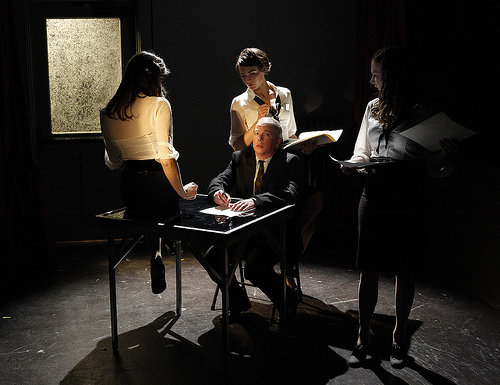
Greta Wilson, Sara Mountjoy-Pepka, Sydney Andrews, and Darragh Kennan in The Trial; photo credit: Chris Bennion/New Century Theatre Company

Greta Wilson, Sara Mountjoy-Pepka, Sydney Andrews, and Darragh Kennan in The Trial; photo credit: Chris Bennion/New Century Theatre Company

Coming up early next month is a workshop of a new chamber opera by Sarah Mattox, Heart Mountain, presented by Vespertine Opera Theater. This will take place in the site-specific space of the repurposed INS building in Seattle. Here’s a piece I wrote a couple years ago about another theater work that made use of that space for an adaptation of Kafka’s The Trial:

Arbitrary, inscrutable bureaucratic authorities with the power to determine individual fates. The tension of not knowing. The cruelly frustrating uncertainty of the whole process. In spite of the trappings of reality, life’s daily rituals twisted into a surreal waiting game.

That’s an impressionistic précis of Franz Kafka’s The Trial in the brand-new theatrical adaptation currently being presented by New Century Theatre Company. But it could also describe what generations of immigrants who hoped to become U.S. citizens experienced while being detained in the former Immigration and Naturalization Service (INS) Building located south of the ID and east of Century Link Field.

continue reading

Filed under: review, theater

Morlot’s intimate view of Mahler’s panoramic Third in Seattle

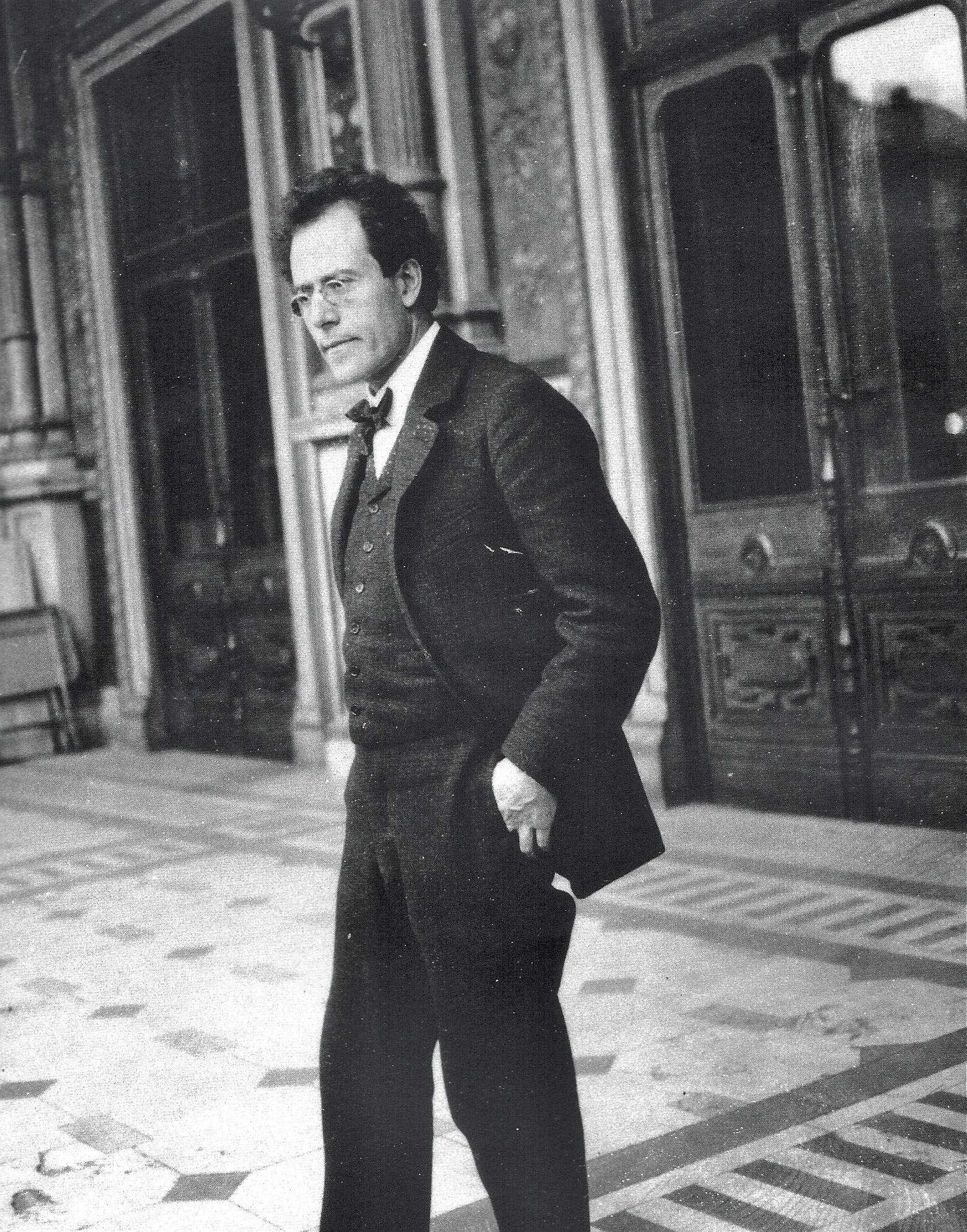
Mahler

My latest review has now been posted on Bachtrack:

With the seemingly boundless D major chord that ends Mahler’s Third Symphony as final benediction, the departing audience encountered a series of suspended chimes in gentle tintinnabulation: part of a recent installation in Benayoya Hall’s grand lobby by Trimpin, Seattle Symphony’s composer-in-residence.
continue reading

Filed under: Ludovic Morlot, Mahler, review, Seattle Symphony

Glas Reflections: Akropolis Performance Lab

Joseph Lavy; photo (c)  Joe Patrick Kane

Joseph Lavy; photo (c) Joe Patrick Kane

It takes a little more effort than usual if you want to arrange to see the current offering from Akropolis Performance Lab: but then, APL is hardly your regular evening of theater. Founded by Joseph and Zhenya Lavy in 2000, APL draws inspiration from the experimental legacy of Jerzy Grotowski and the like. And that bit of extra effort, in my opinion, is certainly worth making.

Now playing at APL is a peculiarly fascinating piece titled The Glas Nocturne. Instead of relying on conventional marketing, APL has allowed news of the production to spread by word of mouth and social media — in fact they’ve generated buzz by keeping the performance location “undisclosed” to the public.

You have to visit their website and express interest in being one of ten (max) lucky audience members to be invited for a given performance, which APL describes as “a speakeasy-styled adventure.” (It’s up to the invitees to choose whether to make a donation as well.) As of today, my understanding is that the run has been extended until 7 June.

The Glas Nocturne is co-artistic director Joseph Lavy’s dramatic adaptation of the scandal-causing, much-abused novel Doktor Glas, which Swedish writer Hjalmar Söderberg published in 1905. Lavy and Annie Paladino are the show’s co-directors. The novel, written as a first-person narration/confession, revolves around the ethical dilemma the eponymous physician faces when a beautiful young patient — with whom Dr. Glas has fallen in love — confesses her disgust for her repulsive older husband, the Reverend Gregorius. And, as Margaret Atwood remarks in her introduction to an English translation of Söderberg’s novel, the tormented narrator knows all too well that he’s “the last person on earth who should have been a doctor.”

The scene is of course set for a murder, but that’s only one of the issues confronted in Lavy’s fine-spun, suspenseful condensation of the novel’s musing on moral codes, eros, the longing for transcendence (Dr. Glass’s first name is Tyko — as in Tycho Brahe), and the oppression of women.

The resulting 90-minute monologue mixes Freudian psychology with the painfully refined decadence of Huysmans — all garnished with a taste of Ingmar Bergman-tinged despair. It makes for a dangerously riveting cocktail. (And if you do go, and are served one of Lavy’s personally crafted “Norwegian Blonde” cocktails after the performance, don’t be surprised if you eye the tempting potion with a barely perceptible tiny shiver of anxiety.)

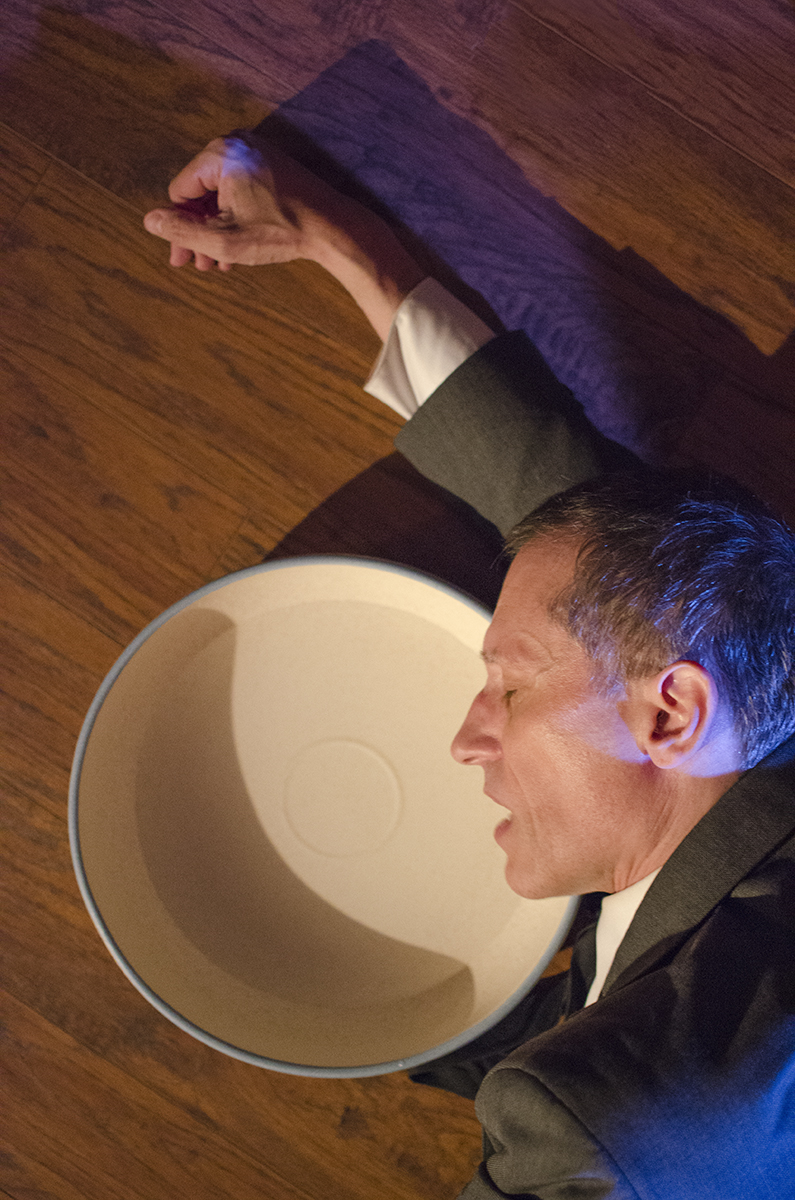
Physical acting is a crucial aspect of Grotowski’s theatrical technique, and Joseph Lavy builds a good deal of his character interpretation from non-verbal cues and gestures: the way he washes his face in a pitcher of freshly poured water, convulses in an agony of sexual despair, or — most chillingly of all — indicates his faked reading of a grave heart condition when Dr. Gregorius pays him a visit.
Joseph Lavy; photo (c)  Joe Patrick Kane

Joseph Lavy; photo (c) Joe Patrick Kane

As for the text, Lavy commands the art of transition in gating the audience through Dr. Glas’s abrupt mood swings, his high intelligence leavening the potential heaviness with the kind of black humor Dostoevsky exploits in Notes from the Underground. Like many a narcissist, Dr. Glas is also an artist manqué, and his odes to nature and childhood are strewn with just enough self-consciousness to inject a slight note of parody.

Punctuating Lavy’s ruminations and rituals is the musical commentary supplied by an ensemble of women. Their “choral” interpolations give voice to the soundtrack of Dr. Glas’s raving mind, for which Zhenya Lavy has devised a neat succession of traditional Scandinavian folk songs and a handful of piano nocturnes she herself plays.

Much of the fun comes from sharing this experience on such on intimate level, with a very small group of fellow guests. Is it just coincidence that another of my most resonant theatrical experiences of late in Seattle involved an audience of at most 20 viewers?

At any rate, I’m now hooked and can’t wait to see APL’s next major production, which is reported to be an original work based on the Faust myth as retold by Marlowe, Goethe, and Thomas Mann (Ecce Faustus). Stay tuned to see this in February 2016.

If you miss the run of The Glas Nocturne, APL plans to bring the piece back for periodic showings over the course of the next year (with showings planned in October and in December as well).

September promises a remount of their re-worked version of Pomegranate & Ash. And APL additionally offers a series of quarterly Sunday Salons — the next one is planned for July 26.

The Glass Nocturne, adapted by Joseph Lavy and co-directed by Lavy and Annie Paladino, plays until June 7. Information on how to apply for an invitation here.

(c) 2015 Thomas May – All rights reserved.

Filed under: review, theater

Primal Ooze: María Irene Fornés at New City Theater

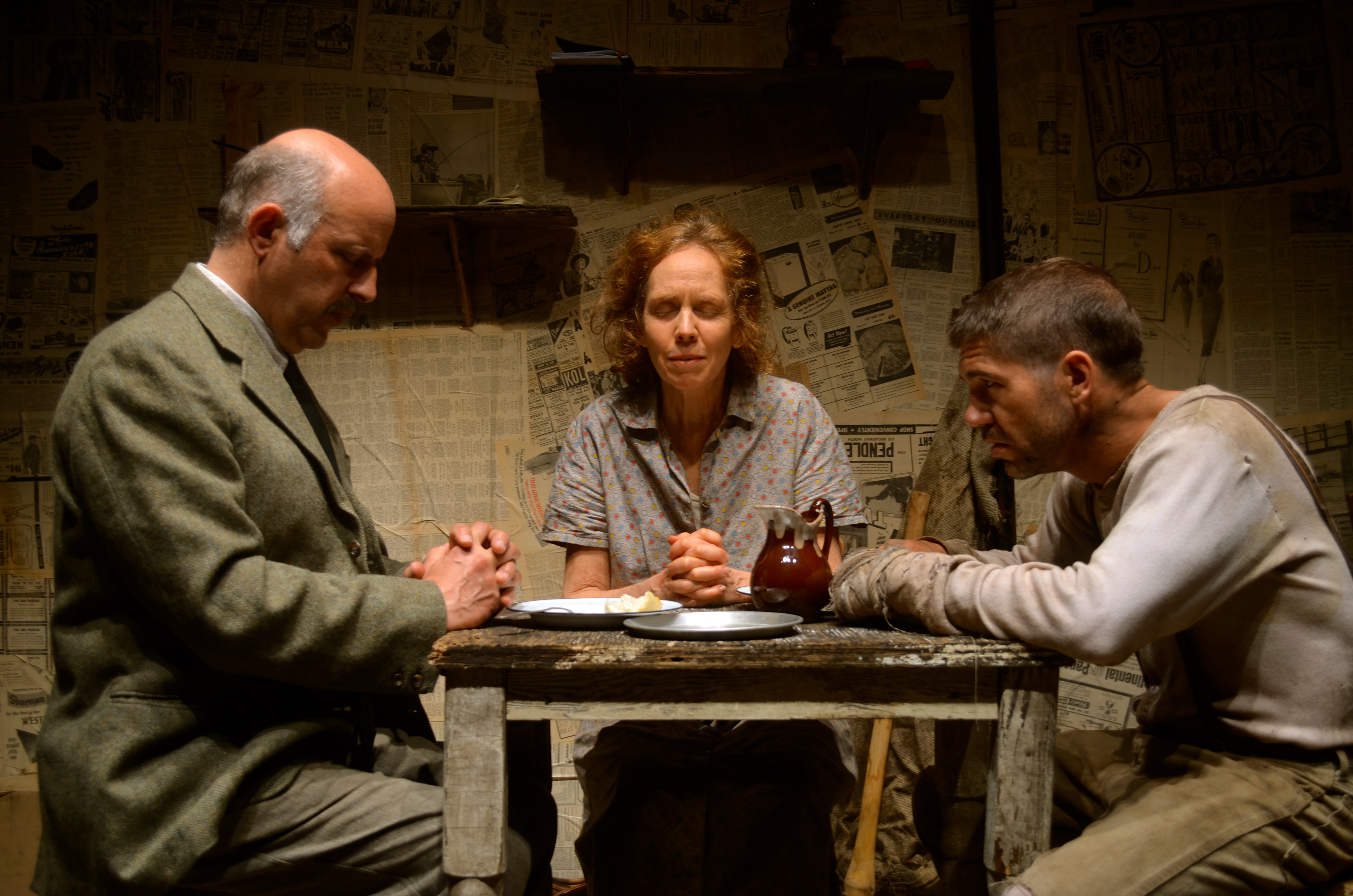
 George Catalano, Mary Ewald, and Tim Gouran in Fornes's Mud; (c) Anya Kazanjian

George Catalano, Mary Ewald, and Tim Gouran say grace in Fornes’s Mud; (c) Anya Kazanjian

Theater done New City style tends as a rule to be remarkably intimate: its current production of MUD is staged with an unflinching up-closeness. With just one row of seats that can accommodate 20 audience members tops, you’re positioned on the same level as the performance space, separated only by a few feet and a fine mesh screen from MUD‘s primal misery.

Written in the early 1980s by María Irene Fornés (now 85) — who collaborated several times with New City in the late 1980s/early 1990s — this grimly concentrated one-act drama spans but a little over an hour yet feels as exhaustive as a classical Greek tragic trilogy in New City director John Kazanjian’s searing production.

The simple-looking but intricately detailed set co-designed by Nina Moser and Kazanjian is a claustrophobic hovel, a roughhewn, comfortless, rural outpost in which Mae (New City co-founder Mary Ewald) longs for “a decent life.” There she ekes out a caged existence with her mysteriously ailing “mate” Lloyd, who had been adopted into the family by Mae’s deceased father as a younger boy. Lloyd’s arrested development has made him a bitter parasite on Mae’s drudgery, and he stinks with resentment against her attempts to improve herself through education.

Into this dire menage enters the more refined-seeming Henry (George Catalono), whose relative (but in fact quite limited) literacy and manners suggest a beacon of civilized hope for Mae. She takes Henry on as her new lover, while the further demoted Lloyd stews in bitterness, rage, and self-pity. Nina Moser’s costumes draw maximal impact from the contrast of Henry’s modest suit and tie with Lloyd’s dirt-encrusted bare feet and soiled rags.

Mae has staked her hopes on an illusion, though, and Henry doesn’t fail to disappoint with his petty behavior when Lloyd steals his money to buy desperately needed medicine. Rendered an invalid following a sudden accident, Henry soon becomes an additional drain on Mae’s resources — even less articulate than the brutish Lloyd. Fornés’ script, filled with poetry of a severe, forlorn beauty, draws metaphorical connections between animals and these hapless humans (making memorable use of an image of the shelter-seeking hermit crab).

Kazanjian gets his superb cast to fathom the many angles of this dark parable by the Cuban-born Fornés, including its registers of black humor. Gouran play Lloyd as a sulking American Caliban but finds variety in a character who can too easily come across as a nasty stereotype. Physical gestures juxtapose his listless impotence in the first scenes against Lloyd’s savagely dancing joy over his rival’s downfall. Catalono brings out Henry’s self-important pomposity as well as his rage over being driven to rage by Lloyd’s theft — Henry knows this undoes his facade.

Mary Ewald is one of the too-little-sung gems of Seattle acting. I was deeply impressed by her portrayal of Hamlet at New City last fall — a prince tormented by his tendency to idealize — and she is a legendary interpreter of avant-garde roles. Ewald sets the tone for the shades of despair and longed-for hope with which Fornés structures her play. Her Mae is trapped but determined not to play the role of victim. She declares that she intends to “die clean” in a hospital. “in white sheets” — not in the filth Lloyd seems content to fester in. All of which intensifies the horror of the otherwise rather predictable denouement.

With snapshot-like black-outs punctuating each of Mud‘s brief 17 scenes, Lindsay Smith’s lighting — along with Smith’s sound design of elegant snippets from J.S. Bach — creates a subtle distancing effect that is crucial to Kazanjian’s production. For all the Dust Bowl social realism of its surfaces, Mud comes across not as documentary critique but as a dark modernist myth of struggle and abandon.

Mud, by María Irene Fornés, until June 13 at New City Theater, 1406 18th Ave., Seattle; tickets here.

(c)2015 Thomas May — All rights reserved.

Filed under: review, theater

Seattle Opera: Buffing the Buffa in Ariadne

Kate Lindsey (The Composer) and Sarah Coburn (Zerbinetta); photo (c) Elise Bakketun

Kate Lindsey (The Composer) and Sarah Coburn (Zerbinetta); photo (c) Elise Bakketun

My review of Ariadne auf Naxos has now been posted on Bachtrack:

At the end of Seattle Opera’s previous production – a refreshing new staging of Handel’s Semele – the ill-fated heroine is burned by Jupiter’s glorious fire, but the god Bacchus emerges from her destruction: “born as my mother expired in the flames”, as Hugo von Hofmannsthal has the wine god explain in his libretto for Ariadne auf Naxos.

continue reading

Filed under: directors, review, Seattle Opera, Strauss

Pacific MusicWorks Retunes The Magic Flute

Cyndia Sieden and Mary Feminear

Cyndia Sieden and Mary Feminear

My review of Pacifc MusicWorks’ Magic Flute production has now been posted on the Musical America site. (The complete review is behind MA’s paywall.) This was a delightfully fresh take on the Mozart classic, matching historically informed performance values with a provocatively revisionist staging (including a newly commissioned translation/adaptaton of Schikaneder’s libretto):

SEATTLE — A couple years after the conductor, lutenist, and recent Grammy laureate Stephen Stubbs resettled in his native Seattle in 2006 — following three decades based in Europe (mostly in Germany) — he established Pacific MusicWorks, a production company focused primarily on presenting Baroque opera and oratorio in innovative collaborations. PMW’s latest project, which closed on Sunday, offered a fresh perspective on The Magic Flute by combining period instruments with a provocatively anti-traditional staging directed by Dan Wallace Miller and a newly commissioned translation and adaptation of the libretto by the playwright Karen Hartman.

continue reading

Filed under: directors, early music, Mozart, opera, review, Stephen Stubbs

After Life: Music of Remembrance Premieres New Opera

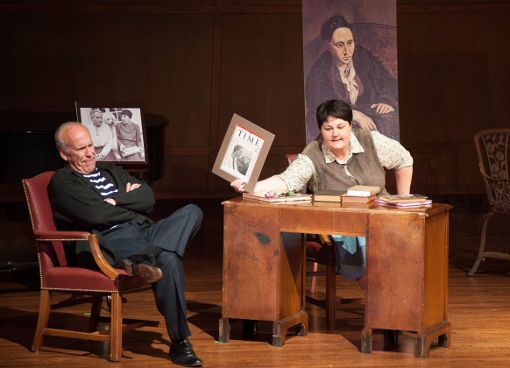
Robert Orth (Picasso) and Catherine Cook (Gertrude Stein); (c) Michael Beaton

Robert Orth (Picasso) and Catherine Cook (Gertrude Stein); (c) Michael Beaton

Just posted on Bachtrack, my latest review is of the world premiere of After Life by Seattle’s Music of Remembrance:

“Questions remember me,” sings the unnamed girl in After Life, the one-act opera by composer Tom Cipullo and librettist David Mason that received its world première on Monday evening in Seattle. Rounded up by the Nazis and sent from her orphanage in a French village to a concentration camp, the girl sings to us from the ‘other side’, the voice of a life stolen by the Holocaust. She knows she has been forgotten – yet the girl’s poignant questions make her presence indelible as she encounters the spirits of Gertrude Stein and Pablo Picasso in the afterlife: two famous figures who survived the war while also living in France.

continue reading

Filed under: Holocaust, Music of Remembrance, new opera, review

Archive

Enter your email address to follow this blog and receive notifications of new posts by email.