MEMETERIA by Thomas May

Music & the Arts

What Fire in the Ears: Much Ado c. 1953

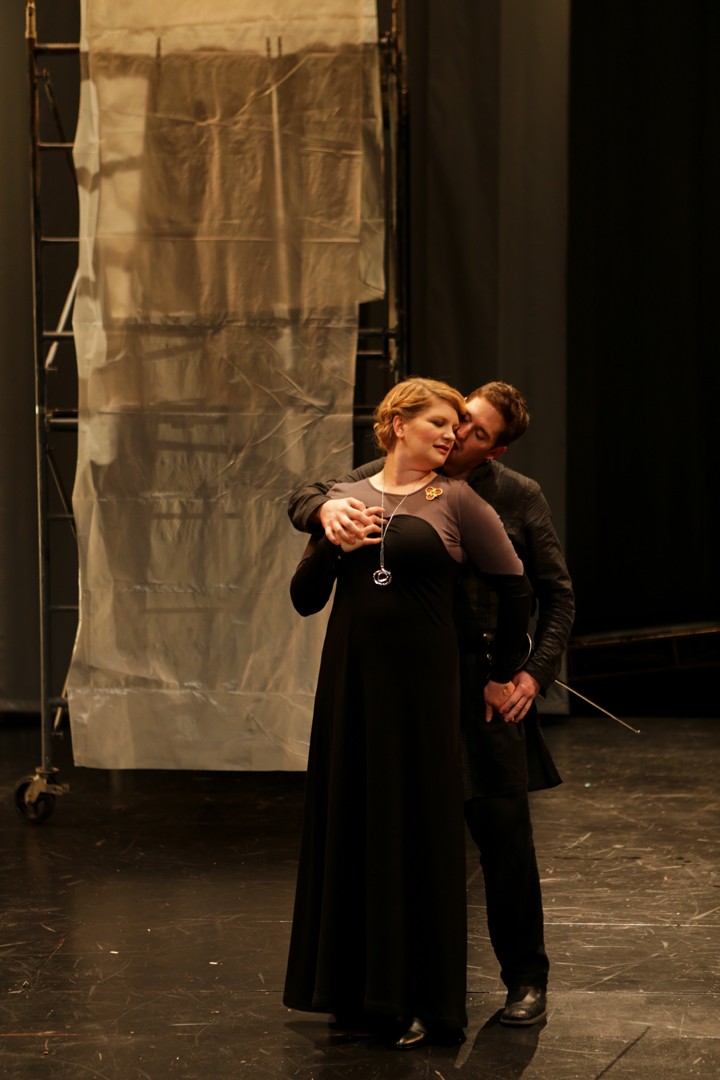
Jennifer Lee Taylor as Beatrice and Matt Shimkus as Benedick; photo by John Ulman

Jennifer Lee Taylor as Beatrice and Matt Shimkus as Benedick; photo by John Ulman

Linguists like David Crystal are fond of pointing out that shifts in pronunciation over the centuries cause modern audiences to miss out on some of the key puns and subtexts in Shakespeare’s plays. The claim that “nothing” and “noting” were all but indistinguishable in Elizabethan English is a case in point. I don’t know who first observed that “Much Ado About Noting” might be a far apter title for Shakespeare’s perennially popular comedy of misalignments realigned, but it’s become a widespread idea by now.

Certainly the play’s momentum is driven by acts of noting, of hearing or seeing things that cause perceptions to be changed dramatically. Most of these eavesdroppings are intentionally stage-managed by other characters – for benevolent if somewhat mischievous purposes (Benedick and Beatrice being led to believe they are the object of each other’s affection) and for nefarious ones (the framing of Hero as unfaithful).

What I find most striking about Seattle Shakespeare’s current production of Much Ado About Nothing is how gullible the main characters prove to be. A good portion of the comedy in the Beatrice-Benedick stand-off arises from the exaggerated language both use to express their mutual disdain – with Beatrice scoring more stinging zingers in Jennifer Lee Taylor’s arch, glib-as-a-movie-starlet delivery. Yet it doesn’t take much trickery to soften them up and make the pair willing to thrust their necks “into a yoke” same as all the rest.

Justin Huertas as Balthasar, Jim Gall as Don Pedro, Jay Myers as Claudio, and Peter A. Jacobs as Leonato; photo by John Ulman.

Justin Huertas as Balthasar, Jim Gall as Don Pedro, Jay Myers as Claudio, and Peter A. Jacobs as Leonato; photo by John Ulman

More tellingly still, Claudio reverses his Prince Charming poses even more readily than he’d pressed his lightning-fast courtship of Hero. She, in turn, is just as content to have the hot-head back after he’s been compelled to “note” her fake funeral.

All this manipulation and puppet-like flexibility can make Much Ado seem pretty arbitrary. The fundamental problem Shakespeare’s comedy poses for the performers is that it nestles a potential tragedy at its core. The notions of love that the two main couples hold on to, imagining they represent the real thing, must be put to the test; they have to enter crisis mode before any genuine change can take place.

Merely “noting” appearances or trying to preempt disappointment is a passive stance, and it can’t substitute for experience. It’s one thing for this testing to take the form of obstacles – standard procedure in comedy – but to be presented as the nightmare which erupts at the play’s center is deeply unsettling.

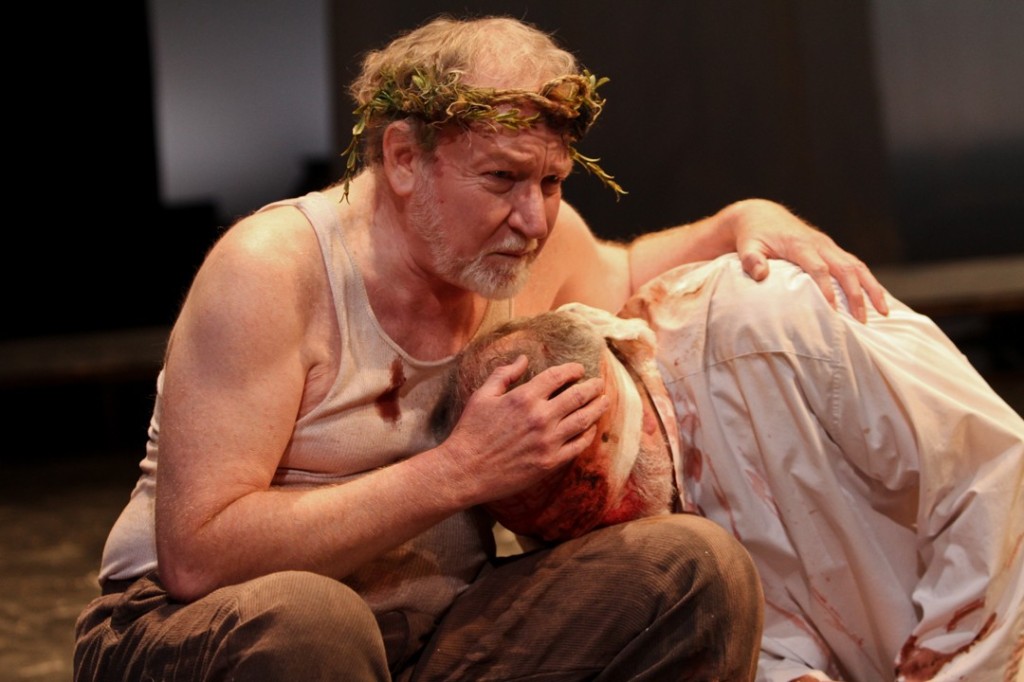
Hero (Brenda Joyner) rejected; photo by John Ulman

Hero (Brenda Joyner) rejected; photo by John Ulman

Or…maybe that’s just making much ado about nothing after all. Maybe the play really should be enjoyed for its witty slant on romance and friendship triumphant, served up with abundant linguistic virtuosity (and a virtuosic reversal of all that when it comes to the malapropic snares in which Dogberry gets entangled). As directed by George Mount, artistic director of Seattle Shakes, this production doesn’t show much interest in digging beyond that, but it still adds up to a pleasurable performance for the most part.

The production’s design elements are a particular attraction. They effectively translate the cheerful Mediterranean clime of Shakespeare’s Renaissance Messina to a tony seaside resort in 1953, with sailors coming home from the (presumably Korean) war, now ready to relax and get back to the pleasures of life. Craig B. Wollam’s elegantly evocative set, Roberta Russell’s sun-kissed lighting scheme, and the delightful period details of Doris Black’s costumes work together to reinforce this background.

Seattle Shakes is also embarking here on the first of two collaborations this season with Seattle Repertory Jazz Orchestra: Michael Brockman composed music for the songs Shakespeare embeds in the play. The jazz ensemble pre-recorded this incidental score. Justin Huertas (Balthasar) does double duty as the resort’s Sinatra-smooth entertainer and also sings a lovely threnody at the tomb of Hero before her “resurrection.”

Dogberry (David Quicksall) and crew; photo by  John Ulman

Dogberry (David Quicksall) and crew; photo by John Ulman

These elements so successfully evoke a concrete sense of place that it seems to encourage some of the cast to adopt a looser, more-relaxed style vis-a-vis Shakespeare’s language – as if to match the “realism” of the setting. Taylor’s Beatrice and Matt Shimkus as Benedick stand out not only for their engaging interactions, spinning off each other’s whip-snap repartee, but for their attention to the textures and rhythms of their words. And Peter A. Jacobs brings a suave edge to Leonato as the entitled party-giver while remaining authoritative in his speech.

As Hero and Claudio, on the other hand, Brenda Joyner and Jay Myers tend toward blandness, failing to voice the different registers of their language. Myers also remains too much the nice guy who’s been duped to give his final transformation its full effect. Especially flat is the one-note resentment displayed by Nick Rempel as the scheming villain Don John.

Noah Greene layers a Fonzie-ish attitude on the rascal-for-hire Borachio, who is the first in the play to set off its chain-reaction of conversations overheard. Most of these are staged, but he chances on Claudio’s spontaneous confession of his love for Hero. And by the play’s symmetry, it’s when Borachio is overheard by chance bragging about his nasty deed that the solution to the crisis is introduced. But before everything can be untangled, the night watch set up by Constable Dogberry (David Quicksall) – who do that bit of overhearing – restore the comic tone that’s so suddenly been sucked out of the play with Hero’s slander. This layer was, to my taste, the least successful, too reliant on extraneous gimmicks at the expense of the hilarity already there in the language.

When all is restored in the finale (the captured Don John notably awaiting his punishment offstage, to be dealt with later), this production infuses an infectious joie de vivre that makes this Much Ado about something after all.

Seattle Shakespeare Company’s production of Much Ado About Nothing, directed by George Mount, continues through November 17, 2013, at the Center Theatre at Seattle Center. Tickets online.

(c) 2013 Thomas May. All rights reserved.

Filed under: review, Shakespeare, theater
Azeotrope’s City-Country Double Bill

 Richard Nguyen Sloniker, Tim Gouran and Mariel Neto in Red Light Winter; photo: Benito Vasquez

Richard Nguyen Sloniker, Tim Gouran and Mariel Neto in Red Light Winter; photo: Benito Vasquez

My recent profile of Seattle’s remarkable Azeotrope Theatre is up on Crosscut:

What makes people want to attend live theater? Sure, it’s an art that dates back to the origins of human culture, but why put up with the hassle when it’s become so easy to find entertainment from the comforts of home? Even the allure of films is no longer enough to guarantee the future of movie theaters.

But Azeotrope has a way of making you remember what’s so unique about theater in the first place. No amount of digitalized special effects can trump the raw, gritty emotional power or the gripping depictions of desperate characters who populate Azeotrope’s latest project.

 Richard Nguyen Sloniker in Red Light Winter; photo: Sebastien Scanduzzi

Richard Nguyen Sloniker in Red Light Winter; photo: Sebastien Scanduzzi

Over the next month the company is presenting a double bill of plays in rotating repertory at the Eulalie Scandiuzzi Space, a tiny black box theater located downstairs at ACT. Both plays are less than a decade old: Adam Rapp’s Red Light Winter (2005), which was a Pulitzer finalist, and the Seattle premiere of the recent 25 Saints by Joshua Rollins (who will be on hand for post-play discussions on Nov. 2 and 3).

“When I when I first read Red Light Winter, it just kicked me in the balls,” says Richard Nguyen Sloniker, an actor, writer, teacher and co-founder of Azeotrope. “It hit me in a way I couldn’t quite grasp, and I had to try to parse out why.”

Rapp’s scenario is a bleak examination of the need for intimacy. It explores the consequences of a night two former college friends spend with a beautiful young prostitute in Amsterdam. “Sure, it’s not a very cheery play,” Sloniker explains, “but I identified with these lost, broken, human characters. A good play doesn’t necessarily have to give you a catharsis.”

continue reading

Filed under: review, theater

The Morning After: Seattle’s Theatre22 Takes Its First Bow

(left to right) Meg McLynn, Alex Garnett, Zach Sanders, Chris Shea, Tom Stewart, Megan Ahiers, Rachel Sedwick, and Mary Machala

(left to right) Meg McLynn, Alex Garnett, Zach Sanders, Chris Shea, Tom Stewart, Megan Ahiers, Rachel Sedwick, and Mary Machala

When he was ready to realize his dream of launching a new theater company in Seattle, director, actor, and teacher Corey D. McDaniel chose a play that centers around rich and complex ensemble acting for their first outing. Theatre22‘s declared mission to serve as “a meeting ground” emphasizes the power of artistic collaboration. And the company’s inaugural production of Fifth of July unquestionably puts its values to the test.

Lanford Wilson’s landmark play from 1978 is a richly textured meditation on the ties and tensions between a circle of highly individual characters coping with the emotional scars of disillusionment – and, in the case of Kenny Talley, a vet who lost his legs in Vietnam, the physical scars as well. Ken has taken temporary refuge in the now-rundown family homestead in rural Missouri which is his inheritance. Kenny’s lover Jed, a creative gardener, is painstakingly restoring the surrounding landscape, but the impulse toward stability Jed represents is countered by the events of a long Independence Day’s journey into night.

Chris Shea and Alex Garnett as Kenny and Jed

Chris Shea and Alex Garnett as Kenny and Jed

Among the holiday guests are Kenny’s sister June and her precocious teenage daughter, their Aunt Sally, and friends from their shared past as erstwhile radical students at Berkeley in the 1960s: the smooth-talking John Landis (who was sexually involved with brother and then sister) and his wealthy wife Gwen, whose big business trust fund didn’t prevent her from accessorizing trendy ’60s-style Marxism back in the day. Now, though, Gwen’s dreams have turned toward a career as a country singer, and her trusty guitarist Wes has accompanied her for the visit.

Borrowing a framework from Chekhov, Wilson establishes dramatic stakes that outwardly revolve around the proposed sale of the Talley home. John and Gwen hope to buy the farm to transform it into a commercial recording studio. But its metaphorical significance – the symbol of Ken’s unrealized potential and also of the past, of the collective memory whose meaning is up for grabs – intensifies the moral weight of the outcome. (Wilson, who died just two and a half years ago, went on to expand his drama of the Talleys into a trilogy, writing two more plays about the Talley family’s past, which take place in the 1940s.)

Fifth of July cast: Megan Ahiers, Tom Stewart, Chris Shea, and Meg McLynn; photo by Robert Falk

Fifth of July cast: Megan Ahiers, Tom Stewart, Chris Shea, and Meg McLynn; photo by Robert Falk

Director Julie Beckman is well attuned to the musical method of Wilson’s writing: like a tapestry of solo instrumentals emerging from the ensemble, different characters unexpectedly detach and come into the foreground to riff on a particular – not necessarily related – theme, only to gently recede while the focus turns elsewhere. A persistent challenge is making these transitions plausible and seamless: at times the production makes them feel too abrupt. There’s a lot of sensitive attention to detail in these monologues, and to their alluringly poetic blend of pathos and eccentric humor. The overall pacing, though, especially in the first act, has a tendency to slacken. As with Chekhov, finding the right tempo for Wilson is an extremely subtle undertaking.

Yet the connections and frustrations that are key to Fifth‘s momentum are vividly realized by the cast. Chris Shea, while tending toward a one-note approach to Kenny’s bitterly ironic tone, is genuinely moving in the final scene when – with beautiful symmetry – he is persuaded to stay by Gwen (a gloriously larger-than-life fuck-up in Meg McLynn’s portrayal). As his boyfriend Jed, Alex Garnett is the force that grounds Kenny, but he also underlines the significance of his rapport with Aunt Sally – and thus is the linchpin who holds this fragile family together. Megan Ahiers conveys sister June’s lingering insecurity; as her uber-curious daughter Shirley, Rachel Sedwick toggles between bratty tantrums and wise-beyond-her years remarks.

Aunt Shirley is meant to embody the contradictions that define the Talley family – or the braver exemplars of the clan – and the link to a past whose meaning has become painfully dubious. Mary Machala shows her as a dreamy eccentric, bruised in her own way and thus in league with her nephew Kenny. Tom Stewart emphasizes John’s sleazy swagger, but he comes off a tad too nice for the cutthroat competitor who has apparently shucked his Age of Aquarius idealism with no qualms. Zach Sanders has a few show-stealing moments as the space cadet Wes – including his famous monolog about the ill-fated Eskimo family.

The fine black box space of Fremont’s West of Lenin underscores the intimacy of this production and the details of Michael Mowery’s picture-frame unit set and Jordan Christianson’s spot-on costuming (complete with unironic bell-bottoms sported by John). Tim Moore’s sound focuses on the music – mostly a blast from the past – though I would’ve also welcomed some environmental sounds for a sense of place. Robert Falk’s lighting traces the first act’s woozy trailing off into memory as the national holiday fades into night, followed by the uneasy promise of the morning after.

It all makes for an impressive inaugural production. And Theatre22 has mapped out some ambitious plans for later in the season: in February comes a new musical titled The Hours of Life by Paul Lewis, based on Edgar Allen Poe, which will be directed by Corey McDaniel; and Terrence McNally’s The Lisbon Traviata is slated for this coming June, directed by Gerald B. Browning.

If you go: Fifth of July plays through October 26 at West of Lenin in Fremont. Tickets online

Corey McDaniel (producer) and Julie Beckman (director); photo by K. Lindsay

Corey McDaniel (producer) and Julie Beckman (director); photo by K. Lindsay

Filed under: review, theater

What a Story: Enda Walsh’s Walworth Farce

NCT's "The Walworth Farce"; photo by Chris Bennion

NCT’s The Walworth Farce; photo by Chris Bennion

For its fall production, Seattle’s enterprising New Century Theatre has chosen Enda Walsh’s The Walworth Farce. Here’s my review for Crosscut:

Talk about a repetition compulsion: For the first half of The Walworth Farce, New Century Theatre’s latest adventure, a father and his two grown sons run through the lines of the play they reenact day after day – an absurd, antic ritual involving a mock procession with a cardboard coffin, constant prop swaps, dizzying identity changes and a hidden “fortune” of shredded Monopoly money.

In the confines of their squalid South London council flat, Dinny (Peter Crook) is the paterfamilias and dictatorial writer-director of the script he and his sons Sean (New Century Theatre artistic director Darragh Kennan) and Blake (Peter Dylan O’Connor) perform day after day. Dinny keeps his boys’ eyes on the prize, egging them on to compete for a chalice-like trophy that will go to that day’s “best actor.” But snafus inevitably occur, and the ritual has to be reorganized.

Dinny’s play is the thing that’s supposed to keep them all safe. It recounts the story, fable repeated until it’s taken as fact, of how this insular family unit was forced to abandon their idyllic home back in Cork. We also learn how Mother was killed in a bizarre accident involving a dead horse. They’ve been living as exiles ever since, surrounded by “savage” Londoners and holed up on the top floor of a grimy, stairless high-rise.
“What are we without our stories?” wonders Dinny by way of justifying the outrageous fiction he’s used to paint over what actually happened – and the real world kept at bay by a half-dozen deadbolts on the flat’s front door.

continue reading

Filed under: playwrights, review, theater

Holy Cabooses! Wilder’s The Matchmaker at Taproot

Matchmaker-Pam Nolte2

(Pam Nolte as Dolly Gallagher Levi in Taproot Theatre’s production of The Matchmaker; photo by Erik Stuhaug)

It’s surprisingly easy to mistakenly associate Thornton Wilder’s theater — or at least his most-famous plays — with feel-good, homespun, Norman Rockwell Americana. (Whether that represents a mistaken idea of Norman Rockwell is another question.) A similarly false impression clings to the widespread image of Aaron Copland, who even composed a score for the 1940 film of Our Town and later considered basing on opera on it — though the playwright declined, countering: “I write amusical plays.”

Of course The Matchmaker, a Broadway and West End hit in 1955 after it bombed in its earlier 1938 incarnation as The Merchant of Yonkers, did morph into the musical Hello, Dolly! in the following decade. But the brassy success of the latter — which, admittedly, I’ve never been able to fathom — only reinforced the notion that Wilder’s play is just another charming twist on the happy alliance between romance and the American Dream.

The new production of The Matchmaker currently on the boards at Seattle’s Taproot Theatre is certainly entertaining. But in director Scott Nolte’s version, it also welcomely embraces Wilder’s deft homage to a vanished, rawer era of American theater-making. For the most part, there’s no embarrassed smoothing-over of the popular farce — complete with its own character types — that was already a fossil when Wilder devised this valentine to it.

Matchmaker-hat store

(Asha Stichter and Natalie Moe as Minnie Fay and Irene; photo by Erik Stuhaug)

Apart from an opening scene that drags, this Matchmaker is delightfully paced and benefits from a consistently focused ensemble energy. The renegade store clerk Cornelius Hackl (given an especially winning turn by Robert Hinds) and the scheming, ambitious milliner Irene Molloy (Natalie Anne Moe, channeling the moxie of Gretchen Mol’s Gillian on Boardwalk Empire) make their wide-eyed anticipation plausible when they remark: “The world is full of wonderful things!”

However “amusical” he may have thought his plays, Wilder’s build-up of the confrontations between the tyrannical merchant Horace Vandergelder and his underlings feels genuinely scherzo-like. Nolte makes room for the other concerns Wilder voices through the pleasure-seeking vehicle of his farcical plot.

Matchmaker-clerks

(Robert Hinds and Brad Walker as Cornelius and Barnaby; photo by Erik Stuhaug)

As these characters become entangled in mixed-up or feigned identities and search for mates and fortunes, they muse about the things that really matter to them. Against the backdrop of the Gilded Age and its class differences — effectively telegraphed by Sarah Burch Gordon’s delightful palette of costumes — Mrs. Dolly Gallagher Levi, the matchmaker in question (among other dubious pursuits), realizes it’s time to let go of memories of her late husband and “live among human beings” again: to be “a fool among fools” once more rather than “a fool alone.” Pam Nolte (Scott Nolte’s wife) animates her portrayal of the ever-confident Dolly with a well-calibrated hint of her disappointments.

Along with his humanist touches, Wilder works in a trenchant commentary on the greedy excess to which the drive for material success can lead. “The difference between a little money and an enormous amount of money is very slight, and that, also, can shatter the world,” observes Dolly, who espouses her own economic theory of “spread-it-around” capitalism. “Everybody thinks when he gets rich he’ll be a different kind of rich person from the rich people he sees around him,” Cornelius says. “Later on he finds out there’s only one kind of rich person. And he’s it.”

The point gets rather blunted in Robert Gallaher’s approach to Horace Vandergelder. Instead of the authoritarian, hard-as-nails “monster” who intimidates everyone, secure in his “half million,” Gallaher comes through as too domesticated, even mildly bemused by his sense of superiority.

Matchmaker-Horace

(Robert Gallaher as Horace Vandergelder; photo by Erik Stuhaug)

Brad Walker, on the other hand, makes a memorable impression by playing up his character type as Barnaby Tucker, the naive sidekick to Cornelius in search of “an adventure” on their self-declared day off. So does Kim Morris in her hilarious depiction of the eccentric Miss Flora, the friend of Dolly and Horace’s late wife. During the denouement in her New York house (a surprise for anyone who knows only Hello, Dolly!), Wilder uses Miss Flora to parody treacly sentiments about “true love.”

Mark Lund’s simple sets (including a painted urban backdrop) and sound design transform the small stage area into 1880s New York with a bare minimum of suggestion. The real time change is conveyed through Wilder’s earthy language — spiced at times with clever, Oscar Wilde-like turns of phrase — and the actors’ demeanor, though, and it all plays out as less dated than you might expect.

The Matchmaker, which closes Taproot’s current season, plays through Oct 19 at 204 N. 85th St., Seattle; tickets at 206 781-9707 or online.

–Thomas May (C) 2013 All rights reserved.

Filed under: review, theater

Ludo Starts His Third Season

Morlot-Thibaudet-Sep 2013
(Ludovic Morlot and Jean-Yves Thibaudet rehearsing Ravel with the Seattle Symphony)

I know I’m not the only one who can’t believe Ludovic Morlot is now in his third season helming the Seattle Symphony. Last night was an impressive all-Ravel program, with the fine pianist Jean-Yves Thibaudet on hand for both concertos. What a feast! My review here:

Wrapping up last night’s all-Ravel program with “Boléro,” Ludovic Morlot and the Seattle Symphony demonstrated complete mutual trust – an ingredient essential to giving this ultra-famous piece its spark. However familiar it is, Ravel’s sequential spotlighting of soloists makes it a dangerous enterprise. The music itself seems to dramatize the issue, with its slinky, head-worming tune twisting about but straitjacketed into a monomaniacal lockstep rhythm. How to find the right but unpredictable balances, to weigh the individual voice against the ensemble?

Continue reading

Filed under: review, Seattle Symphony, Uncategorized

Burning Down the House: Seattle’s Götterdämmerung

Image
Richard Paul Fink (Alberich) and Daniel Sumegi (Hagen); photo ©Alan Alabastro

Talk about a buildup: I can’t think of any other work of art, let alone opera, that stokes our sense of anticipation with such prolonged intensity as the Ring’s grand finale. The whole shebang came about, after all, because Wagner wanted to fortify the emotional payoff of what became Götterdämmerung.

Providing the back stories leading up to his depiction of Siegfried’s downfall and Brünnhilde’s final enlightenment isn’t the only thing the first three Ring operas are supposed to do. They’re meant to give these events a dramatic and musical weight that’s only possible if the audience is persuaded to commit itself over the Ring’s vast scale. And that’s what ultimately can make the cycle feel so “cosmic” – not its mythic congeries of mermaids, gods, giants, dwarves, et al.

On Friday night Seattle Opera arrived at the conclusion of its signature Ring – the first of three cycles being given in this Wagner bicentennial year, as well as in the final season of general director Speight Jenkins’ long tenure.

Which is to say, there’s an additional layer of significance to this Ring for Seattle audiences and for the impressive percentage of non-local fans who’ve made the pilgrimage from afar for what may be their last chance to see this production.

I’ve found this round of the Seattle Ring immensely satisfying as a whole. For those who have had the fortune to see earlier iterations since it was unveiled in 2001, this latest encounter delivers a special cumulative effect of its own by way of comparison with the previous versions. An important factor here is the readjustment of the chemistry of the performing forces, with both a conductor and key members of the cast new to the production.

Die Walkure
Die Walküre: Alwyn Mellor (Brünnhilde), Greer Grimsley (Wotan); photo ©Elise Bakketun

One of these is the British soprano Alwyn Mellor, whose portrayal of Brünnhilde in Die Walküre had the dramatic range to match her enthralling vocal presence. It’s been said that the Ring contains three Brünnhildes, but already in this opera Mellor homed in on different layers of her character beyond the exuberant war cry that first introduces her – above all in the Death Annunciation scene, where she learns compassion from the doomed Wälsung twins, but also in the bewilderment displayed in her last confrontation with Wotan. More than ever before, I was riveted by the “gulf of misunderstanding” that tragically separates her from the “warfather” god – but that will set her on the path to her own liberation.

Unfortunately Mellor fell prey to an ailment and had to bow out of the rest of the cycle. If Lori Phillips, the cover for Brünnhilde, saved the night with her passionate and well-acted performance in Siegfried’s final scene, her ability to step in the spotlight at the last-minute for the brutal demands of Götterdämmerung was little short of miraculous. Both the “continuation” of her love duet on the rock with Siegfried and Brünnhilde’s scene with Waltraute were highlights of the evening. Given the circumstances, it’s hard to fault Phillips for being less convincing in her character’s volatile transformation in the second act. There was a further loss of emotional complexity in the Immolation Scene, where the toll on her upper range became most apparent.

Götterdämmerung 2013
Götterdämmerung: Stefan Vinke (Siegfried), Daniel Sumegi (Hagen), and Markus Brück (Gunther); photo ©Alan Alabastro

I suspect this sudden change in the partner he had rehearsed with most closely may account, in part at least, for a less satisfying rendition of the mature Siegfried by the German tenor Stefan Winke (also new to the production) than the young hero he had managed to make so compelling two nights before.

But another part of the “Siegfried problem” is beyond any individual performer’s control. Let’s face it: Wagner’s actual presentation of Siegfried in Götterdämmerung is deeply flawed. No sooner does Brünnhilde send him off to perform great “new deeds” than he is duped by Hagen and the scheming Gibichungs. He’s not only passive but (rather like Wotan) perfectly willing to compromise himself morally – and this on his own accord – to get what he wants (Gutrune); and like Mime, he fails to learn what he needs to know when he has the chance to from the Rhinedaughters.

Stefan Vinke in Siegfried’s “Forging Song”

At any rate, Vinke’s singing still produced thrills (including a daringly sustained high C in his response to the hunting party soon before his death). But apart from his eerily shaded voice as he sang from within a cave to Gunther’s onstage lip-syncing for the abduction of Brünnhilde, there was far less variety of phrasing than Wednesday night; Vinke tended toward a more one-size-fits-all projection and, most problematically for me, failed to convey the sense of Siegfried’s sudden, harrowing realization of what has been lost in his final, “undrugged” recall of Brünnhilde before he dies.

Still, the massive prelude-plus-first act (nearly comparable in length to the whole of Rheingold) was among the most memorable segments of the cycle. It almost seemed to play out in one sustained arc of thoroughly riveting theater.

Götterdämmerung 2013
Götterdämmerung: Alwyn Mellor (Brünnhilde) and Stephanie Blythe (Waltraute); photo ©Alan Alabastro

Stephanie Blythe’s contributions to the Seattle Ring are pretty much exaggeration-proof. As Fricka in the first two operas, her complex but loving relationship with the excellent Greer Grimsley’s Wotan have been a defining feature of director Stephen Wadsworth’s interpretation since it premiered. As if that weren’t enough, her sculptural phrasing and vocal phrasing also added texture and atmosphere to the Norns (joined by Luretta Bybee and Margaret Jane Wray, who delivered such a moving Sieglinde). And Blythe’s Waltraute, with its “preview” of the Immolation Scene summing-up, actually eclipsed the latter on this occasion. Particularly in this staging, it is this scene that represents the point of no return (rather than the Rhinedaughters’ last-ditch plea later in act three).

I was also extremely pleased with newcomer Wendy Bryn Harmer. She’d also appeared as one of the Valkyries and as a distraught Freia (a great addition to the roster of gods, as was the demigod partially responsible for her plight, Loge, given a mesmerizing performance by Mark Schowalter). Her Gutrune for once had some depth rather than being a mere pawn – uncannily reminiscent of Sieglinde as the victim of a hostile men’s world, but also pathetically desperate at her chance for love, even if it’s cheating, with Siegfried. But to my taste, fellow Seattle Ring newbie Markus Brück remained too constrained by the passivity of his character as the ineffectual Gibichung ruler Gunther.

Die Walkure
Götterdämmerung: Daniel Sumegi (Hagen) and the Vassals; photo ©Elise Bakketun

Making up for this – and grounding a sense of the “real world” power struggle into which Siegfried blithely blunders – was Daniel Sumegi’s Hagen, in a portrayal of spine-chilling menace and cold-blooded calculation. So weighty is the evil this Hagen incubates (manifested with peals of darkly rolling vocal thunder) that even he appears troubled by its implications, as we see in another highly successful scene: the dream-encounter with Alberich. As one of the leading exponents of the latter singing today, Richard Paul Fink has been intensifying his spiteful phrasing and physical acting to such a point that you worry a little he won’t be able to snap out of character.

Yet after this scene and the superb first act, I did feel a kind of dwindling, anti-climactic effect, above all in the conclusion of the cycle. The visual staging of the post-Immolation cataclysm – is there a more impossible design challenge in the theater? – has at least arrived at a reasonably effective compromise (which, for the sake of those still intending to see it, I won’t give away here).

I’ve decided this sense of anti-climax results from a mix of the Ring’s inherent weaknesses which Wagner was never able to sort out and specific choices of this production, compounded with things being thrown off balance owing to the last-minute unavailability of Mellor’s Brünnhilde.

Die Walkure
Das Rheingold Markus Brück (Donner), Andrea Silvestrelli (Fasolt), Wendy Bryn Harmer (Freia), Greer Grimsley (Wotan), Stephanie Blythe (Fricka), Ric Furman (Froh), and Mark Schowalter (Loge); photo (c)Elise Bakketun

While the scenically realistic, Pacific Northwest-inspired look of the fabulous sets designed by Thomas Lynch is largely responsible for the moniker “green” Ring, Seattle Opera’s production isn’t really about imposing some sort of environmental concept. But those who refer to it as a “traditional” Ring are sorely mistaken. This notion has been kicking around because of the tastefully archaic aura of the late Martin Pakledinaz’s costumes or perhaps because of the plausibly mythical zone in which everything plays out (as opposed to, say, the rundown motel on Route 66 for Rheingold in the much-scorned new Bayreuth Ring directed by Frank Castorf).

Die Walkure
Das Rheingold: Jennifer Zetlan (Woglinde), Cecelia Hall (Wellgunde),Renée Tatum (Flosshilde), Richard Paul Fink (Alberich); photo (c)Elise Bakketun

Yet Seattle Opera’s Ring, too, is strongly rooted in a vivid directorial concept. The brilliance of director Stephen Wadsworth’s vision, which centers around an almost Chekhovian psychological realism, is that he has evolved this both from a deep knowledge of Wagner’s text (the combine of words and music, that is) and from obsessively detailed, prolonged rehearsals with the cast to ensure an organically coherent portrayal of the characters and their interactions.

Thus, as mentioned, there’s genuine love between Wotan and Fricka, which underscores the sense of personal tragedy in the god’s dilemma in Die Walküre and its fallout. This does of course mean giving precedence to some elements in the Wagnerian text and overlooking others (such as Wotan’s harsher persona as “war father”). It also means inserting things into the text that aren’t there in the first place so as to draw out an implication: we see Fricka suddenly appear for the hyperintense conclusion to act two of Die Walküre to greet Hunding, only to be dumbstruck when Wotan slays him (an effective and justifiable choice, I thought, to make us think of the future she, too, has to face; otherwise she simply disappears from the cycle after her earlier confrontation).

Die Walkure
Die Walküre: Stephanie Blythe (Fricka), Greer Grimsley (Wotan); photo (c)Elise Bakketun

Wadsworth’s essential approach is to humanize Wagner’s mythical characters and their behavior. This perspective pays its richest dividends in Die Walküre and Siegfried, which, for me, are the two most impressive successes of the Seattle Ring. In fact, often though we’re told that the Ring is a vast epic containing the history of the world, a significant proportion of the cycle (the middle two operas, more or less) actually centers around scenes of intimate dramatic communication between two characters. Wadsworth’s style and concept are ideally suited to these. His humanizing also touch goes a long way toward animating the expository stretches of Das Rheingold, with its much larger ensemble.

Wadsworth
Stephen Wadsworth in rehearsal

The Achilles heel seems to be in the crowd scenes of Götterdämmerung and in the old-fashioned, grand opera style “Lohengrinizing” (as G.B Shaw called it) that makes these parts of the last Ring opera sometimes seem such a throwback. There’s a lot of rustling about from the chorus of Vassals in the second act in response to Hagen’s summoning (where, musically, Wagner seems to nod), but it doesn’t convey the accumulation of menacing tension, the sense of a whole society on the verge of collapse despite the distractions of wedding celebration.

A similar situation lessens the impact of the third act. A comic turn in the Rhinedaughters’ reappearance at the top of the act which has them horsing around is presumably meant for relief, but that choice has always struck the wrong note for me. Wadsworth’s forte is evoking the intimate and personal, but the atmosphere of apocalypse remains absent in the scene of Siegfried’s murder and in the final scene. And it’s a problem that goes beyond this particular production, affecting many others. Wagner himself acknowledged the challenge when he suggested that all the knots are really worked out in what the final music tells us.

Turondot
Maestro Asher Fisch

As the production’s new conductor, Asher Fisch (for whom Daniel Barenboim was an important mentor), proved to be a key asset in making this latest edition – neatly fine-tuned by Wadsworth in increasingly subtle ways – the most successful run since the premiere of Seattle’s Ring production in 2001. Fisch coaxed the most ear-catching collections of sounds and color from this orchestra that I’ve ever heard in their Ring playing.

There was some unevenness, to be sure: Siegfried’s Funeral March sounded inexplicably hollow, and moment after glorious moment of the final scene was thrown away, like an actor so afraid he’ll forget the words of a great Shakespeare monologue he rattles them off without trying to create an interpretation.

Overall, what Fisch sacrificed in sheer dramatic tension (not to mention Soltiesque playing to the gallery) through his often measured tempo choices was compensated by the continual unfolding of layers of the score that often lie buried. The woodwind writing in the last scene of Die Walküre, for instance, bloomed with breathtaking beauty, while Siegfried’s second act was shot through with almost psychedelic streaks of color – growling low brass and electrifying string figurations.

And for the most part Fisch succeeded in integrating the singers into the total fabric of sound and in contouring the ensemble to the dramatic dimension. (One strange quirk of Wadsworth’s stage direction, which posits the characters often “hearing” the music from the orchestra, has them react in stylized, silent-film-type gestures to musical accents.) The result made an incalculable contribution to the gathering theatrical effectiveness of the cycle as each evening progressed.

At the conclusion of this first of three cycles to be performed in August, Speight Jenkins briefly addressed the audience, calling attention to the incredible efforts of everyone involved in what he termed “the biggest collaboration there is in all art.” And he pointed out that this is the valedictory Ring under his long tenure with the company, which has been defined by its Ring productions. It’s hard to imagine a more moving or memorable way to leave the stage.

–Thomas May

Filed under: opera, review, Ring cycle, Seattle Opera, Wagner

Du sollst mich nicht lieben! Siegfried in Seattle

Die Walkure

One of the most-anticipated new elements in the current revival of Seattle Opera’s Ring cycle is the appearance of German tenor Stefan Vinke as Siegfried: the character who initially attracted Wagner to the potential of this material. (The Ring, incidentally, is in the end a myth Wagner made up – not, as sometimes asserted, merely a narrative simplification of actual Nordic myths: several of the key pieces he used to construct it have no relation to each other in their original context.)

Apart from the role’s notoriously wicked vocal demands, the brave soul who takes on Siegfried has to try to gain the audience’s sympathy despite playing an annoying, intensely dislikeable character. Productions can only get so far by retreating into fairy-tale escapism or, at the other extreme, by amping up Siggy’s repulsively thuggish side and hence the ironic distance between the character we see onstage and Wagner’s outsize vision of the hero. (To sing an antihero, do you need an anti- or a counter-heldentenor?)

I admit that, like many, I tend to find Siegfried‘s first two acts contain the weakest links in the entire Ring. But Wednesday night’s performance of Cycle I at Seattle Opera awakened me to the real brilliance of the Ring‘s “second” evening (counting trilogy-wise).

I don’t recall ever being so drawn in by the young Siegfried or being made to feel his mix of curiosity and profound loneliness beyond all the ADHD and nasty treatment of Mime. I don’t just mean that Stefan Vinke somehow “looked” the part (at least more than is usually the case). For me Vinke plausibly depicted a youth in conflict and capable of emotional depth, especially in the anguish he shows when thinking of his mother’s death from childbirth during the “Forest Murmurs” scene. The production’s emphasis on nature is so in sync with its psychological realism here that this scene is one of the highpoints of the Seattle Opera Ring.

Vocally, Vinke veers ever so slightly flatward from time to time (I can’t stop Stab-reiming!), and his enormous voice in general makes an impression with size, not with beauty of tone. His stamina alone is reminiscent of Jane Eaglen in Rings past. The cliche about Siegfried having to face a Brünnhilde who is “fresh as a daisy” just as he’s worn out from hours of singing didn’t even come to mind this time.

But Siegfrieds who have nothing but stamina to offer bore me precisely because it ends there, with stamina – and just reinforce the stereotypes of the role. I thought Vinke was able to give dimension to this phase in the hero’s life, which is otherwise so cartoonish. He really seems to get inside the music, to make it work dramatically and to act convincingly with his voice.

Seattle’s new Brünnhilde, Alwyn Mellor, had to cancel appearing in her one scene in Siegfried because of an allergy attack that morning – and to (we fervently hope) preserve her voice for the massive finale. Speight Jenkins was fortunate to be able to count on soprano Lori Phillips as Mellor’s cover. As with her Turandot, which I heard here last year, I found Phillips has a problematic top but a beautiful voice and genuine stage presence. (Puccini, as it happens, set up a dramatic situation at the climax uncannily reminiscent of the Siegfried-Brünnhilde meeting but died before he could complete the score.) And she had the acting style Wadsworth has been cultivating down completely: the psychodynamics between her and Siegfried, where she can’t quite say goodbye to the old way of life, were riveting.

Crucial to this production and its reimagining of Siegfried are the “kindler, gentler” Mime in a richly crafted performance by Dennis Peterson and Greer Grimsley‘s subtlest portrayal among his three Wotans (as The Wanderer).

Of course a lot of the credit for such a persuasive Siegfried goes to the incredibly detailed staging by Stephen Wadsworth and to the ear-opening, sumptuous attention to color from conductor Asher Fisch. His work in the second act reminded me Mahler’s particular fascination with this score – Mahler conducted Siegfried four times during his stay in London – especially its trippy contrasts. More reflections on Wadsworth and Fisch to come. Now that Vinke has given us a clearer sense of the young Siegfried’s identity, I’m eager to see how he’ll carry it through in Götterdämmerung.

(Image: Seattle Opera’s Siegfried: Dennis Peterson (Mime), Stefan Vinke (Siegfried). Photo © Elise Bakketun.)

Filed under: review, Ring cycle, Seattle Opera, Wagner

Archive

Enter your email address to follow this blog and receive notifications of new posts by email.