MEMETERIA by Thomas May

Music & the Arts

Howler of the Week (Year?)

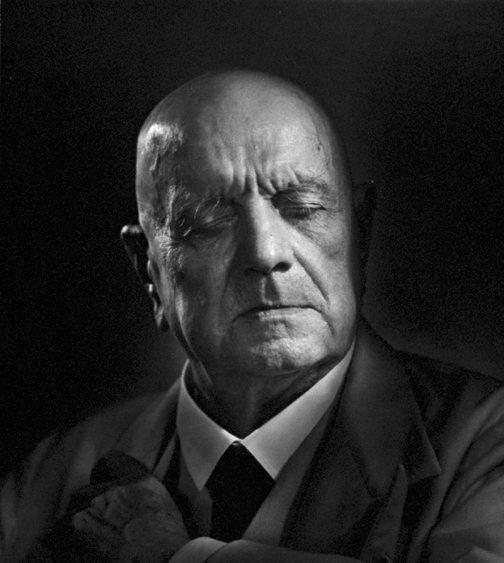
A little-known composer of obscurities

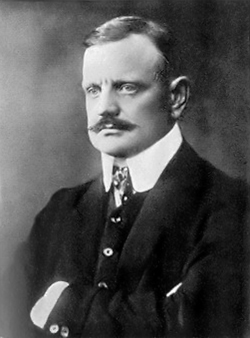
A little-known composer of obscurities

Arts journalism in Seattle — it just keeps getting better and more incisive. Here’s the Seattle Times trying to tell us that it’s reliably “covering” an institution as central to Seattle’s cultural life as the Seattle Symphony: see, we’re devoting a whole preview to this ambitious festival!

And so in this preview of Luminous Landscapes, the Seattle Symphony’s Sibelius Festival, which started last night, we are educated about a work alleged to have been obscure for most of its history — the Violin Concerto (!):

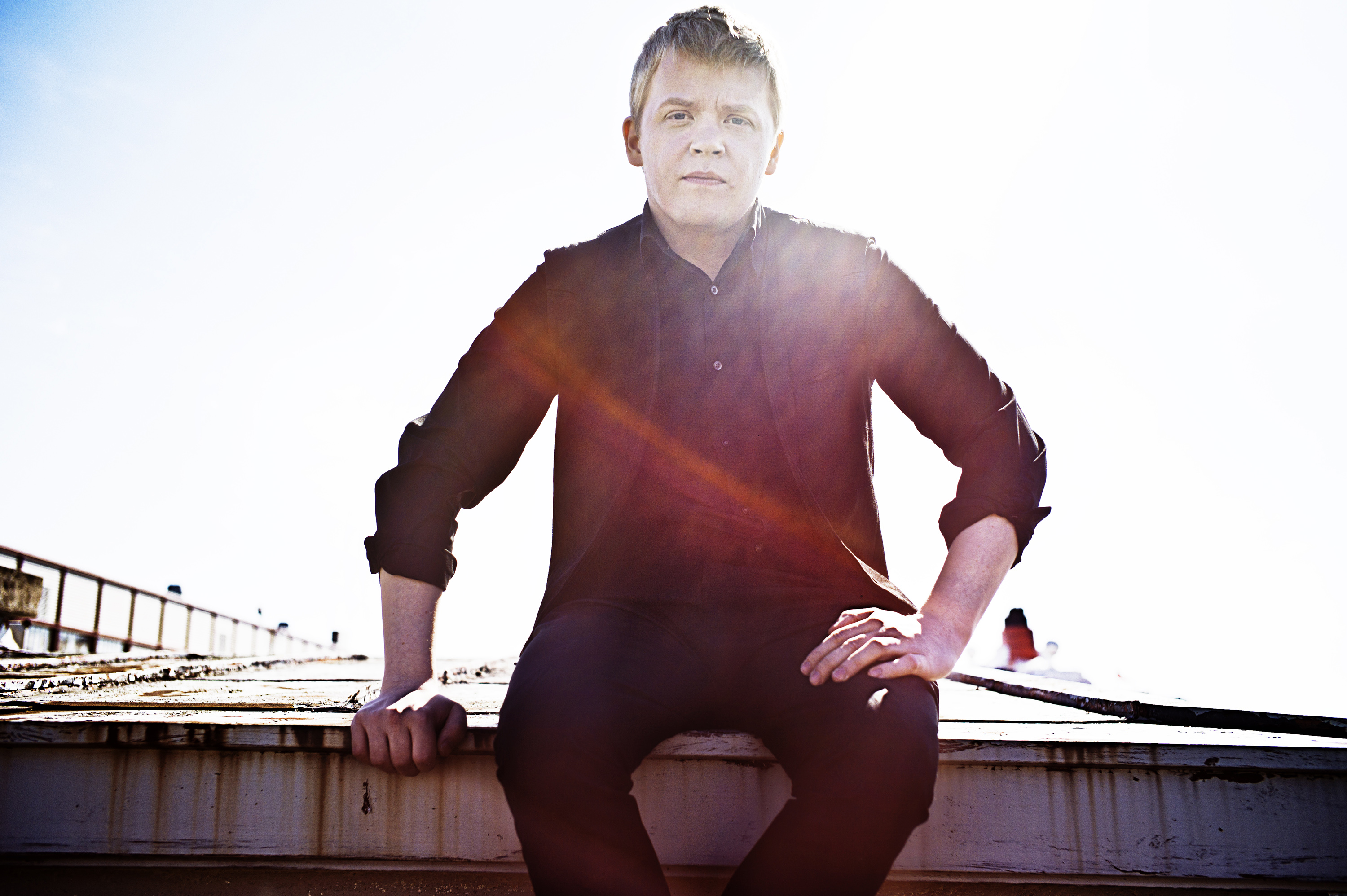
Finnish violinist Pekka Kuusisto will make his Seattle debut for [sic] the often-revised piece, which seems almost to have been cursed during Sibelius’ lifetime; its 1904 premiere was a disaster, due in part to its difficulty, and it was unknown to much of the world until 1991.

Yes, the Wikipedia entry contains a discussion of the belated unveiling of the original version of the Concerto in 1991. (Sibelius had withdrawn that score after its ill-fated premiere.) One of the problems with relying on Wikipedia alone — even when the information is pretty good, as in this case — is that without knowledge of the topic in a fuller context, it’s very easy to skim too fast and come away with a false, superficial sense of “knowing” about something without noticing what’s actually at stake. The preview isn’t discussing the ur-Concerto, just the regular one that will be played next week in the second program of the festival: a recent find!

ADDENDUM: I should add that it has occurred to me that this embarrassing gaffe might not be the author’s fault but that of the Seattle Times editor. It’s conceivable that the copy that was turned in correctly explained the (otherwise essentially irrelevant) reference to the 1991 factoid and that this was haplessly mangled by an editor with limited reading comprehension skills (and even less knowledge of music).

I hope it’s obvious that this matter is far from a pedantic point about correct dates. In either case, it means that a Wikipedia article is more reliable than the information published by the Seattle Times. Of course the second scenario — the one about the unreliable editor — would only further underscore my real point here: that the deteriorating state of arts journalism is doing a terrible disservice to a large population of readers who are genuinely interested in the arts.

Surely we haven’t already reached the point where accuracy in reporting by the “newspaper of record” is considered a luxury? Or have we…..

Filed under: journalism, Seattle Symphony

Berlioz’s Roméo et Juliette Symphony toute entière

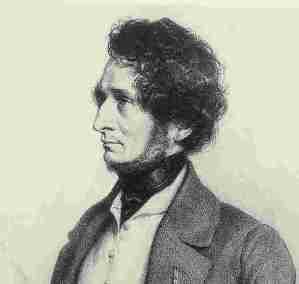
Berlioz

Hector Berlioz didn’t even know English when he saw his first stagings of Shakespeare in 1827 in Paris, performed by a British company on tour. But it didn’t matter. “Shakespeare, coming upon me unawares, struck me like a thunderbolt,” he later recalled. “The lightning flash of that sublime discovery opened before me at a stroke the whole heaven of art, illuminating it to its remotest depths.”

Those reverberations mixed with the young French artist’s discovery of the Beethoven symphonies around the same time. And both epiphanies propelled Berlioz along his adventurous course as a musical revolutionary.

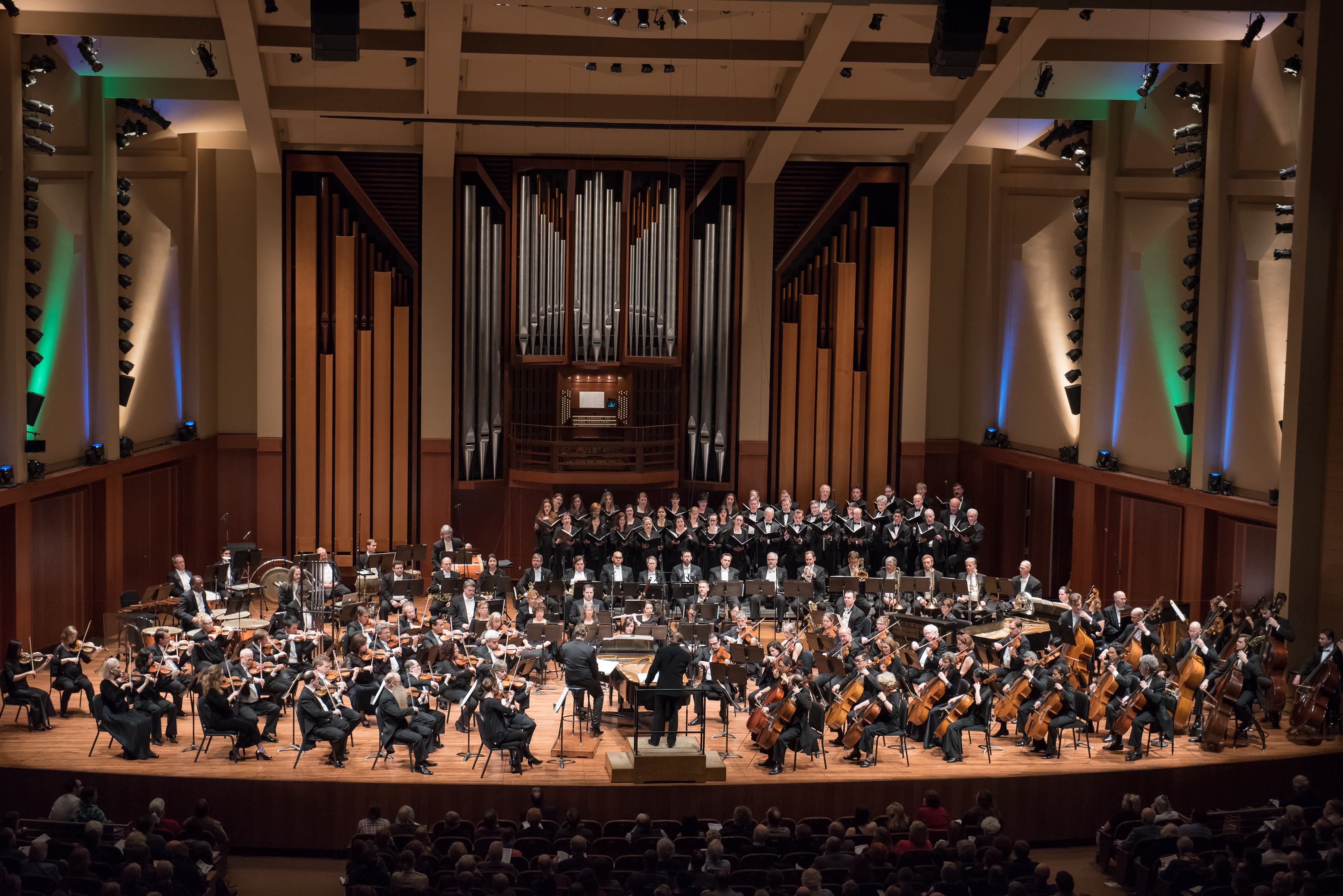
The work that fuses Berlioz’s reimagining of what a symphony could be with his Shakespearean obsession is Roméo et Juliette. Last night the Seattle Symphony performed RnJ in its entirety — to my knowledge, for the first time in their history. Ludovic Morlot led the expansive forces called for by the score: three vocal soloists, chorus, and orchestra (in this case splitting the first and second violins to left and right). There’s even a touch of acoustical “space music” in the positioning of a brief double choir offstage.

It’s a mammoth score (all told, around an hour and a half — not counting the intermission that was inserted here after the “Queen Mab Scherzo”). The instrumental sections are played as a kind of abridged suite often enough, but encountering the whole megillah is a rarity that brings home how radical were Berlioz’s ideas about music and its relation to text and drama. The result is that RnJ is more or less an acknowledged masterpiece that contains some of this genius’s finest music, yet, oddly, as a whole the work remains more often talked about than heard.

Following Maestro Morlot’s work with specific composers since his tenure began here has been fascinating — and the Berlioz thread has proved particularly satisfying artistically (La Damnation de Faust in his first season, an electrifying Symphonie fantastique this time last year).

Morlot and his musicians are showering love on Roméo et Juliette. Sorry if that sounds schmaltzy, but there’s really no other way to put it: the breathtaking precision of their dynamic shadings, the intensified expressivity, their Zen-like focus on detail, the awareness of complicated, even contradictory emotions in this score.

Berlioz carries further the idea from the finale of Beethoven’s Ninth of the instruments trying to break out into words by doing the opposite: after an orchestral introduction — the discipline of fugal writing paradoxically depicts violent disorder and passion — he stages an overall summing up of the play’s main action in a prologue “act” that features chorus and two soloists positioned behind the strings. (Sylvie Brunet-Grupposo contributed her velvety mezzo and tenor Kenneth Tarver sang with elegant fervor.)

But already you sense the instruments straining to take over the telling, with solemn, commanding rebukes from trombonist Ko-ichiro Yamamoto and the brass ensemble standing in for the Prince of Verona. And Berlioz reserves the most sublime passages for his orchestra, above all in the scene of Romeo alone and the nocturne of the young lovers meeting in the garden of the Capulet residence, beneath Juliet’s balcony. The woodwinds played with soulful poignance, with admirably individualized phrasing from Mary Lynch on oboe and clarinetist Ben Lulich; bassoonist Seth Krimsky sustained a mood of deep, anxious melancholy later in the Tomb Scene.

(The playing was so precise and riveting that I encountered a novel torture to add to the usual litany of cell phones, coughers, page-turners, seat kickers, and other occupational hazards of the concert hall: the penetrating sound that a pair of leather shoes squeaking against each other can generate, as a patron helpfully demonstrated during one of the score’s most heartbreaking moments.)

Morlot tenderly shaped the ebb and flow of the scène d’amour, with its sudden pullings-back and renewed outbursts of pained passion. Richard Wagner (Berlioz’s junior by a decade) was there at the historic premiere of this “symphonie dramatique” in Paris in 1839, and it was an epiphany for Little Richard as well.

It’s enlightening to compare/contrast the passionate melody of this music with its transmogrification in Tristan: the Classical transparency of Berlioz’s sensibility survives his most radical harmonic ideas, so that the French composer’s love music still betrays a moving awareness of limits and fragility that is a far reach from the oceanic transports Wagner permits his lovers to experience.

The players’ crisp focus on detail paid off richly, too, in the gorgeously nimble, ear-tickling “Queen Mab Scherzo” — Berlioz’s rendition, purely through the means of orchestral language, of Mercutio’s ingenious speech about the “fairies’ midwife.” Jeff Fair’s horn solo was outstanding, and Michael Werner’s light-as-a-feather pings on hand-held crotales echoed dreamily against infinitesimally delicate pizzicati. The rehearsals must have been incredibly focused, resulting in a lightning speed tempo and crystal-clear textures that throw the sheer weirdness of this music in high relief.

It should be noted that the text set by Berlioz — no mean wordsmith himself — originated in his own paraphrasing and rewriting, only loosely based on Shakespeare’s original; he had the poet Émile Deschamps craft this into a libretto, thus avoiding direct “competition” with Shakespeare’s verse. The “words” and actions of the lovers themselves are reserved strictly for the orchestra to impart.

Another highlight was Juliet’s Funeral March and the Tomb Scene (in the third part or “act,” which was performed after the intermission). A smaller subset of Joseph Crnko’s Seattle Symphony Chorale had appeared for the narrative of the Prologue. Here they came out in full force and sang with clarity and power. The restraint of their single repeated unison E gave way to emotion-laden elegy, its resplendent polyphony expertly balanced.

Arguably the lengthy finale is the weak link in Berlioz’s conception of this symphony-opera-oratorio hybrid. All the pain, longing, and ecstasy — and violence — that lead to the denouement feel swept aside in a superficially rousing reconciliation, the most overtly operatic scena of the work. Here Berlioz gravitates more obviously back toward the Beethovenian Ninth model of a choral finale. Baritone David Wilson-Johnson — filling in at the last minute — delivered the significant part of the peace-maker Friar Laurence with flair and charisma.

But Berlioz knew that “the very sublimity of this love” is beyond words, though not beyond expression. To access this he focuses in Roméo et Juliette on, as he described it, “the language of instruments, a language richer, more varied, less restricted, and thanks to its very indefiniteness, incomparably more potent.”

There’s one more chance to hear this performance of Berlioz’s Roméo et Juliette: Saturday 14 February 2015 at 8 pm at Benaroya Hall. Tickets here.

UPDATE: I asked SSO staff about an odd commotion that took place just as concertmaster Alexander Velinzon came out. A man started shouting something in an agitated voice (I couldn’t make out what he was saying) and walked up the aisle holding a pen and pointing it at one of the ushers. Apparently police were notified and came to Benaroya Hall after the gentleman had exited the hall. I’m told there were no other problems and that he was given a refund for the ticket he had purchased.

On Twitter, Terry Miller wondered whether the disturbance was from the Montague or Capulet side.

(C)2015 Thomas May. All rights reserved.

Filed under: Berlioz, conductors, review, Seattle Symphony

Ivesian Revelations from Morlot and the Seattle Symphony

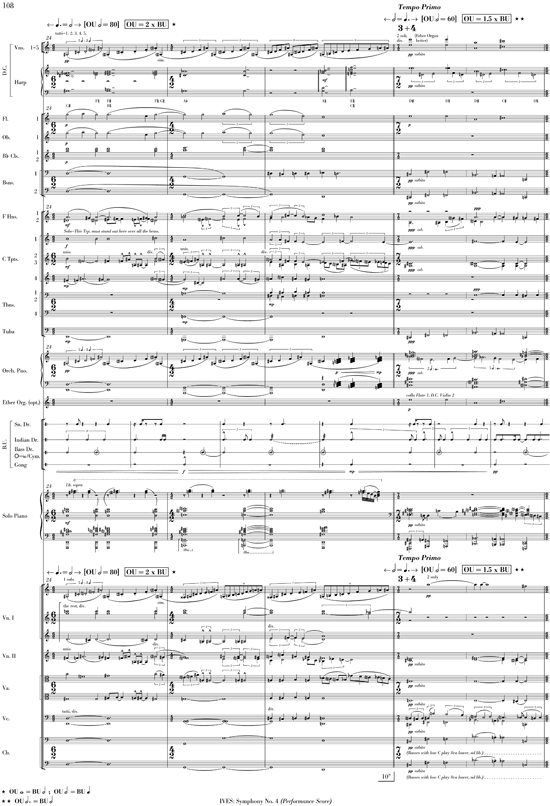
page from score of Ives/4th Symphony

page from score of Ives/4th Symphony

The last time Ludovic Morlot led the Seattle Symphony in a Charles Ives symphony (the Second), he paired it with Rachmaninoff’s Third Piano Concerto (and got pulses running with the Overture to Leonard Bernstein’s musical Candide as a curtain raiser).

I can’t say I get the connections he apparently sees between the conservative Russian and his maverick American contemporary. Maybe the idea is to add still another layer of meta-contrast on top of the already explosively varied mixtures that comprise Ives’ sound world. In any case, this week’s program brings another Rach-Ives pairing.

It was heartening to encounter such an unpredictable interpretation of Rach 3 in last night’s performance (I believe the third time in as many years that Morlot has conducted the work here). Though the previous Rachmaninoff-meets-Ives effort (back in June 2012) had featured the ever-fascinating Stephen Hough as the soloist, the Third Piano Concerto sounded a bit undercooked, the rapport between pianist and orchestra undeveloped.

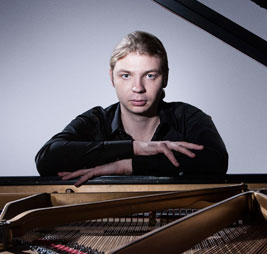
Some unusual angles were explored by the young Russian pianist Denis Kozhukhin. One of the Mighty Four pianists who took part in the complete Rachmaninoff piano concerto cycle at Benaroya two years ago in January (playing the Fourth Concerto), Kozhukhin has a straightforward, unexaggerated presence at the keyboard, concentrating his (and our) attention solely on the music.

kozhukhin_267

What particularly stood out in approach were the glistening, spun-silk textures in the Intermezzo and above all in the final movement. Kozhukhin executed these with such flawless grace I wished the massive chordal climax in the first movement — which was underpowered and lacked profile — had set up an even starker contrast to his gravity-defying elegance. Along with nuanced phrasing of the most lyrical moments, Kozhukhin showed a penchant for the giddier flights in Rachmaninoff’s writing. This reached a state of outright exuberance (ultimately downplaying the composer’s luxuriant moodiness) in the culmination of the finale, where a magnificent rallying of forces between the piano and orchestra joyfully reforges the theme that opens the Concerto.

Despite troublesome issues of coordination and balance between the orchestra and Kozhukhin (the Rach seemed frankly underrehearsed), Morlot coaxed a richly burnished sound from the players — particularly the string ensemble — and the wind solos gently underscored Kozhukhin’s feeling for the melodic currents amid the galaxies of notes in the solo part. (Question: When was the last time Seattle audiences didn’t leap up to give a standing ovation to a visiting soloist?)

Rach 3 was of course the audience-luring part of the program, but the real reason not to miss it is the opportunity to encounter a live performance of the Fourth Symphony, that great Ivesian summa. As fas as I can tell, this was the SSO’s first time performing the work. (You can still catch it on Saturday night, 31 January.)

The Ives Fourth is something like the symphony’s version of The Great American Novel — which is to say, in terms of its aspirations and the impossibility of living up to them. The particulars of its scoring — the need for four conductors to orchestrate the simultaneous offstage performing forces, six keyboards (in this case, with the bells Ives asks for sampled from a keyboard), enlarged onstage orchestra and chorus — sometimes tempt people to describe it like some kind of concert hall circus act. (After all, the moniker “Symphony of A Thousand” was just a marketing ploy to drum up interest in Mahler’s Eighth Symphony, whose premiere around the time Ives was working in earnest on his Fourth — in 1910 — turned out to bring Mahler his greatest success as a composer during his own lifetime.)

In fact, for all the Mahlerian comparison that might be made with Ives, the latter’s Fourth Symphony is quite modest in duration (its length comparable to that of a Classical symphony). But its blend of familiar (even “homey”) elements with the most audacious complexities immediately forces the listener out of easy-going habits. And that gives it an enormous resonance, a field of implications, that may seem disproportionate to the dimensions of the composer’s architecture. Yet it all results in a thrilling rush — and a reset/reboot to your thinking about what music can do.

As he has shown with other musical pioneers like Edgard Varèse, Morlot has an impressive grasp on just that essential point. He knows that behind the show biz factor of all the paraphernalia, the bells and whistles, this is composing at its most ambitious — thinking in music the way writers, philosophers, scientists think with their respective tools.

Ives Concert

By way of a preface, Morlot gave a fairly extensive “show and tell” intro to the piece. He introduced his fellow conductors: Stilian Kirov, who shares the stage with him, positioned a bit further upstage; Julia Tai, heading the ethereal combo of strings, harps, and partially quarter-tone-tuned piano; David Alexander Rahbee coordinating the battalion of offstage percussion for the last movement (described in the score as a “subterranean percussion ensemble”); and Joseph Crnko, who had prepared the Seattle Symphony Chorale in advance. Morlot also illustrated examples of Ives’ radical concept of polyphonic layering and simultaneous, clashing sound worlds, remarking that “this incredible complexity is built up from the simplest basic elements.”

That dialectic of simplicity-complexity informed Morlot’s own overall vision of the Fourth. Instead of presenting a mere jumble of jarring contrasts, he clearly elicited the sense of enigma that is posed in the brief, preludial opening movement — the enigma that is the engine of this work and that successive movements try to “answer.” The simple hymn tune sung by the chorus in the first movement (“Watchman, tell us of the night”) signals a pilgrimage for meaning. But that pilgrimage soon goes astray — or wanders off into directions unforeseen and unforeseeable. As he molded the music’s progress, at times I noticed Morlot using conducting gestures I’ve never seen him make before.

In Morlot’s interpretation, “the searching question” that we “ask of life” (as the composer described his “program”) has to take account of all of it: the mystical meditations of the otherworldly (and offstage) strings and harps, the bright noon of chaotically colliding marches and cheerful anarchy in the second movement (Ives’ “Comedy”), the sober, ordered fugue of the third (more wonderful string ensemble playing here), and the cosmic rhythms that set the finale in motion.

Ives may have intended the more conventional beauty of the “religious” answer offered by the third movement to be heard as parody (perhaps like Strauss in the parallel section of Also Sprach Zarathustra?) — much as the “Comedy” of the second affectionately parodies secular, civic life. Morlot allowed all of these attempts to get at “the searching question” to have their say, as if each represents the answer at the moment it holds the stage. The outsize, raucous, yawping vitality of the second movement was overwhelming, a forerunner of the spell of sonic ecstasy-from-noise that later technology would allow rock and other popular genres to exploit.

Brandon Patoc Photography

Brandon Patoc Photography

The accumulated energy of the final movement had the effect of an epiphany. In his terrific commentary on the Fourth, Michael Tilson Thomas (a longstanding Ives champion) describes the offstage percussion as “the ticking of the universal clock” and captures what it is that makes Ives’ vigorous dissonances so revelatory:

It’s typical for Ives to represent this most exalted moment of spiritual search in ever more dissonant and blaring sound…. This to me has always suggested the Mount Sinai aspect of spiritual revelation. Man searches and searches, [but] as he gets too close to the divine it is more than he can bear, the sounds and the harmonies are just too much…. We have to turn away and a few little tendrils of singed nerve endings then lead to the beginnings of the long, luminous coda.

Morlot and the SSO are recording these performances for eventual release as part of their complete cycle of Charles Ives symphonies on the in-house label. Inevitably there will be details that come across with more refinement on the recording than they do in the concert hall. But there’s no substitute for the live experience — above all in a work so reliant on an acoustically spatial concept of symphonic abundance. To have both to compare is ideal.

(c)2015 Thomas May. All rights reserved.

Filed under: Ives, pianists, Rachmaninoff, review, Seattle Symphony

Protected: How City Arts Tried to Hijack a Seattle Symphony Premiere

This content is password-protected. To view it, please enter the password below.

Filed under: American music, commissions, journalism, new music, Seattle Symphony

Sublime Salonen from the Seattle Symphony and Jennifer Koh

Jennifer Koh; © Juergen Frank

Jennifer Koh; © Juergen Frank

My latest review:

It’s not unusual for Ludovic Morlot to offer a spirited brief introduction to a particular piece. But at the top of last night’s Seattle Symphony concert, the maestro was eager to elucidate a rationale threading together the motley menu of Samuel Barber, Esa-Pekka Salonen, and a Tchaikovsky warhorse: essentially, the proposition that all three works represented personal responses to periods of challenge or even crisis.

continue reading

Filed under: new music, review, Seattle Symphony, Tchaikovsky

Become Ocean on CD

IMG_1303

I had the fortune of spending an afternoon with the composer John Luther Adams in New York City last May, shortly after his Pulitzer Prize-winning orchestral work Become Ocean received its New York premiere at Carnegie Hall. (My article on this Seattle Symphony commission appears in the current issue of Listen magazine.)

And now the SSO’s recording with music director Ludovic Morlot has been released on Cantaloupe.

The spatial conception that informs JLA’s music really needs to be experienced in live performance, but you can get a decent impression of his aesthetic from the recording. This week NPR is making it available to listen to online for free.

Filed under: American music, John Luther Adams, Seattle Symphony

Seattle Symphony’s Dvořák-Fest Begins

Daniil Trifonov: (c) Dario Acosta

Daniil Trifonov: (c) Dario Acosta

My review of the Seattle Season’s opening concert of the season — including pianist Daniil Trifonov’s spectacular SSO debut — is now live on Bachtrack:

Music by Antonín Dvořák was included on Ludovoc Morlot’s first-ever programme leading the Seattle Symphony, which took place in October 2009. At the time – two years before coming on board as music director – Morlot was a visiting conductor, and he offered the barest sampling of his thoughts on Dvořák (three of the Legends).

continue reading

Filed under: conductors, piano, review, Seattle Symphony

Czech Mates: Seattle Symphony’s Dvořák Fest

Antonín Dvořák

Antonín Dvořák

The Seattle Symphony’s new season is about to begin, and I’m especially looking forward to the upcoming Dvořák Festival. Here’s my recent preview for City Arts:

Antonín Dvorák wrote his two most popular pieces during his early 1890s stay in the United States—the “New World” Symphony and the Cello Concerto. Their heart-melting melodies, infectious and thrilling rhythmic ideas, and emotionally complex use of the orchestra make both works among the most beloved in the orchestral repertory.

Their mega-success made the Czech composer into a “two-hit” wonder. But they’re just the tip of the Dvorák iceberg.

continue reading

Filed under: Seattle Symphony

Seattle Symphony’s Stravinsky Marathon

A costume sketch by Léon Bakst for The Costume sketch by Léon Bakst for The Firebird

Costume sketch by Léon Bakst for The Firebird

My review of the Seattle Symphony’s final concert of the season:

The past few months have brought the ensemble far more exposure than usual (an appearance at Carnegie Hall, a concert for the League of American Orchestras, the launch of an in-house label): its appetite for new challenges seems unstoppable.

So it’s hardly surprising that music director Ludovic Morlot is concluding the current season with an all-out marathon of orchestral virtuosity. The program of Stravinsky’s three pre-First World War ballet scores for the Ballets Russes in their entirety lasts close to three hours and, out of necessity for the players, requires two intermissions. It drew what appeared to be a close-to-packed house.

No matter how well we think we know this music, the opportunity to hear the young Stravinsky’s three iconic ballets back to back is bound to prompt new perspectives. And Morlot’s deeply sensitive interpretation of the uncut, sumptuous score for The Firebird (1910) did precisely that – all the more so since, only two weeks before, he’d led the SSO in the complete Daphnis et Chloé, also for the Ballets Russes, which was premiered in 1912, the year between Petrushka (1911) and The Rite of Spring (1913).

continue reading at Bachtrack

Filed under: review, Seattle Symphony, Stravinsky

Ballets Russes: “When Art Danced with Music”

diaghilev

Time to get in the mood for this weekend’s final subscription concerts of the Seattle Symphony’s season — and Ludovic Morlot has planned one hell of a program, with all three of Stravinsky’s blockbuster pre-WW I ballets.

I’m recalling the National Gallery of Art’s thought-provoking exhibition Diaghilev and the Ballets Russes, 1909–1929: When Art Danced with Music last fall. The show gave a dazzling overall impression of the many different areas of creativity that the wizard Serge Diaghilev somehow managed to draw together (not without a massive amount of drama): composers, writers, painters, sculptors, costume and set designers, lighting artists, researchers, propagandists, and naturally musicians and dancers.

Diaghilev’s brain itself must have been a Gesamtkunstwerk. This was the way to out-Wagner Wagner, and Stravinsky certainly intended to do that.

The exhibition also probed into future connections, the way these artists set currents in motion that would give birth to Cubism, Futurism, Dadaism, Surrealism.

The always-brilliant Philip Kennicott points out that “the legend of the Ballets Russes was always a bit better — and better tended — than the reality of what the troupe and its lead artists left behind.” He offers this handy summary of what the lasting impact of the Ballet Russes as a crucible of experiment:

In less than two decades’ time, one sees the invention of something so familiar we take it for granted, the free mixing of commercial entertainment and more traditional forms of art, the valorization of branding and fashion within the intellectual realms of culture, and the troubling, persistent and essential fracturing of art into style and substance.

And it’s important to realize how much of Diaghilev’s legend became linked to the power of celebrity:

Much of what is on display falls into the category of holy relics: Costumes worn by dancers who are legendary names; programs and photographs and publicity posters from tours of the company that are still spoken of in reverential terms by those who remember or knew someone who was there. Theater, including ballet, invites hero worship, and there are many objects in this exhibition that appeal to our celebrity pleasure receptors more than our artistic ones.

[…]

[T]hat’s the difference between performance and the plastic arts. The allure of the former is all about the moment, the luck of being present, the willful illusion that magic is happening. Diaghilev sold that dream, perhaps more effectively than any impresario before or since.

Filed under: art exhibition, ballet, Seattle Symphony, Stravinsky

Archive

Enter your email address to follow this blog and receive notifications of new posts by email.