


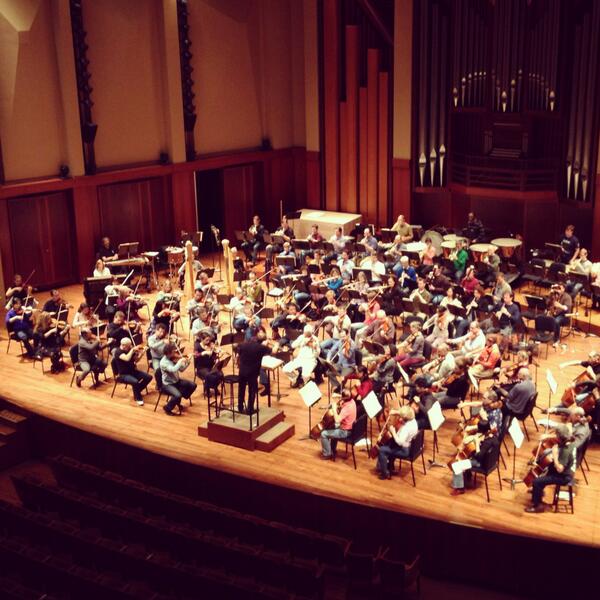
Ludovic Morlot and the SSO; photo by Ben VanHouten
And here it is: the Seattle Symphony’s announcement for the 2014-15 season, hot off the press.
Which means it’s free-association time, as I reveal what I guess is sort of my musical Rorschach test. What leaps out to me from among music director Ludovic Morlot’s choices?
A three-week Sibelius festival – hot-diggity! I loved the personalized touch Morlot brought to his recent reading of Tapiola.
Now we’ll get new principal guest conductor Thomas Dausgaard’s perspective on the Finn. This will be great for the orchestra’s development. I do wish I could hear more of Morlot’s take on Sibelius to juxtapose with Dausgaard. But this is great news. And I’m thrilled to see the bridges being built with other Seattle institutions — here, the Nordic Heritage Museum. This is the way to go.
(And as for Sibelius being “vulgar, self-indulgent, and provincial beyond all description” — dear Mr. Virgil Thomson, professional jealousy much?)
Similarly, Morlot will turn a spotlight on Dvořák with the last three symphonies. I love this in-depth focus. I just wish they’d gone for maybe 5 and 6 instead of 9 for a richer fleshing out of this amazing composer’s portrait. He really is neglected, in the odd way that happens when the rep focus is so absurdly directed to the Cello Concerto and “New World.” And his symphonies are right up there with Brahms. (Excellent to see Daniil Trifonov on the roster, but why oh why Tchaik 1 AGAIN? And Rach 3 AGAIN – really??)
Readers of this blog and of my other writings already know of my high regard for Trimpin and the music of Mason Bates — and we’re getting world premieres from both (including a cello concerto for Joshua Roman!).
As for the remainder of the new-music front, this is mouth-watering: another world premiere from Sebastian Currier, two US premieres from British composers — the eloquent (in words and music) Julian Anderson and the wonderful orchestrator Colin Matthews (responsible for a delicious take on Debussy’s Preludes) — AND a new work by Jugo Kanno, a Japanese composer I will look forward to discovering.
Also mouth-watering: Salonen’s Violin Concerto, featuring the impeccable Leila Josefowicz. Hey — Sibelius isn’t the only great Finnish composer! Wonderful to see this.
Not the world’s biggest Nirvana fan (I won’t get caught up now in an argument about how overrated they are), so the Sonic Evolution 2015 commission of work “inspired by” Pearl Jam and Nirvana does nada for me.
Berlioz’s COMPLETE Roméo et Juliette, in the hands of Morlot — utter musical bliss promised.
Ives 4 – very exciting, I hope it comes off!
Mahler 3 – trepidatious. This happens to be the very first Mahler symphony I got to know inside-out, so I’m especially fond of it, whatever its flaws. I actually love it to death. But if not done right, it can be a disaster. Morlot so far has a shaky record with Mahler. But this could be a breakthrough.
I’ve still got to digest what’s going on with regard to the core rep and the really Dead White Males.
Here’s the official SSO press release:
LUDOVIC MORLOT AND SEATTLE SYMPHONY ANNOUNCE 2014–2015 SEASON
Dvořák’s Last Three Symphonies, Complete Sibelius Cycle,
Stellar Guest Artists, Nine Premieres and Innovative Residency
Highlights
Dvořák’s Final Three Symphonies, Conducted by Ludovic Morlot
Three-Week Sibelius Festival Led by Principal Guest Conductor Thomas Dausgaard Celebrates 150th Birthday of Jean Sibelius in 2015 with Performances of All Seven Sibelius Symphonies and Other Works.
Morlot Conducts Three Epic Symphonies: Mahler’s Third Symphony,
Berlioz’s Roméo et Juliette and Ives’ Symphony No. 4
World Premieres Include Co-Commissions from American Composers Mason Bates and Sebastian Currier, as well as Seattle Symphony Commission and Site-Specific Installation from Seattle-Based “Sound Sculptor” Trimpin
Three World Premieres to be Commissioned for Sonic Evolution 2015,
Including Works Inspired by Music of Pearl Jam and Nirvana
U.S. Premieres Include Works Co-Commissioned from Two Major British Composers,
Julian Anderson (Violin Concerto) and Colin Matthews (The Pied Piper),
as well as New Work from Japanese Composer Jugo Kanno
Morlot to Conduct Parisian-Themed Opening Night Gala Program with Violinist Gil Shaham
London Symphony Orchestra Makes Benaroya Hall Debut Under Michael Tilson Thomas
Symphony Untuxed Series of Informal and Inviting Concerts on Friday Evenings
Expands to Include New Sunday Matinee Series
Principal Pops Conductor Jeff Tyzik Curates Diverse Pops Series Including Film Music of John Williams, Holiday Pops with Cirque Musica, Rodgers & Hammerstein Celebration, Preservation Hall Jazz Band and Tribute to Ray Charles
Distinguished Guest Conductors and Guest Artists:
Conductor debuts with the Seattle Symphony include Jonathan Cohen, Imogen Cooper, Richard Egarr, Mirga Gražinytė-Tyla, Stephen Layton, Cristian Macelaru and Carlo Montanaro. Returning conductors are Andrey Boreyko, Matthew Halls, Miguel Harth-Bedoya, Neeme Järvi, Carolyn Kuan, Nicholas McGegan, Itzhak Perlman, Steven Reineke and Thomas Søndergård. Soloists include: violinists Augustin Hadelich, Hilary Hahn, Leila Josefowicz, Pekka Kuusisto, Itzhak Perlman, Gil Shaham and Pinchas Zukerman; cellists Yo-Yo Ma and Joshua Roman; pianists Kristian Bezuidenhout, Yefim Bronfman, Imogen Cooper, Ingrid Fliter, Marc-André Hamelin, Simon Trpčeski and Yuja Wang; sopranos Amanda Forsythe, Hélène Guilmette, Rena Harms and Heidi Grant Murphy; mezzo-sopranos Sylvie Brunet-Grupposo, Sasha Cooke, Jennifer Johnson Cano, Sarah Larsen and Christianne Stotjin; tenors Zach Finkelstein, Ross Hauck, Eric Neuville and Kenneth Tarver; and baritones Patrick Bolleire, Tyler Duncan, Alexander Hajek and Morgan Smith.
Seattle Symphony Musicians Featured with Orchestra:
Alexander Velinzon, Concertmaster; Meeka Quan DiLorenzo, Assistant Principal Cello; Seth Krimsky, Principal Bassoon; and David Gordon, Principal Trumpet.
Seattle, WA – Music Director Ludovic Morlot today announced a vibrant and prestigious 2014–2015 Seattle Symphony season. Continuing and extending his previous seasons’ themes of eclectic and diverse repertoire, accessibility and exploration, interactions with contemporary culture, and creative innovation, the 2014–2015 season also brings the most important list of guest artists that Seattle has seen in many years.
“I’m thrilled that next season will be my fourth with this wonderful orchestra,” Morlot said. “We have planned a musical and emotional journey through an incredibly exciting repertoire, and I can’t wait to share it with our audiences. So many of the works on our season have great meaning and explore feelings and ideas that we can all relate to, from the romantic love in Berlioz’s Roméo et Juliette to Charles Ives’ search for the meaning of life in his Fourth Symphony. I’m also very happy to introduce our new Principal Guest Conductor, Thomas Dausgaard, next season. He will lead our Sibelius Festival, which features all seven of the composer’s symphonies. It will be a season to remember!”
Seattle Symphony Executive Director Simon Woods added, “We pride ourselves on presenting seasons that are the equal of any orchestra in America — and this one is no exception. Our hallmark is to create seasons that run as deep as Sibelius, as broad as Nirvana, as uplifting as Mahler, as inviting as Untuxed, as edgy as [untitled] and as fun as John Williams. We’re about programming for the deep connections that great music can make with audiences — and about celebrating the inspiration of true artistry on the stage of one of the world’s finest concert halls.”
A hallmark of the 2014–2015 season is the Sibelius Festival in March, led by Principal Guest Conductor Thomas Dausgaard. The Sibelius Festival commemorates the 150th anniversary of Jean Sibelius’ birth includes the complete cycle of all seven Sibelius symphonies, and encompasses programs on the Masterworks, Symphony Untuxed and Chamber series, as well as a stand-alone Beyond the Score® performance. The Seattle Symphony has formed a partnership with Seattle’s Nordic Heritage Museum, with additional festival activities to be announced at a later date.
In 2014–2015 the Symphony will present several non-subscription Special Performances. The fourth annual Sonic Evolution concert led by Ludovic Morlot fuses three newly commissioned works with Seattle’s past and present music scene. In 2015 Sonic Evolution includes world premieres inspired by Pearl Jam and Nirvana performed by the Orchestra with a yet-to-be-revealed band from Seattle’s hip music scene.
Special Performances next season will also include a performance with renowned cellist Yo-Yo Ma; two performances with violinist and conductor Itzhak Perlman; the Seattle Symphony signature event Celebrate Asia, led by former Associate Conductor Carolyn Kuan; and two visiting orchestras: the London Symphony Orchestra, conducted by 2010 National Medal of Arts recipient Michael Tilson Thomas and featuring talented young pianist Yuja Wang, and the Seoul Philharmonic Orchestra, led by Myung-Whun Chung and featuring pianist Sunwook Kim. The Opening Night Concert & Gala, conducted by Ludovic Morlot, is planned for Saturday, September 13, and will feature a Paris-inspired program and celebrated guest violinist Gil Shaham.
The Seattle Symphony has co-commissioned six new works for the 2014–2015 season. Two commissions by American composers, including a new Cello Concerto from Mason Bates written for former Seattle Symphony Principal Cello Joshua Roman, and a new work by Sebastian Currier receive their world premieres in Seattle. A Violin Concerto by Julian Anderson, performed by guest violinist Carolin Widmann, and an all-new, large-scale children’s work by Colin Matthews, The Pied Piper, receive their U.S. premieres in Seattle.
A special focus for the 2014–2015 season is a project involving local “sound-sculptor” Trimpin, who is internationally known for his work in creating inventive musical sculptures. Trimpin will create a site-specific sound installation in Benaroya Hall’s Samuel & Althea Stroum Grand Lobby. He has been commissioned by the Seattle Symphony to compose a new work to be premiered by the orchestra and audience during the Symphony’s late-night contemporary music series, [untitled]. In addition, Trimpin will be involved in mentoring pre-college-age composers in the Seattle Symphony’s annual Merriman Family Young Composers Workshop and a number of other activities for the community.
There will be two changes to the season structure for 2014–2015. The Symphony Untuxed concept, which currently consists of five one-hour Friday evening performances at 7pm, is being expanded to add a separate three-concert Sunday matinee series at 2pm. The popular Symphony Untuxed series does away with typical orchestra performance conventions such as formal attire and a separate concertmaster entrance, replacing these with an onstage introduction to the concert and a post-concert Ask the Artist hosted by orchestra musicians. These concerts, known as Sunday Untuxed, will replace the Beyond the Score® series; however, one Beyond the Score® program, Sibelius’ Fifth Symphony, will be held as a stand-alone performance as part of the Sibelius Festival.
The second change to the season is in Seattle Pops series scheduling. The Seattle Pops series will continue to consist of five diverse programs celebrating the great American popular music tradition. However, instead of five performances of each program, there will be three performances of each program. This change will maximize the opportunities for a variety of additional types of presentations in the Hall, including classical and popular events.
MASTERWORKS SEASON HIGHLIGHTS
Masterworks Season Encompasses Dvořák’s Final Three Symphonies
and Sibelius Festival
Music Director Ludovic Morlot will lead the Seattle Symphony in 12 of the Masterworks Season’s 21-program schedule, opening the series in September with a three-week-long Dvořák focus, including the composer’s last three symphonies. Dvořák’s Symphony No. 7 opens the subscription series, paired with Tchaikovsky’s dramatic Piano Concerto No. 1 with Daniil Trifonov in his Seattle Symphony debut, and Wagner’s Overture to Die Meistersinger. The following week, Dvořák’s Eighth Symphony will be performed alongside Dutilleux’s Métaboles and Rachmaninov’s Rhapsody on a Theme of Paganini with pianist Khatia Buniatishvili in her Seattle Symphony debut. The third and final week includes Dvořák’s Symphony No. 9, “From the New World,” John Adams’ Lollapalooza, and Korngold’s Violin Concerto with famed violinist Hilary Hahn. (In addition to these Masterworks series programs, the Dvořák weeks also include a “New World Untuxed” performance on the Symphony Untuxed series with Symphony No. 9 and Dvořák’s Bagatelles on the program, as well as a chamber performance of Dvořák’s folk-influenced Piano Trio No. 4 in E minor, “Dumky,” for piano, violin and cello.)
In October Morlot will conduct the orchestra and Seattle Symphony Chorale in the Mozart Requiem with soprano Hélène Guilmette, mezzo-soprano Sasha Cooke, tenor Zach Finkelstein and baritone Alexander Hajek. All but Cooke are making their debuts in these performances. In November Morlot will conduct Tchaikovky’s Fourth Symphony in a program that also includes Barber’s Second Essay for Orchestra, and Esa-Pekka Salonen’s Grammy-nominated Violin Concerto with critically acclaimed violinist Leila Josefowicz.
In January Morlot is joined for Rachmaninov’s Piano Concerto No. 3 by pianist Denis Kozhukhin, returning to the Seattle Symphony after his sensational debut in 2013’s Rachmaninov Festival. This program also includes Ives’ complex and rarely performed Symphony No. 4. The following month, Morlot will conduct Beethoven’s Violin Concerto with Grammy Award-nominated violinist Christian Tetzlaff on a program that also features works by three French composers: Berlioz’s Le Corsaire Overture, Debussy’s Ibéria and Ravel’s La valse. Also in February, Morlot conducts the Seattle Symphony and Chorale in Berlioz’s Roméo et Juliette, with mezzo-soprano Sylvie Brunet Grupposo, tenor Kenneth Tarver and baritone Patrick Bolleire, all making their Seattle Symphony debuts.
In April Morlot will conduct the world premiere of Sebastian Currier, followed by Grieg’s Piano Concerto with celebrated pianist Marc-André Hamelin, and Schumann’s Symphony No. 2. Later that month Morlot will conduct an all-Beethoven performance that includes the composer’s Symphony No. 7 and Piano Concerto No. 4 with Grammy Award–winning pianist Yefim Bronfman. Then in June, Morlot conducts Brahms’ Symphony No. 1 on a program that also includes Beethoven’s Egmont Overture and the U.S. premiere of Julian Anderson’s Violin Concerto with violinist Carolin Widmann, who makes her Seattle Symphony debut. The Seattle Symphony Chorale will again join the orchestra under Morlot for Mahler’s Third Symphony, which also includes guest mezzo-soprano Christianne Stotjin and the Northwest Boychoir.
Principal Guest Conductor Thomas Dausgaard will lead the orchestra in March 2015 in a three-week festival commemorating the 150th anniversary of Jean Sibelius’ birth. In three Masterworks subscription concerts, in addition to other programs, the Finnish composer will be honored with a complete cycle of his symphonies and additional works. The first week includes the first two symphonies and the rousing symphonic poem Finlandia. The symphonic cycle continues with performances of Sibelius’ Third and Fourth symphonies, as well as his virtuosic Violin Concerto with violinist Pekka Kuusisto, who makes his Seattle Symphony debut. The festival concludes in the third week with symphonies nos. 5, 6 and 7. Numerous ancillary events will also take place in addition to these Masterworks Season concerts.
The Seattle Symphony welcomes six guest conductors to the Benaroya Hall stage for Masterworks Season performances in 2014–2015. In November Carlo Montanaro, a frequent guest conductor at Seattle Opera, will make his Seattle Symphony debut conducting Beethoven’s Fifth Symphony in a program that also includes Rossini’s Overture to The Barber of Seville and Respighi’s Church Windows. Later that month Miguel Harth-Bedoya returns to conduct Mussorgsky’s Pictures at an Exhibition, which is programmed with Esteban Benzecry’s Colors of the Southern Cross and Mendelssohn’s Violin Concerto with brilliant young violinist Augustin Hadelich.
In December the dynamic Mirga Gražinytė-Tyla will make her Seattle Symphony conducting debut leading the orchestra in the world premiere of the Mason Bates Cello Concerto (co-commissioned by the Seattle Symphony) with former Seattle Symphony Principal Cello Joshua Roman. Also on that program are Prokofiev’s Lieutenat Kijé Suite and selections from Tchaikovsky’s Sleeping Beauty.
Thomas Søndergård, lauded for his “piercing intelligence and intense passion” (The Guardian), returns to Seattle in April to conduct Prokofiev’s Symphony No. 5, Chopin’s Piano Concerto No. 2 with pianist Ingrid Fliter, and Szymanowski’s Concert Overture. In May beloved maestro Neeme Järvi conducts Glinka’s Overture to Russlan and Ludmilla, Borodin’s Symphony No. 2 and selections from Prokofiev’s Cinderella.
ADDITIONAL SUBSCRIPTION SERIES PERFORMANCES
The above Masterworks Season encompasses the Symphony’s core programming of symphonic repertoire. Additional subscription series described below include Distinguished Artists, Baroque & Wine, Mozart: The Great Concertos (formerly Mainly Mozart), Symphony Untuxed, Sunday Untuxed, [untitled], Fluke/Gabelein Organ Recital, Chamber, Seattle Pops, Discover Music, Soundbridge Presents and Tiny Tots.
Distinguished Artists
This celebrated three-concert series brings world-renowned musicians to Seattle to perform the great works of the solo and chamber literature. The Distinguished Artists series opens with virtuosic pianist Yuja Wang, praised for her “practically superhuman keyboard technique” (San Francisco Chronicle). Macedonian pianist Simon Trpčeski will also perform a solo recital in March, and Grammy Award–winning violinist Pinchas Zukerman returns to Benaroya Hall in May with pianist Angela Cheng to conclude the series.
Baroque & Wine
The Baroque & Wine series, with performances on Friday and Saturday evenings, pairs the rich music of the Baroque era with pre-concert wine tastings. The series begins in October with guest conductor Nicholas McGegan presenting music by Bach, Handel and Telemann, including two of Bach’s keyboard concertos with pianist Robert Levin. In February noted conductor and harpsichordist Richard Egarr leads all four of J.S. Bach’s orchestral suites from the keyboard. The series concludes in May when Stephen Layton conducts a concert featuring works by Bach, Handel, Purcell and Vivaldi with the Seattle Symphony and Chorale, soprano Amanda Forsythe, alto Deanne Meek and Seattle Symphony Principal Trumpet David Gordon.
Mozart: The Great Concertos (formerly the Mainly Mozart series)
The popular Mozart series opens in January with Stilian Kirov conducting two programs featuring six of Mozart’s great concertos. Over two nights the orchestra will be joined by soloists Boris Allakhverdyan, recently appointed Principal Clarinet of the Metropolitan Opera Orchestra, on Mozart’s Clarinet Concerto in A minor; Jan Lisiecki, “a pianist who makes every note count” (The New York Times), on Mozart’s piano concertos nos. 20 (K. 466) and 21 (K. 467); in-demand Ukranian violinist Valeriy Sokolov on Mozart’s violin concertos nos. 4 (K. 218) and 5 (K. 219); and the London Symphony Orchestra’s Principal Flute, Adam Walker, on Mozart’s Flute Concerto No. 1. In February guest conductor Jonathan Cohen will lead the orchestra in a performance of Mozart’s Piano Concerto No. 22 (K. 482) featuring 2013 ECHO Award–winning pianist Kristian Bezuidenhout, and Mozart’s spirited Overture to The Marriage of Figaro. The concert will also include Beethoven’s Symphony No. 1. Pianist and conductor Imogen Cooper will conclude the series in May by leading the orchestra from the keyboard in two of Mozart’s piano concertos, nos. 17 (K. 453) and 24 (K. 491).
Symphony Untuxed
The Symphony Untuxed series is comprised of five Friday concerts with an early start time of 7 p.m. and a shorter, no-intermission format. This season the Symphony Untuxed series takes listeners on a musical journey through Europe. In September Ludovic Morlot presents a concert of music by Czech composer Dvořák, including his much-loved Symphony No. 9, “From the New World.” In November guest conductor Carlo Montanaro takes a tour of Italy with works by Boccherini, Rossini and Respighi. The series continues in March with a program presenting works by Finnish composer Sibelius, led by the Seattle Symphony’s newly appointed Principal Guest Conductor, Thomas Dausgaard. Music by Polish composers Chopin and Szymanowski will be explored in April, led by Thomas Søndergård and featuring Ingrid Fliter on Chopin’s Piano Concerto No. 2. The series will end in June with Ludovic Morlot on the podium to lead the orchestra in a performance of works by two of Germany’s most enduring composers, Brahms and Beethoven.
NEW! Sunday Untuxed
Like Friday’s Symphony Untuxed concerts, the brand-new Sunday Untuxed series features short, no-intermission concerts, and its afternoon start time makes it perfect for families. The series opens in October as guest conductor Nicholas McGegan samples some of the best of the Baroque era with music by J.S. Bach and his son C.P.E. Bach, as well as Handel and Telemann. In January Ludovic Morlot leads the orchestra in a Classical program featuring the music of Beethoven and Mozart. Additionally, Seattle Symphony Principal Bassoon Seth Krimsky takes center stage in Weber’s Bassoon Concerto. The series concludes its debut season with Romantic works by Brahms, R. Strauss and Tchaikovsky, conducted by Stilian Kirov.
[untitled]
After debuting to critical acclaim in the 2012–2013 season and enjoying a successful second season, the Seattle Symphony’s late-night [untitled] series returns for a third year. In this three-concert series, Seattle Symphony musicians perform contemporary ensemble pieces in Benaroya Hall’s Samuel & Althea Stroum Grand Lobby. The series kicks off in October with Stilian Kirov leading a performance of Djuro Zivkovic’s On the Guarding of the Heart, Three Arias from Ligeti’s opera Le grand macabre, and Andrew Norman’s Try. In February the series continues with music by Vladimir Martynov, Jacob Druckman and John Adams. May’s program, conducted by Ludovic Morlot, will feature a major event in the residency of “sound sculptor” Trimpin, with the premiere of his new work to be performed on a site-specific installation, by members of the orchestra and audience members, in the Grand Lobby. The program will also feature three works by George Perle in honor of the 100th anniversary of the composer’s birth: Molto Adagio, Critical Moments (No. 1) and Serenade No. 3.
Fluke/Gabelein Organ Recitals
This well-established series places three distinguished organists before Benaroya Hall’s 4,490-pipe, 83-stop Watjen Concert Organ. It begins in October with Isabelle Demers, one of North America’s most virtuosic organists. Seattle Symphony Resident Organist Joseph Adam, hailed by The Seattle Times as “an organist who is capable of virtually anything,” takes the stage in February. Organist Douglas Cleveland, Music Director at Plymouth Congregational Church in Seattle, will conclude the series in May.
Chamber Series
In this three-concert series, audiences have the opportunity to hear Seattle Symphony musicians and guests present chamber works in the intimate Illsley Ball Nordstrom Recital Hall in Benaroya Hall. The series begins in October with a program of music by Dvořák, Jolivet, Mahler and Schumann as part of the Dvořák Celebration. March features an all-Sibelius program as part of this season’s Sibelius Festival, and in May Seattle Symphony musicians close the series with works by Brahms, Prokofiev and Tchaikovsky.
Seattle Pops
Jeff Tyzik begins his second season as Principal Pops Conductor with the unforgettable movie music of John Williams, from Superman to Star Wars to Jaws. The series continues in December with Holiday Pops with Cirque Musica, when Tyzik will entertain the whole family with the ultimate holiday extravaganza — acrobats, jugglers, dancers and mimes performing with the Seattle Symphony. In March Steven Reineke celebrates the golden age of Broadway with music from Oklahoma!, Carousel, South Pacific and more. He and the orchestra are joined by special guest vocalists Ashley Brown, Aaron Lazar and the University of Washington Choirs. In April the Preservation Hall Jazz Band brings the sweet sounds of New Orleans jazz to Benaroya Hall. The Seattle Pops series concludes in June with a tribute to Ray Charles, featuring Ellis Hall, a former protégé of the late singer-songwriter. From hits like “I Can’t Stop Loving You” and “Georgia on My Mind,” this concert is filled with Ray’s soulful hits.
Discover Music Series
The Seattle Symphony’s Discover Music series presents five hour-long symphonic programs for children ages 6 to 11 and their families in the S. Mark Taper Foundation Auditorium, each preceded by special performances and activities in the Samuel & Althea Stroum Grand Lobby. The series will open with Stilian Kirov conducting Beethoven Lives Upstairs, a delightful tale from a youngster’s perspective on the “madman” — none other than Ludwig himself — who moves in upstairs. December brings A Spirit for the Holidays, a fun-filled holiday sing-along again led by Kirov. In February Ludovic Morlot and the orchestra bring toys to life in Debussy’s Toy Box. In May Kirov and the orchestra present Carnegie Hall’s The Orchestra Rocks, exploring rhythm, pulse and groove from selected orchestral repertoire like Orff’s Carmina burana, Holst’s The Planets and more. The series concludes in June with Kirov leading the orchestra and a local youth chorus in British composer Colin Matthews’ new piece based on the story of Michael Morpurgo’s immortal Pied Piper.
Soundbridge Presents
The 2014–2015 season is the second season for Soundbridge Presents, a new series aimed at children ages 3–8 and their families. Soundbridge Presents concerts are 45-minute long interactive concerts featuring Seattle Symphony musicians and other local and guest musicians from a variety of genres. Performers this season include Native American violinist and storyteller Swil Kanim in World Beat: The Tree Story, musical duo Harmonica Pocket, local teachers turned kindie rock band Recess Monkey performing with orchestra musicians, and Seattle Symphony Principal Second Violin Elisa Barston and Friends.
Tiny Tots
The Tiny Tots series, presented by Let Your Music Shine with Lisa and Linda™ is for the youngest music lovers, ages 0–5, and their caregivers. These 35-minute performances are highly interactive and are presented in the Illsley Ball Nordstrom Recital Hall. Each of the following programs is presented four times on Friday and Saturday mornings: Hi-Lo Circus, Holiday Hooray!, Magical Melody Train Ride, Sailing the Musical Seas and Teddy Bear’s Musical Picnic. Pre-concert activities take place before each performance.
SUBSCRIPTION INFORMATION
Subscription renewals and purchases are available online at http://www.seattlesymphony.org.
Online subscription renewals are fully automated. Subscribers will receive a unique login name that allows them to see their entire order on the Seattle Symphony website. Subscribers may request changes to their subscriptions and add options ranging from purchasing prepaid parking to requesting wheelchair-accessible seating. Changes to the order will be made instantly, and changes in seating will be made separately, after the subscription renewal deadline has passed. Season brochures are being mailed to current Symphony subscribers, who will have until March 1, 2014, to renew their seats or request seating changes. To receive a 2014–2015 season brochure, please call the Seattle Symphony Ticket Office at (206) 215-4747 or write to Seattle Symphony Ticket Office, Attn: 2014–2015 Season Brochure Request, P.O. Box 2108, Seattle, WA 98111-2108. The brochure may also be viewed online. Subscription renewals will also be accepted in person at the Ticket Office at the corner of Third Ave. and Union St., by phone at (206) 215-4747, by mail at the address above, or by fax at (206) 215-4748.
NON-SUBSCRIPTION PERFORMANCES
Non-subscription concerts and presentations are available exclusively to Seattle Symphony subscribers before they go on sale to the public in August 2014.
The 2014–2015 Opening Night Concert & Gala on Sunday, September 13, at 4pm, features Ludovic Morlot conducting a Paris-inspired program with showpieces by Saint-Saëns, Sarasate, Massenet and more. A number of works will feature special guest violinist Gil Shaham, one of the foremost artists of our time. Special Gala fundraising packages are available and include cocktails, dinner and dancing. Gala packages must be reserved through the Special Events Office at (206) 215-4856.
Holidays at the Symphony
The Seattle Symphony’s holiday performances at Benaroya Hall will be highlighted by the orchestra’s two traditional presentations: Handel’s Messiah, conducted by Cristian Macelaru and featuring soprano Heidi Grant Murphy, mezzo-soprano Jennifer Johnson Cano, tenor Ross Hauck and baritone Tyler Duncan; and Beethoven’s Symphony No. 9, “Choral,” led this year by Matthew Halls and featuring soprano Rena Harms, mezzo-soprano Sarah Larsen, tenor Eric Neuville, baritone Morgan Smith and the Seattle Symphony Chorale. Beethoven’s Ninth Symphony will also be performed on New Year’s Eve, followed by an audience-wide celebration with dancing, a toast and a countdown to 2015. Other holiday performances include the King’s Singers, one of the world’s most celebrated vocal ensembles, performing a festive program of holiday tunes, as well as A Festival of Lessons & Carols with members of the Northwest Sinfonia, and the Northwest Boychoir and Vocalpoint! Seattle under the direction of Joseph Crnko.
In January violin icon Itzhak Perlman will perform with and conduct the orchestra in an unforgettable concert featuring works by the “three Bs”: Bach, Brahms and Beethoven. At the end of the month, Ludovic Morlot and the orchestra will present the fourth year of Sonic Evolution, a project that celebrates the past, present and future of music in Seattle, combining brand-new classical compositions with the styles and genres of pop music. Next season’s program features three new symphonic commissions inspired by Nirvana, Pearl Jam and others.
March also sees the return of Celebrate Asia, the annual Seattle Symphony event celebrating the musical traditions of East and West. This year former Seattle Symphony Associate Conductor Carolyn Kuan returns to lead the program, which features soloists on traditional Japanese instruments, including Chiaki Endo on koto, as well as Dozan Fujiwara on shakuhachi in the U.S. premiere of a new work by Jugo Kanno, co-commissioned by the Seattle Symphony. The program also includes Seattle Symphony Assistant Principal Cello Meeka Quan DiLorenzo performing selections from Tan Dun’s Crouching Tiger Cello Concerto, from the soundtrack to the film Crouching Tiger, Hidden Dragon. Celebrate Asia also includes pre-concert performances by local artists in the Grand Lobby.
Two visiting orchestras take the stage in April. One of the world’s great orchestras, the London Symphony Orchestra, makes its Benaroya Hall debut with works by Britten and Shostakovich, led by Grammy Award–winning conductor Michael Tilson Thomas, as part of his 75th birthday tour. The program also includes Gershwin’s jazz-inspired Piano Concerto in F, featuring the sensational pianist Yuja Wang. (Wang also appears on the Seattle Symphony’s 2014–2015 Distinguished Artists series.) Then, the Seoul Philharmonic Orchestra returns with conductor Myung-Whun Chung, hailed as “a spiritual conductor” by Le Monde, and a program of Romantic blockbusters by Beethoven and Brahms, including Beethoven’s Piano Concerto No. 5 with skilled young soloist Sunwook Kim.
Classical music icon and cellist Yo-Yo Ma joins Ludovic Morlot and the Seattle Symphony in May for a performance of Schumann’s Cello Concerto. The program also features Ravel’s Mother Goose Suite and Stravinsky’s Suite from Pulcinella.
Filed under: season programming, Seattle Symphony



 MEMETERIA by Thomas May