Guest conductor Dalia Stasevska leads the Seattle Symphony and electric bass soloist Lauri Porra; photo (c) Brandon Patoc
My review of this weekend’s program with guest conductor Dalia Stasevska:
Having missed Stasevska’s SSO debut in March 2022 — a week after Putin invaded Ukraine, the country in which she was born — I was particularly interested in experiencing what all the fuss is about firsthand. Her ability to transmit a sense of focused, joyful discovery while shaping a performance impressed me. The charisma is real. …
Mahani Teave, shown here at a Harriman-Jewell Series recital, will appear at Benaroya Hall Oct. 14 with the Seattle Symphony. (Courtesy of the Harriman-Jewell Series)
I’ve been fascinated — and moved — by Mahani Teave’s story since first writing about her two years ago (link to my New York Times story here). The pianist from Rapa Nui is now in the middle of her inaugural North American tour and comes to Seattle this weekend.
Unlike the rest of her tour, which has been focused on solo recitals, this stop involves a piano concerto and marks Teave’s debut with the Seattle Symphony. She will perform Mozart’s D minor Piano Concerto, K. 466, with SSO assistant conductor Sunny Xia on the podium, on 14 October at 7.30pm at Benaroya Hall. Teave will also play two new solo works inspired by Rapa Nui musical tradition. The other orchestral pieces include Aaron Jay Kernis’s Elegy and Juhi Bansal’s Songs from the Deep.
Ludovic Morlot conducts the SSO and soprano Alexandra LoBianco in excerpts from Götterdämmerung; photo (c)Brandon Patoc
My Bachtrack review of opening night at Seattle Symphony, which paired pieces played on the orchestra’s first-ever concert in 1903 and at their concert inaugurating Benaroya Hall 25 years ago. The fact that about two-thirds of the seats remained empty didn’t dampen the musicians’s spirits, but what a pity that so many missed out on a substantial, gloriously played program — not the lineup of frothy showpieces that orchestras so often put together for their season curtain raiser.
Review:
Though it ended with the downfall of a whole civilization, the Seattle Symphony’s opening-night concert radiated the excitement of a brand new season just getting under way, with all its attendant fresh hopes.
Osmo Vänskä led the Seattle Symphony in a breathtaking account of Mahler’s Symphony No. 2. (Photos by Carlin Ma)
I reviewed the final concert of the Seattle Symphony season — an excellent performance of Mahler’s “Resurrection” Symphony No. 2 with guest conductor Osmo Vänskä:
SEATTLE — The Seattle Symphony’s season of guest conductors concluded with a visit by Osmo Vänskä. On June 24, he led a breathtaking, meticulous performance of Mahler’s Symphony No. 2. Conventional program structure offers a chance to experience each visiting conductor’s skills with a variety of pieces and styles. But with the entire concert devoted to this single work, Vänskä took on the additional test of sustaining the musical narrative over the length of a feature film.
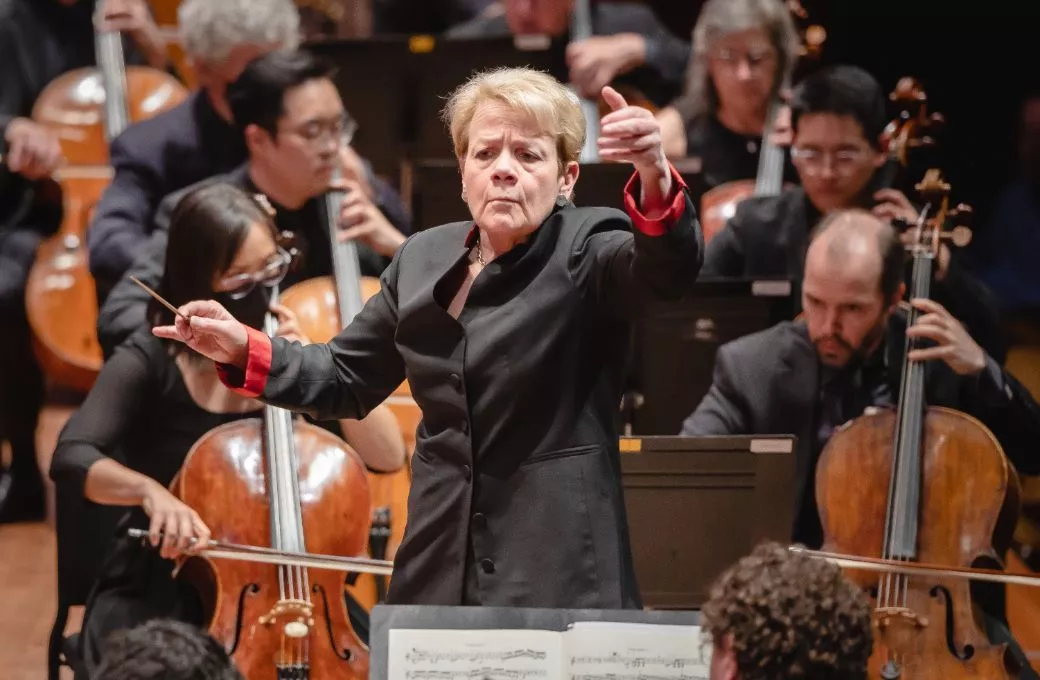
I reviewed this past weekend’s Seattle Symphony program with guest conductor Marin Alsop:
There was nothing star-crossed about Marin Alsop’s guest appearance with the Seattle Symphony. Fortune turned its wheel to allow for a happy, if long-overdue, collaboration following an absence of almost two decades from Benaroya Hall….
Music from Shostavich’s Fourth, Fifth, Eighth, Tenth and Eleventh Symphonies was performed live to Eisenstein’s film. (Seattle Symphony photo)
I wrote about a very interesting film + live symphony event at Seattle Symphony with guest conductor Frank Strobel:
In 1925, Sergei Eisenstein made cinematic history with the release of Battleship Potemkin, his feature debut. Dmitri Shostakovich, still a precocious teenager, was hard at work on his First Symphony, which also caused a sensation when it was premiered the next year by the Leningrad Philharmonic.
Abel Selaocoe and the Seattle Symphony; photo (c) Carlin Ma
What a memorable concert this was — my latest Seattle Symphony review:
“I feel very welcome here,” said Abel Selaocoe just before making his debut with the Seattle Symphony. Not only did he seem completely at home: in remarks introducing Four Spirits, his new work for cello, voice and orchestra, the young cellist-composer invited the audience to enter into his musical world, indicating that he would cue them when to sing along at the appropriate moment. “I’ll see you on the other side,” he winked, just before taking up his position to launch the piece.
UPDATE: See Michael Schell’s insightful comments on the new season announcement here.
The Seattle Symphony’s (SSO) 2023-24 season announcement was released today. The orchestra will celebrate two anniversaries: 120 years since its founding and 25 years since the opening of Benaroya Hall, which became home base in 1998. Main areas of focus: broader programming across all SSO series to connect with new audiences, an increase in the presence of living composers, a greater concentration of works new to SSO’s repertoire, and the launch of a new curated series (“Playlist”).
Opening night will replicate part of the SSO’s first-ever concert from December 29, 1903 (Schubert’s “Unfinished” and Massenet’s Overture to Phèdre) and the first concert the musicians played at Benaroya Hall on September 12, 1998 (selections from Wagner’s Götterdämmerung — which featured Jessye Norman back then); Arthur Honegger’s Pastorale d’Été will also be introduced to the SSO’s repertoire; LudovicMorlot conducts.
SSO’s distinguished emeritus will return for another program in June (versus three separate programs led by Morlot in the current season). Aside from appearances by Sunny Xia, SSO’s Douglas F. King Assistant Conductor, the rest of the season will be led by a wide range of visiting conductors — many of whom have already guested here. Alpesh Chauhan and David Robertson led especially impressive performances earlier this season, so it’s nice to see that they will return. Making their debuts on the podium are Kevin John Edusei, Christian Reif, Bernard Labadie, Sarah Hicks, and Andy Einhorn. I’m also looking forward to hearing the much-touted Dalia Stasevska (I wasn’t able to make her SSO debut a year ago). She will be joined by her composer/electric bassist husband, Lauri Porra, in a program of the Sibelius Fifth complemented by Porra’s concerto for electric bass, Entropia, andNautilus by Anna Meredith. Note that this is not a continuation of the halfway-completed Sibelius cycle paired with new commissions that Thomas Dausgaard had launched before the pandemic. That endeavor has been discontinued.
The SSO has been keeping quiet about the ongoing search for a music director. The Press Office states that “the search is well underway and many performances from seasons past, current, and future are all carefully being considered by the Search Committee.”
I also asked about this press release statement: “The 2023/2024 season brings a continuation of creative partnerships that welcome not only the next generation of composers and performers, but new members of our community as well.” The response was that this refers to less traditional programs like the Metropolis evening and the weeklong residency in January of film composer, conductor, and pianist Joe Hisaishi, as well as popular programming with artists like Audra Macdonald. It also refers to programs and series featuring newer voices among the young generation of classical musicians and SSO’s educational programming.
On the new music front: the press release calls out the following among the “more than 35 living composers” who are part of the programming: “Salina Fisher, Nina C. Young, Aaron Jay Kernis, Reena Esmail, Lauri Porra, David Robertson, Steven Mackey, Linda Catlin Smith, Gretchen Yanover, Donghoon Shin, Dorothy Chang, Han Lash, Sarah Gibson, Alexandra Gardner, Angélica Negrón, Fazil Say, Jake Heggie, Jennifer Higdon, Edgar Meyer, Jessie Montgomery, Kevin Puts and more.” The last five named are co-collaborators for the Elements Concerto featuring Joshua Bell, which Marin Alsop will conduct on the closing program of the season. It should also be noted that several of these are part of the Octave 9 season performed in the SSO’s adjacent experimental space. The SSO began expanding this sold-out series during the current season.
A focus on “firsts” is also on the agenda. Remarkably, Bach’s St. John Passion will receive its first-ever SSO performance. Other firsts for the orchestra: Julia Perry’s Short Piece for Orchestra, John Adams’s Harmonium, Salina Fisher’s Rainphase, Lutoslawski’s Cello Concerto, Dorothy Chang’s Northern Star, Donghoon Shin’s Of Rats and Men, Fagerlund’s Stonework, Aaron Jay Kernis’s Elegy (For Those We Lost), the previously mentioned ElementsConcerto and Meredith and Porra pieces. A program that looks especially intriguing will be the SSO’s first-ever performance of Vaughan Williams’s Symphony No. 7 (Antarctic) led by Gemma New and featuring soprano Jennifer Bromagen. This event promises “an immersive multimedia experience of the doomed Terra Nova Expedition” — Robert Falcon Scott’s journey to the Antarctic in 1910-13 — with original visuals from 1912.
Among debuting soloists, I’m delighted to see that the pianist Mahani Teave will be making her SSO debut in Mozart’s K. 466 piano concerto in October. A native of Easter Island and has an amazing story I wrote about for the New York Timeshere. Teave will also inaugurate the new no-intermission Playlist Series, which will be curated by Conrad Tao and Noah Geller.
As far as new commissions, however, I see only one by SSO on the program (versus five commissions this season, four of them orchestral): a not-yet-titled work for solo cello an video design by Gretchen Yanover, which will be premiered on the Octave 9 series. Reena Esmail’s wonderful Concerto for Hindustani Violin, co-created with soloist Kala Ramnath, will make a welcome return after its premiere here last year.
Complete chronological listing of the 2023-24 season:
David Robertson conducts the Seattle Symphony; photo (c)Brandon Patoc
David Robertson guest conducted the Seattle Symphony last week in a program of Ligeti, Bartók, and Rachmaninoff. My review:
Since it lacks a music director, the Seattle Symphony is presenting a smorgasbord of guest conductors throughout the season. These have been mostly younger artists still early in their careers, but David Robertson’s engagement marked the return of a seasoned conductor already well-liked by the players and in full command of a formidable talent….
Lee Mills and Seattle Symphony in Beethoven’s Seventh
UPDATE: This is a fantastic program and well worth seeking out this weekend. I was completely enchanted by João Guilherme Ripper’s touching, witty, sophisticated, and deliciously melodic song cycle based on the poetry of the legendary Vinicius de Moraes. Mills does a great service introducing this prolific Brazilian composer to U.S. audiences — and this is just one peek into the wealth of creativity south of the border that is routinely ignored here. Filling in at the last minute, lyric soprano Tess Altiveros brings passion and humor to her interpretations.
And Mills inspires the SSO to a refreshingly buoyant account of Beethoven’s Sixth. He closely follows the composer’s metronome markings but without sounding rushed or hectic., The result really is akin to breathing in the invigorating freshness of the countryside — and above all elicits the joyful elation of this score.
Two more chances to hear the program: Saturday at 8:00pm and Sunday at 2:00pm.
Lee Mills, who finished his tenure as Seattle Symphony Associate Conductor last season, returns this week to lead the band in what promises to be an interesting program of Beethoven and contemporary composers. We’ll hear the world premiere of Charles Corey’s Together, This Journey, commissioned and composed in collaboration with members of Northwest Center and Best Buddies (originally as part of the 2020 Beethoven Festival) and Brazilian composer João Guilherme Ripper’s Cinco poemas de Vinicius de Moraes. Written for soprano (Tess Altiveros) and orchestra, Ripper’s piece sets five poems by Moraes to sketch out the story of the poet’s life. And Beethoven’s Pastoral Symphony will complete the program.
I wrote a profile of Mills just about a year ago for Musical America.




 MEMETERIA by Thomas May