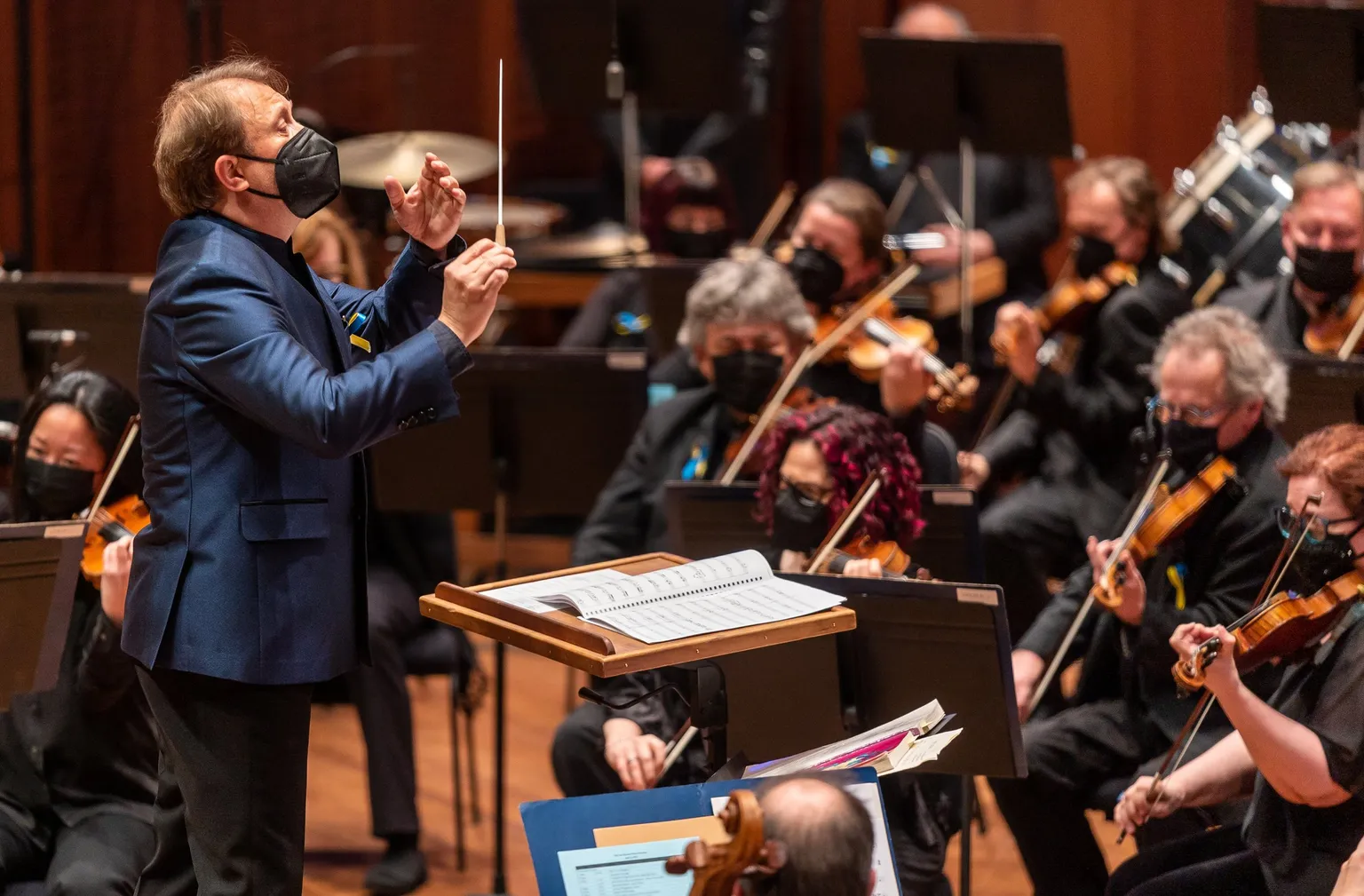
Ludovic Morlot conducts the Seattle Symphony in The Mayors’ Concert for Ukraine and Refugees Worldwide earlier this year. (James Holt / Seattle Symphony)
Tonight Ludovic Morlot rejoins the Seattle Symphony for the first of two performances of one of Messiaen’s Des canyons aux étoiles… I spoke to the conductor about the program for The Seattle Times:
A new chapter in Ludovic Morlot’s relationship with the Seattle Symphony is underway.
Now holding the title of conductor emeritus, Morlot has chosen some unusual fare for his concerts on June 2 and 4: the orchestral epic “Des canyons aux étoiles …” (“From the Canyons to the Stars …”) by Olivier Messiaen, which will be presented in a multimedia presentation accompanied by video projections by Deborah O’Grady.
The Seattle Symphony will present two free Community Concerts this May. On Friday, May 13, at 8 p.m., Seattle Symphony Composer-in-Residence Reena Esmail returns to Benaroya Hall to host the first Community Concert, titled Ram Tori Maya, which features a Seattle Symphony string quartet sharing the stage with students of Swaranjali School of Music, an institution dedicated to the preservation, learning, and performance of Hindustani classical music. This program will explore pieces arranged or composed by Esmail herself along with a carefully curated selection of popular Indian works.
The second community concert will be on Tuesday, May 17, at 7 p.m., with Associate Conductor Lee Mills conducting music by Wolfgang Amadeus Mozart, Hannah Kendall, Astor Piazzolla, Johannes Brahms, and Carlos Simon. 2022 Young ArtistHenry From will join the orchestra for the last movement from Brahms’s Piano Concerto No. 1.
Roderick Cox conducting the Seattle Symphony Orchestra; photo (c)James Holt
I left last night’s performance convinced that Roderick Cox is a major talent destined for something great. Winner of the 2018 Sir Georg Solti Conducting Award, Cox had caught my interest last year leading a Barber in San Francisco Opera’s return to live performance. Those were unusual circumstances dictated by social-distancing rules (with a parking lot as the auditorium, the music transmitted to our car radios), so it was splendid to get to experience this young conductor in the limelight, with a full orchestra, unhampered by any pandemic restrictions more cumbersome than a mask. [UPDATE: Check out the film Conducting Life, an intimate portrait of Roderick Cox and his path toward his vocation.]
Cox chose a challenging program that revealed an impressive gift for communicating his musical vision. The first half was given to William Levi Dawson’s Negro Folk Symphony of 1934–a landmark of early 20th-century American symphonic writing has been shamefully, disgracefully neglected while so many tireless mediocrities continue to clutter the repertoire.
This performance had the quality of a double epiphany, confirming what an excellent piece of music we’ve allowed ourselves to be missing out on and at the same time shedding light on the journey Dawson’s symphony traces–outwardly, the harrowing passage from Africa to the New World, but also an implicitly personal journey. He clarified the originality of Dawson’s response to the challenge Dvořák had issued to cultivate an authentically American voice. For Dawson, that meant writing a symphony that, as the composer put it, “is unmistakably not the work of a white man.”
Negro Folk Symphony is a marvel of the imaginative, indeed, symphonic, transformation of simple, ready-made folk material–Dawson draws on three spirituals in particular–into a complex, multi-faceted structure. Cox led a dramatically compelling account that highlighted Dawson’s elaborate use of rhythmic mottos as a unifying device, while also lavishing attention on the orchestral details that give this score such resonance. His spacing of the implacably tragic minor chords ending the “Hope in the Night Section” was especially memorable. This was the SSO’s first performance of the Dawson, and part of the excitement came from the sense of the players sharing in these discoveries along the way, clearly inspired by Cox’s guidance.
Concertmaster Noah Geller gave a deeply felt and polished interpretation of the 1904 Violin Concerto in A minor by Alexander Glazunov–who, like Dawson, straddled a period of drastic change in musical values and pressures. Basking in his warmly expressive lower register in the opening passage, the violinist kept the audience at an attentive hush in Glazunov’s extended cadenza, counterbalancing the piece’s gentler lyricism with its giddy high spirits and vivaciously articulated virtuosity.
Cox proved fearless in Belá Bartók’s Suite from The Miraculous Mandarin, a piece that doesn’t tolerate weak-willed, insecure conducting. He drew an electrifying performance from the outset, never letting go of the ominous, hair-raising tension and danger that animate this early Bartók score. The music echoes, though in a very original way, impulses from Stravinsky’s RiteofSpring and Strauss’s dancing Salome, also hinting at the spirit of film noir to come. Cox emphasized its brutal violence but also knew how to bring out the delicacy and spookily muted colors of Bartók’s orchestration, loosening the reins to give the platform to Benjamin Lulich for his arresting clarinet solos.
The glowing rapport between the players and Cox left me hoping to see much more of this conductor on the Benaroya stage. Thursday’s audience, though relatively sparse, was enthusiastic and grateful. What a pity it would be to miss this excellent program, which repeats Saturday at 8pm and Sunday at 2pm.
Ludovic Morlot reunites with the Seattle Symphony (image: Nick Klein)
For the second installment in the Seattle Symphony’s Sibelius cycle, emeritus conductor Ludovic Morlot rejoined the orchestra to lead a program centered around the Second Symphony. The occasion inspired some spectacular, edge-of-your-seat playing on Thursday night.
The concert started off with another in the series of commissions of new works from contemporary composers that find a way to “relate” to each of the Sibelius symphonies. In February, when the cycle launched with the Sibelius First (conducted by the talented Ruth Reinhardt), the pairing presented an intriguingly provocative new piece by Ellen Reid. The Puerto Rican composer Angélica Negrón faced the challenge of responding to what is, for many Sibelius fans, the best-loved of the seven symphonies. ColorShape Transmission, the result, offers an imaginatively fresh take on the phenomenon of acoustic space and the orchestra as a kind of mobile aural sculpture. Negrón spins her vast array of forces into a kaleidoscope of mysterious timbres, rapturously sustained clusters, and subtle echo and richochet effects. The impression of a ritual or procession brought to mind the mystery of the Second Symphony’s Andante, with its walking bass and swelling hymn.
I seem to recall that this program had originally been planned to include Sibelius’s Violin Concerto with Isabelle Faust. She was the soloist in Stravinsky’s contribution to the genre instead, but it was a wonderful match and proved captivating from first note to last. Faust displayed multiple personalities, all equally convincing, in Stravinsky’s one-of-a-kind take on the concerto idea: alternately cheeky, heart-breaking, whimsical, and invigorating. Morlot’s tenure with the SSO included some especially memorable encounters with Stravinsky, so it was gratifying to find him shedding light on a different aspect of the composer, tending so carefully to his piquant timbral combinations of woodwinds and soloist; concertmaster Noah Geller matched Faust’s ravishing tone in the duet between both violinists in the Capriccio finale.
But what left the most resounding impression was the epic sweep conveyed by the Second Symphony. In this account, Morlot navigated the SSO through Sibelius’s drastic transformations of landscape with a convincing sense of purpose. Sunlight shifting on the meadows, impending storms, glorious new vistas opened up — the sonic imagery flowed generously, but Morlot shaped its ebbs and flows with architectural understanding, aside from the occasional haze produced by a passing sonic imbalance. He homed in on Sibelius’s use of tension and release to thrilling effect.
In his excellent program notes, Christopher DeLaurenti points out that Sibelius had little use for the political purposes which his work seemed to serve, while at the same time hinting at the Second’s uncanny relevance for the terrible present moment. Its premiere in 1902, he writes, “was welcomed by the Finnish public as a missive of nationalist resilience against their Russian overlords.” He also quotes the composer’s friend and champion Robert Kajanus hailing the Second as “a broken-hearted protest against all the injustice that threatens at the present time to deprive the sun of its light and our flowers of their scent.” Grasping the music’s agonized heroism, this performance invested the final moments of the Second with cathartic grandeur.
The full program will be performed again on Saturday, 9 April, at 8pm. If you need a dose of hope, don’t miss it.
The Seattle Symphony Orchestra (SSO) just announced the lineup for the 2022-23 season. It’s the first time since I’ve been following the SSO that this announcement comes without a music director in place. So the first thing that stands out is the long list of guest conductors: I count a total of 30 (!), including such luminaries as Marin Alsop, Tan Dun, and Osmo Vänskä, who will close out the season with Mahler’s Resurrection Symphony on 22 and 24 June. (Asher Fisch’s moving recent account of Das Lied von der Erde marked the first time Mahler resounded again in Benaroya Hall since the pandemic, and Morlot is set to conduct the Sixth next week. The Second is the only Mahler lined up for next season.)
No fewer than 13 are set to make their SSO debuts. And there will also be familiar faces: particularly Conductor Emeritus Ludovic Morlot, who has the honor of leading the opening night concert on 17 September along with two later programs.
As to new music, five commissioned works will be presented (including both SSO concerts and the Octave 9 chamber series), including a world premiere by 2022-23 artist-in-residence Angelique Poteat (scheduled for opening night) and new compositions by Freida Abtan, Enrico Chapela, Dai Fujikura, and Abel Selaocoe. Other contemporary voices among the 25 living composers represented include Gabriella Smith, Esa-Pekka Salonen, Tan Dun, Gina Gillie, Nina Shekhar, Salina Fisher, Qigang Chen, Caroline Shaw, Shanyse Strickland, and Hannah Lash.
The Symphony No. 7 by Sibelius will be paired with a world premiere by Dai Fujikura in response to the Finn’s last symphony. But that’s the only Sibelius that figures on next season’s schedule. It appears that the Sibelius Cycle that had been intended as a highlight under former music director Thomas Dausgaard will be left incomplete. I haven’t seen any statement on the matter but will update as soon as I do. Which means that by the end of next season, as far as I understand it, SSO will have given Symphonies 1, 2, and 7, together with their corresponding paired commissions (music by Ellen Reid and Angélica Negrón for Symphonies 1 and 2, respectively) — with 3, 4, and 5 apparently falling by the wayside. Since each of these was to be accompanied by a newly commissioned work, I wonder what will become of the “missing” commissions….
There’s also a lot of love for Rachmaninoff, who only seems to increase in popularity each season. The Spring will bring a “Rachfest” devoted to the four piano concertos, featuring pianists Dominic Cheli, Rémi Geniet, and Albert Cano Smit, with Katharina Winkor conducting — all but Geniet making their SSO debuts. Plus, David Robertson will conduct the rarely heard Symphony No. 1 (the work whose fiasco premiere nearly led Rachmaninoff to abandon composing) and yet another program of the ubiquitous Piano Concerto No. 2 in January (with Nobuyuki Tsujii as the soloist and SSO newcomer Jirí Rožeň conducting). The Rachfest originally planned for spring 2020 was cancelled when the pandemic arrived, but 2023 has the added bonus of being the 150th anniversary year of the Russian composer’s birth.
I’m especially excited about the new works by Poteat and Fujikura, as well as the incredible Gabriella Smith’s Tidlewave Kitchen, Esa-Pekka Salonen’s Cello Concerto with Nicholas Altstaedt, and the Seattle premiere of Tan Dun’s remarkable Buddha Passion (which I reviewed three years ago when Gustavo Dudamel and the LA Philharmonic gave the U.S. premiere). And Octave 9 will present Tan Dun’s GhostOpera and also welcome back cellist extraordinaire Seth Parker Woods for the world premiere of Freida Abtan’s My Heart is a River.
In fact, there’s a strong cello theme running through the programming, which includes a new work by Abel Selaocoe (featuring himself as the soloist) and Yue Bao conducting the Three Continents Cello Concerto by Nico Muhly, Sven Helbig, and Zhou Long, with the cellist Jan Vogler.
Link to the complete SSO season announcement press release here.
Reena Esmail, Seattle Symphony’s composer in residence (Rachel Garcia)
ALSO NOTE: Tonight Friday night at 8pm, Reena Esmail curates a program at Seattle Symphony”s Octave 9 space with Kala Ramnath and SSO musicians, titled “Ragamala: A Journey into Hindustani Music.”
I had the pleasure of writing about the marvelous Reena Esmail and her new violin concerto for Hindustani violinist Kala Ramnath, which Seattle Symphony will premiere at the Celebrate Asia concert on Sunday, 20 March.
For its opening night concert last September, when the Seattle Symphony returned for its first full season since the pandemic struck, it was music by Reena Esmail that launched the program. She continues in her role as composer-in-residence with the world premiere of a newly commissioned violin concerto …
Sunny Xia conducting the Arizona State University Studio Orchestra in the Andante cantabile from Tchaikovsky’s Symphony 5
This morning Seattle Symphony announced that Sunny Xuecong Xia has been named the Douglas F. King Assistant Conductor. She will begin her appointment in September 2022. Meanwhile, the search for a new music director since the sudden departure early this year of Thomas Dausgaard is underway. Lee Mills will continue to serve as Associate Conductor through the current 2021-2022 season, until Xia succeeds him at the start of the 2022-23 season.
Currently, Xia is Assistant Conductor of the Phoenix Youth Symphony Orchestra and Arizona State University Symphony Orchestra. The selection process for the SSO position involved a working rehearsal session with SSO musicians as well as an interview with a panel comprising musicians, board, and staff. Xia is also pursuing a doctorate in Orchestral and Opera Conducting at Arizona State University.
Here’s the full bio from Xia’s website:
Recognized for her innate musicality, compelling presence, and technical precision, conductor Sunny Xuecong Xia’s ability to forge an immediate and captivating connection with orchestras and audiences alike has led to engagements around the country. Sunny currently serves as Assistant Conductor of the Phoenix Youth Symphony Orchestra and Arizona State University Symphony Orchestra while pursuing a doctorate in Orchestral Conducting under Dr. Jeffery Meyer. In the 2021-22 season, she was invited to lead a production of La bohème with the Chandler Opera Company and serve as cover conductor for Arizona Musicfest. She recently appeared with double bassist Xavier Foley and violinist Eunice Kim in a performance of Foley’s poignant For Justice and Peace at Arizona’s Mesa Arts Center. In the 2020-21 season, she appeared as guest conductor with the MusicaNova Orchestra and was invited to serve as Assistant Conductor at the National Music Festival and Pierre Monteux Music Festival. In January 2020, she made her successful debut with the Cleveland Women’s Orchestra.
Highlights of the 2019-20 season include being selected by Marin Alsop as a Conducting Fellow in the Peabody Conducting Workshop. She was also appointed Apprentice Conductor at the North American New Opera Workshop (NANOWorks) and served as Cover Conductor for the Cleveland Orchestra Youth Orchestra and Firelands Symphony Orchestra. Chosen from a pool of 75 first-round competitors, she was one of ten semifinalists in the NRTA Conducting Competition in Tirana, Albania. Additionally, she led the Cleveland Institute of Music Orchestra in the 2019 Benefit Concert “A Legacy in Bloom: Celebrating Clara T. Rankin” with violinist Caroline Goulding.
As Assistant Conductor of the Cleveland Institute of Music Opera Theater from 2017 to 2020, Sunny assisted Maestro Harry Davidson in productions of Die Zauberflöte, The Juniper Tree, Le Rossignol, and L’Enfant et les Sortilèges. A dynamic advocate for contemporary music, she has led the CIM New Music Ensemble in music series such as the Cleveland NEOSonicFest and CIM New Music Series. She also served as a Conducting Fellow in the 2020 Cortona Sessions for New Music Conductor and Advocate Virtual Summit. Dedicated to bringing music to unconventional and diverse locations, while in Cleveland, Sunny organized and led concerts in retirement communities and elementary schools, including an interactive presentation of Prokofiev’s Peter and the Wolf in East Cleveland for an audience of 4th and 5th graders.
Sunny holds a dual master’s degree in Orchestral Conducting and Violin Performance from the Cleveland Institute of Music where she studied under the tutelage of Carl Topilow and Jan Mark Sloman. She has had the privilege to be mentored by a number of prominent conductors, including Marin Alsop, JoAnn Falleta, Giancarlo Guerrero, Tito Muñoz, Ludovic Morlot, Larry Rachleff, Robert Spano, Carl St.Clair, and Thomas Wilkins. For two summers, she attended the Monteux School and Music Festival as a Kurt & Torj Wray Conducting Scholar. An accomplished violinist, prior to becoming a conductor, Sunny performed as a soloist with orchestras in China and Australia, including the symphony orchestras of Harbin, Zheijiang, Hunan and Guangxi, and the Concertante Ensemble. While attending Cleveland Institute of music, she served as concertmaster of the CIM Orchestra.
Originally from Guangzhou, China, Sunny relocated to Sydney, Australia at the age of 14 on a sponsorship from the Australian String Academy that allowed her to further her violin studies with Peter Shi-xiang Zhang and Charmian Gadd. A talented basketball athlete, she competed in the semi-professional New South Wales Metro Junior League before focusing primarily on her musical pursuits. When not performing or enjoying a pick-up game, Sunny can be found reading, kayaking, or learning languages. She speaks Cantonese, English, German, Mandarin and Teochew, and is improving her French and Italian.
For this month’s column, I had the privilege of writing about this very talented young conductor:
When he was still in college, Lee Mills had a dream job of becoming a roller coaster designer. But the unexpected career path he ended up following has given the young conductor another way of providing some very memorable thrills—especially during the current season of turbulent twists and turns….
Ruth Reinhardt conducting Seattle Symphony in Bernstein’s Candide Overture during her tenure as an SOO Conducting Fellow (2017)
Last week’s subscription concerts launched Seattle Symphony’s Sibelius Symphony cycle, which had been anticipated as a highlight of Thomas Dausgaard’s return since the pandemic. In the wake of the now-ex-music director’s sudden departure announced last month, a handful of replacement conductors has been enlisted to take over Dausgaard’s commitments for the rest of the season.
First up this month was Ruth Reinhardt, a remarkable conductor of the young generation. She had the formidable task of taking on the first program of the Sibelius cycle, in which the Finnish composer’s symphonies are being combined with newly commissioned compositions. The Pulitzer Prize-winning Ellen Reid responded to Sibelius’s First Symphony with a work titled TODAY AND TODAY AND TODAY AND TODAY AND TODAY AND TODAY AND TODAY AND TODAY AND TODAY AND TODAY. Lasting about a quarter-hour, it showed Reid as a composer who not only creates intriguing soundscapes but is able to illuminate them with psychologically resonant significance.
The Macbethian title (even more despairing than “tomorrow and tomorrow and tomorrow”) refers to the patterns of repetition and monotony endured during the pandemic. But her music stages various escapes — lyrical fantasias, utopian dreaming, even a down-to-earth party — from the stasis and repetition that threaten to drain each day of the joie de vivre. Reid uses the resources of the orchestra with great imagination and variety.
Moreover, as became clear in Reinhardt’s sweeping, panoramic vision of the Sibelius, Reid seems to have found a pandemic-era equivalent for the vision conveyed by Sibelius’s extraordinary debut symphony, which builds to a seeming lyrical breakthrough or even oasis, only to find it illusive. That connection certainly seemed apparent in Reinhardt’s overview of both works. Between them, we were treated to an exquisitely phrased, completely beguiling interpretation by Garrick Ohlsson of the Rhapsody on a Theme of Paganini, followed by thunderous, bell-like chords in his encore, the C-sharp minor Prelude.
What a gift to have Asher Fisch back in town after a long absence. The program he conducted on Thursday evening paired George Walker and Gustav Mahler, and the pairing works beautifully. Fisch infused Lyric for Strings with genuine warmth and underscored the fascinating entanglement of folk and modernist elements in the much later Folksongs for Orchestra, which dates from 1990. It continues to defy belief that this great American composer remains such a rarity in our concert life. How long is it going to take to change that?
Fisch was in his element with Das Lied von der Erde, and the Mahler-starved audience — the pandemic has been especially unkind to the composers who require enlarged orchestras — drank it up with rapt attention. I especially admired his flexible rhythms and feeling for Mahler’s Jugendstil ornamentation, but he also kept the emotional destination of the cycle clearly in view, illuminating the way to, and the journey within, the vast final song. Problems of balance left tenor Russell Thomas largely drowned out for stretches of the opening “Trinklied,” but his passionate delivery conveyed the flashes of bitter epiphany Mahler expresses.
Mezzo-soprano Kelley O’Connor brought a rich, dark timbre to her three songs, carefully building the sense of inevitable leave-taking in “Der Abschied.” The expanded woodwind section was a special highlight, with eloquent contributions from flutist Demarre McGill and oboist Mary Lynch in particular. Fisch’s unpretentious, unfussy clarity allowed each detail to fall into place with memorable impact.
The program will be repeated on Saturday at 8pm and Sunday at 4pm. It would be a shame to miss it.
Thinking of the brilliant composer George Walker today, who passed away almost four years ago at the age of 96. Tonight’s Seattle Symphony program pairs music by Walker with Mahler’s Das Lied von der Erde. Walker will be represented by his Lyric for Strings and Folksongs for Orchestra.
On the podium, in another welcome return, is Asher Fisch, who has been absent far too long. He was principal guest conductor of Seattle Opera from 2007 to 2013.
Here’s the story I wrote about George Walker for the New York Times before the pandemic. Many thanks to Frank Schramm, whose marvelous photos were indispensable to this piece.
SEATTLE — Last fall, the Smithsonian’s National Portrait Gallery began to display, among its recent acquisitions, a photograph of the composer George Walker. It shows him close up, his right index finger and thumb bearing down on a pencil with the precision of a surgeon, at work on the manuscript score of his Sinfonia No. 5….






 MEMETERIA by Thomas May