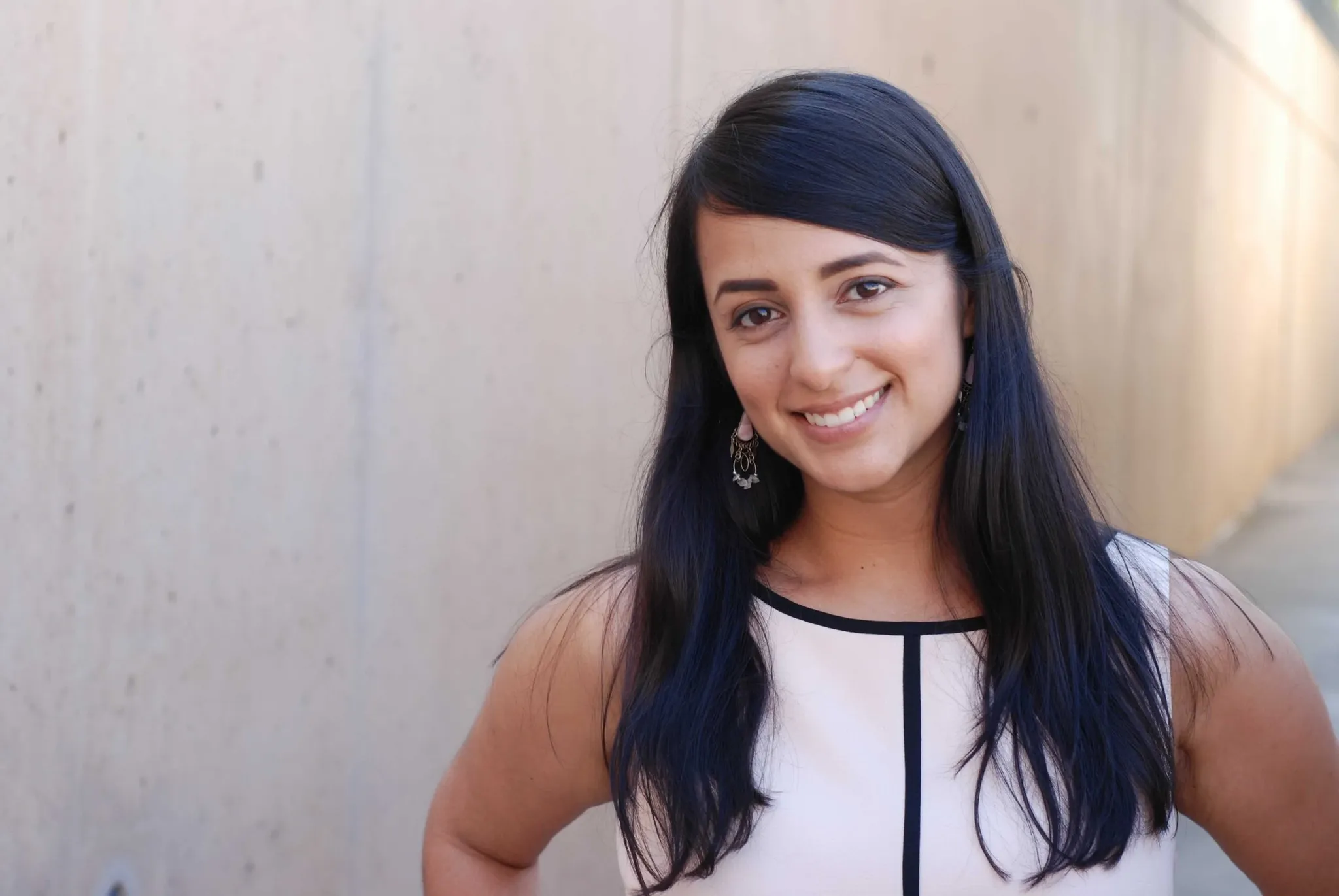
Reena Esmail, Seattle Symphony’s composer in residence (Rachel Garcia)
ALSO NOTE: Tonight Friday night at 8pm, Reena Esmail curates a program at Seattle Symphony”s Octave 9 space with Kala Ramnath and SSO musicians, titled “Ragamala: A Journey into Hindustani Music.”
I had the pleasure of writing about the marvelous Reena Esmail and her new violin concerto for Hindustani violinist Kala Ramnath, which Seattle Symphony will premiere at the Celebrate Asia concert on Sunday, 20 March.
For its opening night concert last September, when the Seattle Symphony returned for its first full season since the pandemic struck, it was music by Reena Esmail that launched the program. She continues in her role as composer-in-residence with the world premiere of a newly commissioned violin concerto …
Sunny Xia conducting the Arizona State University Studio Orchestra in the Andante cantabile from Tchaikovsky’s Symphony 5
This morning Seattle Symphony announced that Sunny Xuecong Xia has been named the Douglas F. King Assistant Conductor. She will begin her appointment in September 2022. Meanwhile, the search for a new music director since the sudden departure early this year of Thomas Dausgaard is underway. Lee Mills will continue to serve as Associate Conductor through the current 2021-2022 season, until Xia succeeds him at the start of the 2022-23 season.
Currently, Xia is Assistant Conductor of the Phoenix Youth Symphony Orchestra and Arizona State University Symphony Orchestra. The selection process for the SSO position involved a working rehearsal session with SSO musicians as well as an interview with a panel comprising musicians, board, and staff. Xia is also pursuing a doctorate in Orchestral and Opera Conducting at Arizona State University.
Here’s the full bio from Xia’s website:
Recognized for her innate musicality, compelling presence, and technical precision, conductor Sunny Xuecong Xia’s ability to forge an immediate and captivating connection with orchestras and audiences alike has led to engagements around the country. Sunny currently serves as Assistant Conductor of the Phoenix Youth Symphony Orchestra and Arizona State University Symphony Orchestra while pursuing a doctorate in Orchestral Conducting under Dr. Jeffery Meyer. In the 2021-22 season, she was invited to lead a production of La bohème with the Chandler Opera Company and serve as cover conductor for Arizona Musicfest. She recently appeared with double bassist Xavier Foley and violinist Eunice Kim in a performance of Foley’s poignant For Justice and Peace at Arizona’s Mesa Arts Center. In the 2020-21 season, she appeared as guest conductor with the MusicaNova Orchestra and was invited to serve as Assistant Conductor at the National Music Festival and Pierre Monteux Music Festival. In January 2020, she made her successful debut with the Cleveland Women’s Orchestra.
Highlights of the 2019-20 season include being selected by Marin Alsop as a Conducting Fellow in the Peabody Conducting Workshop. She was also appointed Apprentice Conductor at the North American New Opera Workshop (NANOWorks) and served as Cover Conductor for the Cleveland Orchestra Youth Orchestra and Firelands Symphony Orchestra. Chosen from a pool of 75 first-round competitors, she was one of ten semifinalists in the NRTA Conducting Competition in Tirana, Albania. Additionally, she led the Cleveland Institute of Music Orchestra in the 2019 Benefit Concert “A Legacy in Bloom: Celebrating Clara T. Rankin” with violinist Caroline Goulding.
As Assistant Conductor of the Cleveland Institute of Music Opera Theater from 2017 to 2020, Sunny assisted Maestro Harry Davidson in productions of Die Zauberflöte, The Juniper Tree, Le Rossignol, and L’Enfant et les Sortilèges. A dynamic advocate for contemporary music, she has led the CIM New Music Ensemble in music series such as the Cleveland NEOSonicFest and CIM New Music Series. She also served as a Conducting Fellow in the 2020 Cortona Sessions for New Music Conductor and Advocate Virtual Summit. Dedicated to bringing music to unconventional and diverse locations, while in Cleveland, Sunny organized and led concerts in retirement communities and elementary schools, including an interactive presentation of Prokofiev’s Peter and the Wolf in East Cleveland for an audience of 4th and 5th graders.
Sunny holds a dual master’s degree in Orchestral Conducting and Violin Performance from the Cleveland Institute of Music where she studied under the tutelage of Carl Topilow and Jan Mark Sloman. She has had the privilege to be mentored by a number of prominent conductors, including Marin Alsop, JoAnn Falleta, Giancarlo Guerrero, Tito Muñoz, Ludovic Morlot, Larry Rachleff, Robert Spano, Carl St.Clair, and Thomas Wilkins. For two summers, she attended the Monteux School and Music Festival as a Kurt & Torj Wray Conducting Scholar. An accomplished violinist, prior to becoming a conductor, Sunny performed as a soloist with orchestras in China and Australia, including the symphony orchestras of Harbin, Zheijiang, Hunan and Guangxi, and the Concertante Ensemble. While attending Cleveland Institute of music, she served as concertmaster of the CIM Orchestra.
Originally from Guangzhou, China, Sunny relocated to Sydney, Australia at the age of 14 on a sponsorship from the Australian String Academy that allowed her to further her violin studies with Peter Shi-xiang Zhang and Charmian Gadd. A talented basketball athlete, she competed in the semi-professional New South Wales Metro Junior League before focusing primarily on her musical pursuits. When not performing or enjoying a pick-up game, Sunny can be found reading, kayaking, or learning languages. She speaks Cantonese, English, German, Mandarin and Teochew, and is improving her French and Italian.
For this month’s column, I had the privilege of writing about this very talented young conductor:
When he was still in college, Lee Mills had a dream job of becoming a roller coaster designer. But the unexpected career path he ended up following has given the young conductor another way of providing some very memorable thrills—especially during the current season of turbulent twists and turns….
Ruth Reinhardt conducting Seattle Symphony in Bernstein’s Candide Overture during her tenure as an SOO Conducting Fellow (2017)
Last week’s subscription concerts launched Seattle Symphony’s Sibelius Symphony cycle, which had been anticipated as a highlight of Thomas Dausgaard’s return since the pandemic. In the wake of the now-ex-music director’s sudden departure announced last month, a handful of replacement conductors has been enlisted to take over Dausgaard’s commitments for the rest of the season.
First up this month was Ruth Reinhardt, a remarkable conductor of the young generation. She had the formidable task of taking on the first program of the Sibelius cycle, in which the Finnish composer’s symphonies are being combined with newly commissioned compositions. The Pulitzer Prize-winning Ellen Reid responded to Sibelius’s First Symphony with a work titled TODAY AND TODAY AND TODAY AND TODAY AND TODAY AND TODAY AND TODAY AND TODAY AND TODAY AND TODAY. Lasting about a quarter-hour, it showed Reid as a composer who not only creates intriguing soundscapes but is able to illuminate them with psychologically resonant significance.
The Macbethian title (even more despairing than “tomorrow and tomorrow and tomorrow”) refers to the patterns of repetition and monotony endured during the pandemic. But her music stages various escapes — lyrical fantasias, utopian dreaming, even a down-to-earth party — from the stasis and repetition that threaten to drain each day of the joie de vivre. Reid uses the resources of the orchestra with great imagination and variety.
Moreover, as became clear in Reinhardt’s sweeping, panoramic vision of the Sibelius, Reid seems to have found a pandemic-era equivalent for the vision conveyed by Sibelius’s extraordinary debut symphony, which builds to a seeming lyrical breakthrough or even oasis, only to find it illusive. That connection certainly seemed apparent in Reinhardt’s overview of both works. Between them, we were treated to an exquisitely phrased, completely beguiling interpretation by Garrick Ohlsson of the Rhapsody on a Theme of Paganini, followed by thunderous, bell-like chords in his encore, the C-sharp minor Prelude.
What a gift to have Asher Fisch back in town after a long absence. The program he conducted on Thursday evening paired George Walker and Gustav Mahler, and the pairing works beautifully. Fisch infused Lyric for Strings with genuine warmth and underscored the fascinating entanglement of folk and modernist elements in the much later Folksongs for Orchestra, which dates from 1990. It continues to defy belief that this great American composer remains such a rarity in our concert life. How long is it going to take to change that?
Fisch was in his element with Das Lied von der Erde, and the Mahler-starved audience — the pandemic has been especially unkind to the composers who require enlarged orchestras — drank it up with rapt attention. I especially admired his flexible rhythms and feeling for Mahler’s Jugendstil ornamentation, but he also kept the emotional destination of the cycle clearly in view, illuminating the way to, and the journey within, the vast final song. Problems of balance left tenor Russell Thomas largely drowned out for stretches of the opening “Trinklied,” but his passionate delivery conveyed the flashes of bitter epiphany Mahler expresses.
Mezzo-soprano Kelley O’Connor brought a rich, dark timbre to her three songs, carefully building the sense of inevitable leave-taking in “Der Abschied.” The expanded woodwind section was a special highlight, with eloquent contributions from flutist Demarre McGill and oboist Mary Lynch in particular. Fisch’s unpretentious, unfussy clarity allowed each detail to fall into place with memorable impact.
The program will be repeated on Saturday at 8pm and Sunday at 4pm. It would be a shame to miss it.
Thinking of the brilliant composer George Walker today, who passed away almost four years ago at the age of 96. Tonight’s Seattle Symphony program pairs music by Walker with Mahler’s Das Lied von der Erde. Walker will be represented by his Lyric for Strings and Folksongs for Orchestra.
On the podium, in another welcome return, is Asher Fisch, who has been absent far too long. He was principal guest conductor of Seattle Opera from 2007 to 2013.
Here’s the story I wrote about George Walker for the New York Times before the pandemic. Many thanks to Frank Schramm, whose marvelous photos were indispensable to this piece.
SEATTLE — Last fall, the Smithsonian’s National Portrait Gallery began to display, among its recent acquisitions, a photograph of the composer George Walker. It shows him close up, his right index finger and thumb bearing down on a pencil with the precision of a surgeon, at work on the manuscript score of his Sinfonia No. 5….
The formidable Doug McLennan brings powerful journalistic chops to a dismayingly complex story that appears to involve a toxic work environment. Many questions are left unanswered — not least because of the stonewalling he reports, which itself would seem to reinforce the picture painted of an institution out of balance.
I would also add that this story fails to give proper credit to Dausgaard’s predecessor, Ludovic Morlot. He played an undeniably important role in developing the orchestra’s current level of artistic excellence.
I rather like the use of “repotia” here — the same rhetorical device Shakespeare uses in “Friends, Romans, countrymen, lend me your ears…”: “Again though, when a new leader comes in, culture inevitably changes, and there’s almost always turnover among staff.”
So sad that the fallout from all of this will inevitably affect these amazing musicians for some time to come — just as we’re coming out of the pandemic…
After the bombshell that dropped on Friday, we hear a response from Thomas Dausgaard via Javier Herndández’s report in The New York Times on the Thomas Dausgaard-Seattle Symphony breakup: “I felt personally not safe,” Dausgaard said, providing few specifics as he offered his first public comments on his abrupt resignation, which the orchestra announced on Friday. “I felt threatened.”
According to Hernández’s report: “Dausgaard said he felt the culture of the organization shifted and became ‘ruled by fear.’ At one point, he said, an employee of the orchestra was pressured to make negative comments about him to the administration. (The symphony denies the accusation.)”
The irony is that, as far as I could tell, Dausgaard and the musicians still had an impressive chemistry together, even after the long absence due to visa restrictions and whatever else might have been responsible — as I noted in what turns out, in retrospect, to have been a de facto farewell concert.
The pandemic obviously exacerbated tensions that seem to have already been simmering, as Hernández points out. What a distressing turn of events — just when SSO was playing at such a high level. Along with Dausgaard and Jaap van Zweden, who are some other major classical music figures who have so radically reassessed their career commitments?
This bombshell has just arrived: Thomas Dausgaard is resigning from his position as Seattle Symphony’s music director. Here’s the official press release, which leaves many questions unanswered:
SEATTLE, WA – The Seattle Symphony honors Thomas Dausgaard, whose defining 12-year partnership alongside the Symphony comes to a close with the announcement today of his decision to step away from his role as its Music Director, ahead of his originally planned final season in 2022/2023. Dausgaard, who appeared regularly as a guest conductor since 2010 and became Principal Guest Conductor in 2014, began his tenure as Music Director of the Seattle Symphony in 2019. Dausgaard’s collaboration with the Symphony for over a decade has earned widespread acclaim, marked by innovative programming, championing of music by composers of today and Grammy-nominated recordings.
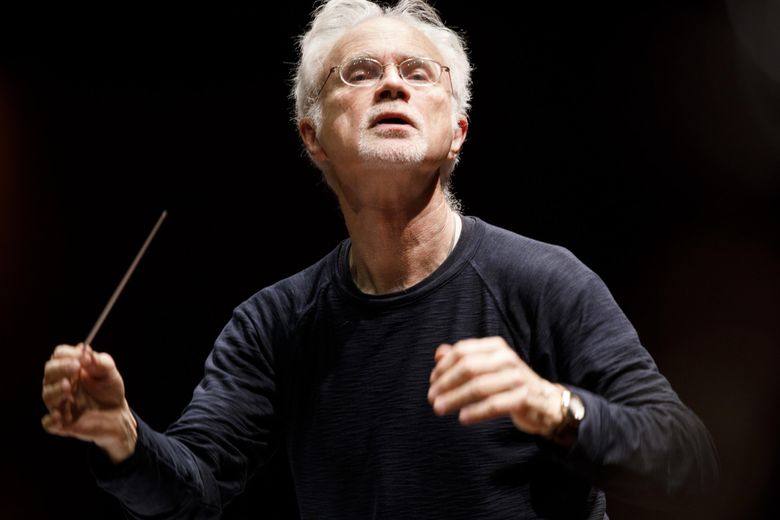
Composer and conductor John Adams returns to Seattle Jan. 6 and 8, his fourth round with Seattle Symphony since making his podium debut here in 2004. (Musacchio-Ianniello-Pasqualini)
Here’s my latest Seattle Timesstory, about John Adams as composer and conductor:
Seattle Symphony audiences have another reason to be proud of their band…
I’m looking forward to this program with Seattle Symphony — and to the next chance to hear associate conductor Lee Mills in action, having been deeply impressed by his last-minute stand-in performance for an incredibly challenging program in November, which featured a world premiere by Hannah Lash and a rarity from Amy Beach.
Regarding Mozart’s take on Handel, Lindsay Kemp offers a helpful summary here of the profound effect that Baron van Swieten’s collection of Baroque music had on the composer. Van Swieten held private concerts in Vienna to explore choral music from the past and “invited Mozart to prepare new performing editions of a group of Handel oratorios…Doubtless Mozart was glad of the money, but, far from being workaday, the job he carried out on the scores is careful and considered, clearly born out of respect for Handel’s skill and creative personality.”
Kemp writes: “His main objective was to recast Handel’s music — whose original Baroque orchestral line-up of strings, oboes and bassoon and occasional brass and timpani would have seemed a little thin to Classical ears — for an up-to-date ensemble which added flutes, clarinets and horns. He thus brings a warm Viennese glow to the music, but in places Mozart also added his own gloss to events, as for instance in Messiah when he adds a contrapuntal shadow to the stark unison accompaniment of ‘The people that walked in darkness’…..”