MEMETERIA by Thomas May

Music & the Arts

Stile Antico’s Homage to Shakespeare

I happily recall the British early music vocal ensemble Stile Antico’s first visit to Seattle over four years ago. On 9 April they return, under the auspices of the Early Music Guild, for a program titled The Touches of Sweet Harmony:  The Musical World of William Shakespeare.

The ensemble describes their program as follows:

“To mark of the 400th anniversary of the death of William Shakespeare, Stile Antico performs a mouthwatering program of Elizabethan and Jacobean music. In addition to settings of words from Shakespeare’s plays, we encounter music written for the great events of his life or which explore some of the themes of his work. Completing this fascinating picture are Shakespeare-texted works by Huw Watkins and Nico Muhly, written especially for Stile Antico.”

Filed under: early music, Shakespeare

Nothing Human Is Alien: A Poignant Mother Courage and Her Children at Seattle Shakespeare

 Trick Danneker, Chesa Greene, Jeanne Paulsen, and Spencer Hamp; photo by John Ulman

Trick Danneker, Chesa Greene, Jeanne Paulsen, and Spencer Hamp; photo by John Ulman

One of the shows on my personal most-anticipated list for the season opened Friday, and I’m still digesting the experience. Staging Mother Courage and Her Children, which is on the boards now at Seattle Shakespeare Company, is not an effort to be undertaken lightly. This is, aside from their 2011 production of The Threepenny Opera, Seattle Shakes’ first time out with the work of Bertolt Brecht.

Obviously at home with the dislocations and built-in “alienation effects” inherent in Shakespearean dramaturgy, the company brings to the challenge a valuable perspective from its long experience with the Bard.

An unconventional, class-focused production of Coriolanus that Bertolt Brecht saw in Berlin in the 1920s (directed by Erich Engel) was, after all, one of the formative influences on the German playwright’s ideas for a radically new kind of theater.

Directed by Jeff Steitzer, this production uses the acclaimed translation David Hare prepared for a Royal National Theatre production in 1995 (directed by Jonathan Kent).

That choice establishes a basic interpretive grid from the outset. Hare’s version underlines the caustic, cynical humor of the text, mostly leavening any hint of preachiness in the longer philosophical asides with a theatrical tartness reminiscent of Samuel Beckett. Could it be that some variety of humor — the more acid-etched, the better — is our preferred modern form of “alienation”?

A couple of topical references depressingly bring home how little has changed over the past two decades. In fact the most “Brechtian” aspect of this Mother Courage might be how it shows the ease with which the condition of war becomes normalized — in the ways it gets talked, even joked, about, justified, maneuvered around.

No matter how far we like to think we’ve advanced since Brecht’s masterpiece was first produced in 1941 (in neutral Zurich, in the middle of war-torn Europe) — or since the play’s setting in the Thirty Years’ War (1618-48), for that matter — the headline news of today’s refugees unnervingly echoes the grim plight of those caught up in those historical conflicts.

Jeanne Paulsen as Mother Courage; photo by John Ulman

Jeanne Paulsen as Mother Courage; photo by John Ulman

Mother Courage is a play, and a project, riddled with paradoxes that are necessarily insoluble — starting with Brecht’s theoretical aims versus realizing the play in praxis. One of these is the (very Shakespearean) ensemble nature of the work which at the same time requires a “star” quality performance to make the role of Anna Fierling (nicknamed “Mother Courage”) work properly.

That’s what Jeanne Paulsen delivers in her unflinching, gritty, sentimentality-proof portrayal of the intrepid matriarch whose idée fixe is to make a living and get her three children — Eilif, Swiss Cheese, and Kattrin — through the war.

But the living she makes by trading from her moveable canteen turns out to be most profitable when nations are at war, so Mother Courage is not to be thought of merely as a pitiable victim of the violence — even if she ends up losing all three children to it.

That’s the paradox anyone who takes on the role has to cope with, and Paulsen emphasizes how this contradiction has hardened Anna into a position where her own cynicism is among her most potent weapons of self-defense.

Paulsen’s steely-tempered Anna delivers her repartees with the deadpan timing of a 17th-century Bea Arthur. She has no need of a Shakespearean fool — it’s the character inside her who comes out with devastatingly witty responses to the war. We see Paulsen’s Mother Courage endure unbearably cruel experiences, yet at her core she’s already been numbed from the beginning.

Seattle Shakes has assembled an admirably strong cast to counterbalance Anna’s powerful personality with other vivid character portrayals and effectively paced ensemble work.

R. Hamilton Wright and Larry Paulsen; photo by John Ulman

R. Hamilton Wright and Larry Paulsen; photo by John Ulman

Trick Danneker gives the elder son Eilif a touch of a dark-spirited Candide, swiftly corrupted by his success at slaughter but too slow to learn the rule of moral relativism that holds sway. Spencer Hemp plays the good-natured Swiss Cheese like the ill-fated hero of a Brechtian fable. As the mute, genuinely heroic daughter Kattrin (in a world where heroism is a sick joke), Chesa Greene does superb work inhabiting her character to life with only gestures and body language.

Larry Paulsen, who accompanies Mother Courage through many of the play’s peripatetic sequence of scenes, reveals the complexity Brecht built into the Chaplain — exactly the sort of character you initially expect to remain a nasty caricature of the evils of religion doubling as an excuse-maker for war. While he doesn’t disguise the Chaplain’s cowardice and opportunism, Paulsen underscores his contradictions, which are almost as imposing as Anna’s — including a sense of compassion he develops in contrast to her stuck-in-place cold-heartedness.

R. Hamilton Wright makes a terrific Cook, an everyman with a well-developed carapace of cynicism as well as a philosophical streak that can match Anna. Alyssa Keene’s Yvette, showing her own ways to profit from the war, also brings to mind a few scenes of Candide in her cartoonish arc from pneumatic camp prostitute to plump, rich widow.

Reacting to the first of her children’s deaths (just before the one intermission taken in this production), Paulsen retreats inside her wagon and lets out a searing cry of anguish — heard but never seen, for as Mother Courage her entire survival strategy requires a constant facade of acting, never revealing true emotion.
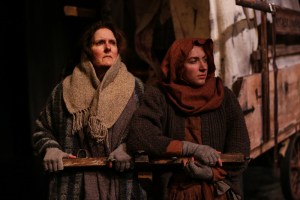
Jeanne Paulsen and Chesa Greene; photo by John Ulman

Jeanne Paulsen and Chesa Greene; photo by John Ulman

It’s a wrenching moment that crystallizes the larger issue that looms over any production of this play: the paradox of Brecht’s epic theater of ironic emotional detachment versus the urge to feel sympathy for Anna. Steitzer’s staging essentially opts to set this contradiction aside, with only a few token efforts at creating “alienation”: the bare-bones set design with curtain (Craig B. Wollam) and some over-the-top stylizations of ancillary characters like the Commander-in-Chief Bill Johns) who mentors his young warrior Eilif.

Otherwise the dramaturgy and design (including Doris Black’s period costumes and Rick Paulsen’s lighting) aren’t really too far off from the staging of a Shakespeare play.

The one area where I’d most expect the distancing to be played up — the songs — represents the production’s weakest aspect. Oddly, there’s no clear credit in the program for the composer of the new songs (not Paul Dessau’s), just a reference to Robertson Witmer for “music arrangements.” In any case, the score offers little more than pallid imitation Kurt Weill. The pre-recorded tracks sound a bit too canned and, not surprisingly, inspire lackluster singing at best. (Seattle Shakes’ blog posts a playlist of songs from various Brecht plays.)

That aside, Seattle Shakes has achieved a powerful and thoroughly engaging theatrical interpretation of a show that tends to be more revered as a “classic” than actually experienced, particularly by American audiences. Anyone bothered by the deviations from Brecht’s principles would do well to remember that the playwright himself believed the classics like Shakespeare only survived through “sacrilege.”

If you go: Seattle Shakespeare’s production of Mother Courage and Her Children plays at the Center Theatre at Seattle Center (305 Harrison Street, Seattle) through 22 November 2015. Tickets here.

–(c)2015 Thomas May. All rights reserved.

Filed under: Brecht, review, Shakespeare, theater

Shakespeare in “Translation”

facelift

Stop right there: “Most educated people are uncomfortable admitting that Shakespeare’s language often feels more medicinal than enlightening.”

This absurd claim (“medicinal”??) is just one of the hopelessly faulty assumptions in John H. McWhorter’s Wall Street Journal piece “A Facelift for Shakespeare”, which attempts to argue the case for “translating” all of Shakespeare’s plays into contemporary English — an initiative commissioned by the Oregon Shakespeare Festival — “because Shakespeare’s English is so far removed from the English of 2015 that it often interferes [sic] with our own comprehension.”

This is the level of argument McWhorter puts forward: “It is true that translated Shakespeare is no longer Shakespeare in the strictest [sic] sense.”

Let’s not forget to rewrite those passages that make us “uncomfortable,” right? After all, they gave King Lear a happy ending back in the Restoration.

And why hesitate when it comes to the other arts? I guess Walter Murphy was way ahead of his time in 1976 when he translated Beethoven’s Fifth Symphony to “A Fifth of Beethoven,” making it safe and trigger-free for the disco era:

https://www.youtube.com/watch?v=4MFbn8EbB4k

Filed under: Beethoven, Shakespeare, stupid ideas

Hughes, Shakespeare, and the Goddess

Goddess

There’s no shortage of “upstart crows” when it comes to Shakespeare studies: scholar-mavericks who challenge the self-appointed gatekeepers in academia. And it’s no surprise that (after discounting the obvious crackpots) many of these turn out to offer little more than half-baked theories that crumble under closer scrutiny.

But one of the most significant unconventional readings of Shakespeare of recent years belongs to a class of its own: the poet Ted Hughes’ Shakespeare and the Goddess of Complete Being. Is this a truly paradigm-shifting vision or an absurdly reductive idea that sacrifices too much to in pursuit of a “hedgehog” theory?

Ann Skea offers a sympathetic portrayal of the scope of Hughs’ great project:

In his long introduction, Ted outlined the religious and psychological conflict caused by the Calvinist Puritan suppression of Old Catholicism in which the goddess of earlier pagan beliefs still flourished. The religious aspect of this conflict was particularly relevant during Shakespeare’s lifetime, but the universal psychological aspect of the suppression of natural human energies, especially sexual and imaginative energies, is clear to see.

It was in Ted’s writing on Shakespeare that what he called “the tragic equation” was explicated: the love goddess, enraged by the puritanical suppression of sexual energies, becomes the ‘Queen of Hell’ – the demonised boar who destroys the hero.

[…]

Much of Ted’s discussion of Shakespeare’s ‘great theme’ can be traced back to [Robert] Graves’ arguments in “The White Goddess,” but the psychological aspect of Ted’s “tragic equation” shows just how much he was also influenced by the work of Carl Jung.

[…]

Ted was well aware that Shakespeare and the Goddess of Complete Being was a difficult book: difficult to write and, for some readers, difficult to read… Ted’s own knot of obsessions meant he was uniquely qualified to recognise an underlying theme that others had never noticed…Most importantly, he was a poet bringing his poetic sensibilities to the work of another poet; and in the whole body of Shakespeare’s work he recognised a progressive exploration of many of his own beliefs, difficulties and questions.

Filed under: poetry, Shakespeare, theater

A Shakespeare Forgery or Rediscovery? The Latest Take on Double Falsehood

Shakespeare

The controversy over the play known as Double Falsehood; or, The Distrest Lovers — a 1727 drama by Lewis Theobald (1688–1744) — is back in the news. Theobald famously claimed he’d adapted his play from a now-lost Shakespeare manuscript, and scholars have been at it ever since. It turns out that Double Falsehood likely represents double authorship.

Based on an episode from Cervantes’ Don Quixote — who died less than two weeks before Shakespeare (if you adjust the traditional date of the Bard’s death to the Gregorian calendar) — Double Falsehood is also one of the candidates that has been speculatively identified with the long-lost play known as The History of Cardenio. The latter play is believed to have been a collaboration between Shakespeare and John Fletcher, a playwright for the King’s Men company. Cardenio was performed by the company in 1613 but was subsequently lost.

The controversy over Double Falsehood is therefore hardly new; nor is the more or less definitive claim of Shakespearean involvement. But this latest crack at identifying Falsehood‘s true authorship uses the tools of modern psychology and linguistic statistics.

Most of the news reports refer to the authors of the study by the catchall term “researchers at the University of Texas in Austin.” It’s worth nothing that said researchers — Ryan L. Boyd and James W. Pennebaker — are actually professors of psychology, not literary critics or Elizabethan scholars. Their research has been published in the journal Psychological Science.

From the Abstract:

Specifically, we created a psychological signature from each author’s language and statistically compared the features of each signature with those of “Double Falsehood”’s signature. Multiple analytic approaches converged in suggesting that “Double Falsehood”’s psychological style and content architecture predominantly resemble those of Shakespeare, showing some similarity with Fletcher’s signature and only traces of Theobald’s.

Closer inspection revealed that Shakespeare’s influence is most apparent early in the play, whereas Fletcher’s is most apparent in later acts. “Double Falsehood” has a psychological signature consistent with that expected to be present in the long-lost play “The History of Cardenio,” cowritten by Shakespeare and Fletcher.

Soon after Theobald made his claim in the 18th century, Alexander Pope declared it must be a forgery, and there will surely be skeptics who remain unpersuaded by this latest analysis. Still, the method of a kind of creating a kind textual psychological profile to identify Shakespeare’s “Weltanschauung” is pretty intriguing.

Now if only they could devise a study to put to rest the silly claims of the Shakespeare truthers once and for all…

Filed under: Shakespeare

Sigmund Shakespeare

Measure
Steven Pinker has published a thought-provoking essay titled “Shakespeare: One of the First and Greatest Psychologists”.

Pinker focuses specifically on the scene in which Isabella pleads to the puritanical interim authority Angelo to spare her brother Claudio’s life in Measure for Measure (which is currently playing in a Seattle Shakespeare production directed by Desdemona Chiang):

Isabella compares the administration of an idealized divine justice with the all-too-fallible human justice. She reminds us that humans are capable of meting out patently cruel and pointless punishment judgments with complete confidence they are doing the right thing.

Aside from Shakespeare’s ceaselessly relevant “universality,” Pinker points to how uncannily spot-on he is with regard to the findings of contemporary psychologists:

Worse still, we humans are the last to notice our own limited nature. In seven words, Shakespeare sums up a good portion of the findings of modern psychology: “most ignorant of what he’s most assured.”

A recurring discovery of social and cognitive psychology is that human beings are absurdly overconfident in their own knowledge, wisdom, and rectitude. Everyone thinks that he or she is in the right, and that the people they disagree with are stupid, stubborn, and ignorant.

People reliably overestimate their own knowledge, and misjudge their own accuracy at making predictions. A common theme of both Shakespeare and modern social psychology is the human species’ overconfidence.

On the Bard’s use of his psychological insight to intensify the drama:

These two perspectives — that of the perpetrator or scientist, and that of the victim or moralist — color every analysis of human behavior. And here, we see Shakespeare suddenly flipping from one to the other for dramatic effect.

Filed under: directors, Shakespeare

Another Wagner Comedy

No, Die Meistersinger is not Wagner’s only comic opera. Ahead of Seattle Shakespeare Company’s new production of Measure for Measure, here’s a taste of the German’s operatic take on this “problem comedy.”

Reviewing a production of The Ban on Love at Glimmerglass Festival back in 2008, the critic Philip Kennicott remarked that this youthful outing “is 99 percent a study in everything the mature Wagner is not.”

Kennicott goes on to note:

Wagner turned away from so much of the spirited energy he let loose in “Liebesverbot.” When it premiered in 1836, he stood, briefly, for free love and revolution and the creative destruction of the collective libido. By the end of his life, in 1883, he viewed sexuality as a kind of sickness, and his final work, “Parsifal,” celebrated a monkish cult of men devoted to celibacy and arcane religious rituals.

[…]

“Liebesverbot” is fascinating — not because Wagner discarded its musical and ethical worldview, but because he would spend his life thrashing its remnants out of himself.

Filed under: Shakespeare, Wagner

Dazed, Confused, and Lovestruck: Twelfth Night at Seattle Shakespeare

Jay Myers as Orsino and Allie Pratt as Viola. Photo by John Ulman.

Jay Myers as Orsino and Allie Pratt as Viola. Photo by John Ulman.

“Why, this is very midsummer madness!” exclaims Countess Olivia in the middle of Twelfth Night — just as the whirligigs of the plot against Malvolio start cranking away. Olivia’s normally uptight steward has been set up to believe his boss is suddenly overcome with uncontrollable passion for him and is putting on a display that makes for one of the most outrageously funny scenes in all Shakespeare.

But Malvolio’s (David Quicksall) crazed behavior is easily matched by the antics indulged in by Olivia herself (Elinor Gunn) in Seattle Shakespeare Company’s deliriously unconventional new production, which opened this past weekend and which plays through Nov. 16 at the Center Theatre at Seattle Center. Visiting director Jon Kretzu approaches Twelfth Night as if it were a vastly elaborated version of the nocturnal spell cast in the Bard’s decade-earlier A Midsummer Night’s Dream. Just about everyone seems to wander about in a woozy haze of confused, mismatched desire.

continue reading

Filed under: directors, review, Shakespeare

All Joy of the Worm

Cleopatra Bitten by the Asp, Guido Reni

Cleopatra Bitten by the Asp, Guido Reni

“I wish you all joy of the worm,” says the Clown bearing a fatal asp just before the final climax of Shakespeare’s Antony and Cleopatra. What a strange scene – a clown, with all his Shakespearean-fool punnery, malapropisms, and word games.

And there’s no equivalent of the Bard’s source, Plutarch. What to make of the tone, the odd insistence on the image of the “worm”?

Richard F. Whalen deciphers evidence for the theory that Shakespeare was really the Earl of Oxford: “‘worm’ in French is ‘ver’ — and, of course, the Earl of Oxford’s family name was de Vere.”

Others perceive Masonic symbolism.

In her biography of a few years ago, Stacy Shiff reminds us of Cleopatra’s own identification with an asp:

Cleopatra unsettles more as sage than as seductress; it is less threatening to believe her fatally attractive than fatally intelligent. (Menander’s fourth-century adage — ‘A man who teaches a woman to write should recognize that he is providing poison to an asp’ — was still copied out by schoolchildren hundreds of years after her death.

But what of the Clown’s phallic punning?

From the ending of Ted Hughes’s poem Cleopatra to the Asp:

Drink me, now, whole, with coiled Egypt’s past
Then from my delta swim
Like a fish toward Rome.

Filed under: Shakespeare

Speak What We Feel: King Lear at Seattle Shakes

Blow, winds, and crack your cheeks!

“Blow, winds, and crack your cheeks!” Dan Kremer as King Lear; photo by John Ulman

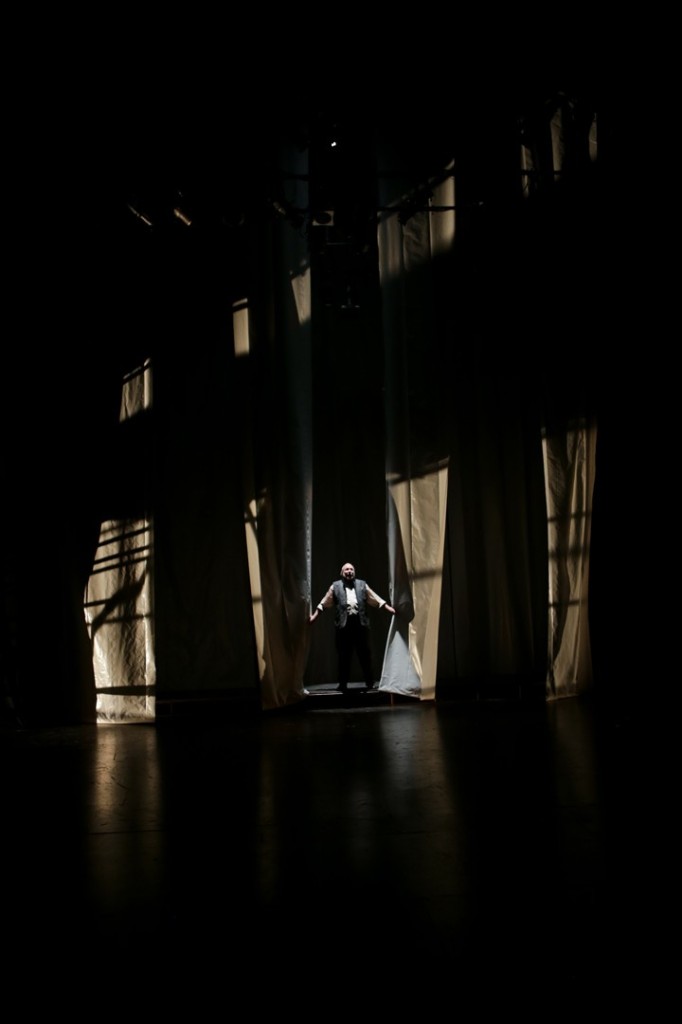
To grapple with the challenge of staging King Lear has to be the Shakespearean equivalent of trying to produce an entire Ring cycle. The play is so vast, so all-encompassing, its web of theatrical and emotional motifs so intricately woven, that it’s no wonder old-fashioned — well, OK, ancient — critical opinion deemed the play simply “too huge for the stage” (A.C. Bradley).

But visionary productions over the past century have dispelled that misgiving. Or maybe it’s just that the course the world itself has undergone makes us more receptive to Lear‘s devastating dramatic truths. Sometimes it almost seems as if Shakespeare had written the script for our times — and we’re just bumbling along, trying to act it out. Things don’t just fall apart; they coil toward entropy.

In Seattle Shakespeare’s new production, the play’s apocalyptic dimensions are essentially eclipsed by the familial — and all-too-familiar — realism of dysfunctional relationships and personal psychology.

Linda K. Morris, Patrick Allcorn, and Dan Kremer; photo  by John Ulman

Linda K. Morris, Patrick Allcorn, and Dan Kremer; photo by John Ulman

Director Sheila Daniels conceives the tragedy as an intimate echo chamber of unstable characters who are progressively losing it. What they undergo entails a series of variations on the theme of Lear’s crack-up. Scene by scene (with the whole divided here into three acts), their attempts to impose order on events, to get closer to their desires, become increasingly desperate. The overriding impression isn’t so much of the grim inevitability of consequences — Shakespeare’s merciless updating of classical “fate” — as of psychological meltdown.

As the ex-monarch, Dan Kremer underscores this approach through the unpredictable variability of his temper. It works very well for the first sections of the play — particularly in how it clarifies the relationship between Lear and his daughters that has already charted the course of the tragedy long before it begins.

We see how Goneril (Linda K. Morris) and Regan (Debra Pralle), given neatly differentiated portrayals here, aren’t just self-serving but have been brought up to fear daddy’s mercurial outbursts. Elinor Gunn’s Cordelia shows a steely stubbornness she must have learned first-hand. That’s what keeps her from seeing the danger she puts herself in — not a martyr complex to speak truth to power.

As for their husbands, while the Duke of Cornwall compresses into a sadistic psychopath (Gordon Carpenter), Shakespeare gives amplitude to the Duke of Albany (Patrick Allcorn) to grow in self-awareness and influence.

What lacks the needed emotional force are the actual climaxes marking each way-station in Lear’s descent. Kremer’s scene on the heath becomes just another fit, his verbal torrent more a fest of self-pity. By the same token, the Lear Kremer depicts in the final scenes fails to stir any deeper pity than he already has at the beginning of his long humiliation.

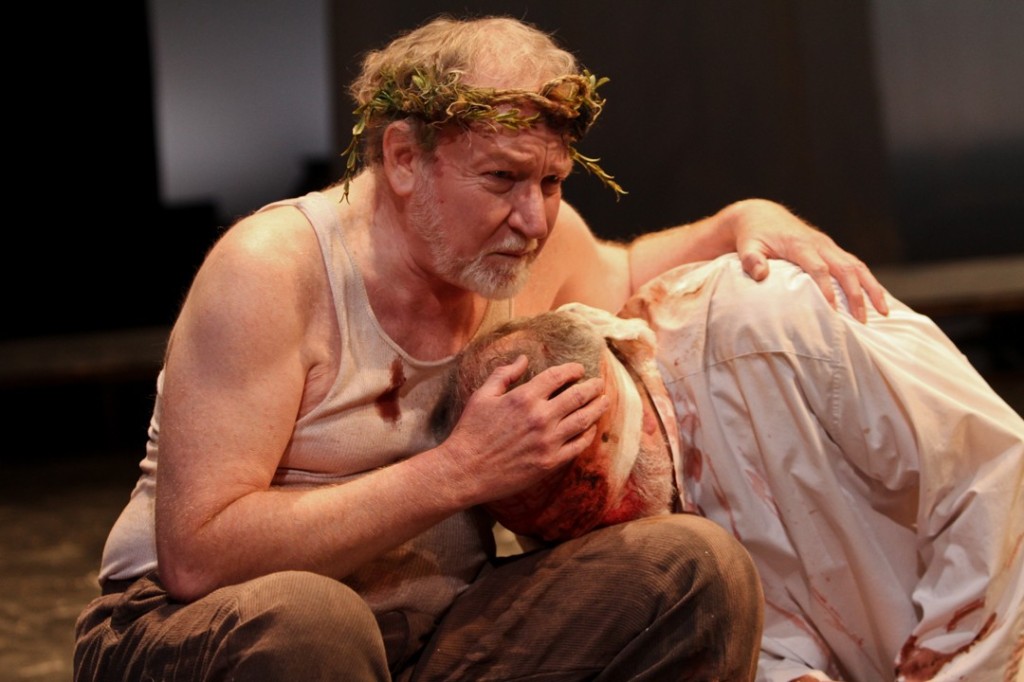
Kremer is more compelling in his interactions with “the other half” — with the fellow victims of ruin who never seem to faze him as they cross his path and all head toward the final confrontations at Dover. His reunion scene with the blinded Gloucester (Michael Winters) is especially resonant in its unsettling blend of horror and comic absurdity.

Dan Kremer and Michael Winters in Seattle Shakespeare Company’s production of “King Lear.” Photo by John Ulman

Dan Kremer and Michael Winters; photo by John Ulman

Some stand-out performances by others in the cast tilt the focus of the play in interestingly unexpected directions. Eric Riedmann’s chillingly embittered Edmund — possibly the most accomplished single interpretation — conveys the malign intelligence of a Iago yet always feels human. It’s one of Daniels’ strengths to clarify each character’s motivations in a way that makes them psychologically persuasive, further emphasizing the intimacy of family connections in this production.

Riedmann moreover revels in Shakespeare’s poetry, articulating its sonorities and rhythms with a relish and variety I wish were not otherwise the exception in this cast. The only misstep is the close-to-campy exaggeration of the sexual dalliance between him and Regan.

Linda K. Morris and Eric Riedmann in Seattle Shakespeare Company’s production of “King Lear.” Photo by John Ulman

Linda K. Morris and Eric Riedmann; photo by John Ulman

Winters makes Gloucester’s wishful gullibility work, and the scenes with his two sons are among the most vividly realized. In his guise as Poor Tom, Jorge Chacon draws on physical hints he’s shown us as the nervous if good-natured Edgar.

King Lear is notable for the overdetermination of the fool archetype. Along with the official fool (Todd Jefferson Moore), the disguised Kent (played as a “Duchess” by the splendid Amy Thone) and Poor Tom on the heath reinforce the fool’s function of bearing witness to the truth as they retreat most deeply into their roles. Thone and Jefferson have a winning dynamic together and help re-introduce some of the play’s larger perspectives — particularly, its obsession with the power of language to shape reality, both positively and negatively. This is what gives the humor they interject its edge.

After all, they continue to subject Lear to the treatment that outraged him when it came from Cordelia. But even to “speak what we feel” is a kind of rhetoric, if the mirror side of Lear’s fulminations and curses. Language is the one thing the dispossessed king is left with — the very language he obviously abused throughout his reign.

Dan Kremer, Craig Peterson, Sophie Paterson, Amy Thone, and Jonathan Crimeni in Seattle Shakespeare Company’s production of “King Lear.” Photo by John Ulman.

Dan Kremer, Craig Peterson, Sophie Paterson, Amy Thone, and Jonathan Crimeni; photo by John Ulman

The scenic conception is notably weak and lags far behind the many fine nuances of the ensemble’s acting. Daniels, who collaborated with set designer Craig Wollam, opts for a colorless, ultra-minimalist playing space with a backdrop of hanging plastic and linen sheets and a scaffold that rolls to and fro. It is a way of making the stage the world, but the process of stripping away so essential to the play’s arc has already happened by the start.

Melanie Burgess’s abstract-pattern, cheerless costumes seem out of sync with the high contrasts of Jessica Trundy’s lighting. I do like the effect of cruel illumination upon the arrival at Dover, but the veer toward a horizontal Rothko glow at the end puzzles. Robertson Witmer picks up on the script’s references to drums to create a sternly percussive sound design.

Seattle Shakespeare Company’s production of King Lear plays through May 17 at the Cornish Playhouse (formerly Intiman) at Seattle Center, Wed. – Sun. Tickets here or call 206 733-8222.

(c)2014 Thomas May. All rights reserved.

Filed under: directors, review, Shakespeare, theater

Archive

Enter your email address to follow this blog and receive notifications of new posts by email.