MEMETERIA by Thomas May

Music & the Arts

Salonen with the Parisians in Lucerne

Big news this week: just after Esa-Pekka Salonen wrapped up his Lucerne Festival visit with the Orchestre de Paris, it was announced that he has been named the ensemble’s Chief Conductor starting in 2027. Parallel to that, he’ll become the take up the new Creativity and Innovation Chair of the Philharmonie de Paris. Salonen’s collaboration with the orchestra in Lucerne offered a vivid taste of that future partnership in two very different programs last weekend.

In the first, Augustin Hadelich was the soloist in an account of the Brahms concerto notable for its shadowed lyricism and spacious pacing, illuminating the score’s darker hues. Hadelich played his own cadenza and his arrangement of a Carlos Gardel tango as a steam-vent of an encore following such intensity. If Salonen brought structural clarity to the Brahms, the suite from Prokofiev’s ‘Romeo and Juliet’ that followed surged with dramatic sweep. The episodes seemed to unfold as part of an inexorable tragic arc rather than a set of contrasting miniatures.

His second evening with the Paris musicians revealed a touch more humor alongside the testosterone of ‘Don Juan’. But all that Straussian horn-iness set the stage for the much-anticipated world premiere of Salonen’s own Horn Concerto written for Berliner Philharmoniker principal Stefan Dohr. It’s a big piece, heroic in its way and abounding in the composer’s deep knowledge of the literature across music history, especially Mozart, Beethoven, and Bruckner (Salonen also trained as a horn player). He colorfully remarked that these moments from the musical past ‘appear and disappear like fish coming to the surface to catch an insect before diving to the depths of the sea again’.

The concerto teems with exposed solo passages that seem to test the limits of breath and control — not to mention imagination, indispensable to giving expressive shape to Salonen’s fertile ideas. Around the horn, the orchestra cast a kaleidoscope of refined colors. The concerto will travel widely in the coming months, so I hope to get a chance for more encounters.

Horn sounds resounded still again, sublimely, in the Sibelius Fifth. Salonen’s control of the art of transition, with subtly judged but dramatically thrilling accelerando, was a marvel. For all the monumentality of the closing chords, I fancied amid their awe an echo of mortality, like the trees being felled at the end of ‘The Cherry Orchard’. But the solace of Sibelius’s glorious Swan Theme circled in the mind’s ear as the swans on Lake Lucerne outside the KKL glided serenely by in serene silence.

Filed under: Esa-Pekka Salonen, Lucerne Festival, music news, Sibelius, , , , ,

Adès Conducts Adès

Here’s the essay I wrote for the Cleveland Orchestra’s program this week featuring guest conductor and composer Thomas Adès:

Among the preeminent composers of our era, Thomas Adès has likened the practice of creating art — whether music, literature, or painting — to fashioning “a simulacrum of the real world, a reflection”…

continue

Filed under: Charles Ives, conductors, program notes, Saariaho, Sibelius, Thomas Adès

All in the Family

Guest conductor Dalia Stasevska leads the Seattle Symphony and electric bass soloist Lauri Porra; photo (c) Brandon Patoc

My review of this weekend’s program with guest conductor Dalia Stasevska:

Having missed Stasevska’s SSO debut in March 2022 — a week after Putin invaded Ukraine, the country in which she was born — I was particularly interested in experiencing what all the fuss is about firsthand. Her ability to transmit a sense of focused, joyful discovery while shaping a performance impressed me. The charisma is real. …

continue

Filed under: new music, preview, Seattle Symphony, Sibelius

Rachel Barton Pine and Kristiina Poska Dazzle with the Royal Scottish National Orchestra

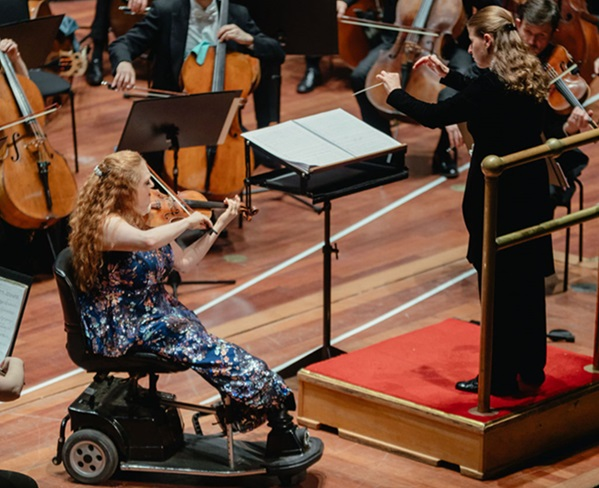
Kristiina Poska conducts violinist Rachel Barton Pine and the RSNO © Leighanne Evelyn Photography

I had the pleasure of covering the Royal Scottish National Orchestra’s latest concert in Edinburgh, which featured two guest artists in remarkable sync:

Although the most recent work on this weekend’s Royal Scottish National Orchestra programme dates from 1952, audiences are still just beginning to make its acquaintance. The ongoing reappraisal of the twentieth-century African American composer Florence Price would not be possible without the contributions of performers who have championed her music….

continue

Filed under: Aaron Copland, conductors, Florence Price, review, Sibelius, violinists

Abdullah, Hadelich, and the Seattle Symphony Offer a Winter-Conquering Musical Feast

Augustin Hadelich, Kazem Abdullah, and the Seattle Symphony; photo (c) Brandon Patoc

Kazem Abdullah’s Seattle Symphony debut included Sibelius, Britten, and a brand-new work by Dai Fujikura. Here’s my review for Bachtrack:

Framed by early and late Sibelius, this luminous program pushed the pause button on dank winter anxieties. A warm bond developed between debuting guest conductor Kazem Abdullah and the Seattle Symphony musicians during the course of the concert, reaching incandescence in their cloud-busting account of the Finnish composer’s Seventh Symphony.

continue

Filed under: Britten, commissions, conductors, Seattle Symphony, Sibelius

Morlot Leads the Next Chapter in the Seattle Symphony’s Sibelius Adventure

Ludovic Morlot reunites with the Seattle Symphony (image: Nick Klein)

For the second installment in the Seattle Symphony’s Sibelius cycle, emeritus conductor Ludovic Morlot rejoined the orchestra to lead a program centered around the Second Symphony. The occasion inspired some spectacular, edge-of-your-seat playing on Thursday night.

The concert started off with another in the series of commissions of new works from contemporary composers that find a way to “relate” to each of the Sibelius symphonies. In February, when the cycle launched with the Sibelius First (conducted by the talented Ruth Reinhardt), the pairing presented an intriguingly provocative new piece by Ellen Reid. The Puerto Rican composer Angélica Negrón faced the challenge of responding to what is, for many Sibelius fans, the best-loved of the seven symphonies. Color Shape Transmission, the result, offers an imaginatively fresh take on the phenomenon of acoustic space and the orchestra as a kind of mobile aural sculpture. Negrón spins her vast array of forces into a kaleidoscope of mysterious timbres, rapturously sustained clusters, and subtle echo and richochet effects. The impression of a ritual or procession brought to mind the mystery of the Second Symphony’s Andante, with its walking bass and swelling hymn.

I seem to recall that this program had originally been planned to include Sibelius’s Violin Concerto with Isabelle Faust. She was the soloist in Stravinsky’s contribution to the genre instead, but it was a wonderful match and proved captivating from first note to last. Faust displayed multiple personalities, all equally convincing, in Stravinsky’s one-of-a-kind take on the concerto idea: alternately cheeky, heart-breaking, whimsical, and invigorating. Morlot’s tenure with the SSO included some especially memorable encounters with Stravinsky, so it was gratifying to find him shedding light on a different aspect of the composer, tending so carefully to his piquant timbral combinations of woodwinds and soloist; concertmaster Noah Geller matched Faust’s ravishing tone in the duet between both violinists in the Capriccio finale.

But what left the most resounding impression was the epic sweep conveyed by the Second Symphony. In this account, Morlot navigated the SSO through Sibelius’s drastic transformations of landscape with a convincing sense of purpose. Sunlight shifting on the meadows, impending storms, glorious new vistas opened up — the sonic imagery flowed generously, but Morlot shaped its ebbs and flows with architectural understanding, aside from the occasional haze produced by a passing sonic imbalance. He homed in on Sibelius’s use of tension and release to thrilling effect.

In his excellent program notes, Christopher DeLaurenti points out that Sibelius had little use for the political purposes which his work seemed to serve, while at the same time hinting at the Second’s uncanny relevance for the terrible present moment. Its premiere in 1902, he writes, “was welcomed by the Finnish public as a missive of nationalist resilience against their Russian overlords.” He also quotes the composer’s friend and champion Robert Kajanus hailing the Second as “a broken-hearted protest against all the injustice that threatens at the present time to deprive the sun of its light and our flowers of their scent.” Grasping the music’s agonized heroism, this performance invested the final moments of the Second with cathartic grandeur.

The full program will be performed again on Saturday, 9 April, at 8pm. If you need a dose of hope, don’t miss it.

Filed under: commissions, Ludovic Morlot, Seattle Symphony, Sibelius, Uncategorized

Dausgaard and Seattle Symphony Take on an Early Sibelius Epic

84319-1617-concerts-dausgaard-0091-credit-brandon-patoc

photo: Brandon Patoc

My review for Bachtrack of Thomas Dausgaard and the Seattle Symphony in Sibelius’s Kullervo:
On 28 April 1892, when he was only 26, Jean Sibelius unveiled Kullervo to the public. Its triumph established both his career as a composer and his reputation as Finland’s musical bard…

continue reading

Filed under: review, Seattle Symphony, Sibelius, Thomas Dausgaard

Sibelius: Kullervo

Today’s listening, preparing for this weekend’s Seattle Symphony program.

Filed under: Seattle Symphony, Sibelius

Sibelius at the Piano

“For one thing — and, given the era, it was no small achievement — Sibelius never wrote against the grain of the keyboard. At its best, his style partook of that spare, bleak, motivically stingy counterpoint that nobody south of the Baltic ever seems to write.” –Glenn Gould

Filed under: piano, Sibelius

A Primer in the Romantic Spirit from Seattle Symphony

khachatryan-12Sergey Khachatryan. Image courtesy of Seattle Symphony.

My review of this weekend’s Seattle Symphony program with Ludovic Morlot and violinist Sergey Khachatryan is now live on Vanguard Seattle:

The Seattle Symphony Orchestra (SSO)’s sixth season with Music Director Ludovic Morlot has so far included a pair of electrifying programs that paired world premiere commissions by composers of today with Beethoven classics—the latter part of an ongoing two-year cycle of the composer’s complete symphonies and piano concertos.

continue reading

Filed under: Berlioz, Ludovic Morlot, review, Seattle Symphony, Sibelius, Tchaikovsky, Vanguard Seattle

Archive

Enter your email address to follow this blog and receive notifications of new posts by email.