There’s no shortage of “upstart crows” when it comes to Shakespeare studies: scholar-mavericks who challenge the self-appointed gatekeepers in academia. And it’s no surprise that (after discounting the obvious crackpots) many of these turn out to offer little more than half-baked theories that crumble under closer scrutiny.
But one of the most significant unconventional readings of Shakespeare of recent years belongs to a class of its own: the poet Ted Hughes’ Shakespeare and the Goddess of Complete Being. Is this a truly paradigm-shifting vision or an absurdly reductive idea that sacrifices too much to in pursuit of a “hedgehog” theory?
In his long introduction, Ted outlined the religious and psychological conflict caused by the Calvinist Puritan suppression of Old Catholicism in which the goddess of earlier pagan beliefs still flourished. The religious aspect of this conflict was particularly relevant during Shakespeare’s lifetime, but the universal psychological aspect of the suppression of natural human energies, especially sexual and imaginative energies, is clear to see.
It was in Ted’s writing on Shakespeare that what he called “the tragic equation” was explicated: the love goddess, enraged by the puritanical suppression of sexual energies, becomes the ‘Queen of Hell’ – the demonised boar who destroys the hero.
[…]
Much of Ted’s discussion of Shakespeare’s ‘great theme’ can be traced back to [Robert] Graves’ arguments in “The White Goddess,” but the psychological aspect of Ted’s “tragic equation” shows just how much he was also influenced by the work of Carl Jung.
[…]
Ted was well aware that Shakespeare and the Goddess of Complete Being was a difficult book: difficult to write and, for some readers, difficult to read… Ted’s own knot of obsessions meant he was uniquely qualified to recognise an underlying theme that others had never noticed…Most importantly, he was a poet bringing his poetic sensibilities to the work of another poet; and in the whole body of Shakespeare’s work he recognised a progressive exploration of many of his own beliefs, difficulties and questions.
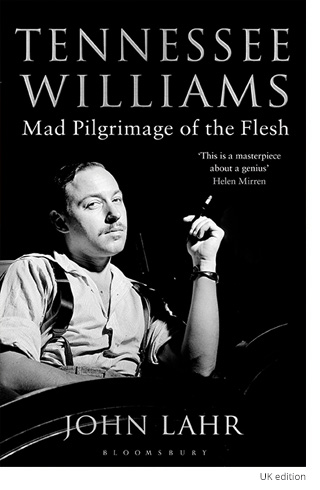
Suddenly what seems like a flood of Tennessee Williams-related material has been vying for my attention. First is the long-delayed but always expected new John Lahr biography, Mad Pilgrimage of the Flesh, which I’ve been devouring and don’t want to end. (It won last year’s National Book Critics Circle Award.)
An undated early horror story, “”The Eye That Saw Death,” was recently unearthed from the Williams Archives at the University of Texas at Austin and published in the spring issue of The Strand Magazine.
In March came news that Francesca Williams, the playwright’s niece (daughter of little brother Dakin), discovered a forgotten treasure of memorabilia in her parents’ Missouri basement, with letters going back to the 1920s.
James Grissom’s Follies of God — another project long in the making, and attended by some controversy (it’s Tenn Williams, after all) — has finally been published. From the excerpt Longreads has published of Grissom’s new book:
Tenn believed that writers, all artists, had several homes. There was the biological place of birth; the home in which one grew up, bore witness, fell apart. There was also the place where the “epiphanies” began—a school, a church, perhaps a bed. Rockets were launched and an identity began to be set.
There was the physical location where a writer sat each day and scribbled and hunted and pecked and dreamed and drank and cursed his way into a story or a play or a novel. Most importantly, however, there was the emotional, invisible, self-invented place where work began—what Tenn called his “mental theater,” a cerebral proscenium stage upon which his characters walked and stumbled and remained locked forever in his memory, ready, he felt, to be called into action and help him again.
And for National Poetry Month, here’s a podcast from the Poetry Foundation including Tennessee Williams reading his own poetry.
He’s been the darling of the experimental theater scene in New York for well over a decade. Last year he received the Spalding Gray Award, which honors genuinely maverick work in the theater. This weekend Seattleites have a chance to experience the latest commission by playwright and director Richard Maxwell and his New York City Players ensemble.
It’s a piece called The Evening and is being presented by On the Boards — part of the consortium that conferred the Award — following its world premiere as part of the Walker Art Center’s Out There arts festival last month in Minneapolis.
Although Maxwell has been engaged by On the Boards before (Drummer Wanted 12 years ago, back when Lane Czaplinski took over as artistic director), last night’s Seattle premiere was my first encounter with his work.
And it’s a signature of Maxwell’s theater that it sends you out into the night with the feeling that you’ve just recalled an interesting dream and now have the work of trying to figure out why it interested you and whether it’s meant to “tell” you something — or just happens to be an arresting collage of images that won’t stop flickering in your mind.
The Evening involves a cast of three characters interacting in a depressing dive bar. Beatrice (Cammisa Buerhaus) tends bar and manages the sexual advances of the hedonist Cosmo (Jim Fletcher) as well as the petulant neediness of her sorta ex-boyfriend Asi (Brian Mendes), a washed-up fighter managed by Cosmo.
Framing this “slice of life” core of The Evening is a monologue delivered by Buerhaus: she reads from a diary documentation of a (Beatrice’s?) father’s dying days, a text replete with high-flown poetic cadence and rhetoric. Then comes the pseudo-“naturalist” dialogue of the bar sequence, followed by another poetic flight — this time rendered visually, after the bar stage set has been pointedly struck and deconstructed by stage hands. The Beatrice character cocoons herself in snow-expedition wear and disappears into the now heavily fogged upstage region, where we imagine isolated wintry mountains.
During the bar sequence we learn that bartender Beatrice (who also works as a stripper) yearns to get away from it all and head to Istanbul. Testosterone-addled Asi has just won a fight but knows he is unhappy, and he can’t seem to win Beatrice back, but he doesn’t want her to go. Track suit-clad, cheesy gold chain-adorned Cosmo confines his interest in life to drinking, getting high, insulting Asi, and making the moves on Beatrice.
The characters voice a Three Sisters-ish longing to go “there,” to escape. But Cosmo at least seems content with the bar — the drab-minimalist brown wall set and slightly menacing lights are Sascha van Riel’s design — and even finds it a kind of paradise. Cosmo’s also the one who first notices the live music (written by Maxwell) that becomes part of the action when a trio of musicians walk in and start that evening’s gig. He tries to incorporate the music into his exchanges with Asi and Beatrice.
Is this coda meant to be a vision of the adventure Beatrice pursues after bringing the situation at the bar to a violent denouement? Was it her father who died, as recounted in the “prologue,” thus lending a layer of motivation to her need to snap out of the hopeless humdrum patterns we see in the more Edward Hopper-esque scenes?
Ah, there’s the rub: Maxwell’s dramaturgy is neo-Brechtian in that it de-familiarizes the familiar by highlighting its theatricality. The whole business of “motivation” becomes suspect, just as the seemingly “real-life” setting deliberately draws attention to the artifice of its naturalism. The actors deliver lines that can make sense from moment to moment but that add up to a maze of non-sequiturs and repeated patterns. And Maxwell plays with the compositional cliché of the triangle, with the archetypes that get triggered from seeing the clues he gives us to each character.
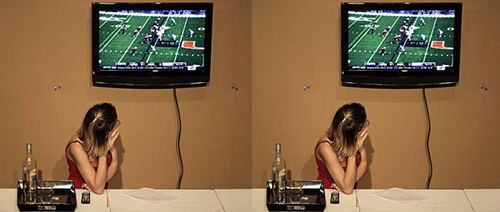
The apparently “realistic” throughline in The Evening, which we’re so conditioned by TV and mainstream film to expect, to be served, is a decoy. (There’s even a TV set hoisted above the bar showing a sports channel as part of the set, but it acquires a Big Brotherish aura as the play continues.)
We become frustrated by the lack of all the rest following suit (understandable motivation, easy-to-read cause and effect etc.) — which is exactly what Maxwell seems to be aiming for. It reminds me of the effect of hyper-realist paintings: beneath the shimmering, “life-like” detail, a kind of uncanny valley opens up where we find ourselves in a twilight zone. The zone of evening.
So The Evening exaggerates realism to undermine it. And even the framing parts seem to be “placeholders” for the deeper aspects of an evening in the theater: these are the “visionary” parts that are meant to endow the proceedings with meaning, the “take-away” that tells us our time was well spent.
Yet in just 60 minutes — the duration of The Evening — the theatrical trickster Maxwell lays out a crossword puzzle of clues, teases, resemblances, and images that isn’t meant to be solved. What’s also striking is the pivotal role of audience response. Last night a fair group of spectators seemed bent on “figuring it out” by chuckling and guffawing as if Maxwell were merely endeavoring parody of theatrical clichés — turning the experience at times into a kind of meta-sitcom.
I found that adversely affected the haunting strangeness of The Evening — an attempt to re-familiarize what’s happening onstage. Sure, Cosmo might be a sloppy, self-satisfied creep — or, rather, Fletcher plays Cosmo playing that archetype — but Maxwell constructs a context for these characters that speed-bumps our knee-jerk tendency to read them as we would read a group of people when, say, we stroll into a bar for the evening. It’s the empty spaces that are left to resonate — and, as Beatrice/Buerhaus remarks in the opening section, meditating on the father’s death, “they say that atoms are made of 99.9% empty space.”
If you go: Richard Maxwell’s The Evening plays at On the Boards through this weekend, 100 West Roy Street. After the Friday performance there will be a post-show discussion with Richard Maxwell and Todd London; following Sat’s performance the musicians will continue with post-show music. Tickets here.
About 10-15 years ago, it seemed one of the big trends around Chekhov productions was to ratchet up the comedy. All that tristesse and Russian pathos had become so clichéd that directors tried to outdo one another in getting audiences to laugh — too often by hard-hitting with effects that were more vulgar sit-com-y than Chekhovian non-sequitur (Kulygin’s “nonsense”).
So it intrigued me to notice some of the audience bafflement during intermission at last night’s preview of The Three Sisters in a new production by the Seagull Project soon to open at ACT Theatre. “It sounds like theater of the absurd,” insisted the woman next to me. “You can’t keep it straight what they want!”
Not humor and laughs, but frustration over the confusion of tone — which is exactly what makes Chekhov, and in particular The Three Sisters, such a formidable challenge to direct. Not the relaxed “plotlessness,” but the matter of tone For all the self-congratulation we hear about how our we “break down barriers” nowadays, so many are still glued to obvious genre distinctions: is it supposed to be a comedy? a tragedy? avant-garde? (I sensed similar reactions recently to Seattle Shakespeare’s Measure for Measure, that notorious “problem play.”)
For me, the two characters who most successfully establish real Chekhovian ambiguity in John Langs’s thoughtful production (using Carol Rocamora’s translation) — though the director relies a bit too much on leitmotivic tics that turn characters into caricatures — are CT Doescher’s poignantly resigned but cheerful Tusenbach and the intelligent, suave, but gently bitter Vershinin of David Quicksall.
Julie Briskman comes closest to getting the Chekhov chiaroscuro as the oldest sister, Olga. Her mood swings feel more integrated and organic, whereas they come across as merely “quirky” in several other characters’ portrayals. Alexandra Tavares’ Masha is especially compelling in her “stolen moment” of brief happiness with Vershinin. Sydney Andrews conveys the woozy longing of Irina as a young woman on the cusp of adulthood in the first act; her later development still seems to be a work in progress. John Abramson’s captures the proto-Uncle Vanyan angst of their brother Andrey Sergeevich as he tries to put up a bold front in the face of his crushing disappointments.
Hannah Victoria Franklin plays up Natalya’s bossy boorishness and her independent streak, but the class resentment that fuels her seems lost in translation. Recently seen doing good work in New City Theater’s Hamlet, Brandon J. Simmons takes a more straightforwardly comic approach as Kulyigin but gives his pomposity an awkward edge that pays off well in his final scene with Masha.
Langs is particularly good at organizing this talented cast in the larger ensemble scenes; he’s not able to solve the complex issues of Chekhov’s tempo and pacing from these to intimate encounters — but this will probably improve as the production matures. He neatly frames the play with marching scenes featuring the army arriving at and then departing from the provincial garrison town where the Prozorov family languishes. They stomp in to the beating of a big bass drum, automatons ready for the call of duty; but at they end we see them marching in silent slow motion far upstage — and can imagine them heading straight for the trenches of the First World War.
Among the delights of this production are the design elements: Jennifer Zeyl’s birch-framed set with tricky Chekhovian seasonal changes beautifully established by Robert J. Aguilar’s lighting. Robertson Witmer’s soundscape brings out the full range of Chekhov’s “score” — in this play whose subtexts include a major role for sounds: the forest echoes, a flock of birds passing, the wind, the magic of the spinning top given as a gift to Irina by the aging army doctor Chebutykin (such a powerful symbol of frenzied but futile action).
There’s another Chekhovian music in Péter Eötvös’ gorgeous opera distilled from the play:
So a major festival devoted to Samuel Beckett is about to launch: indeed, a several-month-long, city-wide focus on a playwright and writer who happens to be one of my favorites. Enlisted in the undertaking are no fewer than 15 arts organizations based in Seattle.
Why has this been so poorly publicized?! Already I can see so many opportunities for other collaborations here — with the Seattle Chamber Players, for example — or with relevant groups who likewise know nothing about this. I happened to run across a notice of the opening event by chance: Life = Play at West of Lenin, starting August 14.
Anyway, I wanted to quickly bring this to the attention of local folks and of anyone planning to visit Seattle over the coming months: “The festival, which runs from August through November, features not only the plays (such as Waiting for Godot, Endgame, Krapp’s Last Tape, Act Without Words parts I & II, etc.), but also readings of Beckett’s poetry and prose, screenings of his films, master classes on Beckett, pop-up performance events, presentations of the radio plays, and more.”
Buckets of Beckett. When it rains, it pours. No, it does not rain; it does not pour.
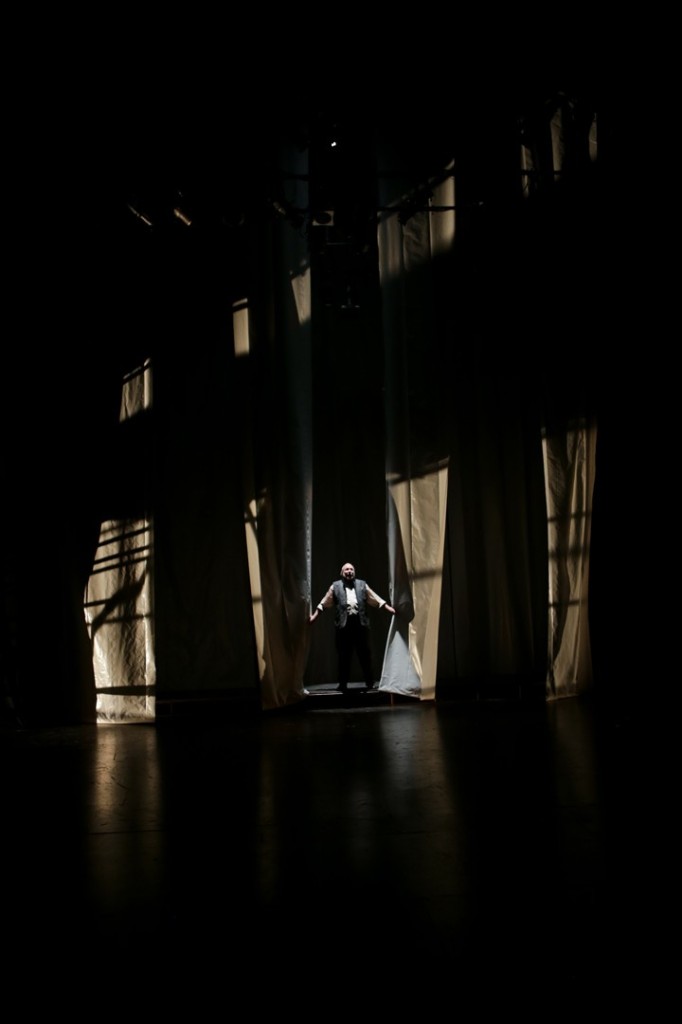
“Blow, winds, and crack your cheeks!” Dan Kremer as King Lear; photo by John Ulman
To grapple with the challenge of staging King Lear has to be the Shakespearean equivalent of trying to produce an entire Ring cycle. The play is so vast, so all-encompassing, its web of theatrical and emotional motifs so intricately woven, that it’s no wonder old-fashioned — well, OK, ancient — critical opinion deemed the play simply “too huge for the stage” (A.C. Bradley).
But visionary productions over the past century have dispelled that misgiving. Or maybe it’s just that the course the world itself has undergone makes us more receptive to Lear‘s devastating dramatic truths. Sometimes it almost seems as if Shakespeare had written the script for our times — and we’re just bumbling along, trying to act it out. Things don’t just fall apart; they coil toward entropy.
In Seattle Shakespeare’s new production, the play’s apocalyptic dimensions are essentially eclipsed by the familial — and all-too-familiar — realism of dysfunctional relationships and personal psychology.
Linda K. Morris, Patrick Allcorn, and Dan Kremer; photo by John Ulman
Director Sheila Daniels conceives the tragedy as an intimate echo chamber of unstable characters who are progressively losing it. What they undergo entails a series of variations on the theme of Lear’s crack-up. Scene by scene (with the whole divided here into three acts), their attempts to impose order on events, to get closer to their desires, become increasingly desperate. The overriding impression isn’t so much of the grim inevitability of consequences — Shakespeare’s merciless updating of classical “fate” — as of psychological meltdown.
As the ex-monarch, Dan Kremer underscores this approach through the unpredictable variability of his temper. It works very well for the first sections of the play — particularly in how it clarifies the relationship between Lear and his daughters that has already charted the course of the tragedy long before it begins.
We see how Goneril (Linda K. Morris) and Regan (Debra Pralle), given neatly differentiated portrayals here, aren’t just self-serving but have been brought up to fear daddy’s mercurial outbursts. Elinor Gunn’s Cordelia shows a steely stubbornness she must have learned first-hand. That’s what keeps her from seeing the danger she puts herself in — not a martyr complex to speak truth to power.
As for their husbands, while the Duke of Cornwall compresses into a sadistic psychopath (Gordon Carpenter), Shakespeare gives amplitude to the Duke of Albany (Patrick Allcorn) to grow in self-awareness and influence.
What lacks the needed emotional force are the actual climaxes marking each way-station in Lear’s descent. Kremer’s scene on the heath becomes just another fit, his verbal torrent more a fest of self-pity. By the same token, the Lear Kremer depicts in the final scenes fails to stir any deeper pity than he already has at the beginning of his long humiliation.
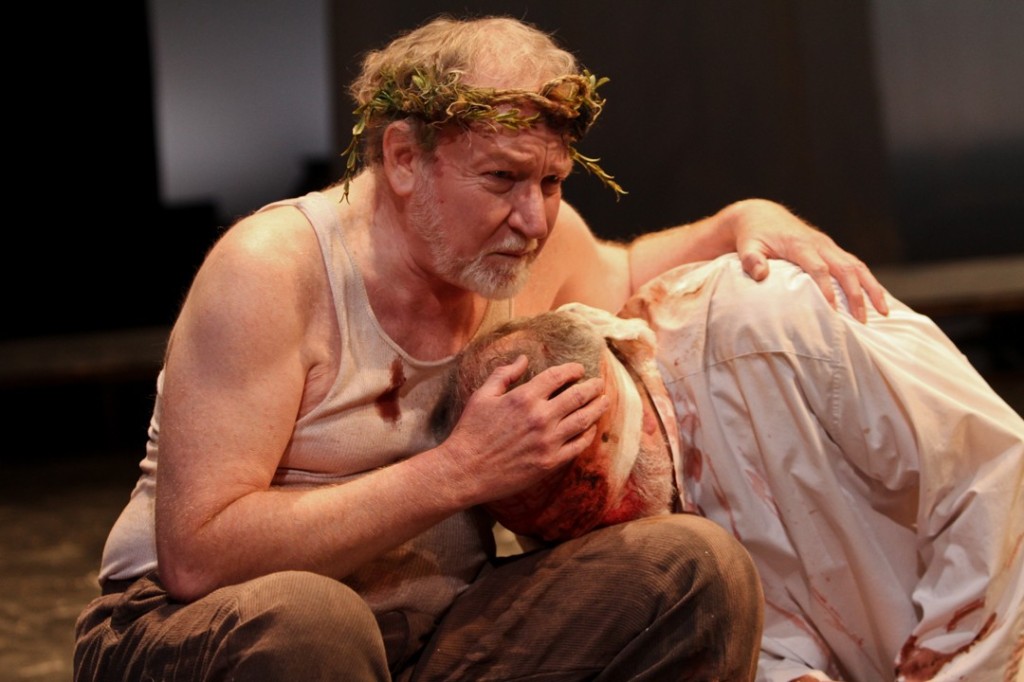
Kremer is more compelling in his interactions with “the other half” — with the fellow victims of ruin who never seem to faze him as they cross his path and all head toward the final confrontations at Dover. His reunion scene with the blinded Gloucester (Michael Winters) is especially resonant in its unsettling blend of horror and comic absurdity.
Dan Kremer and Michael Winters; photo by John Ulman
Some stand-out performances by others in the cast tilt the focus of the play in interestingly unexpected directions. Eric Riedmann’s chillingly embittered Edmund — possibly the most accomplished single interpretation — conveys the malign intelligence of a Iago yet always feels human. It’s one of Daniels’ strengths to clarify each character’s motivations in a way that makes them psychologically persuasive, further emphasizing the intimacy of family connections in this production.
Riedmann moreover revels in Shakespeare’s poetry, articulating its sonorities and rhythms with a relish and variety I wish were not otherwise the exception in this cast. The only misstep is the close-to-campy exaggeration of the sexual dalliance between him and Regan.
Linda K. Morris and Eric Riedmann; photo by John Ulman
Winters makes Gloucester’s wishful gullibility work, and the scenes with his two sons are among the most vividly realized. In his guise as Poor Tom, Jorge Chacon draws on physical hints he’s shown us as the nervous if good-natured Edgar.
King Lear is notable for the overdetermination of the fool archetype. Along with the official fool (Todd Jefferson Moore), the disguised Kent (played as a “Duchess” by the splendid Amy Thone) and Poor Tom on the heath reinforce the fool’s function of bearing witness to the truth as they retreat most deeply into their roles. Thone and Jefferson have a winning dynamic together and help re-introduce some of the play’s larger perspectives — particularly, its obsession with the power of language to shape reality, both positively and negatively. This is what gives the humor they interject its edge.
After all, they continue to subject Lear to the treatment that outraged him when it came from Cordelia. But even to “speak what we feel” is a kind of rhetoric, if the mirror side of Lear’s fulminations and curses. Language is the one thing the dispossessed king is left with — the very language he obviously abused throughout his reign.
Dan Kremer, Craig Peterson, Sophie Paterson, Amy Thone, and Jonathan Crimeni; photo by John Ulman
The scenic conception is notably weak and lags far behind the many fine nuances of the ensemble’s acting. Daniels, who collaborated with set designer Craig Wollam, opts for a colorless, ultra-minimalist playing space with a backdrop of hanging plastic and linen sheets and a scaffold that rolls to and fro. It is a way of making the stage the world, but the process of stripping away so essential to the play’s arc has already happened by the start.
Melanie Burgess’s abstract-pattern, cheerless costumes seem out of sync with the high contrasts of Jessica Trundy’s lighting. I do like the effect of cruel illumination upon the arrival at Dover, but the veer toward a horizontal Rothko glow at the end puzzles. Robertson Witmer picks up on the script’s references to drums to create a sternly percussive sound design.
Seattle Shakespeare Company’s production of King Lear plays through May 17 at the Cornish Playhouse (formerly Intiman) at Seattle Center, Wed. – Sun. Tickets here or call 206 733-8222.
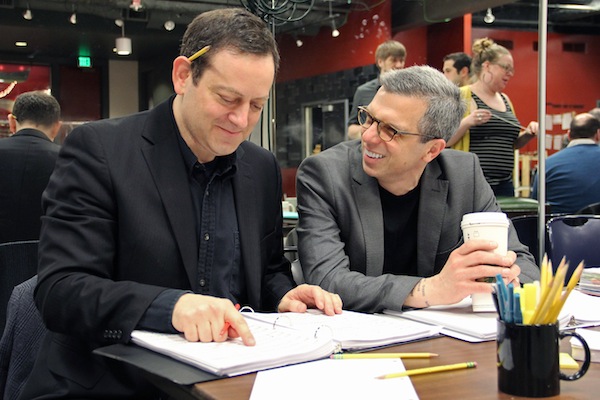
Photo of Jeffrey Stock (l) and Marc Acito (r) by Jeff Carpenter.
It was just a little over a century ago that E.M. Forster published A Room with a View, neatly bookmarking the end of the strictly organized Edwardian era he so memorably satirizes. But amid its social critique, the novel traces a journey of romantic discovery. This is the journey undertaken by the heroine, Lucy Honeychurch, as the promise of love prompts her to challenge the code of conventional behavior she has been brought up to obey.
The success of the 1985 film A Room with a View, produced with characteristic opulence by the Merchant-Ivory team, won a new generation of fans over to Forster’s elegant fiction. After all, Lucy’s awakening begins during an actual journey, and the stunning Italian and English landscapes of the novel’s setting lend themselves naturally to cinematography.
But writer Marc Acito and composer-lyricist Jeffrey Stock decided that Forster’s vision is also ideally suited to the medium of musical comedy, and their hunch quickly attracted the interest of theaters devoted to nurturing new works. Following initial incubation at the Musical Theatre Lab at Running Deer Ranch (located at the base of Mt. Adams), Acito and Stock were invited by San Diego’s Old Globe Theatre to audition what they’d come up with. Nine months later, A Room with a View received its world premiere there in March 2012.
l to r: Nonhlanhla Kheswa, Rikki Henry, Raphaël Chambouvet, and Ivanno Jeremiah, in Peter Brook’s The Suit. Photo: Pascal Victor, ArtcomArt.
“Truth in theatre is always on the move. As you read this book, it is already moving out of date. it is for me an exercise, now frozen on the page. but unlike a book, the theatre has one special characteristic. It is always possible to start again. In life this is myth, we ourselves can never go back on anything. New leaves never turn, clocks never go back, we can never have a second chance. In the theatre, the slate is wiped clean all the time.” — from Peter Brook’s The Empty Space
Brook’s insights into theatrical reality have meanwhile kept the director himself perennially relevant, despite the inevitable backlash and challenge from younger artists who take his innovations for granted. Consider the theatrical reality he creates in The Suit, which just opened at Seattle Repertory Theatre.
With extraordinary economy — and in dramatic contrast to popular culture’s fixation on psychological realism and “virtual reality” — The Suit centers on one of the most paradigmatic of all stories and yet fills it with surprise, sorrow, and revelation. It is the immemorial story of love given and love taken away — the story of jealousy, revenge, and the patterns of cruelty that link our social, political, and private selves.
In other hands, it might be easy to be misled by the brevity and light touch of this play — it lasts a mere 75 minutes or so — into regarding The Suit merely as a sad and wistful tale, or perhaps a rather slight essay in pathos benefiting from the vibrancy of its South African “local color.” A trio of actors and a trio of musicians together recount the story of a young married couple, Matilda (“Tilly”) and Philemon. Soon after Philemon introduces us to his happy life with Tilly, he’s informed by a friend that she’s been cheating on him. He rushes home, discovering the suit left behind by Tilly’s fleeing (and disrobed) lover. As punishment, Philemon insists that she pretend the suit is her lover, in the flesh, and react as she would to a third person who has now settled in with them.
But it would take the theatrical equivalent of tone deafness to remain impervious to the deeper realities sounded in Brook’s remarkably potent blend of narrative, acting, stage movement, and live music. Simplicity, that hallmark of so much great art, becomes all the more effective when allied with this degree of nuance and ambiguity.
Peter Brook. Photo: Colm Hogan
The source of this unforgettable theatrical experience is a story by the tragically short-lived South African journalist and fiction writer Daniel Canodoce “Can” Themba (1924-1968). His short story was posthumously adapted for the famous Market Theatre in early-1990s Johannesburg by Mothobi Mutloatse and Barney Simon.
Over the years, Brook and Marie-Hélène Estienne, his longtime partner, further honed and directed this material in keeping with the aesthetic of Brook’s Paris-based company, Théâtre des Bouffes du Nord. The show currently on tour across the U.S. represents a more-recent adaptation (in English) of an earlier Brook staging and is receiving its West Coast premiere in Seattle Rep’s presentation.
Themba wrote the The Suit in the 1960s in the wake of the brutal destruction by South Africa’s apartheid government of the black community of Sophiatown. From this thriving though impoverished suburb of Johannesburg, many residents were “resettled” into the sprawling shantytowns of Soweto.
Not that life was easy in 1950s Sophiatown, where one of Themba’s characters recounts a Sunday being denied the right to celebrate with other worshipers by racist church gatekeepers. But it represents a comparative Eden, and this takes on a domestic guise at the beginning of the play in the private idyll as depicted by Philemon (Ivanno Jeremiah). He greets each morning as “a daily matutinal miracle” that reinforces his love for his young wife, Matilda (Nonhlanhla Kheswa).
l to r: Nonhlanhla Kheswa and Ivanno Jeremiah in Peter Brook’s The Suit. Photo: Pascal Victor, ArtcomArt.
Here Brook’s method is already apparent. The most minimal of details — framed by a minimalist set of bright wooden chairs, a table, and rolling clothes racks and Philippe Vialatte’s versatile, effective lighting — evoke a world that is simultaneously specific and timeless. Brook refuses to allow us to settle into the complacent (and apolitical) attitude of abstracted “universality”; at the same time, he has no intention to preach a didactic lesson about oppression whose moral we already know (another form of complacency).
And so one dimension of the scene that Philemon so charmingly lays out for us feels like something between folk and fairy tale. But as The Suit progresses, Brook clarifies the dangers and humiliations of his social milieu. Philemon commutes on a bus to his job as a lawyer’s secretary, meets with one of his friends (Jordan Barbour, in a variety of roles) in a speakeasy, where the government’s increasingly harsh racist policies are discussed. A trio of musicians (guitarist Arthur Astier, keyboardist Mark Christine, and trumpet player Mark Kavuma) provides an ongoing level of commentary with powerful music interludes designed by Franck Krawczyk. On occasion they also play minor roles. The pared-down aesthetic here similarly draws a great deal from the elegantly simple cues of Oria Puppo’s costumes.
By the devastating final tableau, you realize how complex and multilayered are the threads Brook has woven underneath the simple facade of the narrative. There’s a recognition of the recurrent elements of human nature — and yet this story could happen only in the most extreme circumstances of oppression and cruelty.
Jeremiah’s demeanor in his first scenes as Philemon is so disarming we spend the rest of the play trying to square it with the humiliation and psychological pain he’s willing to inflict on his beloved Tilly. Barbour’s depictions of a large cast of characters, from Philemon’s “realistic” friend to a flirtatious townswoman at the play’s climactic party, contain an enthralling study in the art of transition and theatrical timing. But alongside even such excellence, Kheswa’s transformation from a bored, doted-on wife to a woman cornered into hopeless desperation is a rare theatrical achievement in its power to shock and move. The visual of the opening returns full circle, but the light-as-a-feather story with which we began is now freighted with the most intricate emotional counterpoint.
As to the actual score, Krawczyk’s choices and arrangements are uncannily effective. Among the pieces the musicians perform are some Schubert references (his song “Serenade,” intoned by an accordion, and the ominous tread of “Death and the Maiden”), a lovely and lilting Tanzanian song (sung by Kheswa), and a chillingly detached version of “Strange Fruit” (featuring Barbour). At the end Christine softly plays the music of one of the most moving arias from Bach’s St. Matthew Passion (given just a few weeks ago by the Seattle Symphony).
What we’re left with are gnawing questions of who is to blame, who could have changed, how could the tragedy which had begun like a comedy have been averted — for in theater, as Brook tells us, the slate is wiped clean all the time.
Just before the performance, Jerry Manning and Benjamin Moore of Seattle Rep and Josh LaBelle of Seattle Theatre Group spoke about their partnership to bring this tour of The Suit to Seattle. I very much share the sense of gratitude they expressed that Seattle was able to host Brook’s The Tragedy of Hamlet back in 2001 — among the most indelible memories of my theater-going life — and that this city is again giving a platform to his work. You really should try to see this one — more than once, if possible.
The Suit runs through Sunday, April 6, at Seattle Rep’s Bagley Wright Theatre. Tickets here.
Michael Tisdale and Gillian Williams in Seattle Repertory Theatre’s Venus in Fur; photo by Chris Bennion.
It’s not just the topic of sexual power dynamics combined with S&M role play that makes it seem as if David Ives has taken on something risqué in his Tony-nominated Venus in Fur, which premiered in 2010. He dares a lot formally by writing an evening-length, two-character play set in a drab rehearsal room.
In terms of ambition, he dares even more in his obvious desire to probe the personal politics and psychological complexity of our “theatrical” selves: the rotating, evolving, ever-variable selves we present in our daily encounters.
Seattle Repertory Theatre’s staging — a co-production with Arizona Theatre Company — offers a smart, riveting, often unsettling take on Ives’s much-hyped play. It makes for a largely persuasive theater experience, though without managing to overcome all the dramaturgical stumbling blocks in the script — most of all, the unconvincing swerve that marks the drama’s culmination.
Ives is, to start with, a masterful writer of dialogue, attuned to the ways actors manipulate their subtexts as they monitor and mirror the variabilities of their stage partners. In the ongoing, intermissionless duologue that is the basic structure of Venus in Fur, his two characters assume and cast off multiple identities that continually keep the audience guessing about what the real stakes are.
Venus in Fur starts in quasi-sitcom mode: a frustrated playwright/director, Thomas Novachek, rails against the limitations of the women he’s seen audition for the lead in his new stage adaptation of Venus in Furs, the once-scandalous novella published in 1870 by the Austrian writer Leopold von Sacher-Masoch (part of the first volume of a large-scale fictional cycle he had planned under the overall title Legacy of Cain).
In blusters Vanda Jordan in a scenery-chewing entrance. She’s an actress who presents herself as desperate for the part — so desperate, she ends up convincing the reluctant Thomas to stay on and see her audition, even though she’s hours late and all the others have already left.
But Ives cleverly uses the familiar patterns of lightweight humor to disarm his audience, to set up expectations that repeatedly trip us up — exactly mirroring the dance of role-playing and sudden change of tack Vanda stage manages vis-a-vis Thomas.
Sibyl Wickersheimer has designed an imposingly affectless rehearsal loft — we’re told it’s been converted from a former sweatshop (its identity around the time Sacher-Masoch’s novella was written) — and tilts it to an angle, adding yet another layer of obliquity. Geoff Korf’s lighting starts with unfriendly late afternoon light and descends into terrifying darkness
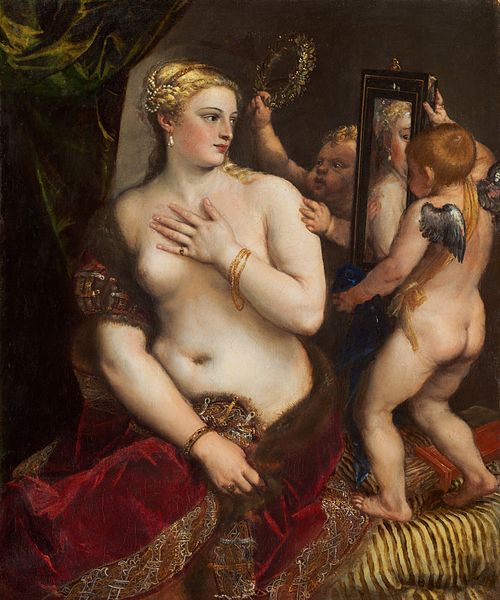
Thomas wants to be appreciated for having written what he believes to be an important play — his Fur is a gloss on the “furs” of Sacher-Masoch and the mirror of Titian. He loathes being misunderstood for tackling the trendy “issues” of the day. Vanda pretends to be clueless about his artistic aspirations, describing the novella that’s the basis for his play as “S&M porn” and hastily showing off the up-to-date dominatrix outfit (Harmony Arnold’s witty costume design) that she picked out for her audition.
Titian, Venus with Mirror, c. 1555 (National Gallery of Art)
Director Shana Cooper sustains the slow burn of tension that underlies the rapidly shifting scenario as Thomas starts to realize Vanda has been dissembling and is intimately familiar with the nuances of Sacher-Masoch. Like a staged Droste effect, ironies begin to proliferate within the play-within-a-play setup. Vanda the over-emoting, stressed-out New Yawk actress suddenly seems to be more authentic when she casts her “real” self aside to play the fictional role of the nineteenth-century, velvet-gown-clad Wanda von Dunajew.
Ives’s play is completely dependent on the effectiveness of his lead actress. Gillian Williams gives an untrammeled and multifaceted performance, toggling back and forth between “acting” and — to the evident unease yet fascination of Thomas — taking over his role as the playwright and director. It’s also an intensely physically aware performance, her shifts in tone mirrored by a virtuosic range of gestures and physical expression.
As Thomas, Michael Tisdale (like Gilliam Williams, making his Seattle Rep debut) doesn’t project the sheer arrogance needed at the beginning to give substance to Vanda’s fury — he’s too fussy — but grows more convincing in the transformation into Sacher-Masoch’s alter ego Severin von Kusiemski, which he willingly undergoes.
Gillian Williams and Michael Tisdale; photo by Chris Bennion.
The real interest of the dramatic arc lies in its unpredictability: shocks of recognition intensify and begin to align Thomas’s script with the power play developing between him and Vanda, but Ives counterpoints this with a movement away from the realism at the start of the play toward an ambivalent surrealism.
And there the chief difficulty lies. As Vanda’s rage gathers righteous feminist force and we’re led to expect a straightforward revenge plot, Ives changes the fundamental tone again — and makes her an archetype, an avatar of the pagan classical world.
But it ends up evoking a bit of old-fashioned stagecraft: a dea ex machina come to deliver a moral lesson for our times. The rattling thunder of a storm raging outside (Robertson Witmer’s atmospheric sound design) isn’t enough to pull off the transformation.
Venus in Fur runs through Sunday, March 9, at Seattle Rep at Seattle Center.
Jennifer Lee Taylor as Beatrice and Matt Shimkus as Benedick; photo by John Ulman
Linguists like David Crystal are fond of pointing out that shifts in pronunciation over the centuries cause modern audiences to miss out on some of the key puns and subtexts in Shakespeare’s plays. The claim that “nothing” and “noting” were all but indistinguishable in Elizabethan English is a case in point. I don’t know who first observed that “Much Ado About Noting” might be a far apter title for Shakespeare’s perennially popular comedy of misalignments realigned, but it’s become a widespread idea by now.
Certainly the play’s momentum is driven by acts of noting, of hearing or seeing things that cause perceptions to be changed dramatically. Most of these eavesdroppings are intentionally stage-managed by other characters – for benevolent if somewhat mischievous purposes (Benedick and Beatrice being led to believe they are the object of each other’s affection) and for nefarious ones (the framing of Hero as unfaithful).
What I find most striking about Seattle Shakespeare’s current production of Much Ado About Nothing is how gullible the main characters prove to be. A good portion of the comedy in the Beatrice-Benedick stand-off arises from the exaggerated language both use to express their mutual disdain – with Beatrice scoring more stinging zingers in Jennifer Lee Taylor’s arch, glib-as-a-movie-starlet delivery. Yet it doesn’t take much trickery to soften them up and make the pair willing to thrust their necks “into a yoke” same as all the rest.
Justin Huertas as Balthasar, Jim Gall as Don Pedro, Jay Myers as Claudio, and Peter A. Jacobs as Leonato; photo by John Ulman
More tellingly still, Claudio reverses his Prince Charming poses even more readily than he’d pressed his lightning-fast courtship of Hero. She, in turn, is just as content to have the hot-head back after he’s been compelled to “note” her fake funeral.
All this manipulation and puppet-like flexibility can make Much Ado seem pretty arbitrary. The fundamental problem Shakespeare’s comedy poses for the performers is that it nestles a potential tragedy at its core. The notions of love that the two main couples hold on to, imagining they represent the real thing, must be put to the test; they have to enter crisis mode before any genuine change can take place.
Merely “noting” appearances or trying to preempt disappointment is a passive stance, and it can’t substitute for experience. It’s one thing for this testing to take the form of obstacles – standard procedure in comedy – but to be presented as the nightmare which erupts at the play’s center is deeply unsettling.
Hero (Brenda Joyner) rejected; photo by John Ulman
Or…maybe that’s just making much ado about nothing after all. Maybe the play really should be enjoyed for its witty slant on romance and friendship triumphant, served up with abundant linguistic virtuosity (and a virtuosic reversal of all that when it comes to the malapropic snares in which Dogberry gets entangled). As directed by George Mount, artistic director of Seattle Shakes, this production doesn’t show much interest in digging beyond that, but it still adds up to a pleasurable performance for the most part.
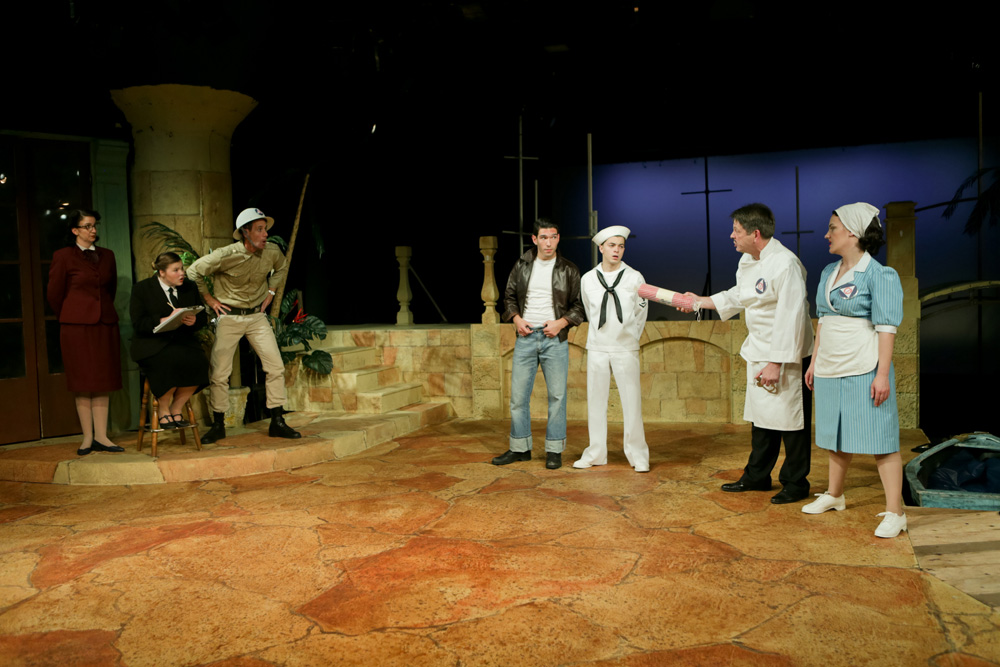
The production’s design elements are a particular attraction. They effectively translate the cheerful Mediterranean clime of Shakespeare’s Renaissance Messina to a tony seaside resort in 1953, with sailors coming home from the (presumably Korean) war, now ready to relax and get back to the pleasures of life. Craig B. Wollam’s elegantly evocative set, Roberta Russell’s sun-kissed lighting scheme, and the delightful period details of Doris Black’s costumes work together to reinforce this background.
Seattle Shakes is also embarking here on the first of two collaborations this season with Seattle Repertory Jazz Orchestra: Michael Brockman composed music for the songs Shakespeare embeds in the play. The jazz ensemble pre-recorded this incidental score. Justin Huertas (Balthasar) does double duty as the resort’s Sinatra-smooth entertainer and also sings a lovely threnody at the tomb of Hero before her “resurrection.”
Dogberry (David Quicksall) and crew; photo by John Ulman
These elements so successfully evoke a concrete sense of place that it seems to encourage some of the cast to adopt a looser, more-relaxed style vis-a-vis Shakespeare’s language – as if to match the “realism” of the setting. Taylor’s Beatrice and Matt Shimkus as Benedick stand out not only for their engaging interactions, spinning off each other’s whip-snap repartee, but for their attention to the textures and rhythms of their words. And Peter A. Jacobs brings a suave edge to Leonato as the entitled party-giver while remaining authoritative in his speech.
As Hero and Claudio, on the other hand, Brenda Joyner and Jay Myers tend toward blandness, failing to voice the different registers of their language. Myers also remains too much the nice guy who’s been duped to give his final transformation its full effect. Especially flat is the one-note resentment displayed by Nick Rempel as the scheming villain Don John.
Noah Greene layers a Fonzie-ish attitude on the rascal-for-hire Borachio, who is the first in the play to set off its chain-reaction of conversations overheard. Most of these are staged, but he chances on Claudio’s spontaneous confession of his love for Hero. And by the play’s symmetry, it’s when Borachio is overheard by chance bragging about his nasty deed that the solution to the crisis is introduced. But before everything can be untangled, the night watch set up by Constable Dogberry (David Quicksall) – who do that bit of overhearing – restore the comic tone that’s so suddenly been sucked out of the play with Hero’s slander. This layer was, to my taste, the least successful, too reliant on extraneous gimmicks at the expense of the hilarity already there in the language.
When all is restored in the finale (the captured Don John notably awaiting his punishment offstage, to be dealt with later), this production infuses an infectious joie de vivre that makes this Much Ado about something after all.
Seattle Shakespeare Company’s production of Much Ado About Nothing, directed by George Mount, continues through November 17, 2013, at the Center Theatre at Seattle Center. Tickets online.











 MEMETERIA by Thomas May