
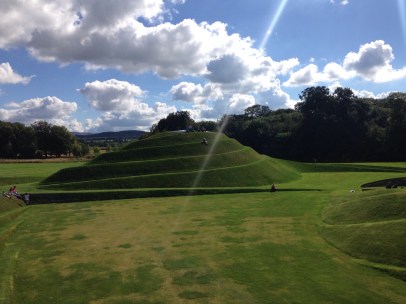
 Charles Jencks’s incandescent mounds at Jupiter Artland.
Filed under: art, photography

September 6, 2016 • 7:17 pm Comments Off on Cells of Life
Charles Jencks’s incandescent mounds at Jupiter Artland.
Filed under: art, photography
September 5, 2016 • 4:48 am 1
I was very fortunate finally to have a chance to catch up with Thomas Ostermeier’s acclaimed production of Richard III the Schaubühne — not in Berlin, but at the Edinburgh International Festival.
Much has been made of Ostermeier’s highly original direction as a saturated, intensified portrait — a Machiavellian mirror — of the title anti-hero. That of course has been facilitated by the exciting, controversial translation/adaptation/condensation of the German text prepared by company dramaturg Marius von Mayenburg.
One of the most brilliantly effective choices — apparently a spontaneous decision arrived at during the course of rehearsal, according to Ostermeier — was to streamline the litany of climactic battles into a sequence of Richard fighting with himself, up to his inglorious demise.
This portrait approach was also made possible only through the weird, cultish charisma and electrifying stage presence of Lars Eidinger as a maniac-depressively embittered Richard. Not an “evil” character, according to Ostermeier, so much as one who makes the workings of power and its aggrandizement theatrically transparent, naked.
“The play is not about evil as such,” says Ostermeier, “but about participation in power, the exclusion of an outsider and the manipulation of others’ antipathies. In this respect it does have significant political implications.”
Eidinger’s matchless account requires intense physical acting, stamina, singing, and clownish, stand-up improv with the audience — the humor was particularly well-pointed, not a cop out (with a delightful exchange accusing a prematurely exiting patron of being rude when he claimed he was heading “to the toilet”).
But that’s not to shortchange the contributions of the rest of a stupendous ensemble cast. Percussionist Nils Ostendorf contributed an excellent, live-wire score, which interpolated some fascinating touches (like an intensely repeated loop that segued in and out of Laurie Anderson’s “O Superman”).
Filed under: directors, Schaubühne, Shakespeare
September 3, 2016 • 1:46 am Comments Off on The Legend of Sawney Bean

The things one learns while traveling…. This made for some good tale-spinning while visiting Edinburgh:
The story of Sawney Bean is one of the most gruesome Scottish legends, the plot of which would not look out of place in any modern horror/slasher movie. Evidence suggests the tale dates to the early 18th century.
more on the gruesome legend of the Bean clan
Bonus scare:
Filed under: miscellaneous, travel
September 2, 2016 • 2:53 am Comments Off on Adventures with the Seattle Symphony
The September 2016 issue of Gramophone is out and contains my feature on innovations at the Seattle Symphony in the era of Ludovic Morlot.
Filed under: Gramophone, Ludovic Morlot, Seattle Symphony
September 1, 2016 • 2:39 am Comments Off on Olga Neuwirth’s New Percussion Concerto for Lucerne Festival
Last weekend at Lucerne Festival brought the world premiere of Olga Neuwirth’s latest major orchestral work: a percussion concerto titled Trurliade – Zone Zero (which references one of the Austrian composer’s sources of inspiration, the sci fi master Stanisław Lem). The soloist was Victor Hanna, and Matthias Pintscher conducted the Orchestra of the Lucerne Festival Academy.
Trurliade was the eighth in the ongoing Roche Commissions series, which picks from the leading composers at work today to commission a new orchestral work every two years, which is then premiered at Lucerne Festival. Neuwirth has also been serving as this year’s composer-in-residence at the Festival, which is focusing on the theme of women in music.
Neuwirth is a genuinely fascinating, one-of-a-kind composer who has created especially striking works of music theater (including collaborations with fellow Austrian and Nobel laureate Elfriede Jelinek, an operatic treatment of David Lynch’s Lost Highway, and a “musicstallation” in homage to Herman Melville, among others).
In her Neue Zürcher Zeitung review, Michelle Ziegler writes:
Trotz der plastischen Anlage geht Neuwirth mit den Bezügen und Zitaten in ihrer «Trurliade – Zone Zero» ungemein feinsinnig um. Sie lässt die Zahnräder der Orchestermaschinerie zwar wie geschmiert laufen, verliert sich aber nie in einem vorhersehbaren Trott. Sie fügt Geräusche nicht zur Show ein, sondern findet im Klang der Schrottobjekte einen poetischen Zauber. Damit hat die Komponistinfür ihre zweite Residenz beim Lucerne Festival ein wunderbar persönliches, zugleich tiefsinniges und erfrischendes Werk geschaffen.
The composer has written an intriguing program note introducing her new concerto:
This is why the title of the piece refers to Stanisław Lem’s Trurl’s Machine. With his warning against unfreedom, Lem in turn alludes to George Orwell’s novel 1984. In Lem’s story the machine designed by Trurl insists on its mindless and inflexible assertion: “Two plus two is seven.” In Orwell’s book the apparatus of power demands obedience through re-education, propaganda lies, and surveillance by illogically claiming that “two plus two is five” – until the individual complies with the stipulations of the regime and gives up thinking. The regime “teaches” renegades and dissidents to love Big Brother by using cruel methods of torture. The protagonist, already demoralized and worn down mentally and physically through continual re-education measures, nevertheless does not give up the fight and becomes dangerous to the Party when he dares to express (mathematical) facts: “Freedom is the freedom to say two plus two is four.” And he does so even though, according to Orwell, the loudspeakers keep demanding over and over again that everyone accept whatever Big Brother defines as true, including that two and two is five. This phrase represents the obedience required by an ideology in contrast to rational facts and truth.
Filed under: commissions, Lucerne Festival, Olga Neuwirth
August 30, 2016 • 2:40 am Comments Off on End of the Runnicles Era
The conductor Donald Runnicles concluded his tenure with the BBC Scottish Symphony Orchestra on the last day of the 2016 Edinburgh International Festival with a performance of Schoenberg’s epic Gurre-Lieder at Usher Hall.
The gargantuan forces needed bring to mind the festival atmosphere Mahler’s Eighth Symphony also evokes. Here’s a sampling of the reviews:
And so this concert summed up the kind of playing that he and this orchestra have developed together – a rich glow at the heart of the strings and a capacity to turn on a dime and power up almighty sounds.
–Kate Molleson in The Guardian
Runnicles is particularly well known for his interpretations of the core Austro-German Romantic repertoire, so Gurrelieder plays to his strengths. Under his baton Schoenberg’s ripe score yields up its influences. There is Wagner in the love music, of course, but also Bruckner in the solemnity of the Wood-Dove, Beethoven in the nature-painting and, of course, Mahler in the scale and structure. That scale could be pretty overpowering at times, and not just in the final, overwhelming greeting to the sun that ends the work. The sweep and surge of the love music was intoxicating, as was the wall of brass and percussion that accompanied the chorus’ romping as the hellish riders. What was most striking, however, was the way Runnicles repeatedly brought out the delicacy of the orchestration.
–Simon Thompson for Seen and Heard International
[Schoenberg’s] mega-cantata Gurrelieder, was the vehicle chosen to whisk us off on such a glorious journey, driven by the massively-inflated forces of the BBC Scottish Synphony Orchestra, a male-dominated Edinburgh Festival Chorus, five soloists and speaker, all under the towering leadership of maestro Donald Runnicles, and formulated by a musical language gathering up the scraps of Wagner, colouring them with whole-tone harmonic treats from Debussy, sweeping up Mahler in its tracks before opening the gates to teasers of the world-changing Schoenberg-to-come.
–Ken Walton in The Scotsman
This concert will be broadcast on BBC Radio 3 on Friday 16 September at 7.30pm.
Filed under: conductors, Runnicles, Schoenberg
August 28, 2016 • 12:55 am Comments Off on Common Ground at Maxim Gorki
Berlin’s Maxim Gorki Theater launched its season last night with a reprise of the acclaimed Yael Ronen production Common Ground.
Exploring with the aftermath of the fall of Yugoslavia in the early 1990s, it’s the kind of ensemble piece that Gorki has made a signature.
Reviewing n earlier version of the work-in-progress two years ago, critic Anne Peter noted:
Ronens Theater weiß es nie besser und hält sich nicht heraus. Sein Trumpf ist Selbstironie. Immer befragt es auch die eigene Perspektive, stößt sich und uns auf unsere eigenen Widersprüche, ohne dabei mit irgendeiner “richtigen” Haltung vor unserer Nase umherzuwedeln. Kaum der Rede wert, dass bei dieser vom Publikum ausgiebig bejubelten Premiere noch nicht alles wie am Schnürchen lief, mancher Satz verhaspelt wurde. In einer Zeit, in der Europa auseinanderdriftet und sich entsolidarisiert, populistischer Nationalismus vielerorts erschreckend hoch im Kurs steht und die Ukraine ganz konkret vor einer möglichen Teilung steht, beschert uns Yael Ronen einen brennend wichtigen Abend.
If anything, Common Ground is proving even more relevant for the Europe of 2016.
Filed under: Maxim Gorki Theater, theater
August 26, 2016 • 12:59 am 1
 From the Mendelssohn House on Goldschmidstrasse in Leipzig.
From his final summer, when he made his last trip to Switzerland, Mendelssohn’s watercolor of Luzern:

Filed under: Mendelssohn, musical travels, photography
August 25, 2016 • 9:14 am Comments Off on Remembering Lenny
In honor of Leonard Bernstein’s birthday — just two years away from the centenary now! — I’m reposting a link here to some thoughts from a few years ago.
Filed under: American music, anniversary, Bernstein
 Arts & Culture Stories from NPR
 MEMETERIA by Thomas May