
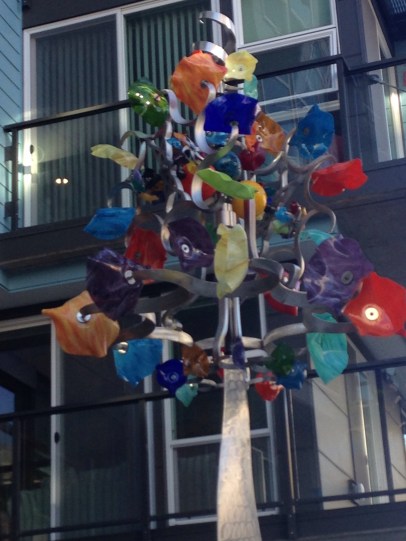
Filed under: photography

April 19, 2016 • 10:32 pm Comments Off on Magickal Mysterie
Filed under: photography
April 18, 2016 • 11:23 am Comments Off on Congratulations to Henry Threadgill
This year’s Pulitzer winners were just announced, and the hugely imaginative avant-garde jazz legend Henry Threadgill has been awarded the Music Pulitzer for In for a Penny, In for a Pound. From the Pulitzer Committee’s citation:
In for a Penny, In for a Pound is the latest installment in saxophonist/flutist/composer Henry Threadgill’s ongoing exploration of his singular system for integrating composition with group improvisation. The music for his band Zooid — Threadgill’s main music-making vehicle for the past fourteen years and the longest running band of his illustrious forty plus-year career — is no less than his attempt to completely deconstruct standard jazz form, steering the improvisatory language towards an entirely new system based on preconceived series of intervals. His compositions create a polyphonic platform that encourages each musician to improvise with an ear for counterpoint and, in the process, creating striking new harmonies.
Threadgill is widely considered to be among the most important artists in jazz. The New York Times called him “one of the most thrillingly elusive composers in and around the jazz idiom: a sly maestro of unconventional timbres, bristling counterpoint and tough but slippery rhythms,” and NPR called him “a true idiosyncratic great.” He is a founding member of the Association for the Advancement of Creative Musicians (AACM), which is celebrating the 50th anniversary of its founding this year, and he continues to adhere to one of that august organization’s basic tenets: that of finding one’s individual path through original music. He continues to create music that is pushing the boundaries for what is possible.
The new work, which Threadgill calls an “epic,” includes four main movements written specifically to feature each of the musicians in Zooid: “Ceroepic” for Elliott Kavee on drums and percussion, “Dosepic” for Christopher Hoffman on cello, “Tresepic” for Jose Davila on trombone and tuba, and “Unoepic” for Liberty Ellman on guitar. They are introduced by an opening shorter piece and sandwich an exordium (“In for a Penny, In for a Pound” and “Off The Prompt Box,” respectively.) Threadgill’s own alto saxophone, flute and bass flute is woven throughout each section. In for a Penny, In for a Pound utilizes, as with all of his music for Zooid, a strategy of Threadgill’s own device: a set of three note intervals assigned to each player that serves as the starting point for improvisation. While this may seem simple on the surface, the juxtaposition of the notes played on each instruments alternately meld and clash, creating surprising chords and harmonies on-the-spot. Not held together by any chordal preconceptions, the result is true, improvised four-part polyphony. Of this music, Liberty Ellman, who will release Radiate, his first new album as a leader since 2006’s Ophiuchus Butterfly later this year, says: “Henry is extending the forms and writing more varied thematic material. There is even more dynamic and timbral contrast with ensemble vignettes turning to sparse monologues or group improvisation on the turn of a dime.” Zooid is certainly the only group able to perform these compositions since they involve a wholly different way of engaging in group improvisation. Thoroughly attuned with each other, the band continues to provide Threadgill with the foundation to expand on his ever evolving musical inspirations.
In all the discussion about the complex terrain of his compositions, it is sometimes easy to lose sight of Threadgill’s power as a player. In his review of Zooid’s performance at the Village Vanguard in 2014 — the first time Threadgill had played at that iconic venue as a leader in almost 25 years — critic Ben Ratliff of the New York Times, who chose it as one of his top ten top concerts of the year, wrote: “The intensifying strokes were his alto saxophone solos. They were built of epigrammatic phrases, aligned with the moving intervals but pivoting off from them. They were out in front, gestural, actorly, elegant, noisy and tragic. Dealt in short segments, their essence could be absorbed piece by piece, as if he were feeding you with crumbs. They’d often end without traditional resolution, but with a sense of something serious hanging in the air.” A great Threadgill solo sets you on edge: you know that it’s going to be a jab, an uppercut or a body blow, but you never know how or when it’s going to hit you. It’s the same way with his compositions on In for a Penny, In for a Pound: it comes at you from every angle, at different speeds, in infinite combinations. That’s the beauty of Threadgill’s music for Zooid: that sense of constant surprise.
Seth Coulter Wells did an interesting interview with the artist for The Guardian:
Prior to Monday, the only jazz performers to win a Pulitzer prize for music (while still alive) were Wynton Marsalis and Ornette Coleman….
On what his Pulitzer could mean for the school of ‘creative music’ pioneered by the AACM
Well, you know – we have no control over anything but what we do. I just try to stay hopeful: I don’t want to get too pessimistic about anything. Hopefully like some type of enlightenment will come about. Which is better for everyone, for all of humanity. Any time we can understand a little bit more about culture, I think it makes us better as a group of people, and more civilized as a group of people.
Filed under: awards, jazz, music news
April 15, 2016 • 9:47 am Comments Off on Mason Bates’s Violin Concerto

Here’s my program note on the Violin Concerto Mason Bates wrote for Anne Akiko Meyers, on this weekend’s program with the National Symphony Orchestra:
With the Violin Concerto of Mason Bates, this all-American program extends to music being written in the 21st century. At the same time, Bates’s adventurous outlook and interest in expanding the possibilities of the orchestral sound world link him to the American maverick tradition represented by such composers as Charles Ives, whose music concludes the program.
Filed under: Mason Bates, National Symphony, new music
April 14, 2016 • 11:56 am Comments Off on Breaking: James Levine To Retire
From the Met’s Press Office:
Legendary Maestro James Levine to Retire as Music Director of the Metropolitan Opera at the End of the Current Season;
Will Become The Company’s First Music Director Emeritus
New York, NY (April 14, 2016) – Maestro James Levine, the Met’s Music Director since 1976, announced that after 40 years in the position, he will retire at the end of the current season, for health reasons. At that time, he will assume the new position of Music Director Emeritus. In this role, he will continue as the artistic leader of the Met’s Lindemann Young Artist Development Program, a training program for operatic talent he began in 1980, and will continue to conduct some Met performances. Next season, he will withdraw from the new production of Strauss’s Der Rosenkavalier, but plans to lead revivals of Rossini’s L’Italiana in Algeri, Verdi’s Nabucco and Mozart’s Idomeneo—three works he has led more than any other conductor in Met history.
He intends to conduct his remaining performances for the current Met season, which include the current run of Verdi’sSimon Boccanegra and a five-performance revival of Mozart’s Die Entführung aus dem Serail later this month, as well as theMay 19 and 26 MET Orchestra concerts at Carnegie Hall. He will not conduct the MET Orchestra at Carnegie Hall on May 22.
Over the course of his unparalleled career at the Met, Levine has led 2,551 performances—far more than any other conductor in Met history—working with thousands of the world’s most gifted musicians and conducting more than 85 different operas, ranging from 18th century works to contemporary world premieres. In recent years, Levine has struggled with the effects of Parkinson’s disease, making it increasingly difficult for him to conduct a full schedule of Met performances.
“There is no conductor in the history of opera who has accomplished what Jim has achieved in his epic career at the Met,” said Peter Gelb, the Met’s General Manager. “We are fortunate that he will continue to play an active and vital role in the life of the company when he becomes Music Director Emeritus at the end of the season.”
“Through 45 years of unwavering devotion, Maestro Levine has shaped the MET Orchestra into the world-class ensemble it is today,” said Jessica Phillips, chair of the orchestra committee and a clarinetist in the Met’s orchestra. “He has a unique ability to inspire those around him to perform to the best of their abilities and beyond. We eagerly anticipate his upcoming projects as Music Director Emeritus, which promise to add to an already incomparable legacy of tireless dedication and artistic integrity. It is an honor to carry the values Maestro Levine has instilled in us into this new era at the Metropolitan Opera—the house that Jimmy built.”
Replacement conductors for this season’s May 22 Carnegie Hall concert, and for the remainder of Mo. Levine’s 2016-17 engagements—the new production of Der Rosenkavalier, and three May 2017 MET Orchestra Carnegie Hall concerts—will be announced in the coming days.
A plan is in place to appoint a new Music Director for the Met, who will be announced in the coming months.
As Mo. Levine transitions to his new role at the Met, John Fisher, currently Director of Music Administration, has been promoted to Assistant General Manager, Music Administration, effective immediately. Fisher’s duties include overseeing the Met’s staff conductors, rehearsal pianists, and prompters; coaching principal singers; and working with Mo. Levine and the conductors for each Met performance to prepare and maintain the highest level of musical quality.
James Levine at the Met
Levine made his Met debut in 1971 at the age of 28, leading a performance of Puccini’s Tosca, and quickly became a company favorite. He was named Principal Conductor of the Met less than a year later, in February of 1972, and became Music Director in 1976.
He has led a total of 2,551 performances with the company, including more than 2,000 opera performances at the Met itself as well as orchestral and chamber concerts, and national and international tours. This is more than twice the number led by any conductor in the company’s history.
Perhaps more than any musician in Met history, Levine has been noted for the ever-expanding range of operatic repertory in which he excels, one of the hallmarks of his extraordinary career. He has led Met performances of works by 33 composers, ranging from the Verdi, Puccini, Mozart, and Wagner operas that are staples of the company’s seasons to works by such composers as Berg, Berlioz, Bartók, Debussy, Schoenberg, and Stravinsky. Earlier this season, he conducted Johann Strauss, Jr.’s Die Fledermaus for the first time in his Met career.
A tireless champion of new works and neglected masterpieces, Levine expanded the company’s repertory by leading the first-ever staged Met performances of Berg’s Lulu; Gershwin’s Porgy and Bess; Rossini’s La Cenerentola; Verdi’s I Vespri Siciliani, Stiffelio, and I Lombardi; Mozart’s Idomeneo and La Clemenza di Tito; Schoenberg’s Erwartung and Moses und Aron;Weill’s Rise and Fall of the City of Mahagonny; Busoni’s Doktor Faust; and Berlioz’s Benvenuto Cellini, as well as the world premieres of John Corigliano’s The Ghosts of Versailles and John Harbison’s The Great Gatsby.
Filed under: Metropolitan Opera, music news
April 14, 2016 • 8:09 am Comments Off on Silvestrov Premiere in Seattle
This week’s Seattle Symphony concerts bring the U.S. premiere of Valentin Silvestrov’s Symphony No. 8, a work in six movements. The world premiere took place last year, on 25 May 2015, in the composer’s native Kiev. Mikhail Tatarnikov (Music Director and Principal Conductor of the Mikhailovsky Theater in St Petersburg) will guest conduct.
Here are some samples of Silvestrov’s work:
Filed under: new music, Seattle Symphony
April 12, 2016 • 4:39 pm Comments Off on Mr Handel
 Keeping watch in his Brook St bedroom.
Filed under: Handel, photography
April 12, 2016 • 12:42 am Comments Off on Alexander’s Feast: A Handelian Ode to the Power of Music
 My essay on Handel’s magnificent ode Alexander’s Feast has been posted on the LA Master Chorale Site:
It sounds strange to refer to George Frideric Handel as a neglected composer. Messiah is such a fixture that the holiday season would feel bereft were it suddenly to disappear from the scene. (Never mind that its association with Christmas postdates the practice during the composer’s lifetime.)
Filed under: choral music, Handel, Los Angeles Master Chorale
April 10, 2016 • 1:40 am Comments Off on Harold Pinter on Samuel Beckett
Filed under: Harold Pinter, playwrights, theater
April 7, 2016 • 12:37 am Comments Off on Heart-Shaped Snack

Filed under: photography
April 5, 2016 • 1:49 am Comments Off on Opera Without Words

Under Christoph Eschenbach, the National Symphony recently premiered Tobias Picker’s Opera Without Words — his first major orchestral composition in years. The perceptive critic Hilary Stroh gave a sensitive review for Bachtrack.
Here’s the program essay I wrote for the NSO world premiere:
Tobias Picker, described as “displaying a distinctively soulful style that is one of the glories of the current musical scene” by BBC Music Magazine and “a genuine creator with a fertile unforced vein of invention” by The New Yorker, has drawn performances and commissions by the world’s leading musicians, orchestras, and opera houses.
Filed under: American music, commissions, new music, Tobias Picker, Uncategorized
 Arts & Culture Stories from NPR
 MEMETERIA by Thomas May