

Filed under: photography

December 10, 2014 • 5:22 am Comments Off on The Romance of the Ruin
Filed under: photography
December 8, 2014 • 9:12 pm Comments Off on Seattle Symphony’s Dvořák-Fest Begins
In honor of Trifonov’s 2015 Grammy nomination for Best Classical Instrumental Solo (The Carnegie Hall Recital on DG).
 Daniil Trifonov: (c) Dario Acosta
My review of the Seattle Season’s opening concert of the season — including pianist Daniil Trifonov’s spectacular SSO debut — is now live on Bachtrack:
Music by Antonín Dvořák was included on Ludovoc Morlot’s first-ever programme leading the Seattle Symphony, which took place in October 2009. At the time – two years before coming on board as music director – Morlot was a visiting conductor, and he offered the barest sampling of his thoughts on Dvořák (three of the Legends).
Filed under: Uncategorized
December 5, 2014 • 5:40 am Comments Off on Thy Choiring Strings

O Sleepless as the river under thee,
Vaulting the sea, the prairies’ dreaming sod,
Unto us lowliest sometime sweep, descend
And of the curveship lend a myth to God.
–Hart Crane, To Brooklyn Bridge
Filed under: photography, poetry
December 3, 2014 • 4:08 pm Comments Off on Consuming Consumption: TB on the Opera Stage

On the TB angle in Puccini (for San Francisco Opera’s La bohème:
“But if she’s dying of that dreadful disease, how could she still sing such gorgeous music?” It’s a question opera-goers often get asked when trying to describe what happens at the climax of one of the most beloved works in the repertoire. In the famous scene from the film Moonstruck, the character played by Cher —who is seeing La Bohème for the first time — notices the paradox and declares, “I didn’t know she was going to die!”
But Mimì’s tragic demise isn’t a medical documentary: it’s depicted in the context of a cultural and artistic tradition in which a wide range of diseases — whether of the body or of the mind — carried powerful symbolic meanings. Influenced by the legacy of Italian opera as well as by Wagner, Puccini was intimately familiar with the sudden…
View original post 60 more words
Filed under: Uncategorized
December 1, 2014 • 12:01 am Comments Off on Die Meistersinger
My new essay on Die Meistersinger for the Metropolitan Opera’s program book (production starts 2 December 2014):
In the spring of 1861, Richard Wagner endured the very worst humiliation of his mature career—a humiliation of Beckmesserian proportions. The high-profile revival of his early opera Tannhäuser, thoroughly revised for its Paris premiere, caused such a scandalous uproar that Wagner pulled up stakes and canceled the production after only three performances. That failure reinforced his burning sense of resentment against the opera capital of the world, where he had already experienced crushing rejection nearly two decades before.
continue reading (essay starts on p. 42 of pdf)
Filed under: essay, Metropolitan Opera, Wagner
November 27, 2014 • 7:41 am Comments Off on Thanksgiving Music
Filed under: holiday
November 26, 2014 • 6:25 am Comments Off on Don’t Even Think of It!
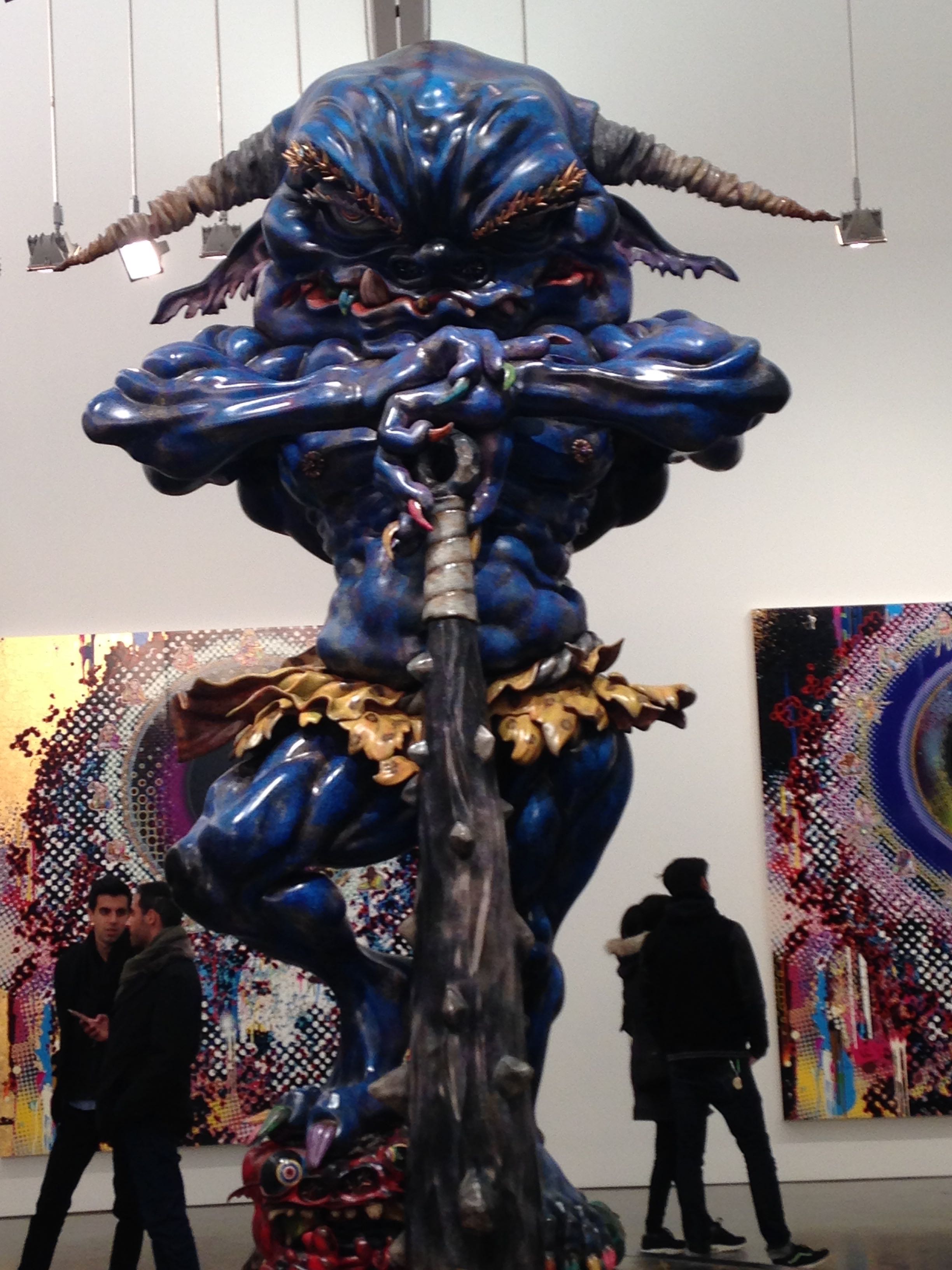
Filed under: photography
November 24, 2014 • 7:16 am Comments Off on Guest Review: World Premiere Staging of The Gospel According to the Other Mary

I’m deeply grateful to Tom Luce to be able to publish his insightful review of the world premiere of the opera staging of John Adams’s The Gospel According to the Other Mary. Directed by Peter Sellars, the production just opened this past weekend at English National Opera.
Review by Tom Luce:
The Gospel According to the Other Mary
World Premiere Staging of John Adams’s and Peter Sellars’s Masterpiece
On Friday 21 November, English National Opera unveiled its new production of the Adams/Sellars “alternative” version of the crucifixion of Christ. The two-act work, described by its creators as a “Passion Oratorio”, was premiered in a concert performance at Disney Concert Hall by the Los Angeles Philharmonic in May 2012 under Gustavo Dudamel’s baton. The following year came the first semi-staged concert performance, also featuring the LA Philharmonic under Dudamel. That version later toured to New York and Europe (including a stop at London’s Barbican). Dudamel’s interpretation was released on a recording by Deutsche Grammophon earlier this year, so the music has been accessible to the public at large since then.
Directed by Sellars himself, ENO’s production was the work’s first full staging. Along with its two creators, it deservedly received a prolonged ovation from a rapt and obviously much moved audience.
The performance was uniformly excellent, with cast and chorus admirably meeting the challenging mixture of singing, movement, and acting Sellars demands of and inspires from his performers. All the principal singers — Patricia Bardon as Mary Magdalene, Meredith Arwady as Martha, and Russell Thomas the Lazarus — were committed and effective, as were dancers Banks, Stephanie Berge, Ingrid Mackinnon, and Parinay Mehra, who variously shadowed them and contributed other parts to the narrative.
The musical side at ENO was in the hands of Joana Carneiro. Of Portuguese origin, she is better known in the U.S. than in Britain, having for some years been music director of the Berkeley Symphony. Her technical mastery and impassioned commitment to this highly complex score were remarkable. The ENO orchestra played magnificently.
Those familiar with Sellars’ “ritualisations” of the two Bach Passions with the Berlin Philharmonic Orchestra would find nothing to surprise them in his staging. One hallmark is his use of dance, mime, and body movement to externalise and heighten emotion. “Put your body where your belief is”, he says in the ENO’s introductory video. Another is the subtle intermingling of narrative and representation. The main thrust is narrative, but to heighten impact at critical points in the drama, the narrators act out the events — just as the Evangelist in the Berlin Bach Passions both expounds the story and at times impersonates characters — e.g., Peter in denial, or Christ at his death. This subtle shifting of roles keeps crude dramatisation at bay but facilitates a wide variety of dramatic tone and effects. I have not seen anything comparable in other directors’ work; it is one of Sellars’s most skilful and original attributes.
The stage design by George Tsypin, subtly lit by James Ingalls, is spare but eloquent: sand and barbed wire represent a Middle East riven by conflict and oppression, simultaneously biblical and contemporary.
The work juxtaposes and fuses ancient and modern in presenting Mary and Martha as running a hostel for homeless, impoverished, and marginalised people, with Jesus as a mixture of family friend, honoured guest, and spiritual patron. He is also a miracle worker in the raising of their dead brother Lazarus, sacrificial victim of the elites whose power he challenges, and a source of hope for the future of the world.
The literary sources are the Bible — especially St John’s Gospel — supplemented and re-interpreted through modern American cultural figures: poet and author Louise Erdrich, who is partially of native American descent; Dorothy Day of the radical Catholic Worker movement; Rosario Castellanos, the Mexican writer, activist, and diplomat; and the black poet June Jordan (who wrote the libretto for an earlier Adams/Sellars collaboration, I Was Looking at the Ceiling and Then I Saw the Sky).
In the ENO video Sellars also says: “The moment you feminize Christianity and you go into feminine spirituality, you go into a very different space and it operates very differently”. It is of the essence in Sellars’s dramatic work that he sees the cultural myths we have inherited through women’s eyes. This is as much an emotional and dramatic as a political standpoint.
The main originality of his St Matthew Passion ritualisation lies in its inspiration and liberation in the listener and viewer of wider and wilder feelings going well beyond the conventional liturgical responses or the “authentic” musical response to a deeper human involvement in the passion of Christ and its human and political significance. In doing so he responds to the injunction in the very first line of the work: “Come, ye daughters, help me lament”. (The discreet presence in the audience of Mark Padmore, the Evangelist in the Berlin Passions, at Friday’s Gospel premiere served to underline the connection between the Bach and Adams ventures.)
John Adams’s music reaches new levels of emotional profundity, dramatic responsiveness, and absence of mannerism, going even beyond his achievement in The Death of Klinghoffer. There is an extraordinary richness and flexibility of harmony and melody and a fascinating orchestral sound, to which a cimbalom gives an exotic edge without ever sounding kitschy. Amongst many fine moments, the most deeply moving for me is the aria with which the first act ends, sung by Lazarus after the Passover evening: “Tell me, how is this night different? … This is the night we eat the bread of affliction so that evil may turn into good”. Within an orchestral palette evoking a kind of Nachtmusik, Adams here creates a deep and movingly optimistic reflection on the events of the opera. Over many years I have heard nothing finer from a contemporary composer.
With this production English National Opera cements its standing as the world’s most committed John Adams house, having previously mounted Nixon in China and Doctor Atomic and having originated the Klinghoffer production admired recently at the Met.
The work itself will surely take a high place in the canon of works from the last century or so in which great composers address themes of human injustice and inequality. It will be alongside Tippett’s A Child Of Our Time (1944) and his The Knot Garden (1970), an opera featuring a female revolutionary fighter and a mixed-race/same-gender couple, which sadly seems to have slipped out of the repertoire in recent years); Hans Werner Henze’s dramatic cantata The Raft of Medusa; and above all Alban Berg’s Wozzeck. Its full unveiling at last week’s premiere was an event of real significance.
Tom Luce lives in London and Seattle. He has followed musical events for over 50 years. He wrote music reviews for Seattle’s Crosscut.com.
Filed under: American opera, Bach, culture news, directors, John Adams, new music, opera
November 21, 2014 • 7:38 am Comments Off on John Adams at ENO: The Other Mary
The full opera staging of John Adams’s The Gospel According to the Other Mary premieres tonight at English National Opera in London, in a production directed by the brilliant Peter Sellars (recently named Musical America’s Artist of the Year).
Here’s a clip with Peter Sellars and John Adams discussing the work:
Filed under: American music, American opera, John Adams, opera
 Arts & Culture Stories from NPR


