MEMETERIA by Thomas May

Music & the Arts

Overview of 2023 BBC Proms

Guest contribution from writer Tom Luce:

The 2023 edition of the BBC Proms offered 84 concerts — 72 at the Royal Albert Hall and 6 across the UK — over eight weeks, concluding with the Last Night event on 6 September.

All of these performances are now available online on BBC Sounds until 8 October. The BBC Promenade Festival each summer is justifiably recognized as one of the world’s finest concert festivals, and the 2023 program was probably the most astounding in recent years. 

All of the concerts are worth experiencing, but there are some which, in my view, should have special priority. Of course, the opening and closing nights are imbued with special drama and communal music, as the audience becomes involved with the performers, sometimes joining in to sing. 

Two other concerts also included some singing from the audience in addition to applause. One was a Sunday program given twice, in the morning and afternoon of 22 July, by the English National Opera. It was designed as an introduction to opera for the many children brought to the concert hall by their families, and also to amuse them. Actors played the roles of Mozart and Verdi, for example, explaining their achievements, while soloists, chorus, and orchestra performed parts of some of their operas. The program’s title was Horrible Histories: Orrible Opera, and it brilliantly exemplified opera’s capacity  to convey social and political conflicts that complicate personal love relationships. A closing event presented a musical listing of British Monarchs over the last 1,000 years, in which all audience members were encouraged to join their voices, presumably to convince the attending children of the value of knowing British monarchical history following this year’s coronation, though it seemed that almost as many of us adults as the children couldn’t fully remember the long list.

Another was the outstanding concert, from memory, by all players in the Aurora Orchestra, who are widely admired for performing classical music without instrumental stands or parts. The work was Stravinsky’s The Rite of Spring, performed twice, on the afternoon and the evening of 2 September. The concert’s opening half presented an illustrative introduction to the work led by an actor representing the composer, with key examples of the music played by the orchestra. For a couple of moments of interesting harmony and rhythm, we in the audience were asked to join in: quite a lot us tried, but probably thousands of times less convincingly than the brilliant Aurora experts.

Amongst the other concerts to look for online, I would especially recommend a fine solo organ performance given on 26 August by the Canadian organist Isabelle Demers, who opened with her own powerful and effective organ arrangement of Wagner’s Prelude to Die Meistersinger. Also fascinating is a performance of Schumann’s Das Paradies und die Peri , a fine but rarely heard oratorio, by the London Symphony Orchestra and Chorus conducted by Sir Simon Rattle. He also led the LSO on 27 August in a superb interpretation of Mahler’s Ninth Symphony prefaced by Figure humaine, a fascinating choral cantata by Francis Poulenc expressing solidarity with the Nazi-occupied French Resistance during the Second World War; it was sung by the admired BBC Singers. 

Other recommendations include: a splendid performance on 29 July of Mendelssohn’s oratorio Elijah by the Scottish Chamber Orchestra and Chorus and soloists an English translation; William Walton’s powerful and dramatic Belshazzar’s Feast by the BBC Symphony Orchestra and Chorus on 4 August by, which was preceded by Yuja Wang’s magnificent rendition of Rachmaninoff’s Rhapsody on a Theme of Paganini and the European premiere of Jimmy López Bellido’s Perú Negro, a vibrant homage to Afro-Peruvian music;  a Budapest Festival Orchestra program on 12 August led by Iván Fischer, which included a wonderful account by Sir András Schiff of Schumann’s Piano Concerto as well as Mendelssohn’s “Scottish” Symphony; the same pianist on the following day in Bartók’s Third Piano Concerto, and Beethoven’s Eroica Symphony; the Boston Symphony conducted by Andris Nelsons on 26 August, performing Stravinsky’s Petrushka and Gershwin’s Concerto in F;  and, in an astounding and rare appearance in the concert hall, a performance of Berlioz’s complete opera Les Troyens by the Monteverdi Choir, a cast of brilliant soloists, and the Orchestre Revolutionnaire et Romantique founded by Sir John Eliot Gardiner but, after he pulled out of the Proms, brilliantly conducted by his assistant Dinis Sousa, who filled in. Also  rarely seen in opera houses because of its difficulty and expense, Berlioz’s hugely passionate and exciting stage epic is a tremendously powerful example of how opera uses social and political conflicts to complicate personal relationships — a point that had previously been made in the special concert of 22 July for children and family audiences. This account of Les Troyens in particular should not be missed.

Also worth mentioning is that, in most countries, some of the live Proms recordings appear on YouTube not only in audio but also in video, conveying the dramatic public enthusiasm expressed by the gigantic Proms audiences — as at the Last Night of the Proms.

–Tom Luce

Filed under: BBC Proms, music news

Seattle Area Classical Music Picks

Breana McCullough, violist and scholar of both 17th-century European and traditional Karuk performance practices, will be at Benaroya Hall for a Sound Salon performance Oct. 1. (John Williams)

Some recommendations for the fall season in Seattle region for the Seattle Times:

These are turbulent times for the performing arts. Even before the pandemic, there were challenges in attracting new audiences to the concert hall, and key local organizations are facing leadership changes. Yet the Puget Sound region remains home to some of the most imaginative and dedicated artists and presenters in the field. The offerings this fall are wonderfully varied: Here are six well worth your time:

continue

Filed under: music news, Seattle Times

In A Sunny Vale Where Hemingway Sheltered, Free Concerts Resound

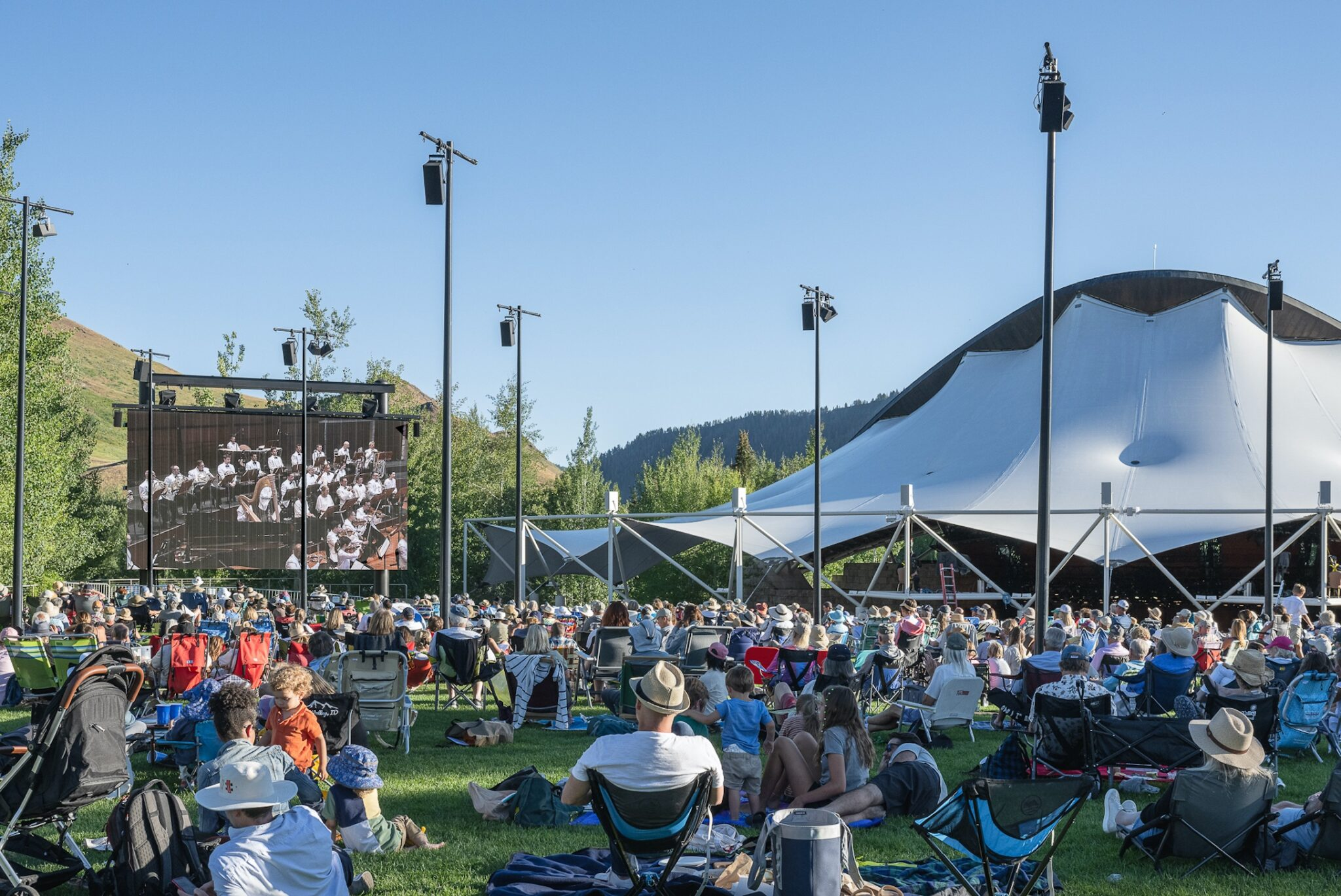
A high-definition LED wall screen made its debut this season on the lawn outside the Pavilion at the Sun Valley Music Festival. (Photo by Nils Ribi)

On my visit to the Sun Valley Music Festival this month:

SUN VALLEY, Idaho — A couple of golden eagles wheeling across the sky offered a dramatic welcome during my inaugural visit to the Sun Valley Music Festival. Viewed on the drive into town from nearby Friedman Memorial Airport, these fabled messengers of Zeus complemented the stark majesty of Bald Mountain with their agile flight. The area’s most-prominent Rocky Mountain peak towers 9,150 feet into the heavens and has been beckoning serious ski lovers since the area was first promoted as a winter sport destination — part of a pioneering campaign by Union Pacific Railroad in the late 1930s…

continue

Filed under: Classical Voice North America, music festivals, musical travels

Roche Young Commissions 2023

Saturday was the big day for the 2023 Roche Young Commissions. Two years after David Moliner and Hovik Sardaryan were announced as the selected composers, the project culminated in a concert in which the Lucerne Festival Contemporary Orchestra performed the world premieres of Estructura IV: Dämonischer Iris and Ikone, their respective new works.

I had discussed the process in depth with both composers over the past spring while compiling Roche’s publication documenting and introducing their new compositions, so it was especially thrilling to be present for this moment, with such palpable creative energy emanating from the immensely talented LFCO players.

A native of Cuenca, Spain, David Moliner was born in 1991 and also performs as a percussionist — a background that has clearly left its mark on Dämonischer Iris, which begins with attention-grabbing thwacks. This is the fourth and last part of his Estructuras cycle of orchestral works that trace his evolution as a composer. Inspired by images and insights from Dante, Goethe, the Symbolist poets, and an epiphany while visiting the illusory Rakotzbrücke near Dresden, Moliner’s piece embraces the contradictions of human experience, including our latent demonic side, mostly hidden away beyond conscious awareness.

Dämonischer Iris made a very strong impression, the audience bringing the excellent conductor Jack Sheen back for another curtain call with their applause. Moliner is a gripping storyteller, creating a sense of suspense at the beginning and then moving in several unexpected directions, swerving from Ligeti-like whimsy (musicians doubling on harmonicas feature among the sound world, along with whistles and birdcalls) to dead-serious intensity as if in a stream of consciousness. After hearing Klaus Mäkelä conduct the Oslo Philharmonic in Scriabin’s Poème de l’extase the previous day, I couldn’t help but think of Dämonischer Iris as a kind of 21st-century counterpart depicting the intensely contradictory character of human nature.

Whistles and harmonicas to defamiliarize the sound, the instrumentalists. Overall thought of an essay on the idea of emotional/tone transitions in a work: where does it “go” from being a parody or ironic to dead serious? Compare this to transitions in use of musical material, the Strauss waltz, the rowdy football song. How much of the violence and terrifying music here is a sort of Freudian ID that we are trying to repress? What is the Reason here? He provokes interesting questions. Prominent descending scale figure. Big Mahlerian trombone solo (or horn?). Imaginative use of the orchestra and of creating suspense. March gestures to get the music moving, on a track. A counterpart to Poeme of Ecstasy — here the intoxication of dark impulses. Anti-ecstasy. 

Hovik Sardaryan comes from Sevan, Armenia, where he was born in 1993; he and Moliner are both now based in Berlin. Ikone similarly explores what lies beyond the surface of everyday appearances — yet the two sound worlds invented by these composers could hardly be different. Sardaryan found inspiration in the work of Armenian filmmaker Sergei Parajanov as well as the theory of icons developed by the early-20th-century polymath Pavel Florensky, a Russian Orthodox theologian, engineer, mathematician, and inventor.

Florensky focused on icons as a challenge to the concept of pictorial space developed by Renaissance painters that has prevailed in the West: he explored how the spatial organization of icons from Byzantine and Russian culture negates the linear perspective the West has come to rely on to depict the “real” world. An icon, by contrast, becomes a portal between the viewer’s present reality and transcendence.

Conductor Rita Castro Blanco showed deep sympathy with Sardaryan’s complex score and confidence in how to shape its dense texture of microtonal layers and subtly, constantly shifting tempi — quite an accomplishment, as Ikone clearly showed itself to be the more challenging piece overall for the orchestra. With his astonishingly original tone colors and intriguing musical dramaturgy, Sardaryan invites us to imagine the transcendent perspective from the “other side” of an icon: unlike Wagnerian “time become space,” it suggests a moment of terrifying beauty sub specie aeternitatis.

As if all this weren’t a wonderfully full meal, Enno Poppe, this summer’s composer-in-residence, took the stage after intermission to lead the Swiss premiere of Mathias Spahlinger‘s passage/paysage, a massive orchestral opus from 1989/90 whose rarity in the concert hall is obvious in light of the immense challenges it poses. Poppe offered an elegant and engaging overview of the work and then led the LFCO in a deeply committed performance.

Spahlinger has described the Hegelian “theme” of passage/paysage as “the suspension, decomposition of order through its own regularity.” This idea manifests itself above all through the radical use of contrasts — or static non-contrasts. But the real tour de force comes in the long final section, a prolonged insistence on sonorities organized around the note B, which — as Poppe pointed out — Alban Berg famously used in the murder scene in Wozzeck as a figure for death. Poppe said he finds this among the most gripping finales in the orchestral literature, even comparing it to the dying gestures at the end of Mahler’s Ninth Symphony. The strings’ violent pizzicatos seemed to evoke incessant attempts at stoppage, at finding an ending — or perhaps a broken lyre string.

Radio SRF 2 Kultur will rebroadcast the concert on 20 September 2023 at 21:00 (CET) here.

Interview with Moliner on Dämonischer Iris here (in German)

Interview with conductor Jack Sheen on Dämonischer Iris here (in English)

Interview with Sardaryan on Ikone here (in German)

Interview with conductor conductor Rita Castro Blanco here (in English)

Filed under: commissions, Lucerne Festival, Lucerne Festival Academy, Roche Commissions

Social Harmony: Shinichi Suzuki’s Legacy

For my story on the legacy of the music educator and visionary, which appears in the latest issue of Strings magazine, I spoke to Anne Akiko Meyers, Leila Josefowicz, and Patricia D’Ercole, past chair of the Suzuki Association Board of Directors.

Filed under: education, Strings, violinists

Music on the Strait: 2023 Edition

This summer’s Music on the Strait summer festival of chamber music (19-27 August) opens on Saturday, 19 August, at the newly opened Field Arts & Events Hall in Port Angeles, WA. The opening night concert in the 500-seat Donna Morris Auditorium begins at 7pm and features Garrick Ohlsson and the Takács Quartet in a program of Brahms and Amy Beach, as well as the world premiere of a new work for violin and viola by 2023 composer-in-residence Lembit Beecher, which was written for Artistic Directors James Garlick and Richard O’Neill. It was inspired in part by the transformation of the Elwha River. This will be one of the first performances at the Field Arts and Events Hall .

The 19 August opening concert will be livestreamed here and on Music on the Strait’s homepage; you can also watch the concerts on 25 August and 27 August (check MotS’ homepage).

On 26 August at 7pm, also at Field Hall, Jeremy Denk performs Bach’s Complete Partitas; the students of the Olympic Strings Workshop will present a showcase at 6.15pm. For the festival finale on 27 August at 2pm, Jeremy Denk & Friends will play music by Clara Schumann, Robert Schumann, and Johannes Brahms. 

Other events will take place at Maier Hall at Peninsula College in Port Angeles:

On Sunday 20 August at 2pm, Takács plays Haydn, Beethoven, and Bartók, and on Friday 25 August at 7pm, Noah Geller, Seattle Symphony’s concertmaster, makes his Music on the Strait debut together with James Garlick, Richard O’Neill, and Ani Aznavoorian in Grieg’s String Quartet in G minor and shares the stage with percussionist Mari Yoshinaga in Anton Prischepa’s Based on Actual Events for Violin and Marimba. The quartet will also perform Jerod Impichchaachaaha’ Tate’s Pisashi for string quartet.

Filed under: chamber music, music news, Music on the Strait

Seattle Opera Mines a Novel, Futuristic Rheingold

From left: Frederick Ballentine as Loge, Michael Mayes as Alberich and Greer Grimsley as Wotan in “Das Rheingold” at Seattle Opera. (Philip Newton)

I reviewed Seattle Opera’s new production of Das Rheingold:

Richard Wagner once described his trailblazing brand of opera as “deeds of music made visible.” The new production of “Das Rheingold” that opened Seattle Opera’s 60th season Saturday adds a literal twist to that concept by having the orchestra share the stage with the singers.

continue

Filed under: review, Seattle Opera, Wagner

Mount Green: Monteverdi in Santa Fe

Santa Fe Opera Chorus | Photo: Curtis Brown

I wrote for Opera Now about Yuval Sharon’s Monteverdi production this summer at Santa Fe Opera:

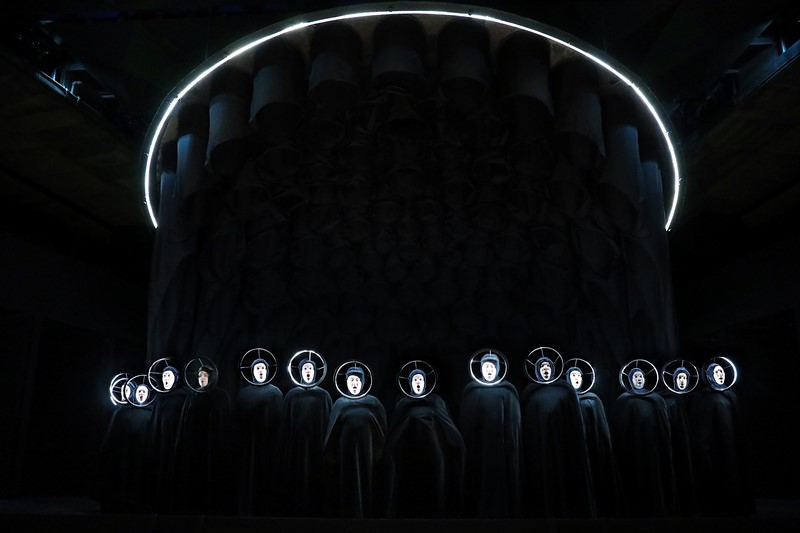
The rousing fanfare that famously calls the audience to order for Orfeo was preceded by the sound of a modern orchestra tuning up – a preliminary signal of many surprises to come in Santa Fe Opera’s first-ever staging of the epochal work by Claudio Monteverdi.
continue

Filed under: directors, Monteverdi, review, Santa Fe Opera

Orfeo in Santa Fe

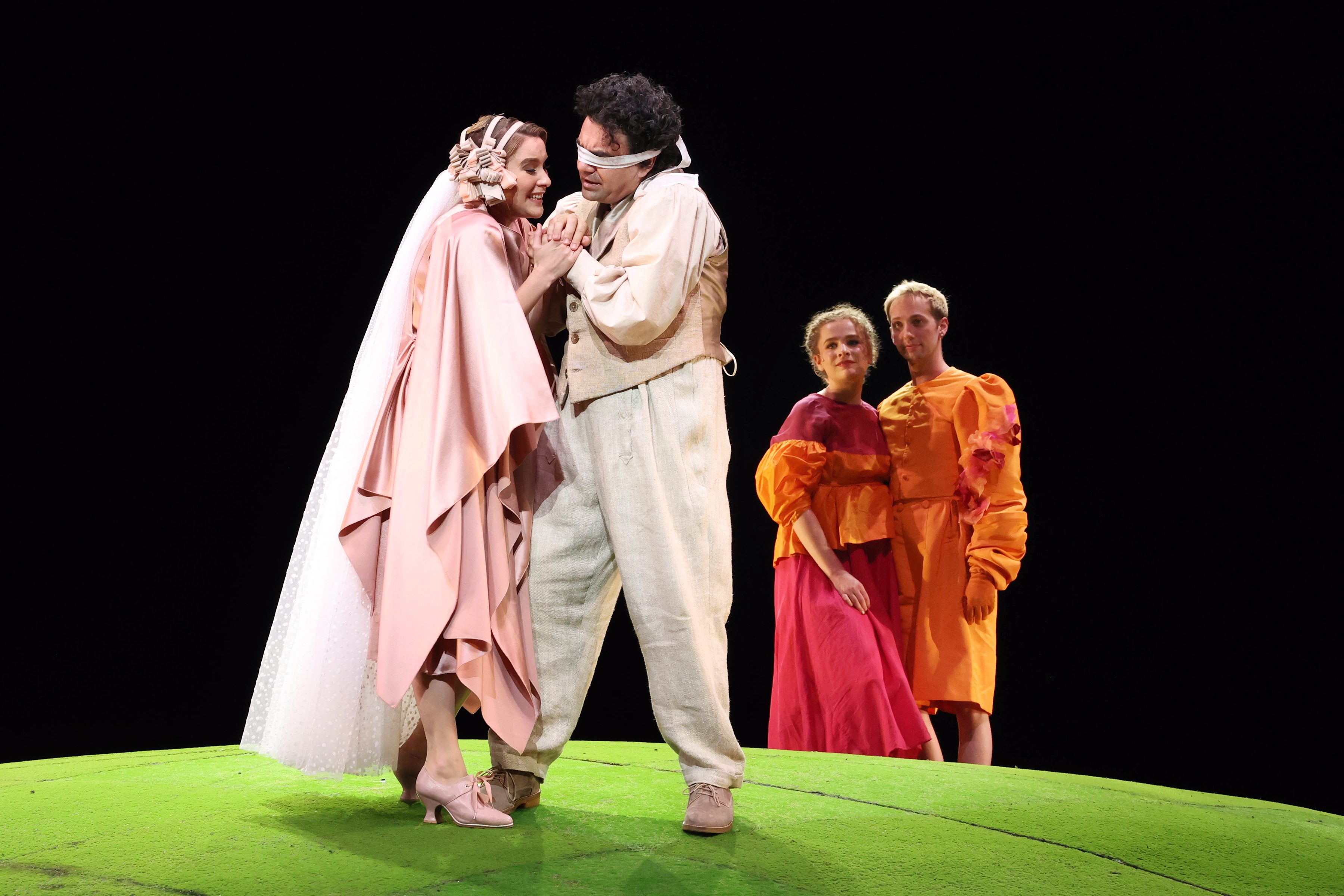
Amber Norelai (Euridice), Rolando Villazón (Orfeo), Lucy Evans (La Ninfa), Luke Elmer (3rd Pastore); photo by Curtis Brown for Santa Fe Opera

The first of my reviews from Santa Fe Opera’s 2023 season is open through the weekend (no paywall) here. I discuss Yuval Sharon’s extraordinary new production of L’Orfeo (or Orfeo, as they’re calling it), which features new orchestrations commissioned from Nico Muhly.

My review of Tosca is here (but behind the paywall). More reviews upcoming in Opera Now.

continue

Filed under: directors, Monteverdi, Musical America, Puccini, reviews, Santa Fe Opera

Mahler 3 Opens Lucerne’s 2023 Summer Festival

A performance of Mahler’s Third from 2007 by the Lucerne Festival Orchestra with Claudio Abbado

Lucerne’s Summer Festival officially starts today with a performance of Mahler’s Third Symphony by the Lucerne Festival Orchestra, which is celebrating its 20th anniversary this season; Paavo Järvi conducts. This concert launches the 2023 Summer Festival: for the next five weeks, the Festival will explore musical reflections of the theme of “Paradise.” The concert is being streamed live on arte at 19:30 Swiss time.

more on the concert

on the 20th anniversary of the Lucerne Festival Orchestra

Filed under: Lucerne Festival, Mahler, music news

Archive

Enter your email address to follow this blog and receive notifications of new posts by email.