Ask violinist David Harrington what he’s listening to these days, and you’ll get an instant glimpse into the insatiable hunger for discovery that defines and fuels Kronos Quartet, the trailblazing ensemble he founded in 1973. With Kronos Quartet, it’s the ears that are the window to the soul.
Celebrating Unity around the World is the title of inaugural program of the All-Star Orchestra’s 10th-anniversary season; the program aired on September 28, 2023. Founded by the conductor Gerard Schwarz in 2012, soon after he concluded his 26th season as music director of Seattle Symphony, the All-Star Orchestra comprises prominent musicians from leading orchestras across the United States, including members of the New York Philharmonic and Metropolitan Opera Orchestra, Boston Symphony, Cleveland Orchestra, National Symphony, and San Francisco Symphony, among several other ensembles.
The name evokes the kind of showcase team of outstanding athletes familiar from the sports world, or perhaps a supergroup of highly successful rock stars — but with the All-Star Orchestra, the focus is first and foremost on the music itself. Schwarz, who also serves as music director, devised the orchestra as a project through which top-level musicians could join together to cultivate symphonic music and share their love of this living tradition through public broadcasts. Each concert/program lasts about an hour and includes the maestro’s commentary — a latter-day response to Leonard Bernstein’s Omnibus concerts that spread the word about classical music a half century ago.
One unusual aspect of this multiple Emmy Award-winning project is that the All-Stars do not play for live audiences but record their performances in a ballroom at the Manhattan Center with an array of 18 high-definition television cameras and a team of top audio engineers. The results are not only broadcast on member PBS stations but released as DVDs on the Naxos label, and ensuring the highest quality for both the visual and the audio dimensions has been essential to the project’s success.
Along with the musicians he handpicked to be members of the All-Star Orchestra, Schwarz thus invited the eminent producer Dmitriy Lipay, winner of five Grammy Awards, to serve as audio director and producer for the project. The audio engineering team for the present program provided excellent sound — an especially notable feat in view of the vast spectrum of orchestral sonorities Schwarz selected to showcase, ranging from Richard Wagner to the 20th-century master Alberto Ginastera to the contemporary American composer Valerie Coleman.
Schwarz chose a thrilling opening work with music from Wagner’s early opera Tannhäuser. Rather than simply present the Overture from the original 1845 version, however, he leads the musicians in an engrossing account of the expanded version Wagner created for the Paris production of 1861 — an event of unique music historical importance despite the provocations of the composer’s opponents, which forced the production to close after just three performances. Schwarz thus segues from the Venusberg music at the center of the original Overture to the extended ballet Wagner devised for the opening scene in Paris.
The ballet depicts both the orgiastic transports sponsored by Venus in her forbidden realm, where Tannhäuser has been sojourning, and a feeling of languor from the bacchantes’ overstimulation. Schwarz seamlessly move from the vocabulary of Wagner’s earlier style to the chromatically saturated harmonies he had explored in Tristan und Isolde and imported into his revision of Tannhäuser. The overlap of languages from different eras of Wagner’s creative life intensifies the fundamental conflict between sacred and profane love that gives Tannhäuser its universal appeal.
A very different ballet music emerges in Alberto Ginastera’s dance suite from Estancia. The Argentine composer wrote this ballet score commissioned in 1941 by the forerunner of New York City Ballet. Schwarz coaxes the players to revel in Ginastera’s vibrant use of rhythms, majestically clashing harmonies, and boldly colorful orchestration as he pairs percussion and horns to evoke a sense of raw, elemental power. But the quasi-Impressionist evocation of the cattle ranch’s shimmering horizons is also well-calibrated. For the climatic dancing tournament that ends the suite, Schwarz coordinates a kaleidoscopic battery of percussion and trumpets.
The final selection is Umoja: An Anthem for Unity by the American composer and flutist Valerie Coleman, also known as the founder of the pioneering Imani Winds ensemble. Coleman initially composed Umoja for women’s choir; in 2019 the Philadelphia Orchestra commissioned her to write an expanded instrumental version. The title comes from the Swahili word for “unity” and refers to “the first principle of the African Diaspora holiday Kwanzaa.”
In her interview segment on the program, Coleman discusses how Umoja is the kind of music that “not only sends a message but is also part of a vast tradition of passing stories down, passing heritage, just through the element of intuition and feel.” She situates the sonority of African drums within a classical framework, evoking a sense of the vast Serengeti: “You feel the wildlife — you feel all of these things that are truly what I think is Mother Earth … the core of unity,” according to Coleman. “And we’re truly celebrating the moment and the message of unity.”
Ultimately, Schwarz has said that his vision for the All-Star Orchestra project is to make great music as accessible as possible. This first program of the latest season is proof that with the right elements in place, he can offer an appealing alternative to the many distractions competing for our attention span.
Mahani Teave, shown here at a Harriman-Jewell Series recital, will appear at Benaroya Hall Oct. 14 with the Seattle Symphony. (Courtesy of the Harriman-Jewell Series)
I’ve been fascinated — and moved — by Mahani Teave’s story since first writing about her two years ago (link to my New York Times story here). The pianist from Rapa Nui is now in the middle of her inaugural North American tour and comes to Seattle this weekend.
Unlike the rest of her tour, which has been focused on solo recitals, this stop involves a piano concerto and marks Teave’s debut with the Seattle Symphony. She will perform Mozart’s D minor Piano Concerto, K. 466, with SSO assistant conductor Sunny Xia on the podium, on 14 October at 7.30pm at Benaroya Hall. Teave will also play two new solo works inspired by Rapa Nui musical tradition. The other orchestral pieces include Aaron Jay Kernis’s Elegy and Juhi Bansal’s Songs from the Deep.
A rare opportunity to hear John Adams’s mammoth symphonic canvas on this weekend’s San Francisco Symphony program. Esa-Pekka Salonen, who led the Los Angeles Philharmonic in the world premiere in 1999, conducts. My program note here.
The program also includes the world premiere of Jesper Nordin’s Convergence, with violinist Pekka Kuusisto as the soloist.
Pacific MusicWorks opens the season this weekend with A Concert with the Countess: The Baroque Meets Drag. With music inspired by Shakespeare and Pepys, bass-baritone Taylor Ward channels his actual direct ancestor, Nicholas Lanier, in drag. Also featured are the extraordinary young dancer Tschedzom Tsingkhye and the Pacific MusicWorks ensemble.
Featuring PMW favorites, Danielle Reutter-Harrah, Stephen Stubbs, Tekla Cunningham, Henry Lebedinsky, and Maxine Eilander, and introducing John Taylor Ward and Paul Dudley, the Gala will take place at The Ruins at 570 Roy St, Seattle, WA 98109.
This birthday week for Steve Reich also brings his latest world premiere. I had the honor of writing the program note for Jacob’s Ladder. The New York Philharmonic and Synergy Vocals will perform the new work at this week’s concerts, which also include Leif Ove Andsnes in Beethoven’s “Emperor” Concerto and Schubert’s “Unfinished” Symphony. (Notes can be accessed via link next to program listing here.)
Congratulations to Stephanie Childress, Musical America’s New Artist of the Month for October 2023. My profile of this remarkable conductor has now been posted on Musical America’s website here.
The good fairies generously allotted the skills required to succeed as a conductor to Stephanie Childress. Or so it occurred to me while recently seeing this 24-year-old phenomenon in action leading a spirited, remarkably poised account of excerpts from Tchaikovsky’s Sleeping Beauty, beginning with “La Fée des lilas.” …
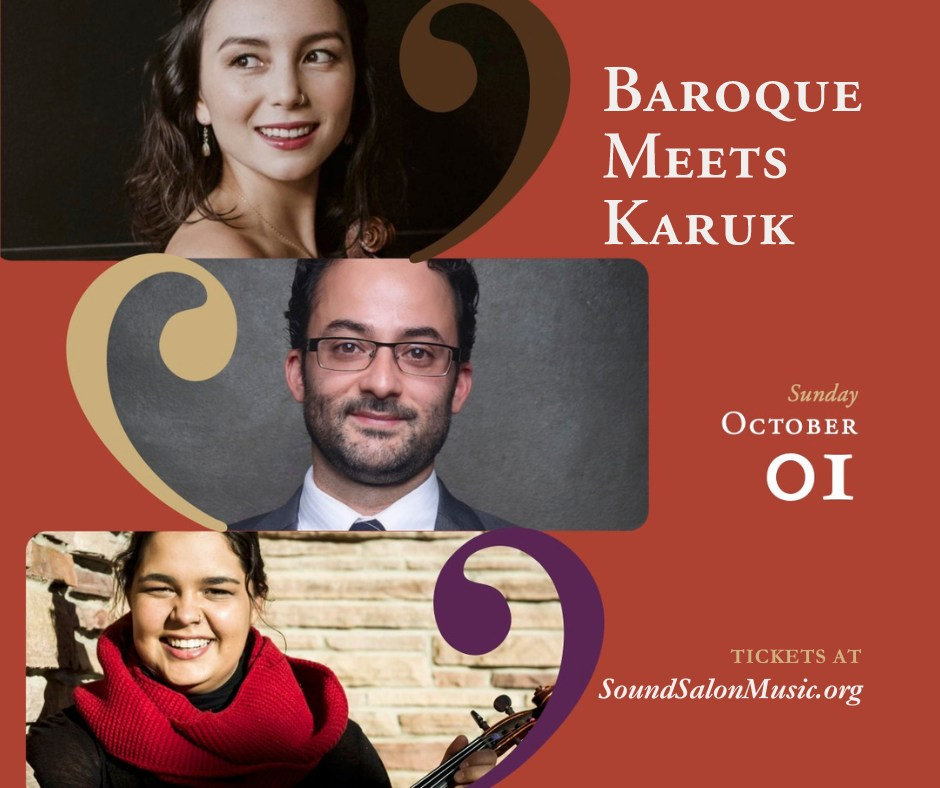
Sound Salon, formerly known as Byron Schenkman & Friends, launches a new season — and a new decade — Sunday evening with a program titled Baroque Meets Karuk. One of my fall picks for The Seattle Times, the concert begins at 7pm on 1 October at Benaroya Hall.
The chamber series has rebranded itself but remains committed to engaging and thought-provoking programs that encourage re-examining assumptions and, even more, making welcome discoveries.
This opening program, for example, will juxtapose pieces by 17th-century European composers with music from the Karuk tradition of the North American Pacific Coast, exploring connections between Spain, Italy, Austria, and the colonization of Turtle Island (now known as the North American continent).
Notes on the Program
By Byron Schenkman
We open our season with festive music from 17th-century Europe and from the Karuk tradition of what is currently known as northern California. Baroque composers of the 17th century learned from the music of diverse nations and cultures, whether by traveling themselves or by exposure to travelers.
Johann Heinrich Schmelzer likely studied in Italy before settling in Vienna where he was employed for many years as a violinist at the Habsburg court. The Spanish bassoonist Bartolomé de Selma y Salaverde was employed in Innsbruck and published music in Venice. Andrea Falconieri led the music at the Spanish court in Naples. The violinist Biagio Marini was born in Brescia and died in Venice, but also worked in Brussels and in various German and Italian cities.
Salamone Rossi was a Jewish violinist employed as concertmaster at the court in Mantua. He published many volumes of secular Italian vocal and instrumental music including the first trio-sonatas for two violins and continuo, a genre which would become standard for composers all over Europe for about 150 years. He also published a rare collection of Jewish polyphonic sacred music, starting a potential tradition which was wiped out by the destruction of the Jewish ghetto in 1630.
Like many of the women who published music in 17th-century Italy, Claudia Rusca and Isabella Leonarda were both nuns. Rusca published just one volume of sacred vocal music which also contains two short instrumental works. Leonarda was an exceptionally prolific composer who published hundreds of works including twelve instrumental sonatas.
Henry Purcell never left his native England yet his music was influenced by various international styles. Purcell’s royal employer Charles II spent his years of exile in France and much of Purcell’s theater music, including the Chaconne from “King Arthur,” is closely modeled on French music of the time. The French chaconne had its origins in an indigenous dance brought to Spain from what is now South America.
Duwamish Land Acknowledgement
Sound Salon would like to acknowledge that we are on the traditional land of the first people of Seattle, the Duwamish People past and present, and honor with gratitude the land itself and the Duwamish Tribe which has stewarded the land throughout the generations.
Ludovic Morlot conducts the SSO and soprano Alexandra LoBianco in excerpts from Götterdämmerung; photo (c)Brandon Patoc
My Bachtrack review of opening night at Seattle Symphony, which paired pieces played on the orchestra’s first-ever concert in 1903 and at their concert inaugurating Benaroya Hall 25 years ago. The fact that about two-thirds of the seats remained empty didn’t dampen the musicians’s spirits, but what a pity that so many missed out on a substantial, gloriously played program — not the lineup of frothy showpieces that orchestras so often put together for their season curtain raiser.
Review:
Though it ended with the downfall of a whole civilization, the Seattle Symphony’s opening-night concert radiated the excitement of a brand new season just getting under way, with all its attendant fresh hopes.
As part of its ongoing centennial tribute to Maria Callas, The Greek National Opera presentsCallas at the Herodiumon Saturday, 16 September, which marks the anniversary of Maria Callas’s passing. The gala features the repertoire the legendary soprano performed at the Odeon of Herodes Atticus in 1944 and 1957. Anna Pirozzi, Catherine Foster, Vassiliki Karayanni, and Nina Minasyan pay tribute to Callas’s remarkable talent and leave their own mark on the iconic venue with this special tribute, led by conductor Philippe Auguin. The program features arias from composers Kalomiris, Beethoven, Wagner, Verdi, Donizetti, and Thomas and celebrates the legacy of Maria Callas at the historic venue that she helped make famous.
Maria Callas’s legacy in Greece is deeply rooted in her performances at the Odeon of Herodes Atticus. In 1944, before she left Athens for New York, she sang the role of Smaragda in The Masterbuilder by Manolis Kalomiris, and Leonora in Beethoven’s Fidelio, both under the baton of acclaimed conductors and directors. Thirteen years later, in 1957, she returned to the same venue to give a legendary recital as part of the Athens Festival, showcasing her vocal range and virtuosity in arias from such operas as Tristan und Isolde, La forza del destino, Il Trovatore, Lucia di Lammermoor, and Hamlet.
Opera gala
Callas at the Herodium
September 16, 2023
Odeon of Herodes Atticus
Starts at: 8:30 pm
Conductor: Philippe Auguin
Soloists: Anna Pirozzi, Catherine Foster, Vassiliki Karayanni, Nina Minasyan
With the Orchestra of the Greek National Opera
GALA PROGRAM
Manolis Kalomiris, The Masterbuilder
— Overture
— “The sun, the sun”
Smaragda’s aria from Part II – Vassiliki Karayanni
Ludwig van Beethoven, Fidelio
— Overture
— “Abscheulicher! Wo eilst du hin? … Komm, Hoffnung” / “Monster! Where are you hurrying? … Come, hope”
Leonore’s recitative and aria from Act I – Catherine Foster
Ambroise Thomas, Hamlet
— “À vos jeux, mes amis” / “To your games, my friends”
Ophélie’s “mad scene” from Act IV – Nina Minasyan
Giuseppe Verdi, La forza del destino
— Overture
— “Pace, pace, mio Dio” / “Peace, peace, my God”
Leonora’s aria from Act IV – Anna Pirozzi
Gaetano Donizetti, Lucia di Lammermoor
— “Regnava nel silenzio” / “Reigning in the silence”
Lucia’s aria from Act I – Vassiliki Karayanni
Giuseppe Verdi, Il trovatore
— “D’amor sull’ali rosee” / “On the rosy wings of love”
Leonora’s aria from Part IV – Anna Pirozzi
Richard Wagner, Tristan und Isolde
— Prelude and Isolde’s “Liebestod” – Catherine Foster