MEMETERIA by Thomas May

Music & the Arts

Judith Cohen and the Governor’s Chamber Music Series

left to right: Hal Grossman, Judith Cohen, and David Burgess

Pianist Judith Cohen, a Steinway artist and one of Seattle’s musical treasures, presents her latest program as longtime Artistic Director of The Governor’s Chamber Music Series. Titled Small Plates: Tasty Musical Tapas from around the World, the concert features Cohen at the keyboard with colleagues David Burgess on guitar and Hal Grossman on violin and will be presented in Bellevue this weekend before the Governor’s Mansion performance in Olympia.

The Bellevue performance begins at 7.30 on May 13 at Resonance Events in Bellevue. Tickets here.

You can also experience this program in the beautiful setting of the Governor’s Mansion in Olympia on Monday, May 15, at 6.45 pm. Tickets here.

ABOUT THE ARTISTS

Judith Cohen made her European recital debut in 2002, performing two solo recitals in Budapest, Hungary, and since then has returned three times for concert tours of Hungary. She has performed solo recitals in Mexico, under the sponsorship of the Instituto Nacional de Bellas Artes. Critic Robert Somerlott of the Mexico City News hailed her as “an artist of unusual talent who captivated the audience with both her musicianship and stage presence.” She has performed solo and chamber music recitals throughout the Pacific Northwest, in Massachusetts, New York, Florida, Kentucky and Texas. She has also been presented in solo recitals by the Dame Myra Hess Recital Series in both Chicago and Los Angeles, and by the Florence Conservatory of Music in Italy.

Violinist Hal Grossman has been hailed by critics for his “tremendous virtuosic technique” and “outstanding artistic sense”. As concerto soloist, he has appeared with American, European, and Canadian orchestras including the Rochester Phil Harmonica, the North Carolina Symphony, Polish Symphonette, the Illinois Lima, Guelph, and Battle Creek Symphonies. He was the Grand Award Winner of the Lima Young Artist Competition and Silver Medalist of the International Stulberg Competition. Mr. Grossman also received First Prize Awards at the prestigious International Cleveland Quartet Competition and the National Fischoff Chamber Music Competition. He has performed for the Royal Highnesses, Prince Charles and Princess Diana in his New York debut at Carnegie Hall.

Classical guitarist David Burgess studied music at Mexico City’s Estudio de Arte Guitarrìstico under the noted Argentine guitarist Manuel López Ramos, subsequently landing a full scholarship to study in Italy with Oscar Ghiglia. An occasional pupil of Andrés Segovia throughout the mid-’80s, Burgess also took top honors in the Andrés Segovia Fellowship Competition in New York City, and placed first in the Mexico City’s Ponce International Competition, Toronto’s Guitar ’81 competition and Munich’s 31st International Music Competition. A onetime instructor at the University of Washington and the Cornish Institute of the Arts, in time Burgess settled in New York City, releasing his solo debut Silver Nuggets and Fool’s Gold.

The Governor’s Mansion Foundation, with more than 200 members, is an all-volunteer, non-profit, non-partisan organization, that honors the historical and cultural importance of the Washington State Governor’s Mansion by maintaining and enhancing furnishings and art for the public rooms of the Mansion, educating the public about the Mansion and its history, and advocating on its behalf. GMF is not affiliated with the Governor or the Governor’s office. For more information on GMF go to www.wagovmansion.org.

Filed under: Judith Cohen, music news, pianists

Thibaudet and the Colburn Ensemble in Berlin

Jean-Yves Thibaudet and an ensemble from the Colburn School perform a chamber program this evening at Boulez-Saal in Berlin.

Frank Gehry, architect of Boulez-Saal and a friend of Daniel Barenboim, has also designed a 100,000 square-foot expansion of the Colburn School campus in downtown LA, including a 1,000-seat, in-the-round performance space, a studio theater, dance studios, and public gardens and green spaces. Reuniting with Gehry for that project is another name familiar to Berliners: Yasuhisa Toyota of Nagata Acoustics, who served as acoustician for Boulez-Saal (along with other Gehry buildings, including Disney Concert Hall). The new Colburn performance hall, expected to open to the public in 2025, will have parallels with Boulez-Saal.

I wrote about tonight’s program here.

Filed under: architecture, chamber music, music news, Pierre Boulez Saal

LA Master Chorale’s Lagrime

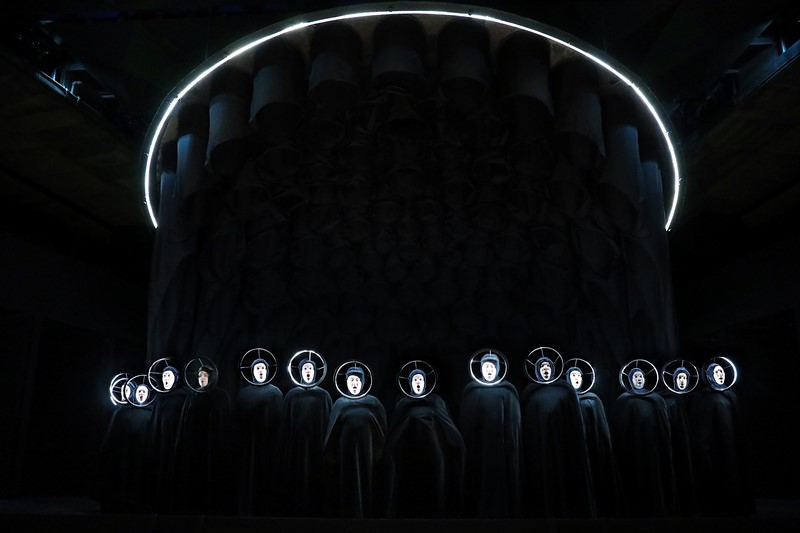
The Meany Center at University of Washington presents the Los Angeles Master Chorale’s production of Lagrime di San Pietro by Orlando di Lasso on Saturday evening, with Peter Sellars directing and Grant Gershon conducting. My program essay for the performance can be found here.

What’s the correct way to refer to one of the most extraordinary musical minds in history: Orlande/Orlando/Roland de Lassus/di Lasso? There’s a Franco-Flemish form and an Italianized one; sometimes the two get mixed together. There’s even a Latin option intended to standardize the situation. The very profusion of variants points to the internationalism and cross-pollination across borders that marked the era of the High Renaissance in Europe….

continue

Filed under: early music, Los Angeles Master Chorale, Peter Sellars

Composing Inclusion: Juilliard and New York Philharmonic

A new model for promoting diversity in the concert hall through a multifaceted collaboration among composers, performers, and educators reaches one of its first milestones this weekend. The inaugural orchestral concert of Composing Inclusion, a partnership between the Preparatory Division, the New York Philharmonic, and American Composers Forum, takes place on May 6 at the renovated David Geffen Hall.

My preview of this event for the Juilliard Journal is here.

Here’s my profile of James Díaz, whose and does the Moon also fall? is among the new commissions.

The program:

Jordyn Davis
As I AM (World premiere—Juilliard Preparatory Division Co-Commission with the New York Philharmonic and American Composers Forum)

James Díaz
and does the Moon also fall? (World premiere—Juilliard Preparatory Division Co-Commission with the New York Philharmonic and American Composers Forum)

Trevor Weston
Subwaves (World premiere—Juilliard Preparatory Division Co-Commission with the New York Philharmonic and American Composers Forum)

Jordyn Davis’ and James Diaz’ commissions are part of Composing Inclusion: a collaboration between the New York Philharmonic, American Composers Forum, and Juilliard’s Preparatory Division, made possible with funding from the Sphinx Venture Fund.

Trevor Weston’s work was co-commissioned by American Composers Forum, Juilliard’s Preparatory Division, and the New York Philharmonic. It was funded, in part, with support from the National Endowment for the Arts.

Filed under: Juilliard, music news

Biber’s Glorious Mysteries at Whidbey Island Music Festival

If you’re looking to plan an unforgettable weekend, here’s a suggestion to start it off: the Whidbey Island Music Festival presents Heinrich Ignaz Franz von Biber’s complete Mystery Sonatas performed by some of the finest artists from the early music scene: Tekla Cunningham (baroque violin and director of Whidbey Island Music Festival), Elisabeth Reed (baroque cello), and Henry Lebedinsky (organ and harpsichord.) Performance at 7pm on 5 May. Info and tickets here.

This is the final concert in a three-concert series traversing Biber’s Mystery Sonatas. The Glorious Mysteries begin with the events of Easter and the Resurrection. The capstone of the final set of sonatas is the Passacaglia for solo violin (also known as the “Guardian Angel”).

The concert takes place in the intimate St. Augustine’s in-the-woods Church in Freeland on Whidbey Island, which boasts spendid acoustics.

And to top it off: Tekla Cunningham’s trademark springerle cookies pressed with images of a Guardian Angel will be served at the reception. 

PROGRAM:

The Glorious Mysteries

Sonata XI in G Major:  The Resurrection          Heinrich Ignaz Franz von Biber (1644-1704)Sonata – Hymn: Surrexit Christus hodie and variations

Canzona on ‘Christ ist erstanden’                                     Georg Reutter der Ältere (1656-1738)

Sonata XII in C Major:  The Ascension                                                                   H.I.F. von BiberIntrada – Aria tubicinum (trumpet) – Allemanda – Courante and double

Ricercar in G minor for solo cello                                        Domenico Gabrieli (ca. 1651-1690)

Sonata XIII in D minor:  The Descent of the Holy Ghost                                    H.I.F. von Biber
Sonata – Gavotte – Gigue – Sarabanda

Intermission

Sonata XIV in D Major:  The Assumption of the Virgin                                      H.I.F. von Biber[Sonata] – Arias 1 and 2 – Gigue

Capriccio in G                                                                       Johann Jakob Froberger (1716-1767)

Sonata XV in C Major:  The Coronation of the Virgin Mary                              H.I.F. von Biber
Sonata – Aria with 3 doubles – Canzona – Sarabanda and double

Passacaglia in G minor for solo violin                                                                H.I.F. von Biber

From Whidbey Island Music Festival:

About the Mystery Sonatas: 

Named for the 15 Mysteries of the Rosary (also known as the Rosary Sonatas), these three sets of 5 sonatas for violin and continuo, plus a concluding Passacaglia for solo violin, were completed around 1676. Dedicated to the Archbishop Gandolph in Salzburg, these sonatas are as compelling, affecting and moving as they were when they were written almost 350 years ago. In the manuscript copy, each sonata has a copper-plate print at the opening of the sonata showing the story of the piece. 

About scordatura: 

Scored for a single violin supported by continuo, Biber asks the violinist to tune differently for each sonata. Only the first sonata (the Annunciation) and the final Passacaglia share the standard G-D-A-E tuning. The Resurrection sonata has the most extreme tuning, involving switching the G and the D strings. This technique of mistuning the violin, called scordatura, gives a tremendous range of affects and emotions to this music. Retuning brings the violin into different key areas and creates a kaleidoscope of overtones and sonic effects, helping Biber to create specific emotions or affects in the listener. 

ARTIST BIOS

Tekla Cunningham

Elisabeth Reed, Oakland, CA teaches Baroque cello and viola da gamba at the University of California at Berkeley and at the San Francisco Conservatory of Music, where she is co-director of the Baroque Ensemble. Recent teaching highlights include master classes at the Juilliard School, the Shanghai Conservatory and Middle School, and the Royal Academy of Music. A soloist and chamber musician with Voices of Music, Pacific Musicworks, Archetti, and Wildcat Viols, she has also appeared with the Smithsonian Chamber Players, the American Bach Soloists and the Seattle, Portland, Pacific, and Philharmonia Baroque Orchestras. Elisabeth directs “Voice of the Viol”, the renaissance viola da gamba ensemble of Voices of Music. She can be heard on the Virgin Classics, Naxos, Focus, Plectra, and Magnatunes recording labels and has many HD videos on the Voices of Music Youtube channel. She is a Guild-certified practitioner of the Feldenkrais Method™ of Awareness Through Movement ™ with a particular interest in working with musicians and performers.  

Hailed by The Miami Herald for his “superb continuo… brilliantly improvised and ornamented,” GRAMMY-nominated historical keyboardist, composer, and conductor Henry Lebedinsky has performed with the Seattle Symphony, Seattle Opera, the St. Paul Chamber Orchestra, Pacific Northwest Ballet, the Charlotte Symphony, Seraphic Fire, Sonoma Bach, and the Cantata Collective, among others. Recent conducting engagements include the Seattle Baroque Orchestra and Sonoma Bach’s Live Oak Baroque Orchestra. As part of a career built on collaboration, he serves as co-Artistic Director of the San Francisco Bay Area’s AGAVE and Seattle’s Pacific MusicWorks. With countertenor Reginald L. Mobley, he has introduced listeners on three continents to music by Black composers from Baroque to modern, including recent appearances at the Musée d’Orsay in Paris and Festival Printemps Musical des Alizés in Morocco. In 2014, he founded Seattle’s Early Music Underground, which brought Baroque music to brewpubs, wineries, and other places where people gather, and presenting it in multimedia contexts which both entertain and educate. Lebedinsky’s works for choir and organ are published by Paraclete Press, Carus-Verlag Stuttgart, and CanticaNOVA, and two volumes of his poetry and hymns are in preparation. He holds degrees from Bowdoin College and the Longy School of Music, where he earned a Master of Music in historical organ performance as a student of Peter Sykes. Currently entering his third decade as a church musician, he serves as Missioner for Music at St. Augustine’s Episcopal Church on Whidbey Island.

ABOUT THE WHIDBEY ISLAND MUSIC FESTIVAL

Founded in 2006 by Tekla Cunningham, the Whidbey Island Music Festival is a beloved annual event that presents great performances of baroque and classical chamber music in relaxed and intimate indoor and outdoor venues on beautiful Whidbey Island, with repertoire from Monteverdi to Florence Price. We bring music of the past four centuries to life with vivid and moving concert performances on period instruments.

Filed under: early music, music news

Big Move for All Classical Portland

All Classical Portland (one of the largest classical radio stations in the U.S.) today announced their relocation from the Portland Opera building to downtown Portland’s KOIN Tower in early 2024. The move will expand the range of activities All Classical can offer.

And it is hoped that this move will serve as a national beacon for arts-based urban regeneration at a time when many businesses and organizations have been moving out of downtown Portland. The new state-of-the-art location at KOIN Tower is in the heart of Portland’s downtown, where All Classical is building a new space to host community concerts and events. The recording studio will be made available to document local artists.

More on the move from Oregon Artswatch here.

Filed under: music news

James Díaz: Musical America’s New Artist of the Month

Credit: Mariangela Quiroga fotografia

Congratulations to composer James Díaz, Musical America’s New Artist of the Month for May 2023. My profile:

When he was 14, James Díaz started taking keyboard lessons thanks to the toss of a coin. His parents wanted to have one of their two sons receive training so as to be able to play in the local church. Díaz, born in 1990, would commute every day from his working-class district on the outskirts of Bogotá. …

continue

Filed under: artist profile, composers, Musical America

Music Of Shostakovich Brings Fresh Drama To Silent Film ‘Potemkin’

Music from Shostavich’s Fourth, Fifth, Eighth, Tenth and Eleventh Symphonies was performed live to Eisenstein’s film. (Seattle Symphony photo)

I wrote about a very interesting film + live symphony event at Seattle Symphony with guest conductor Frank Strobel:

In 1925, Sergei Eisenstein made cinematic history with the release of Battleship Potemkin, his feature debut. Dmitri Shostakovich, still a precocious teenager, was hard at work on his First Symphony, which also caused a sensation when it was premiered the next year by the Leningrad Philharmonic.

continue

Filed under: Classical Voice North America, film, film music, review, Seattle Symphony

Abel Selaocoe Brings His Spirited Musicianship to Seattle

Abel Selaocoe and the Seattle Symphony; photo (c) Carlin Ma

What a memorable concert this was — my latest Seattle Symphony review:

“I feel very welcome here,” said Abel Selaocoe just before making his debut with the Seattle Symphony. Not only did he seem completely at home: in remarks introducing Four Spirits, his new work for cello, voice and orchestra, the young cellist-composer invited the audience to enter into his musical world, indicating that he would cue them when to sing along at the appropriate moment. “I’ll see you on the other side,” he winked, just before taking up his position to launch the piece.

continue

Filed under: Berlioz, cello, new music, review, Seattle Symphony

Hannibal Lokumbe’s The Jonah People

This week the Nashville Symphony and Giancarlo Guerrero present the world premiere of Hannibal Lokumbe‘s boundary-breaking The Jonah People: A Legacy of Struggle and Triumph. This bold and uncompromising opera draws on Hannibal’s own family history and the biblical parable of Jonah and the Whale to tell and epic, visionary story that honors the countless Africans stolen from their homeland as well as their descendants through the generations. 

You can find my program guide to this extraordinary collaborative work here:

Filed under: American opera, commissions, Nashville Symphony, new music

Archive

Enter your email address to follow this blog and receive notifications of new posts by email.