Former German Chancellor Angela Merkel has been channeling her passion for Richard Wagner into a podcast discussion on SWR2 in a three-episode series as part of Sprechen wir über Mord!? Merkel’s podcasts explore criminal contexts and motives in the Ring cycle. The podcasts are in German.
Angela Merkel: “The ring is so universally applicable to humanity that from family life to political life, you can always find things that just keep happening to us humans.”
Angela Merkel: “To claim that anyone is completely free of vanity, well, I wouldn’t say that for me either. Vanity is something that is quite inherent in people, but it also has to be restrained.”
UPDATE: Due to freezing rain and icy streets, The Saddest of All Keys with Richard Lefebvre & Rachel Kessler will be postponed to 14 January 2023.
Marimbist Erin Jorgensen joins forces with poet/Renaissance woman Rachel Kessler and ubiquitous front man Richard Lefebvre for a one-night-only-anti-holiday-holiday show. Expect dreamy visions, tales of kicking drugs, musings on seasonal depression and spiders, JS Bach, and amplified and acoustic marimba – all in the key of D Minor, of course.
Two shows on Friday 23 December at 6 and 9pm at Odd Sea | 1539 NW Leary Way. The venue is a new performance space made from a former auto-body shop in Ballard. Run time is approximately 50 minutes. Tickets here.
The Houston-based chamber music and jazz presenter DACAMERA is offering a holiday gift of Chopin performed by one of the leading interpreters of his music, the Grammy Award-winning Garrick Ohlsson. Listen to his Chopin recital, which opened DAMERA’s season, as a free stream for two weeks, available herewith registration.
Seattle Pro Musica presents its holiday program on 17 December at 3pm at First Baptist Church in Seattle. Titled Behold the Star, the program offers holiday favorites as well as the world premiere of Shruthi Rajasekar‘s newly commissioned I am my own, set to texts by the three Brontë sisters (Emily, Charlotte, and Anne). Winter and holiday-themed works by Herbert Howells, Francis Poulenc, and Guillaume Dufay share the program.
Behold the Star is the third in Seattle Pro Musica’s New American Composer Series. The five-concert series celebrates Seattle Pro Musica’s 50th Anniversary,with commissions and Seattle residencies by five BIPOC composers from across the country.
This performance will also be available by livestream in real time and on demand following the performance (simply register in advance here).
This is a holiday treat I’m especially looking forward to: the upcoming “teaser” for choreographer extraordinaire Donald Byrd‘s The Harlem Nutcracker at Spectrum Dance Theater.
Duke Ellington and Billy Strayhorn’s Nutcracker Suite is the musical inspiration for this work-in-progress. “The original story centers around an African-American family in Harlem on Christmas Eve,” according to Spectrum’s description. “It highlights the unique warmth and centrality of the grandmother in African-American culture, the resilience of Black American families and Harlem as a center of the African Diaspora.”
This year’s performance is being billed as a “teaser” to the complete production, tentatively scheduled to premiere in a little over a year. It includes the whole show except for the final 20 minutes — which will be unveiled as a surprise at the full premiere.
Dates: DEC 8-11 + 15-18, 2022 at On the Boards, 100 W Roy Street, Seattle, WA 98119. Tickets here.
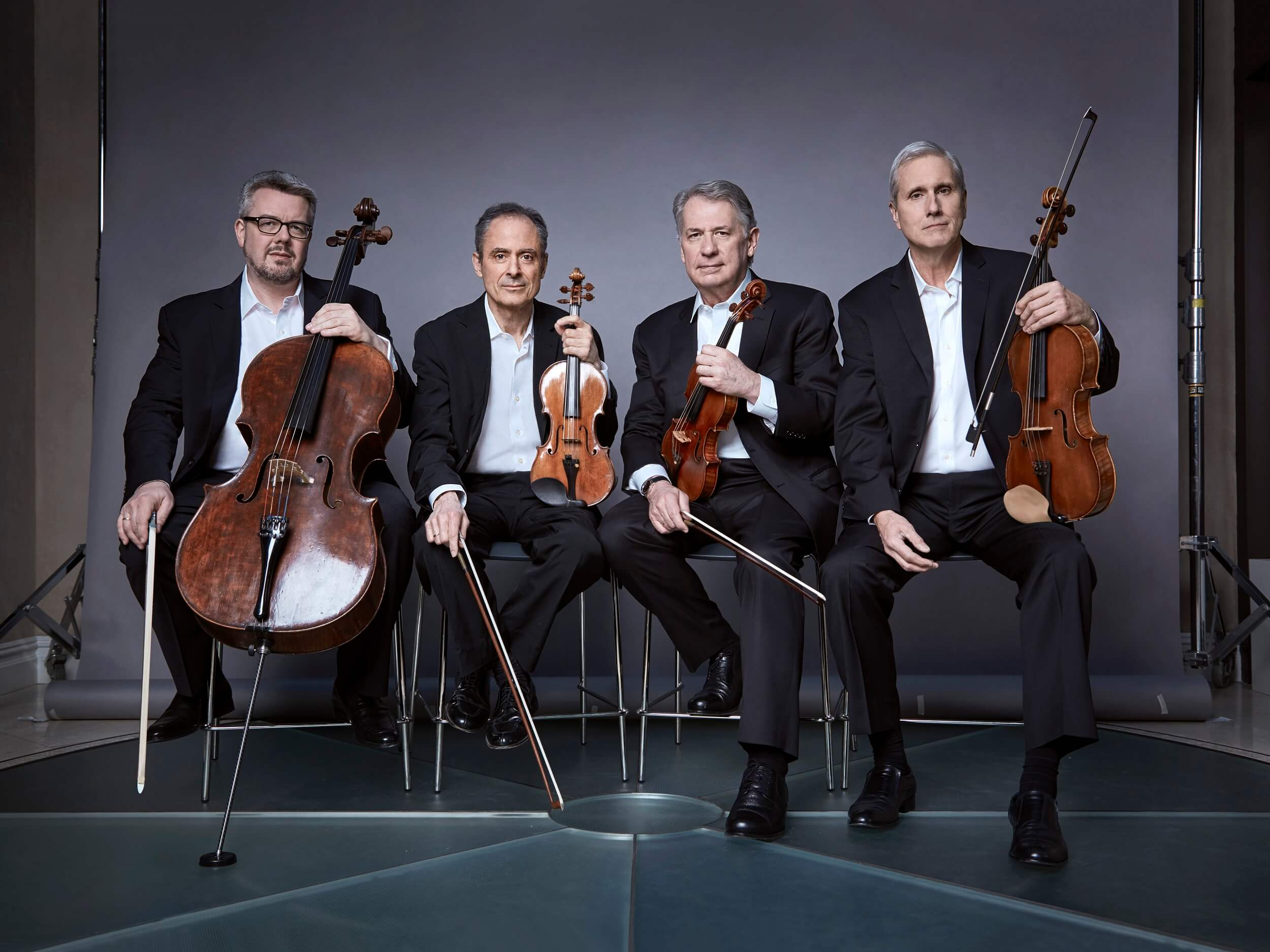
The Emerson String Quartet; photo (c) Jürgen Frank
There’s actually still nearly a year to go before the Emerson String Quartet (ESQ) plays its final final concert, which is currently planned for the end of October 2023 at Alice Tully Hall in Manhattan. On top of that, they are also preparing a feature-length documentary of their farewell tour, written and directed by Tristan Cook and produced by Birgit Gernbōck. So this splendid, storied American ensemble still has some way to go before reaching the end of the line….
Still, the Emersons’ concert on 1 December at the Meany Center for the Performing Arts had a distinctly valedictory accent. One of the stops on their official farewell tour, their appearance at the University of Washington venue had already been postponed from the spring and marked the 27th (or possibly even 28th) visit since the ESQ’s debut there in 1988. The ensemble attracts a loyal following, and an impressive percentage of the audience indicated that they had attended that inaugural performance.
As for the musicians, violinists Eugene Drucker and Philip Setzer have remained part of the ESQ since they founded it in 1976, and violist Lawrence Dutton joined in 1977. The only other change in personnel has been the arrival of Paul Watkins in 2013 following the departure of longtime cellist David Finckel. (Reunions with Finckel and the other two former members, cellist Eric Wilson and violist Guillermo Figueroa, are also on the agenda during the farewell tour.)
The ESQ have been offering their renowned Shostakovich interpretations as part of the farewell tour — their final London concert a few weeks ago featured the bleak implications of the Russian composer’s last three quartets — but they chose a blend of American and classic European fare for their Meany Center program. Each selection suggested an individual variant on the idea of leave-taking. George Walker expressed his grief over the passing of his grandmother in his 1946 Lyric for Strings, which originated as the slow movement of his String Quartet No. 1. Walker’s structural idea of having the single voices enter one after the other served as a beautiful metaphor for the individuality of the quartet members joining together in song and converging in a collective eloquence.
The ESQ here set the tone for the entire program, which at times seemed uncharacteristically understated, even subdued — as if to keep the audience pricking up its ears to fill in the spaces for what seemed left unsaid. This ploy took particularly delightful form in the fifth of Haydn’s Op. 33 set, the Quartet in G major that since the 19th century has been known by the English nickname “How Do You Do.” The “farewell” here was especially sly and sophisticated. Haydn cleverly plays with the idea of musical endings, which is to say, cadences, by starting off the whole work with a cadential gesture that befits a closing phrase — but that he catchily turns into the connective idea, leading us ever onward. The ESQ didn’t overemphasize Haydn’s little jokes of time and timing — the pizzicato ending that throws an enigmatic question mark on the otherwise plaintive slow movement, or the stop-and-start high-jinx of the scherzo, for example. The focus seemed to be on letting the music have its say, with minimal “interference.”
This translated into a decidedly austere, anti-sentimental take on Samuel Barber’s Adagio for Strings — like Walker’s, music by a young man, originally positioned as part of a string quartet, which seems wise far beyond its composer’s years. The Adagio (which is said to have been inspired by the third of Virgil’s Georgics) has of course been turned into a default song of farewell, an idealized elegy enlisted to provide a kind of shared catharsis in times of devastating tragedy. Despite some wavering intonation (here and elsewhere in the program), the Emersons homed in, without exaggeration, on the simplicity of the line, Setzer’s first violin soaring with courageous honesty and Dutton’s viola adding a slight, pleading edge. I was especially struck by how an early music sensibility emerged here in place of the usual, throbbing Romanticism.
Schubert was just a couple years older than the Barber of the Adagio for Strings when he wrote his great Quartet in G major in 1826. But rather than launch his career, the Austrian’s final string quartet (unpublished while he was still alive) seems to combine an expansive sense of symphonic writing with his most ambitious ideas of the quartet genre. (It was just around this time that Beethoven was working on his final quartet, in the very same city.)
There was less dramatic digging-in to the muscular aspect of Schubert’s sound world than I expected, and more nuance and room left for inference. Drucker took the lead here (as he had in the Haydn), while Watkins offered some especially flavorful phrasing. The ensemble’s rhythmic flexibility served the Schubert well, and the harmonic revelations of this remarkable quartet were presented as if being discovered for the first time, to mesmerizing effect. The finality of the final cadence to the dance of the fourth movement — which felt as it might otherwise have kept driving ahead, a frenzied vision of eternal return — came as a shock.
As a gentle encore, the Emersons turned to Dvořák’s quartet arrangement of one of the numbers from the collection known as Cypresses (“I Wander Often Past Yonder House”) — the string quartet distilled into pure song.
I wrote about the fantastically talented composer Nina Shekhar for this month’s Musical America column:
Questions involving identity have fascinated Nina Shekhar since she can remember. Coming of age as a first-generation Indian American has meant learning to navigate different cultural expectations not only in her personal life but also in her priorities as an artist. “A lot of my work is identity driven,” the composer explained in a recent conversation via Zoom. “Music was always a way of understanding my relationship to myself and to my environment.”
As a gesture of solidarity and to support humanitarian aid to Ukraine, the Grammy-winning, Ukrainian-American pianist Nadia Shpachenko has released the album Invasion: Music and Art for Ukraine. The title work, composed for for piano, alto saxophone, horn, trombone, timpani, snare drum, and mandolin, represents the response to the war of her longtime collaborator and Pulitzer Prize winner Lewis Spratlan.
Invasion was composed for Shpachenko at the beginning of the invasion (the period 24 February–13 March 2022). The rest of the album features world premiere recordings of other works by Spratlan for solo piano. “These pieces reflect on the human experience, often finding solace and inspiration in nature and music of the past,” notes the press release from Reference Recordings. “Wonderer, a major piece that closes the album, connects in its character to the current experience of many Ukrainian people, especially those displaced by the war. The hero, searching through the unknown, overcoming pain, and reminiscing about things past, triumphs at the end.”
100% of the proceeds go to benefit Ukrainian people affected by war.
To celebrate the art ofMeredith Monk — who turns 80 today — Flotation Device is presenting a two-hour career retrospective from her experimental origins (w/Collin Walcott & Don Preston) through her recordings for ECM to the large-ensemble works she has written in recent years. Sunday 10pm to midnight PST, @KBCS 91.3fm https://kbcs.fm.
The incredible João Carlos Martins — a genuine cultural hero — celebrates the 60th anniversary of his debut at Carnegie Hall this evening at 7pm ET. He will lead NOVUS NY in a program combining Bach with music by the Brazilian composers Heitor Villa-Lobos and André Mehmari.
One of the great Bach interpreters at the keyboard, Martins shifted to conducting when it became no longer possible to continue his career as a concert pianist as a result of injuries and the condition of focal dystonia (which also affected the late Leon Fleisher). You can read in much greater detail here about the musician’s epic struggles and the love of music that has kept him going.
I had the honor of writing the program notes for his Carnegie Hall concert, which will present the following program:
J.S. Bach: Brandenburg Concertos 1 and 3 “Jesu, Joy of Man’s Desiring” from the Cantata Herz und Mund und Tat und Leben BWV 147 (arranged by Heitor Fujinami)
HeitorVilla-Lobos Prelúdio from Bachianas BrasileirasNo. 4 W264 – 424




 MEMETERIA by Thomas May