When he was 14, James Díaz started taking keyboard lessons thanks to the toss of a coin. His parents wanted to have one of their two sons receive training so as to be able to play in the local church. Díaz, born in 1990, would commute every day from his working-class district on the outskirts of Bogotá. …
Music from Shostavich’s Fourth, Fifth, Eighth, Tenth and Eleventh Symphonies was performed live to Eisenstein’s film. (Seattle Symphony photo)
I wrote about a very interesting film + live symphony event at Seattle Symphony with guest conductor Frank Strobel:
In 1925, Sergei Eisenstein made cinematic history with the release of Battleship Potemkin, his feature debut. Dmitri Shostakovich, still a precocious teenager, was hard at work on his First Symphony, which also caused a sensation when it was premiered the next year by the Leningrad Philharmonic.
Abel Selaocoe and the Seattle Symphony; photo (c) Carlin Ma
What a memorable concert this was — my latest Seattle Symphony review:
“I feel very welcome here,” said Abel Selaocoe just before making his debut with the Seattle Symphony. Not only did he seem completely at home: in remarks introducing Four Spirits, his new work for cello, voice and orchestra, the young cellist-composer invited the audience to enter into his musical world, indicating that he would cue them when to sing along at the appropriate moment. “I’ll see you on the other side,” he winked, just before taking up his position to launch the piece.
This week the Nashville Symphony and Giancarlo Guerrero present the world premiere of Hannibal Lokumbe‘s boundary-breaking The Jonah People: A Legacy of Struggle and Triumph. This bold and uncompromising opera draws on Hannibal’s own family history and the biblical parable of Jonah and the Whale to tell and epic, visionary story that honors the countless Africans stolen from their homeland as well as their descendants through the generations.
You can find my program guide to this extraordinary collaborative work here:
John Luther Adams onstage at Carnegie Hall after the New York premiere of his ‘Vespers of the Blessed Earth’ by the Philadelphia Orchestra and The Crossing. (Photos by Chris Lee)
A most interesting concert at Carnegie Hall, pairing a new major work by John Luther Adams with the never-old Rite of Spring: my review for Classical Voice North America is now online.
I had the pleasure of writing this profile of Sameer Patel, Musical America’s New Artist of the Month for April 2023:
As he describes the career choices that have led to his current position, Sameer Patel refers to a verse from the Bhagavad Gita: “‘It’s better to strive in one’s own dharma than to succeed in the dharma of another’ — in other words, to follow your own virtue or path or journey.”
Lucerne Festival launches its new year tonight with the first offering in a three-day spring celebration featuring the Lucerne Festival Orchestra. Replacing the ailing Riccardo Chailly tonight is Iván Fischer. He leads the orchestra in the continuing Mendelssohn cycle, pairing the First Symphony with music by Schubert and Chopin’s F minor Concerto (Rafał Blechacz the soloist). Listen to Susanne Stähr’s excellent introduction to Mendelssohn’s First (in German) here.
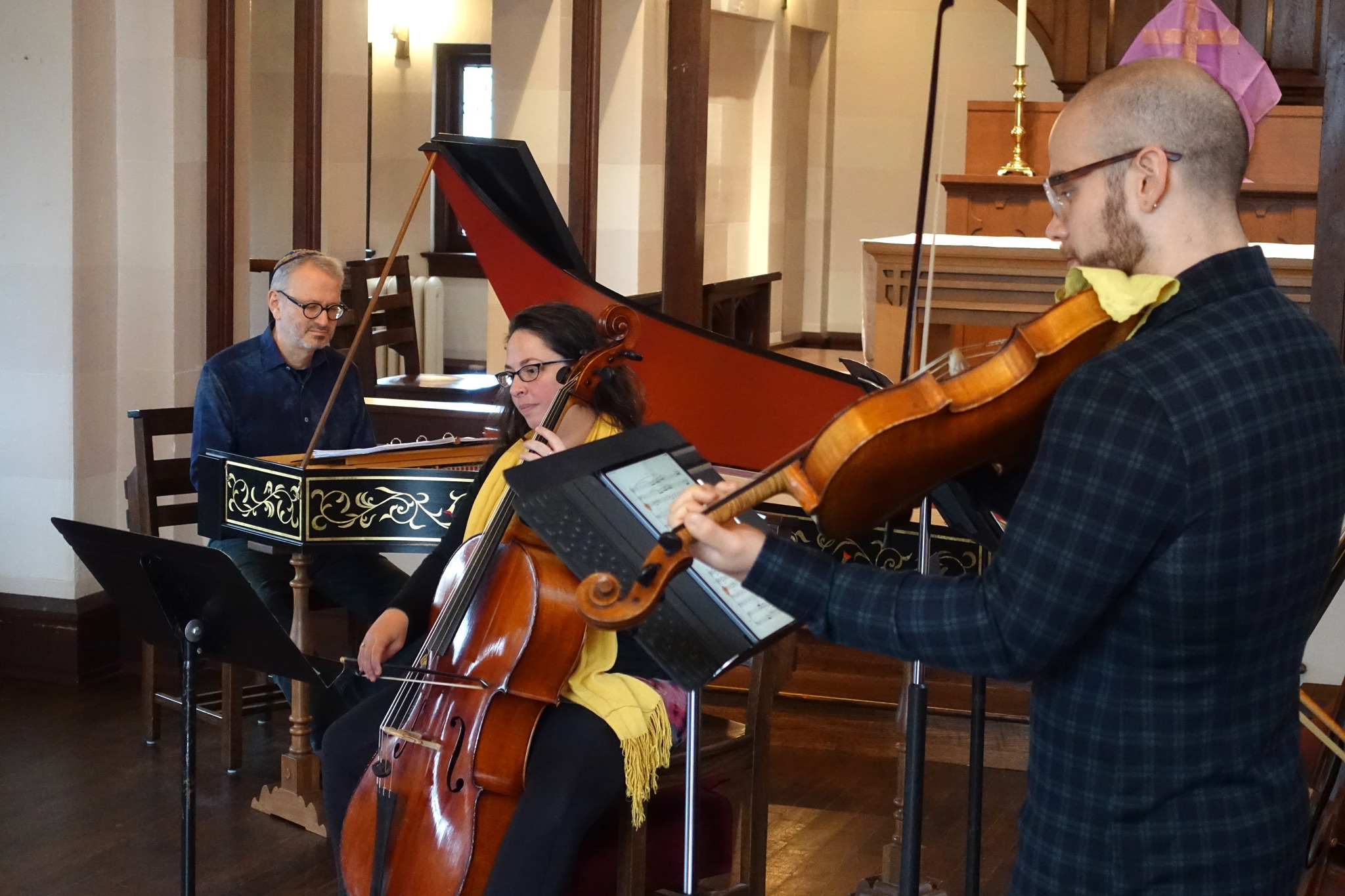
Byron Schenkman has long been a vital force in Seattle’s musical life. Here’s my Seattle Times story about the legacy of Byron Schenkman & Friends, which he founded ten years ago, and their latest project, a newly commissioned harpsichord concerto by Caroline Shaw. The world premiere takes place on tonight’s concert at 7pm:
You need to engage with the present if you really want to appreciate the musical past.
That, in a nutshell, is the premise underlying the latest program that the Seattle-based chamber music series Byron Schenkman & Friends will present on Sunday, March 26 at Benaroya Hall. Instead of merely repeating baroque masterpieces by J.S. Bach, the concert includes a contemporary counterpart tailor-made for Schenkman and his colleagues by the acclaimed American composer Caroline Shaw.
This weekend Seattle Pro Musica presents The Glimmer, the fifth and last in its New American Composer Series. Led by Karen P. Thomas, the program featres a newly commissioned work by the composer Jerod Impichchaachaaha’ Tate. A citizen of the Chickasaw Nation in Oklahoma, Tate is dedicated to the development of American Indian classical composition and has chosen The Glimmer by Washington State Poet Laureate Rena Priest of the Lhaq’temish (Lummi) Nation to set to music.
Tate explains: “Most of my commissioned works focus on tribal culture directly from the land of the commissioner. It is my way of helping the performers and public become closer to their tribal neighbors. The Glimmer deeply echoes the ethos of Lummi and local Salish culture. Out of respect, there is not a direct quote of specific melodies; however, it is greatly influenced by the regional paddle songs. This poem also speaks a language evocative of the sea and it is my hope that the listener and performers resonate with the gestures in this work.”
This is the final installment of a five-concert series celebrating Seattle Pro Musica’s 50th Anniversary by featuring commissions and Seattle residencies by five BIPOC composers from across the country.
The rest of the program includes several other works by Tate as well as Father Thunder(Pērkontēvs) by Laura Jēkabsone, music by Lili Boulanger and Barlow Bradford, and an arrangement o the traditional Scottish song “The Parting Glass.”
The concert takes place at Seattle First Baptist Church on March 25 at 7:30 pm.
Tickets for THE GLIMMER are available at seattlepromusica.org. The performance will also be available by livestream in real time, and on demand following the performance. Register before the concert begins here.
Following the triumph of her opera The Romance of the Rose, which received its world premiere at Long Beach Opera in February, Seattle Modern Orchestra presents Kate Soper’s evening-long chamber music theater work Ipsa Dixit (“She, herself, said it…”) at Cornish College of the Arts’ Raisbeck Auditorium this weekend: Friday, March 24 and Saturday, March 25, both at 8PM.
Pulitzer Prize finalist Soper explores the intersections of language and music and has been described by Alex Ross as “a 21-century masterpiece … a ninety-minute tour de force …call it philosophy-opera.” Zachary Wolfe praised The Romance of the Rose‘s “ability to stick in the mind and soul.”
SMO’s performances will feature local soprano Maria Männistö alongside musicians Sarah Pyle (flute), Eric Rynes (violin), and Bonnie Whiting (percussion). This dramatic showcase will be directed by C. Neil Parsons and includes immersive lighting design.
Kate Soper is a composer, performer, and writer whose work explores the integration of drama and rhetoric into musical structure, the slippery continuums of expressivity, intelligibility and sense, and the wonderfully treacherous landscape of the human voice. She has been hailed by The Boston Globe as “a composer of trenchant, sometimes discomfiting, power” and by The New Yorker for her “limpid, exacting vocalism, impetuous theatricality, and mastery of modernist style.” A Pulitzer Prize finalist, Soper has received awards from the Guggenheim Foundation, the American Academy of Arts and Letters, and the Koussevitzky Foundation, and has been commissioned by ensembles including the Los Angeles Philharmonic, the American Composers Orchestra, and Yarn/Wire. She has received residencies and fellowships from the Civitella Ranieri Foundation, the Radcliffe Institute for Advanced Study, the Camargo Foundation, the Macdowell Colony, Tanglewood, and Royaumont, among others.
Praised by the New York Times for her “lithe voice and riveting presence,” Soper performs frequently as a new music soprano. She has been featured as a composer/vocalist on the New York City-based MATA festival and Miller Theatre Composer Portraits series, the Chicago Symphony Orchestra’s MusicNOW series, and the LA Philharmonic’s Green Umbrella Series. As a non-fiction and creative writer, she has been published by McSweeney’s Quarterly, PAJ, the Massachusetts Review, Theory and Practice, and the Journal of Interdisciplinary Voice Studies.
Soper is a co-director and performer for Wet Ink, a New York-based new music ensemble dedicated to seeking out adventurous music across aesthetic boundaries. She is the Iva Dee Hiatt Professor of Music at Smith College. http://www.katesoper.com
Founded in 2010, Seattle Modern Orchestra (SMO) is the only large ensemble in the Pacific Northwest solely dedicated to the music of the 20th and 21st centuries. Led by co-artistic directors Julia Tai and Jérémy Jolley, SMO commissions and premieres new works from an international lineup of composers, in addition to presenting important pieces from the contemporary repertoire that are rarely if ever heard by Seattle audiences. The ensemble “operates at that exciting cusp between old and new, between tradition and innovation” (Vanguard Seattle) curating new sounds and experiences for concert goers in the region.
SMO provides audiences with performances of the best in contemporary chamber and orchestral music, and develops radio talks, lectures, and other forms of outreach in an accessible and inviting format all designed to expand the listener’s appreciation and awareness of the music of today. https://www.seattlemodernorchestra.org