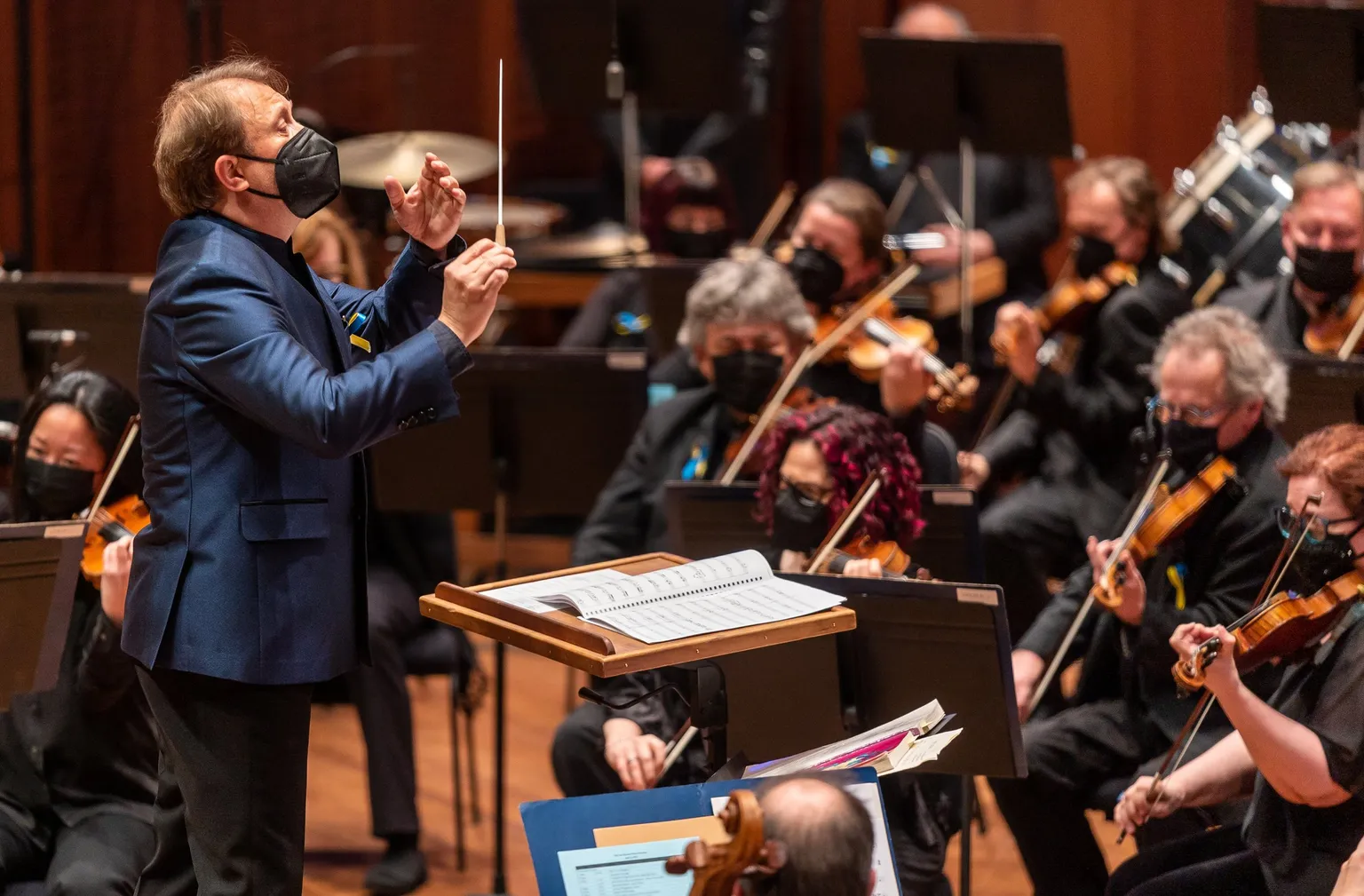
Former Seattle Symphony music director Ludovic Morlot returned to conduct Messaien’s ‘Des canyons aux étoiles…‘ (Photos by James Holt / Seattle Symphony)
I reviewed an extraordinary (and rare) performance of Messiaen by Ludovic Morlot and Seattle Symphony for Classical Voice America:
SEATTLE — For their recent reunion, Ludovic Morlot and the Seattle Symphony put aside the familiar repertoire to offer a program devoted entirely to Olivier Messiaen’s vast, 12-movement work inspired by the landscape of the American West, Des canyons aux étoiles…. The experience was blissfully unique, reminiscent of similarly rare outings during Morlot’s eight-year tenure as music director (2011-19) that have not faded from memory: a riotous Varèse Amériques early on, the collaborations with John Luther Adams, semi-staged Ravel and Stravinsky — and, indeed, other Messiaen performances, including the orchestra’s first encounter with the Turangalîla Symphony….
Friday night at 7.30 pm, Seattle Pro Musica will stream its final concert of the season, The Way Home, which they performed live on 21 and 22 May.
From SPM’s description: “The Way Home honors America’s multicultural heritage with music that seeks to foster respect for all persons and groups, especially immigrants and refugees. Through these performances, we hope to enrich audiences with a greater understanding of and compassion for those who seek shelter from harm.
Music from trailblazing young composers Saunder Choi, Caroline Shaw, Derrick Skye, and Chris Hutchings explore the peril and helplessness faced by many refugees. Songs from the 14th and 15th centuries remind us that the refugee experience resonates across human history. Works by Melissa Dunphy, Reginald Unterseher, and Stephen Paulus express the hope that our hearts will open to welcome those in need of refuge.”
Ludovic Morlot conducts the Seattle Symphony in The Mayors’ Concert for Ukraine and Refugees Worldwide earlier this year. (James Holt / Seattle Symphony)
Tonight Ludovic Morlot rejoins the Seattle Symphony for the first of two performances of one of Messiaen’s Des canyons aux étoiles… I spoke to the conductor about the program for The Seattle Times:
A new chapter in Ludovic Morlot’s relationship with the Seattle Symphony is underway.
Now holding the title of conductor emeritus, Morlot has chosen some unusual fare for his concerts on June 2 and 4: the orchestral epic “Des canyons aux étoiles …” (“From the Canyons to the Stars …”) by Olivier Messiaen, which will be presented in a multimedia presentation accompanied by video projections by Deborah O’Grady.
The news of Ingram Marshall‘s passing hits hard. His music was wonderfully imaginative and rich in personality, and his generosity and warmth as a mentor made an enormous impact well beyond the experimental-music scene. I will be forever grateful for Ingram’s kindness and support in participating in The John Adams Reader. He shared so many evocative stories about the culture he and his friend experienced in the Bay Area in the 1970s and early ’80s.
From Frank J. Oteri has reposted an extensive interview he conducted in July 2001 for NewMusicBox.
And here is a series of linked articles and interviews from Ingram’s own website.
The Greek-French avant-garde composer was born on 29 May 1922 in Brăila, Romania. In honor of his centenary, fellow composer Roger Reynolds and flutist and arts activist Karen Reynolds have published Xenakis Creates in Architecture and Music: The Reynold Desert House, which explores their collaboration to create a house design integrating music and architecture. The book also includes analyses of three representative chamber works by Xenakis as well as letters, diaries, notes, photographs, sketches, and transcriptions of person-to-person conversations. More here from Roger Reynolds:
A few years ago, we contracted with Routledge publishers to issue a book: Xenakis Creates in Architecture and Music: The Reynolds Desert House. The cumbersome title was a result of negotiation over how to assure the maximum number of potential “key words” that could attract search engines. In the following months and years, we learned a bit about book publishing.
We had worked for years on the notion that the multifarious materials we had gathered over four decades could somehow be shape-shifted into a coherent collection of chapters, they forming a book that would be detailed, accurate, informative, and would also provide an intimate window into Xenakis’s ways and capacities as we had experienced them.
Iannis and Françoise came to UC San Diego at our invitation for a festival in his honor in 1990. While they were in Southern California, we drove them out to the land that we had purchased in the Anza-Borrego Desert — a deeply ravined site on which we dreamed of realizing a design that he had offered to us during a dinner we shared with them in their 9, rue Chaptal apartment in Paris in 1984.
When several representative chapters were drafted, we submitted them to our Routledge editor, who in turn sent them to the required external reviewers. A particularly thoughtful remark by one clinched the deal:
This is a very unique proposal of the highest quality on a topic that is greatly underdeveloped: the links between musical, architectural and literary creativity in Xenakis’s work.
We worked for many months completing eight chapters with a multitude of illustrative images: photos, designs, letters … Now, after innumerable proofings, the book exists, and we hope it will be shared.
The Metropolitan Opera has revived its splendid production of Philip Glass’s Akhnaten. Joshua Barone writes: “There were, though, some crucial differences from 2019. Phelim McDermott’s production, now more lived-in, unfolded with elegant inevitability rather than effort; the score was executed with a clarity and drive absent on the often slack album. And while “Akhnaten” may be one of Glass’s tributes to great men who changed the world — through science, politics and faith — Thursday’s performance of it made a persuasive argument for where the real power lies: with the women.”
Friday 20 May at 8pm at the Royal Room: Slapback features Paddy, a virtuosic, nonstop percussion solo by Irish composer Donnacha Dennehy; Boris Kerner, an ethereal duo for amplified cello and tuned flowerpots by Pulitzer-Prize-winning American composer Caroline Shaw; Slapback, a tour-de-force of deconstructed Pete Townshend riffs for electric guitar by American composer Michael Fiday; and a drop-tuned, mildly metal version of American composer David Lang’s Warmth for electric guitar duo.
Pacific MusicWorks members David Morris on viola da gamba, harpist Maxine Eilander and lutenist Stephen Stubbs, in a performance of ‘Wayward Sisters’
This weekend’s program by Early MusicWorks, titled Wayward Sisters, will include the world premiere of artistic director Stephen Stubbs’s new musical completion of the “lost ending” to Monteverdi’s 1607 opera L’Orfeo. I spoke to Stubbs about the project for Early Music America:
Opera was born of the tantalizing premise that what had been lost to history could be regenerated through an act of creative imagination. So it seems peculiarly fitting that one of the foundational works of the art should inspire a similar effort…
Another Jonathan Woody composition: Nigra Sum Sed Formosa: A Fantasia on Microaggressions
For their end-of-season program, Byron Schenkman & Friends juxtapose a world premiere by composer and bass-baritone Jonathan Woody with 19th-century music by Maria Szymanowsk, Francisca Gonzaga, Clara Schumann, Joseph Joachim, and Johannes Brahms. The concert takes placeSunday, May 22, 2022, at Illsley Ball Nordstrom Recital Hall at Benaroya Hall, at Third and Union in downtown Seattle, beginning at 7:00 P.M. (Prices range from $48 for Regular Price, $41 for Seniors, and $10 for Youth and Students with ID.
Woody’s nor shape of today, a BS&F commission, sets a text by Raquel Salas Rivera and was written, according to the composer, as “a companion to Johannes Brahms’s Two Songs for Voice, Viola and Piano, op. 91.” Woody writes: “In our 21st-century existence, many individuals still experience a longing for a place to belong, and I was struck by the similarity between these Romantic sentiments and the experience of trans and non-binary individuals, who face relentless pressure to conform to outdated norms surrounding gender and identity in our supposedly modern world…. I hoped to capture the sense of longing that so many human beings feel to belong, to be loved, and to be safe.”
The program will feature performances by soprano Hailey McAvoy, violist Andrew Gonzalez, and pianists Charles Enlow and Byron Schenkman.
Complete Program:
Johannes Brahms: 16 Waltzes, op. 39, for piano
Maria Szymanowska: Polonaise in C (c.1820) for piano
Francisca “Chiquinha” Gonzaga: Tango in F Minor “Sospiro” (c.1881) for piano
Jonathan Woody: nor shape of today for mezzo-soprano, viola, and piano
Clara Schumann: Romance in A Minor, op. 21, no. 1 for piano
Clara Schumann: Impromptu in E Major (c.1844) for piano
Joseph Joachim: Hebrew Melody in G Minor, op. 9, no. 1 for viola and piano
Johannes Brahms: Lullaby, op. 49, no. 4, for voice and piano
Johannes Brahms: Two Songs for alto, viola, and piano, op. 91
The Seattle Symphony will present two free Community Concerts this May. On Friday, May 13, at 8 p.m., Seattle Symphony Composer-in-Residence Reena Esmail returns to Benaroya Hall to host the first Community Concert, titled Ram Tori Maya, which features a Seattle Symphony string quartet sharing the stage with students of Swaranjali School of Music, an institution dedicated to the preservation, learning, and performance of Hindustani classical music. This program will explore pieces arranged or composed by Esmail herself along with a carefully curated selection of popular Indian works.
The second community concert will be on Tuesday, May 17, at 7 p.m., with Associate Conductor Lee Mills conducting music by Wolfgang Amadeus Mozart, Hannah Kendall, Astor Piazzolla, Johannes Brahms, and Carlos Simon. 2022 Young ArtistHenry From will join the orchestra for the last movement from Brahms’s Piano Concerto No. 1.