Donald Runnicles conducted the Grand Teton Music Festival Orchestra in Britten’s ‘Four Sea Interludes,’ Elgar’s ‘Enigma Variations,’ and Carl Vine’s ‘Five Hallucinations’ for trombone and orchestra. (Photo by J. Gustavo Elias)
JACKSON HOLE, Wyo. — Even when obscured by smoke drifting in from distant wildfires, the Grand Tetons’ towering peaks command awe. The tallest cluster, which dominates the promotional posters for this summer’s Grand Teton Music Festival, has been dubbed “the Cathedral Group.”
After more than three decades as a computer music pioneer, Paul Lansky made a dramatic change of tack and began composing exclusively for acoustic instruments. This release is Vol 17 in the extensive series from the Bridge label …
Image (c) J. Gustavo Elias: Sir Donald Runnicles with the Grand Teton Music Festival Orchestra
Gemma New was originally scheduled to make her Grand Teton Music Festival debut conducting this week’s full orchestral program. But when she had to cancel at the last minute, GTMF’s music director Sir Donald Runnicles stepped in to save the day, adding two more concerts to those for which he is already responsible during this 60th-anniversary season.
My full report is forthcoming elsewhere, but in the meantime, even though the remaining performance tonight at 8pm is sold out, you might have luck by getting on the Festival’s waitlist (see here for ticket info and contacts).
The warm bond Runnicles enjoys with the Festival musicians was gloriously evident, moving to behold and experience. He led the orchestra in an account of the Four Sea Interludes from Benjamin Britten’s Peter Grimes — with such a fierce intensity that the entire opera seemed distilled into this purely instrumental music of transition and commentary.
Also on the menu was another Runnicles specialty, Edward Elgar’s Variations on an Original Theme, Op. 36 (aka the Enigma Variations). No matter how often he has conducted this repertoire staple, how often the musicians have delivered it as part of their respective subscription seasons back with their home orchestras, there was no sign of jaded habit, no room for “been-there-done-that” mediocrity.
The loving attention to every detail in Elgar’s score clearly pulled the Walk Festival Hall audience breathlessly in, reaffirming confidence — sorely needed confidence after the long deprivation — in music’s power to transform. (Incidentally, you can get another potent dose of Runnicles’s affinity for Elgar in an account of the Symphony No. 1 with the Berliner Philharmoniker from 2011, available in the Digital Concert Hall.)
The Britten and Elgar framed the evening’s contemporary work, Five Hallucinations for Trombone and Orchestraby the Australian composer Carl Vine. The work was commissioned for GTMF Orchestra’s principal trombonist (and fellow Australian) Michael Mulcahy and premiered in Chicago in 2016. It makes a solid addition to a rare repertoire, taking for its inspiration case studies described by Oliver Sacks.
Vine describes his starting point: “Hallucinations are fascinating phenomena – instantaneous random inventions of our brains overlaid on the sensation of common reality and indistinguishable from it…. Sufferers of brain damage or a range of neurological disorders regularly hallucinate. Others without mental illness but under great stress or fatigue can also hallucinate, as of course can those who use psychotropic drugs. It is this bridge between the real world and some of the surprising ways in which our brains interpret the mundane reality around us that I find endlessly fascinating.”
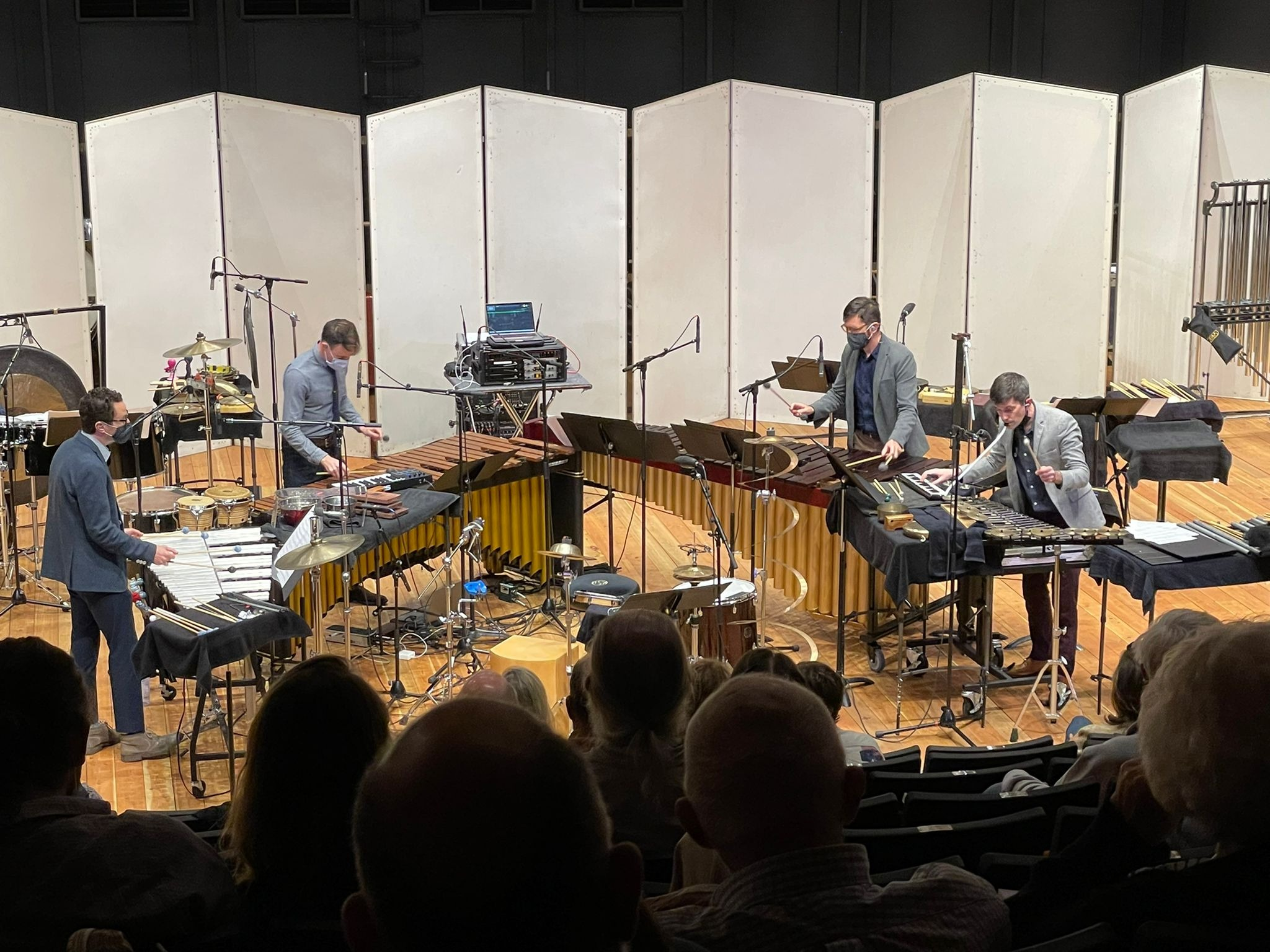
Photo (c) Jorge Gustavo de Araujo Elias Third Coast Percussion: David Skidmore, Robert Dillon, Peter Martin, and Sean Connors
Week 4 of the Grand Teton Music Festival continued with an enthusiastically received performance by Chicago-based Third Coast Percussion making their Festival debut. Presented without intermission, the concert unfolded with unflagging energy as each member of the quartet — David Skidmore, Robert Dillon, Peter Martin, and Sean Connors — took turns introducing the selections.
The entire program consisted of living composers — indeed, composers with whom Third Coast has collaborated. Their style of music making overall synthesizes a kind of surgical precision with frenetic spontaneity — and that intriguing blend is mirrored by their exciting visual performance, a virtuoso choreography that is functional and at the same time abstractly alluring.
These are artists who make music by hitting things, their bodies acting, reacting, incorporating the sounds they produce. At times the performance resembled a wild physics experiment trying to calibrate new sources of energy. Expressivity as energy, in different shapes and contours, certainly characterized their renditions of Clarice Assad’s The Hero, one of the 12 “archetypes” from their most recent album of the same name. Likewise for the extensive, four-movement Percussion Quartet by Danny Elfman, which contained some of the unexpected-but-just-right harmonic progressions familiar from his signature film scores.
Metamorphoses, the name of one of Third Coast’s ongoing projects, is also the title of some of Philip Glass’s best-known pieces (from his 1989 Solo Piano album). The ensemble’s arrangement of Metamorphosis 1 for percussion quartet, created in consultation with Glass, reminded me of the composer’s Baroque affinities with its chaconne-like eternal recurrence. Especially intriguing in this transcription — despite an obbligato solo for melodica that seemed to dissipate some of the piece’s haunting solemnity — were the carefully prepared shifts in dynamic shading.
A good part of the aesthetic interest in this concert involved connecting the vast armamentarium of instruments — tuned and untuned, made of metal or wood, acoustic or digitally manipulated — with the specific sounds produced. Devonté Hynes’s Fields, which originated as a commission from Hubbard Street Dance and choreographer Emma Portner, made a striking, joyful impression; the album garnered several nominations in the 2021 Grammy Awards. Also known as Blood Orange, Hynes (a British multi-instrumentalist, singer, songwriter, and record producer as well as composer) made his “classical” debut with this Third Coast Percussion collaboration.
The program ended with a long, suite-like offering of pieces by Jlin (Jerrilynn Patton), an electronic musician and producer from Gary, Indiana. These came from a seven-movement project titled Perspective — debuting here ahead of the postponed Carnegie Hall premiere — and showcased a feverishly inventive imagination. Jlin’s music juxtaposes a universe of samples and sound colors worthy of Stravinsky, exploding with complex rhythmic counterpoint and exuberant variety. In her own words, Jlin’s compositions are “clean, precise, and unpredictable.”
Photo (c) Jorge Gustavo de Araujo Elias. Pictured: Elisabeth Remy Johnson, harp; Mercedes Smith, flute; Zach Boeding, oboe; Marci Gurnow, clarinet; Madeline Sharp, viola
It’s only my first time in these parts, but already I can understand the deep, magnetic sense of connection that draws people back here again and again. Upon passing through the elk antler arch at Jackson Hole Airport (the only U.S. airport located within a national park, incidentally), I soon began to feel the charm of a place that hasn’t been flattened out by plastic predictability. Even with lingering smoke from the latest Western fires imposing a thin pall, the capacity for this landscape to inspire awe was undimmed.
With its marriage of valley and dramatic, looming scarps, it’s obvious how the Jackson Hole area beckoned as an ideal spot to make music. The GrandTetonMusicFestival opened on 2 July, following the all-too-familiar hiatus, and is now into Week 4 of a seven-week season — which also marks the Festival’s 60th anniversary.
Last night I began with the first of the week’s offerings, a chamber music evening at Walk Hall, GTMF’s home performance space. It was decently attended, taking into account the reduced-capacity seating plan and a sudden shift in mask policy. (Just last night, in the wake of the new CDC announcement, the official recommendation switched to suggesting that vaccinated and unvaccinated people both wear masks indoors.)
Part of a series curated — and engagingly introduced by — Adelle Eslinger Runnicles, the concert presented a flavorful sampling of periods and instrumental formations, starting with a transcription by Phil Brink for low brass of J.S. Bach’s D minor Chaconne from the Partita No. 2 for solo violin (Michael Mulcahy, trombone; Jared Rodin, trombone; Craig Mulcahy, trombone; Jay Evans, trombone; JáTtik Clark, tuba). The Baroque fondness for transcription aside, Bach’s masterpiece sounded of a different era — not Romantic exactly, but funereal, ritualistic, the opening to new vistas in the later variations remarkably fluid and gentle.
Unmistakably Romantic phrasing beguiled in Saint-Saëns’s Fantaisie for Violin and Harp, Op. 124, featuring Eunice Keem on violin and Elisabeth Remy Johnson on harp. Exquisitely balanced and fully engaged in playing off each other, the duo cast a spell throughout this late-period piece’s range of moods.
Johnson also performed in Kimberly Osberg’s Just Another Climb,* joined by colleagues Mercedes Smith on flute, Zach Boeding on oboe, Marci Gurnow on clarinet, and Madeline Sharp on viola. If the Saint-Saëns suggested a leisured dreamscape, Just Another Climb packed the punch of an involving musical short story, its impact belying the brevity of the piece’s duration (about four minutes) — and making this a real highlight of the evening.
The young, Portland, Oregon-based Osberg, who was present in the audience, was inspired by the feat of the first “manless” ascent of the Grand Teton made in 1939 by Margaret Bedell, Anne Sharples, Margaret Smith Craighead, and Mary Whittemore — upon which achievement Craighead remarked: ” Craighead wrote: “This may have been of importance to the record of events, but to us it was just another climb.”
This first performance before a live audience emphasized Osberg’s colorfully individualistic writing for each component of the ensemble. The result was an assuredly paced musical storytelling that found freshness in a diatonic idiom, using evocative gestures to hint at but not dictate a plausible narrative. I’m eager to learn more about this composer and hear what she can accomplish with a longer form.
The program’s brass theme sets the stage for the main new work on this week’s orchestral concert, Five Hallucinations for Trombone and Orchestra by Carl Vines. It returned in John Stevens’s Triangles for horn (Josh Phillips), trombone (Jay Evans), and tuba (JáTtik Clark), a piece from 1978 that (not always convincingly) juggles with jazz vernacular.
Concluding the program was a rendition of Beethoven’s C minor String Trio from the Op. 9 set by violinist Louise Morrison, violist Chiara Kingsley Dieguez, and cellist Thomas Carpenter that reveled in the tension between the first movement’s ominous energies and the halcyon release of the Adagio. The long time away from live performance could be sensed in some issues of balance and phrasing, but the richness of this score — Beethoven declared these trios among his finest compositions of the period — came through, most notably in the spidery enigma of the concluding measures.
After a yearlong delay caused by the pandemic, the Festival d’Aix-en-Provence has unveiled Innocence, its latest opera commission from Kaaija Sariaho. Despite its tragic story involving a school shooting, the experience — even at a distance, via the stream currently available on arte.tv, is overwhelmingly affirmative: of the power of art to transform impossible pain and senselessness.
Innocence, set in contemporary Helsinki, features a libretto by the Finnish novelist Sofi Oksanen, with multilingual contributions by Aleksi Barrière. The text incorporates English, Czech, Romanian, French, Swedish, German, Spanish, and Greek in addition to Finnish, its setting in an international school suggesting an allegory for Europe’s attempt to achieve a multicultural society.
From the Aix summary: “It is a typical wedding for a cosmopolitan city, in present-day Finland. The fiancé is Finnish, the bride Romanian, and the mother-in-law French. But suddenly, during the wedding banquet, the Czech waitress feels ill… Ten years earlier, these characters were struck by a tragic event. Ghosts revive their memories of the trauma, which occurred in a school; there is a guilty haze, a lost innocence.”
The Australian director Simon Stone staged Innocence, with Susanna Mälkki conducting the London Symphony Orchestra and the Estonian Philharmonic Chamber Choir; the cast features Magdalena Kožená, Sandrine Piau, Tuomas Pursio, Lilian Farahani, Markus Nykänen, Jukka Rasilainen, Lucy Shelton, among others.
Zachary Wolfe, in his eloquent review, describes Saariaho’s score: “Porous and agile; simmering beneath and around the voices; and only occasionally, briefly exploding, this is music as a vehicle for exploring and intensifying drama. It is complex, yet confident enough to exist not merely for its own sake.”
Writing for Bachtrack, Romain Daroles observes: “The score is served with a masterly hand by Susanna Mälkki and the London Symphony Orchestra who, from the opening of the opera, creates a music box that the implacable and impeccable rigor of execution quickly transforms into a Pandora’s box, revealing one by one the secrets, the defects, and the evils of individuals, of humanity.”
Declares Reinhard Brembeck in the Süddeutsche Zeitung: “She continues what Claude Debussy initiated. She meets the unadorned reality and its brutality with a slight detachment, she wraps the action with a veil of sadness, love and clairvoyance. This enables the audience to accept this confidently unobtrusive avant-garde music without resistance. Kaija Saariaho is the greatest master of opera today.”
Innocence was co-commissioned by a consortium of companies that will bring the work to Helsinki, Amsterdam, London, New York, and San Francisco.
My review of the cellist Lavena is in the July issue of Gramophone:
An enigmatic soundscape shivers into being in Gemma Peacocke’s Amygdala for solo cello and fixed electronics. The cellist wends her way, tentatively, towards acoustic clarity, playing richly expressive double-stops as if coming up for air….
I just received this press release for the world premiere of Abraham’s Land at Kirkland Performance Center, 350 Kirkland Avenue, Kirkland, WA, July 15-18, 2021:
This original musical is by Seattle playwright Lauren Goldman Marshall and Pulitzer-nominated composer, Roger Ames, with additional music by David Nafissian and Paul Linnes, at Kirkland Performance Center, 350 Kirkland Avenue, Kirkland, WA, July 15-18, 2021.
A public preview performance is scheduled for Thursday, July 15, at 11 am PST to reach audiences in Israel, West Bank and Gaza, where it will be 9 pm. Remaining performances will be at 7 PM on July 15 (opening night), 16, and 17, and 2 PM on Sunday, July 18. For ticketing, live and livestream, go towww.kpcenter.org or call 425-893-9900.
Thirty years in the making, Abraham’s Land began as a Jewish/Palestinian collaboration, by Lauren Goldman Marshall, Hanna Eady, and David Nafissian, and was first performed in Seattle in 1992. Marshall further developed it with Palestinian and Israeli youth at Seeds of Peace International Camp in 1999. The current rendition features a new libretto and score.
The three lead roles are played by Jewish-American, Israeli, and Palestinian-American actors. Abraham’s Land tells a human story, set against the backdrop of the Israeli occupation of Palestine, during the First Intifada. Israeli Sergeant Yitzhak prides himself on being an ethical soldier, but when a Palestinian demonstration in Jerusalem appears threatening, he fatally shoots the provocateur, Ismail.
Devastated to learn that the victim was unarmed, Yitzhak is haunted by Ismail’s ghost. Disguising himself as a Palestinian, Yitzhak journeys to a refugee camp in Gaza to return Ismail’s identity card and ask his family for forgiveness. In the process, he experiences the humanity of the other side and the darker aspect of his own. Ultimately, he must choose between making amends and his duty to his country.
With recent changes in Israeli leadership, increasing tensions and violence in the region, the reexamination of the United States’ role in the Middle East, and the rise of antisemitism, Islamophobia, racism and tribalism in the United States and abroad, this work is especially timely.
This innovative production is directed by acclaimed director David Grabarkewitz, former Resident Director at the New York City Opera. Music director Paul Linnes conducts a seven-member ensemble. Choreography is by Kathryn Van Meter and Waseem Sbait. The 22-member racially and culturally diverse, professional cast is drawn from New York City, Los Angeles and Seattle. It features Michael Strass, Netanel Bellaishe, Maria Habeeb, Hassan Nazari-Robati, David Studwell, Bobbi Kotula, Danya El-Kurd, Camilla Ethridge & Paul Shapiro, along with a multi-generational ensemble.
Each performance will be followed by a post-play discussion, with representatives from local Jewish and Muslim communities. In addition, the Saturday performance will feature a pre-show talk by a visiting public health professional and mother from Gaza, Alaa Hammouda, who will share her story from her perspective as a 30-year resident of Gaza. Further, an interactive workshop on Saturday 1-3 PM PST, will use techniques from Theater of the Oppressed to explore issues in the play.
General admission is $39, students & seniors $25, with discounts for groups of ten or more. Day of show rush tickets, as available, will be offered for $20, and for youth through TeenTix for $5. Livestream performances are pay-what-you-can, with levels ranging from $1 to $20.
Originating at a palatial, 17th-century hunting lodge near Madrid, the Zarzuela is a dramatic form of musical storytelling that once dominated the stages of Spanish-speaking counties in worlds both old and new. Opera stage director Emilio Sagi will lead us on a historical survey of an art form rarely appreciated—or even known—in modern-day America
Sunday, July 18, 1 pm: Baroque Opera in the New World
The arrival of Spanish colonists in what they thought was a “new world” forever changed human civilization and its course in history. Laura Prichard will travel with us back in time to the Baroque Era in Latin America, where unique forms of classical music and opera flourished. From boy choirs singing a cappella to the lost operatic works of Mexican composers like Manuel de Zumaya, this lecture will have you yelling Bravo! for all things Mexican Baroque.
Sunday, July 25, 1 pm: Contemporary Latin Stage Works
In today’s operatic landscape, the old classics still reign, and the roster of new works premiered by major companies is dominated by composers of European and American birth. Meanwhile, composers throughout Latin America continue to tell their own stories and heritage through our beloved art form of opera. Multidisciplinary artist Albert Montañez returns to Opera Aficionado to shine a spotlight on new stage works from the contemporary Latinx world.
TICKETS: $5–$40
Students, educators and individuals in need: $5/session.
General admission: $20/session, discount available for multiple-sessions order.
Louis Andriessen has died at the age of 82. His publisher, Boosey & Hawkes, announced the death this morning of the eminent Dutch composer:
Boosey & Hawkes is sad to announce the death of Louis Andriessen, one of the most original and influential composers of the contemporary era. He died this morning (1 July) in De Hogeweyk dementia village in Weesp, near Amsterdam, aged 82. Andriessen leaves behind a corpus of remarkable music including the ensemble work De Staat and the opera Writing to Vermeer. A generation of younger composers were taught by him or were indebted to his unique fusion of jazz and minimalist styles.
Andriessen wrote in a wide range of idioms, including orchestra and chamber works, songs, choral pieces, music for brass band and solo works for piano, bassoon, organ, harpsichord, violin, oboe, percussion and trumpet. Perhaps most visible were his collaborative theatre works and operas, which adapted an eclectic array of texts. For De Materie, a genre-resistant theater work created with Robert Wilson for the Netherlands Opera, Andriessen incorporates documents pertaining to 17th-century shipbuilding, a decree on Dutch independence from Spain, the diary of Marie Curie and the straight-lined art of painter Piet Mondrian. Near the work’s end, as staged in 2016 at New York’s Park Avenue Armory, a flock of 100 sheep joined the cast.
On The only one, the world premiere of which Esa-Pekka Salonen conducted with the LA Philharmonic in May 2019:
Two artistic discoveries influenced Andriessen as he wrote The only one. The first was a collection of poems by the Flemish poet Delphine Lecompte from The animals in me. “These witty, intelligent, experimental, and sometimes scabrous poems immediately fascinated me. My focus turned to faraway America, with its great tradition of songwriting,” he says.
His second discovery was the work of Nora Fischer, an Amsterdam–based singer known for developing dynamic creative projects that fuse classical and pop music. Andriessen says, “The depth of her versatility has strongly influenced the musical language of the piece.” He further explains that “the piece flirts a bit with certain kinds of pop songs and light music, and starts out with a beautiful song.”
“Andriessen used bits of old music, an allusion to the Dies Irae motif and some Minimalism, a jazz riff here and a Mexican brass allusion there, as he often has,” says the Los Angeles Times. “But he always remakes it into a complex and powerfully blatant new thing, and here edge-of-your-seat operatically so.”
Andriessen’s final work was May for choir and orchestra, a tribute to Frans Bruggen setting texts from the Dutch impressionist poem by Herman Gorter and premiered at the Concertgebouw in December 2020: